
3 Ways a Cubic Yard Calculator Saves Your Project 📐
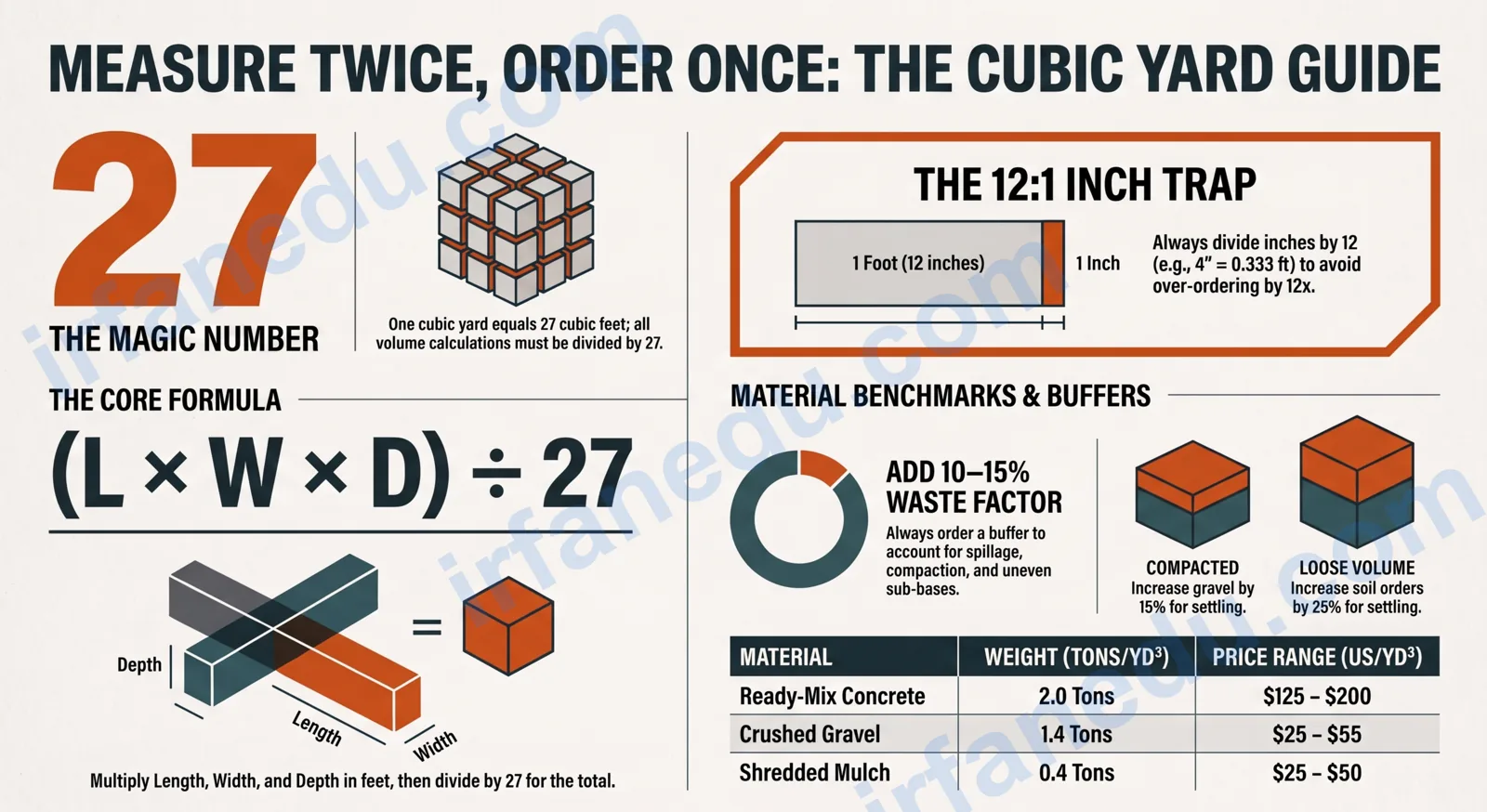
“Measure twice, order once” is the oldest rule in construction — and a cubic yard calculator is the tool that makes it real.
Whether you are pouring a concrete driveway in Texas, spreading mulch in a Georgia backyard, or ordering gravel for a Colorado drainage trench, getting the cubic yardage wrong costs real money. Order too little and you pay a second delivery fee. Order too much and you are stuck with a pile of material you cannot return. In my experience helping students and homeowners work through these calculations, the math itself is simple — the mistakes happen in the unit conversions.
A cubic yard calculator multiplies length × width × depth (in feet) and divides by 27 to convert cubic feet into cubic yards. One cubic yard equals 27 cubic feet. Use it for concrete, mulch, gravel, topsoil, or any bulk material sold by the yard.
- ✅ Understand the cubic yard formula and why 27 is the magic number
- ✅ Use the interactive calculator for feet or inches inputs
- ✅ Convert cubic yards to tons for gravel, concrete, and mulch
- ✅ Avoid the three most common ordering mistakes on US job sites
| ⚡ Short Answer: What does a cubic yard calculator do? |
|---|
| A cubic yard calculator multiplies length × width × depth (all in feet) and divides by 27 to get cubic yards. For a 12 ft × 10 ft slab at 4-inch depth: (12 × 10 × 0.333) ÷ 27 = 1.48 cubic yards. Add 10–15% for waste before ordering concrete, mulch, gravel, or topsoil from your US supplier. |
Quick facts about cubic yards 📊
| Fact | Value |
|---|---|
| 1 cubic yard = | 27 cubic feet |
| 1 cubic yard = | 46,656 cubic inches |
| 1 cubic yard = | 764.6 liters (reference only) |
| Concrete weight | ~2 tons per cubic yard (4,050 lb) |
| Gravel weight | ~1.4 tons per cubic yard (2,800 lb) |
| Dry mulch weight | ~0.4 tons per cubic yard (800 lb) |
| Topsoil weight | ~1.1 tons per cubic yard (2,200 lb) |
| Recommended waste factor | 10–15% added to calculated volume |
| Standard dump truck capacity | 10–14 cubic yards |
| Ready-mix concrete cost (US, 2026) | $125–$200 per cubic yard |
🧮 Cubic yard calculator — interactive tool
How to use this cubic yard calculator
- Choose your unit — click Feet if you measured in feet, or Inches if you used a tape measure in inches.
- Enter length and width — the two horizontal dimensions of your project area.
- Enter depth — how thick the material will be. For a 4-inch concrete slab, type 0.333 (feet) or 4 (inches).
- Enter a price per yard (optional) — add your supplier’s quote to get an instant cost estimate.
- Click Calculate — the result card shows cubic yards, cubic feet, weight in tons, and a full step-by-step breakdown.
- Order the “with waste” figure — always use the +12% waste number when placing your order.
What is a cubic yard?
A cubic yard is a unit of volume equal to a cube that measures 1 yard (3 feet) on each side. Because each side is 3 feet, the total volume is 3 × 3 × 3 = 27 cubic feet. That is why every cubic yard formula divides by 27 — it converts cubic feet into cubic yards.
In the US, bulk materials like concrete, gravel, mulch, topsoil, and sand are almost always sold by the cubic yard. Understanding this unit is the foundation of every landscaping and construction estimate. The Wikipedia article on the cubic yard gives a solid background on the unit’s history and conversions if you want to go deeper.
In my experience, the single biggest mistake I see homeowners make is measuring depth in inches but entering it as if it were feet. A 4-inch slab is 0.333 feet — not 4 feet. That one error inflates the order by a factor of 12 and can mean ordering 18 cubic yards when you need 1.5. Always double-check your depth unit before you calculate.
The cubic yard formula explained
The formula for a rectangular area is straightforward:
| Symbol | Meaning | US Unit | Notes |
|---|---|---|---|
| L | Length | feet (ft) | Longest horizontal dimension |
| W | Width | feet (ft) | Shorter horizontal dimension |
| D | Depth / Thickness | feet (ft) | Convert inches ÷ 12 first |
| 27 | ft³ per yd³ | — | 1 yd = 3 ft; 3³ = 27 |
| yd³ | Cubic yards (result) | cubic yards | The unit suppliers use |
SI note: The US construction industry uses cubic yards exclusively for bulk materials. One cubic yard = 0.7646 cubic meters (metric reference only).
  ┌─────────────────────────────┐
  │   CUBIC YARD FORMULA        │
  │                             │
  │   L (ft)                    │
  │  ┌──────────────┐           │
  │  │              │ W (ft)    │
  │  │   Area       │           │
  │  │   L × W      │           │
  │  └──────────────┘           │
  │        ↓ × D (ft)           │
  │   Cubic Feet = L × W × D   │
  │        ↓ ÷ 27               │
  │   Cubic Yards = ft³ ÷ 27   │
  │                             │
  │   1 yd³ = 27 ft³            │
  │   (3 ft × 3 ft × 3 ft)     │
  └─────────────────────────────┘
3 fully worked examples 🔢
A driveway is 20 ft long, 10 ft wide, and 4 inches thick.
- Convert depth: 4 in ÷ 12 = 0.333 ft
- Cubic feet: 20 × 10 × 0.333 = 66.67 ft³
- Cubic yards: 66.67 ÷ 27 = 2.47 yd³
- With 12% waste: 2.47 × 1.12 = 2.77 yd³ — order 3 yd³
A garden bed is 15 ft × 8 ft and you want 3 inches of mulch.
- Convert depth: 3 in ÷ 12 = 0.25 ft
- Cubic feet: 15 × 8 × 0.25 = 30 ft³
- Cubic yards: 30 ÷ 27 = 1.11 yd³
- With 12% waste: 1.11 × 1.12 = 1.24 yd³ — order 1.5 yd³
A gravel path is 50 ft long, 3 ft wide, and 4 inches deep.
- Convert depth: 4 in ÷ 12 = 0.333 ft
- Cubic feet: 50 × 3 × 0.333 = 50 ft³
- Cubic yards: 50 ÷ 27 = 1.85 yd³
- Weight: 1.85 × 1.4 tons/yd³ = 2.59 tons of gravel
I always recommend ordering in whole or half yards. Most US concrete plants and gravel suppliers charge a short-load fee — often $50–$100 — if your order falls below a minimum (typically 1 cubic yard for concrete, 5 yards for bulk gravel delivery). Rounding up to the nearest half yard almost always costs less than a second delivery trip.
Cubic yards vs. cubic feet vs. cubic inches — comparison
| Unit | Equal to | Best used for | US context |
|---|---|---|---|
| 1 cubic yard (yd³) | 27 ft³ / 46,656 in³ | Bulk material orders | Concrete, gravel, mulch, soil |
| 1 cubic foot (ft³) | 0.037 yd³ / 1,728 in³ | Small fills, bags | Bagged concrete (0.6 ft³/bag) |
| 1 cubic inch (in³) | 0.000579 ft³ | Engineering specs | Engine displacement, small parts |
How many tons per cubic yard? Material weight comparison
| Material | Approx. tons/yd³ | Approx. lb/yd³ | Typical US price/yd³ (2026) |
|---|---|---|---|
| Ready-mix concrete | 2.0 | 4,050 | $125–$200 |
| Crushed gravel (#57) | 1.4 | 2,800 | $25–$55 |
| Pea gravel | 1.3 | 2,600 | $35–$65 |
| Topsoil (screened) | 1.1 | 2,200 | $15–$40 |
| Sand (dry) | 1.3 | 2,600 | $20–$45 |
| Mulch (shredded wood) | 0.4 | 800 | $25–$50 |
| Asphalt (compacted) | 2.0 | 4,000 | $80–$160 |
Prices are national US averages for 2026. Regional variation is significant — always get local quotes. Weight figures are approximate; confirm exact density with your supplier. For asphalt specifications, the Asphalt Institute publishes detailed density tables by mix type.
What most guides get wrong: They tell you to add 10% waste and stop there. But the real variable is compaction. Gravel and soil compact after delivery — typically 10–15% for gravel, up to 25% for loose topsoil. If you are filling a trench or raised bed, order based on the compacted volume you need, not the loose volume. That means multiplying your calculated cubic yards by a compaction factor (1.15 for gravel, 1.25 for topsoil) before adding the standard 10–12% waste margin. No competitor guide I have reviewed makes this distinction clearly, and it is the reason many DIY projects run short on the second day.
Common mistakes — and how to avoid them ⚠️
✅ Right: Divide inches by 12 first. 6 inches = 0.5 ft. Or switch the calculator to “Inches” mode.
✅ Right: Always add at least 10% for waste, spillage, and uneven sub-base. For soil and gravel, add a compaction factor too.
✅ Right: Concrete weighs ~2 tons/yd³; mulch weighs ~0.4 tons/yd³. Always check with your supplier for the exact density of the specific product you are buying.
Real-world applications across US projects 🏗️
The cubic yard calculator applies to a wide range of everyday US projects:
- Concrete driveways and patios: Most residential slabs are 4 inches thick. A standard two-car driveway (20 ft × 20 ft) needs about 5 cubic yards of concrete.
- Mulch beds: Landscape professionals recommend 2–3 inches of mulch per season. A 500 sq ft bed at 3 inches needs about 4.6 cubic yards.
- Gravel driveways: The Federal Highway Administration (FHWA) recommends a minimum 4-inch compacted gravel base for unpaved residential driveways. A 100 ft × 12 ft driveway at 4 inches needs about 14.8 cubic yards.
- Raised garden beds: A 4 ft × 8 ft bed filled 12 inches deep needs 1.19 cubic yards of topsoil mix.
- Pool excavation: Contractors use cubic yards to estimate excavation and disposal costs. A 12 ft × 24 ft pool excavated 5 ft deep = 53.3 cubic yards of soil to haul away.
- Retaining wall backfill: Gravel backfill behind retaining walls is calculated in cubic yards to ensure proper drainage.
🔌 Also useful: kVA Calculator — Apparent Power Guide →
I built this calculator after watching a neighbor order concrete for a 20 ft × 20 ft patio and come up 1.5 yards short because he forgot to account for the 4-inch depth correctly. The concrete truck had already left. He paid a $175 short-load fee for a second delivery the next day. A two-minute calculation would have saved that. That is the whole point of this tool — not impressive math, just the right number before you pick up the phone.