
Topsoil Calculator: How Much Topsoil Do You Need?
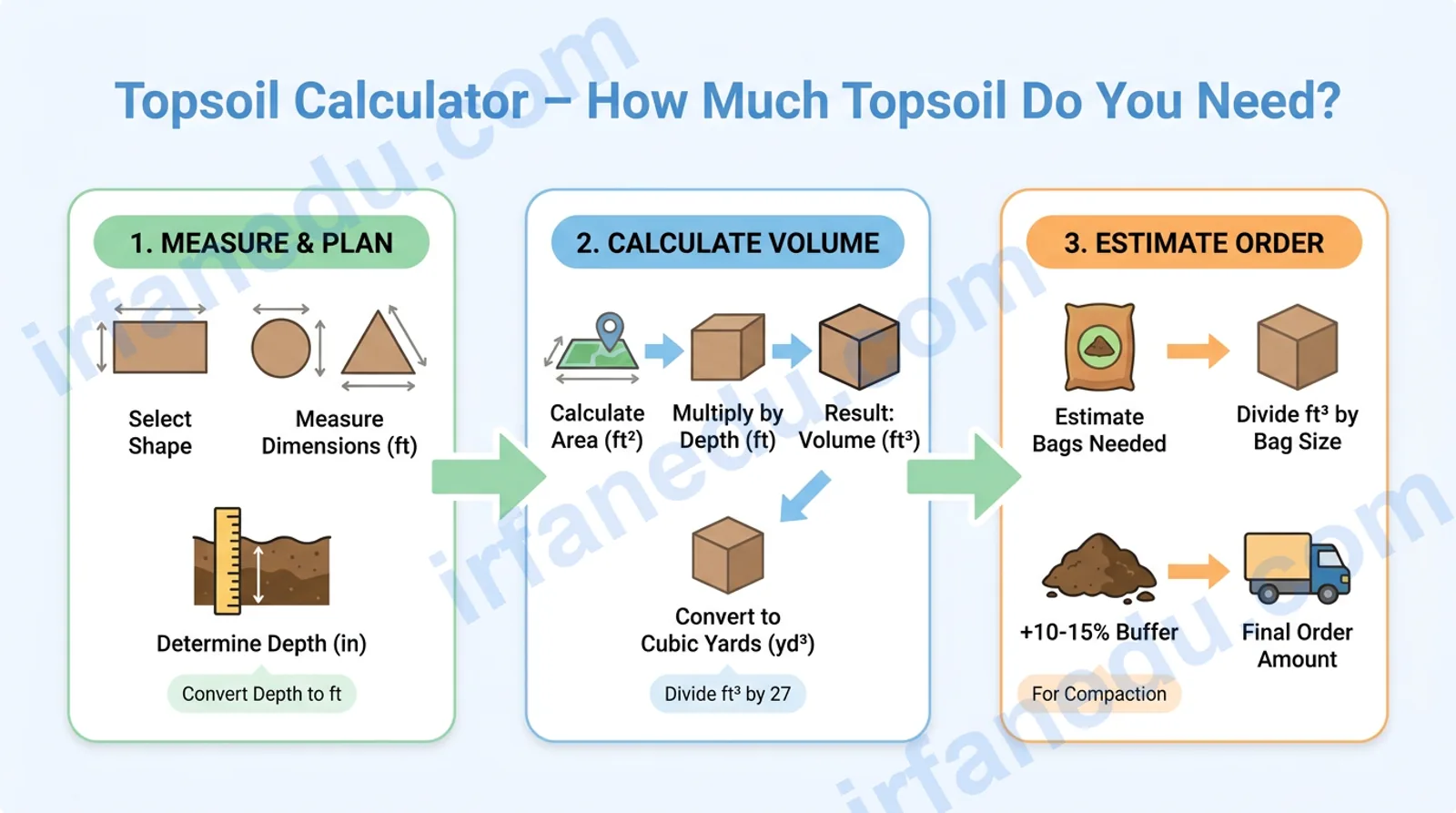
To calculate topsoil needed, multiply your area’s length by width by depth (all in feet), then divide by 27 to convert to cubic yards. A 10 ft x 10 ft bed at 6 inches deep needs 100 x 0.5 / 27 = 1.85 cubic yards. One cubic yard covers 324 sq ft at 1 inch deep. Add 10-15% extra for compaction.
You already know the answer. Now let me show you exactly how to get there for your specific project — and why most people order the wrong amount.
This topsoil calculator handles rectangular, circular, and triangular areas. Enter your dimensions, pick your depth, and get cubic yards, cubic feet, and bag count instantly — with a numbered step-by-step solution you can screenshot and take to the hardware store.
⚡ TL;DR
- Volume (cu ft) = Length x Width x Depth (all in feet)
- Divide by 27 to convert cubic feet to cubic yards
- One 40-lb bag covers ~0.75 cu ft; divide total cu ft by 0.75 for bag count
- Grass needs 4-6 in; flower beds 6 in; vegetable gardens 8-12 in
- Always order 10-15% extra — topsoil compacts after settling
- Use the calculator below for circles and triangles too
Select your area shape, enter dimensions, and choose depth.
ft
ft
in
lb
How to use this topsoil calculator
- Pick your shape — rectangle/square, circle, or triangle.
- Enter dimensions in feet — length and width for rectangles; radius for circles; base and height for triangles.
- Enter desired depth in inches — see the depth guide below if you are unsure.
- Set your bag size — defaults to 40 lb (most common in the US). Change it to 50 lb or 1 cu ft bags if needed.
- Click Calculate — the result card shows cubic yards, cubic feet, bag count, and a full numbered solution.
- Add 10% for compaction — the calculator does this automatically in the “+10% bags” chip.
The topsoil formula explained
The core formula is straightforward. Volume equals area multiplied by depth. The only trick is keeping units consistent — everything must be in feet before you multiply.
RECTANGLE / SQUARE
  Volume (cu ft) = Length (ft) × Width (ft) × Depth (ft)
  Depth (ft)     = Depth (in) ÷ 12

CIRCLE
  Volume (cu ft) = π × Radius² (ft) × Depth (ft)

TRIANGLE
  Volume (cu ft) = 0.5 × Base (ft) × Height (ft) × Depth (ft)

CONVERT TO CUBIC YARDS
  Volume (cu yd) = Volume (cu ft) ÷ 27

BAGS NEEDED (40-lb bag ≈ 0.75 cu ft)
  Bags = ⌈ Volume (cu ft) ÷ 0.75 ⌉
Variables and symbols table
| Symbol | Meaning | Unit |
|---|---|---|
| L | Length of the area | feet (ft) |
| W | Width of the area | feet (ft) |
| r | Radius of a circular area | feet (ft) |
| b | Base of a triangular area | feet (ft) |
| h | Height of a triangular area | feet (ft) |
| d | Desired topsoil depth | inches (in) → convert to ft ÷ 12 |
| Vft | Volume in cubic feet | cu ft |
| Vyd | Volume in cubic yards | cu yd (= Vft ÷ 27) |
| N | Number of 40-lb bags | bags (= ⌈Vft ÷ 0.75⌉) |
SI note: 1 cubic yard = 0.7646 cubic metres. For metric projects, multiply cubic yards by 0.7646 to get cubic metres.
Worked examples that match the calculator’s steps
- Area = 20 × 15 = 300 sq ft
- Convert depth: 4 in ÷ 12 = 0.3333 ft
- Volume = 300 × 0.3333 = 100 cu ft
- Cubic yards = 100 ÷ 27 = 3.70 cu yd
- Bags (40 lb) = ⌈100 ÷ 0.75⌉ = 134 bags
- With 10% buffer: 148 bags recommended
- Area = π × 6² = 3.14159 × 36 = 113.10 sq ft
- Convert depth: 6 in ÷ 12 = 0.5 ft
- Volume = 113.10 × 0.5 = 56.55 cu ft
- Cubic yards = 56.55 ÷ 27 = 2.09 cu yd
- Bags (40 lb) = ⌈56.55 ÷ 0.75⌉ = 76 bags
- With 10% buffer: 84 bags recommended
- Area = 0.5 × 10 × 8 = 40 sq ft
- Convert depth: 12 in ÷ 12 = 1.0 ft
- Volume = 40 × 1.0 = 40 cu ft
- Cubic yards = 40 ÷ 27 = 1.48 cu yd
- Bags (40 lb) = ⌈40 ÷ 0.75⌉ = 54 bags
- With 10% buffer: 59 bags recommended
  TOPSOIL DEPTH GUIDE (cross-section view)
  ─────────────────────────────────────────
  Surface
  ┌──────────────────────────────────────┐
  │░░░░░░░░░░░░░░░░░░░░░░░░░░░░░░░░░░░░░│ ← 4 in  Grass / turf
  │░░░░░░░░░░░░░░░░░░░░░░░░░░░░░░░░░░░░░│
  │▓▓▓▓▓▓▓▓▓▓▓▓▓▓▓▓▓▓▓▓▓▓▓▓▓▓▓▓▓▓▓▓▓▓▓│ ← +2 in Flower beds (6 in total)
  │▓▓▓▓▓▓▓▓▓▓▓▓▓▓▓▓▓▓▓▓▓▓▓▓▓▓▓▓▓▓▓▓▓▓▓│
  │█████████████████████████████████████│ ← +6 in Vegetable garden (12 in total)
  │█████████████████████████████████████│
  └──────────────────────────────────────┘
  Subsoil / native ground

  ░ = 4 in layer   ▓ = 6 in layer   █ = 12 in layer
How deep should topsoil be for different projects?
The right depth depends on what you are growing. Using too little means roots hit hard subsoil; using too much wastes money and can waterlog shallow-rooted plants.
| Project type | Recommended depth | Why |
|---|---|---|
| Overseeding / topdressing existing lawn | 0.5 – 1 inch | Just enough to fill low spots and feed seed |
| New lawn from seed or sod | 4 – 6 inches | Grass roots need 4 in minimum to establish |
| Flower beds (annuals) | 6 inches | Shallow roots; good drainage matters more |
| Shrubs and perennials | 8 – 10 inches | Deeper roots need more soil volume |
| Vegetable garden | 10 – 12 inches | Root vegetables (carrots, beets) need 12 in |
| Raised bed fill | Full bed depth (12 – 24 in) | No native soil contact; all growing medium |
Most topsoil calculators — including popular ones — treat all topsoil as weighing the same. In practice, moist screened
Sources & References
Written and fact-checked by Dr Irfan Mansuri. External links open in a new tab and are provided for further reading and verification.