
Extreme Math: Your Complete Guide to Maximum & Minimum Values 📈
🗺️ What You’ll Learn in This Guide
- What Is Extreme Math? (Plain-English Definition)
- ⚡ Quick Answer
- TL;DR – Quick Summary
- Quick Facts Table
- Types of Extreme Values: Local vs. Global
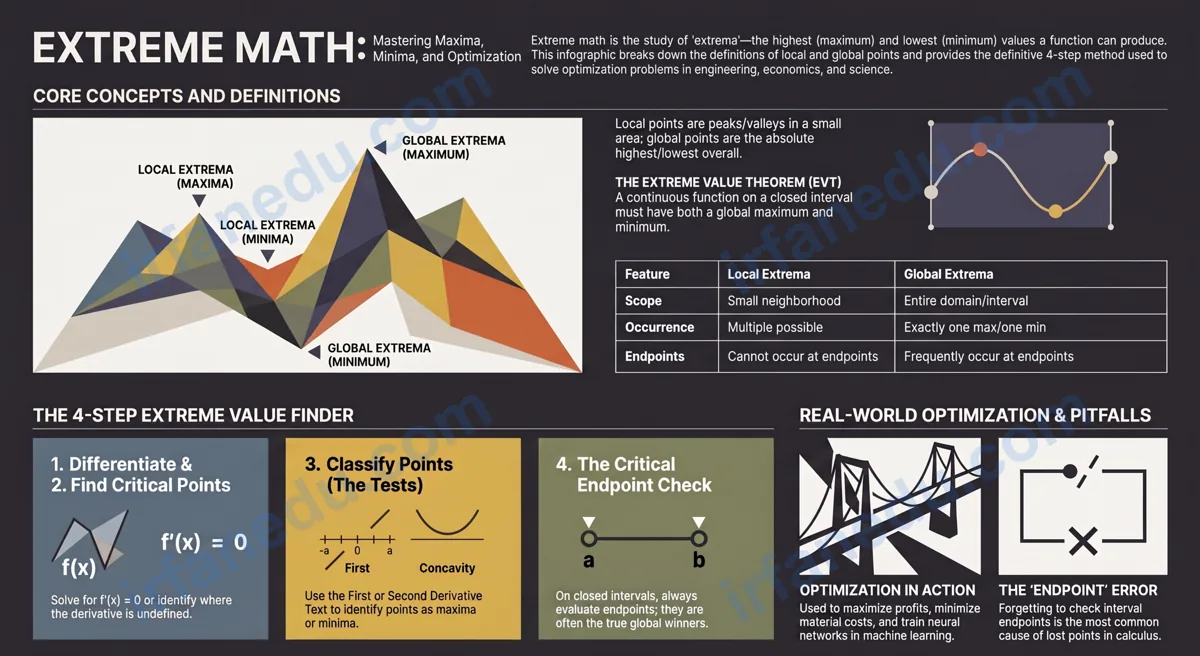
- What Is the Extreme Value Theorem?
- How Do You Find Extreme Values? (4-Step Method)
- Worked Examples: From Algebra to Calculus
- Common Mistakes Students Make (and How to Fix Them)
- How Does Extreme Math Power Real-World Optimization?
- 💡 Unique Insight
- Quick Quiz
- Practice Problems
- FAQ
- Key Takeaways
- Related Articles
- About the Author
- Sources & References
Good news: extreme math is not as intimidating as it sounds. 🎉 Whether you’re in 8th grade finding the vertex of a parabola, or in AP Calculus hunting for critical points, you’re already doing extreme math. This guide walks you through every level — from the very first definition all the way to real-world optimization — in a friendly, step-by-step tour. Bookmark it, share it with a classmate, and let’s get started.
Extreme math is the area of mathematics concerned with finding the maximum (largest) and minimum (smallest) values of a function or dataset. These values are called extrema. Extreme math appears in algebra (vertex of a parabola), pre-calculus (analyzing function behavior), and calculus (using derivatives to locate critical points). It is the mathematical engine behind every optimization problem — from maximizing profit to minimizing material cost.
- ✅ Understand what extrema are and why they matter
- ✅ Tell the difference between local and global extreme values
- ✅ Apply the 4-step method to find extreme values with derivatives
- ✅ Solve optimization word problems confidently
- ✅ Avoid the 3 most common errors students make
Extreme math is the branch of mathematics focused on finding the maximum (highest) and minimum (lowest) values of a function or dataset. It covers local and global extrema, the Extreme Value Theorem, and optimization. You find extreme values by setting a function’s derivative equal to zero and testing critical points — a skill used in algebra, calculus, and real-world problem-solving.
⚡ TL;DR – Quick Summary
- 📌 Extreme math = finding the highest or lowest value a function can reach.
- 📌 A local extremum is the peak or valley in a small region; a global extremum is the overall highest or lowest.
- 📌 The Extreme Value Theorem guarantees extrema exist on any closed, continuous interval.
- 📌 Find extrema by differentiating, setting f'(x) = 0, and testing critical points.
- 📌 On a closed interval, always check the endpoints too — the global extreme often hides there.
- 📌 Optimization problems are extreme math in disguise — maximize or minimize a real-world quantity.
📊 Quick Facts: Extreme Math at a Glance
| Term | Plain-English Meaning | First Seen In |
|---|---|---|
| Extremum (pl. extrema) | A maximum or minimum value of a function | Algebra / Pre-Calc |
| Local (Relative) Max/Min | Highest/lowest point in a small neighborhood | Pre-Calculus |
| Global (Absolute) Max/Min | Highest/lowest point over the entire domain | Calculus |
| Critical Point | Where f'(x) = 0 or f'(x) is undefined | Calculus |
| Extreme Value Theorem (EVT) | Continuous function on [a,b] must have a max and min | Calculus |
| Optimization | Using extrema to find the “best” real-world value | Algebra → Calculus |
| Saddle Point | Critical point that is neither a max nor a min | Multivariable Calculus |
🔍 What Is Extreme Math? (Plain-English Definition)
Extreme math is the study of the highest and lowest values a mathematical function can produce. The word “extreme” simply means “at the edge” — you’re looking for the function’s peak (maximum) or its valley (minimum).
These peaks and valleys are called extrema (singular: extremum). Finding them is one of the most practical skills in all of mathematics. Every time an engineer asks “what bridge design uses the least steel?” or a business analyst asks “what price generates the most revenue?” — they are solving an extreme math problem.
Extreme math is NOT a single course or a single topic. It is a thread that runs through your entire math education:
- 🏫 Middle school: finding the max/min value in a data set
- 📐 Algebra: finding the vertex of a parabola (the maximum or minimum of a quadratic)
- 📈 Pre-calculus: analyzing where a polynomial rises and falls
- ∫ Calculus: using derivatives to locate critical points and apply the Extreme Value Theorem
- 🌐 Multivariable calculus: finding extrema of functions with two or more inputs
In my experience teaching math at every level, students who understand extreme math early have a huge advantage. When a student sees a parabola and immediately thinks “that vertex is an extreme value,” they’ve made a conceptual connection that pays dividends all the way through AP Calculus and beyond. The vocabulary is the first barrier — once you own the words “extremum,” “critical point,” and “optimization,” the problems feel far less scary.
🏔️ Types of Extreme Values: What Is the Difference Between Local and Global?
The most important distinction in extreme math is between local (relative) and global (absolute) extrema — and most students confuse them at least once.
Local (Relative) Extrema
A local maximum is a point where the function value is higher than all nearby points. A local minimum is lower than all nearby points. “Nearby” means within some small open interval around that point — not necessarily across the whole function.
Think of it like hills on a hiking trail. A local maximum is the top of any hill. You might climb higher later, but right there, you’re at the top of that particular hill.
Global (Absolute) Extrema
A global maximum is the single highest output value the function ever reaches across its entire domain (or a specified interval). A global minimum is the single lowest.
Back to the hiking analogy: the global maximum is the tallest peak on the entire trail — not just any hill, but the highest point of all.
Consider f(x) = x³ − 3x on the interval [−2, 2].
- At x = −1, f has a local maximum of 2.
- At x = 1, f has a local minimum of −2.
- At x = −2 (endpoint), f(−2) = −2. At x = 2 (endpoint), f(2) = 2.
- The global maximum is 2, achieved at both x = −1 and x = 2.
- The global minimum is −2, achieved at both x = 1 and x = −2.
Notice: a global extreme can tie with a local extreme, and endpoints can be global extrema even if they are not critical points.
| Feature | Local Extremum | Global Extremum |
|---|---|---|
| Scope | Small neighborhood around the point | Entire domain or closed interval |
| How many can exist? | Multiple (one per hill/valley) | Exactly one max and one min (on closed interval) |
| Can occur at endpoint? | No (open neighborhood required) | Yes — endpoints are always candidates |
| Found using | First/Second Derivative Test | Compare all critical points + endpoints |
| Guaranteed to exist? | Not always | Yes, if function is continuous on [a, b] (EVT) |
📜 What Is the Extreme Value Theorem?
The Extreme Value Theorem (EVT) is one of the most important guarantees in calculus: if a function f is continuous on a closed interval [a, b], then f must attain both a global maximum and a global minimum on that interval.
Two conditions are non-negotiable:
- Continuous: no holes, jumps, or vertical asymptotes on [a, b].
- Closed interval: both endpoints a and b are included.
The EVT guarantees that extreme values exist — it does not tell you where they are. You still have to find them by locating critical points and checking endpoints. Think of the EVT as a promise that the treasure is buried somewhere in the yard; you still have to dig.
On an open interval (a, b), extreme values are not guaranteed. For example, f(x) = 1/x on (0, 1) has no maximum — the function grows without bound as x approaches 0. Always check whether your interval is open or closed before applying the EVT.
[IMAGE: Diagram comparing a continuous function on a closed interval (EVT applies) vs. a function with a jump discontinuity (EVT does not apply) | ALT: Extreme Value Theorem diagram showing continuous vs discontinuous function on closed interval]
🛠️ How Do You Find Extreme Values? (4-Step Method)
Finding extreme values with calculus follows a clear, repeatable 4-step process. Master this sequence and you can handle any extrema problem on a test.
- Step 1 — Differentiate: Find f'(x), the derivative of the function.
- Step 2 — Find critical points: Set f'(x) = 0 and solve for x. Also note any x-values where f'(x) is undefined (corners, cusps, vertical tangents).
- Step 3 — Classify each critical point: Use the First Derivative Test (does f’ change sign?) or the Second Derivative Test (is f” positive or negative at the point?).
- Step 4 — Check endpoints (closed interval only): Evaluate f at x = a and x = b. Compare all values to identify the global maximum and minimum.
  f(x)  ← Start here
    │
    ▼
  f'(x) = 0  or  f'(x) undefined
    │
    ▼
  Critical Points: x₁, x₂, x₃ ...
    │
    ├──► First Derivative Test
    │       f' changes + → −  ⟹  LOCAL MAX
    │       f' changes − → +  ⟹  LOCAL MIN
    │       f' no sign change  ⟹  NEITHER
    │
    └──► Second Derivative Test
            f''(xᵢ) < 0  ⟹  LOCAL MAX
            f''(xᵢ) > 0  ⟹  LOCAL MIN
            f''(xᵢ) = 0  ⟹  INCONCLUSIVE (use 1st test)
    │
    ▼
  Evaluate f at endpoints a and b
    │
    ▼
  Compare ALL values → pick largest (GLOBAL MAX)
                             pick smallest (GLOBAL MIN)
First Derivative Test vs. Second Derivative Test: Which Should You Use?
| Test | How It Works | Best Used When | Limitation |
|---|---|---|---|
| First Derivative Test | Check the sign of f’ on each side of the critical point | Always reliable; works on all differentiable functions | Requires sign analysis on both sides |
| Second Derivative Test | Evaluate f” at the critical point | Quick when f” is easy to compute | Fails (inconclusive) when f”(c) = 0 |
✏️ Worked Examples: Extreme Math From Algebra to Calculus
The best way to understand extreme math is to work through real problems at increasing difficulty. Here are three fully solved examples — one at each level.
Example 1 — Algebra Level: Vertex of a Quadratic
Find the maximum or minimum value of f(x) = −2x² + 8x − 3.
Step 1: The coefficient of x² is −2 (negative), so the parabola opens downward → the vertex is a maximum.
Step 2: Use the vertex formula: x = −b / (2a) = −8 / (2 × −2) = −8 / −4 = 2.
Step 3: Evaluate: f(2) = −2(4) + 8(2) − 3 = −8 + 16 − 3 = 5.
Answer: The global maximum is 5, occurring at x = 2. There is no minimum (the parabola falls to −∞).
Example 2 — Pre-Calculus Level: Polynomial on a Closed Interval
Find the global extrema of f(x) = x³ − 6x² + 9x + 1 on [0, 4].
Step 1 — Differentiate: f'(x) = 3x² − 12x + 9.
Step 2 — Critical points: 3x² − 12x + 9 = 0 → x² − 4x + 3 = 0 → (x−1)(x−3) = 0 → x = 1 and x = 3.
Step 3 — Evaluate at critical points and endpoints:
- f(0) = 0 − 0 + 0 + 1 = 1
- f(1) = 1 − 6 + 9 + 1 = 5
- f(3) = 27 − 54 + 27 + 1 = 1
- f(4) = 64 − 96 + 36 + 1 = 5
Answer: Global maximum = 5 (at x = 1 and x = 4). Global minimum = 1 (at x = 0 and x = 3).
Example 3 — Calculus Level: Optimization Word Problem
A farmer has 120 meters of fencing to enclose a rectangular field. One side borders a river and needs no fence. What dimensions maximize the enclosed area?
Step 1 — Set up the function: Let the two sides perpendicular to the river each have length x. The side parallel to the river has length (120 − 2x). Area A(x) = x(120 − 2x) = 120x − 2x².
Step 2 — Differentiate: A'(x) = 120 − 4x.
Step 3 — Critical point: 120 − 4x = 0 → x = 30.
Step 4 — Confirm maximum: A”(x) = −4 < 0 → concave down → x = 30 is a maximum.
Answer: Each perpendicular side = 30 m; the river-parallel side = 60 m. Maximum area = 30 × 60 = 1,800 m².
🚫 Common Mistakes Students Make in Extreme Math (and How to Fix Them)
After reviewing hundreds of student solutions, I’ve identified three mistakes that account for the majority of lost points on extreme math problems.
Mistake 1: Forgetting to Check Endpoints
Students find critical points, test them, and stop — never evaluating the function at the endpoints of a closed interval. The global maximum or minimum often sits at an endpoint, not at a critical point.
✅ Right approach: “I found the critical points, tested them, AND evaluated f at both endpoints. Then I compared all values.”
Mistake 2: Confusing Local and Global Extrema
A local maximum is NOT necessarily the global maximum. Students often label the first peak they find as “the maximum” without checking whether a higher value exists elsewhere on the domain.
Mistake 3: Trusting the Second Derivative Test When f”(c) = 0
When the second derivative equals zero at a critical point, the test is inconclusive — it tells you nothing. Students sometimes incorrectly conclude “neither max nor min” when f”(c) = 0. You must fall back to the First Derivative Test in that case.
In my experience, Mistake 1 — ignoring endpoints — is the single most expensive error on AP Calculus exams. I’ve seen students lose 4–6 points on a single free-response question because they found the local extrema perfectly but never checked the endpoints. My rule: on a closed interval, always write out a table with every critical point AND both endpoints before declaring a winner. It takes 60 seconds and saves points every time.
🌍 How Does Extreme Math Power Real-World Optimization?
Optimization is extreme math applied to the real world. Every time a system needs to be made “as good as possible,” extreme math is the tool that gets the job done.
Here are five genuine real-world applications — not textbook fluff, but actual uses:
- 🏗️ Engineering: Minimizing the amount of material needed to build a container of a given volume (classic calculus optimization).
- 💰 Economics: Finding the price point that maximizes revenue or profit for a business.
- 🚀 Physics: Calculating the launch angle (45° on flat ground) that maximizes the range of a projectile.
- 💊 Medicine: Determining the drug dosage that maximizes therapeutic effect while minimizing side effects.
- 🤖 Machine learning: Training a neural network is literally an optimization problem — minimizing a loss function using gradient descent, which is calculus-based extreme math at massive scale.
Every optimization word problem has the same skeleton: (1) identify what you’re maximizing or minimizing, (2) write a function for it, (3) use a constraint to reduce to one variable, (4) apply the 4-step extreme-value method. If you can identify these four elements, you can solve any optimization problem.
Most textbooks and online guides teach extreme math as a calculus topic — derivatives first, everything else second. This creates a blind spot: students who haven’t taken calculus yet believe they can’t do extreme math. That’s simply wrong.
Here’s the non-obvious truth: the vertex formula for a quadratic (x = −b/2a) is a closed-form solution to f'(x) = 0 for degree-2 polynomials. Algebra students are already finding critical points — they just don’t know it yet. When I show pre-calculus students that completing the square is secretly the same operation as setting the derivative to zero, I watch the conceptual gap between algebra and calculus close in real time.
The practical implication: if you’re an algebra or pre-calc student, you already have the intuition for extreme math. You don’t need to wait for calculus to start thinking in terms of maxima and minima. Start now — it will make calculus feel like a natural extension, not a foreign language.
🧠 Quick Quiz: Test Your Extreme Math Knowledge
Q1. A function f is continuous on [1, 5]. According to the Extreme Value Theorem, what is guaranteed?
Q2. You find that f'(3) = 0 and f”(3) = −7. What can you conclude about x = 3?
Q3. For f(x) = x² − 4x + 7 on [0, 5], where does the global minimum occur?
📝 Practice Problems (Click to Reveal Solutions)
Problem 1: Find the extreme values of f(x) = 3x² − 12x + 5 on [0, 5].
Step 1: f'(x) = 6x − 12. Set equal to zero: 6x − 12 = 0 → x = 2.
Step 2: Evaluate at critical point and endpoints:
- f(0) = 0 − 0 + 5 = 5
- f(2) = 12 − 24 + 5 = −7
- f(5) = 75 − 60 + 5 = 20
Global maximum: 20 at x = 5. Global minimum: −7 at x = 2.
Problem 2: A rectangle has a perimeter of 40 cm. What dimensions maximize its area?
Let width = x. Then length = (40 − 2x)/2 = 20 − x.
Area A(x) = x(20 − x) = 20x − x².
A'(x) = 20 − 2x = 0 → x = 10.
A”(x) = −2 < 0 → local maximum confirmed.
Answer: Width = 10 cm, Length = 10 cm. Maximum area = 100 cm². (A square maximizes area for a fixed perimeter — a beautiful result!)
Problem 3: Find all local extrema of f(x) = x³ − 3x² − 9x + 2 using the First Derivative Test.
f'(x) = 3x² − 6x − 9 = 3(x² − 2x − 3) = 3(x − 3)(x + 1).
Critical points: x = 3 and x = −1.
Sign analysis of f'(x):
- x < −1: pick x = −2 → f'(−2) = 3(−5)(−3) = 45 > 0 (increasing)
- −1 < x < 3: pick x = 0 → f'(0) = 3(−3)(1) = −9 < 0 (decreasing)
- x > 3: pick x = 4 → f'(4) = 3(1)(5) = 15 > 0 (increasing)
At x = −1: f’ changes + → − → local maximum. f(−1) = −1 − 3 + 9
Sources & References
Reviewed by Dr. Irfan Mansuri. External links open in a new tab and are provided for further reading and verification.