
Area Model for Division: Step-by-Step Guide + Free Printable Worksheet
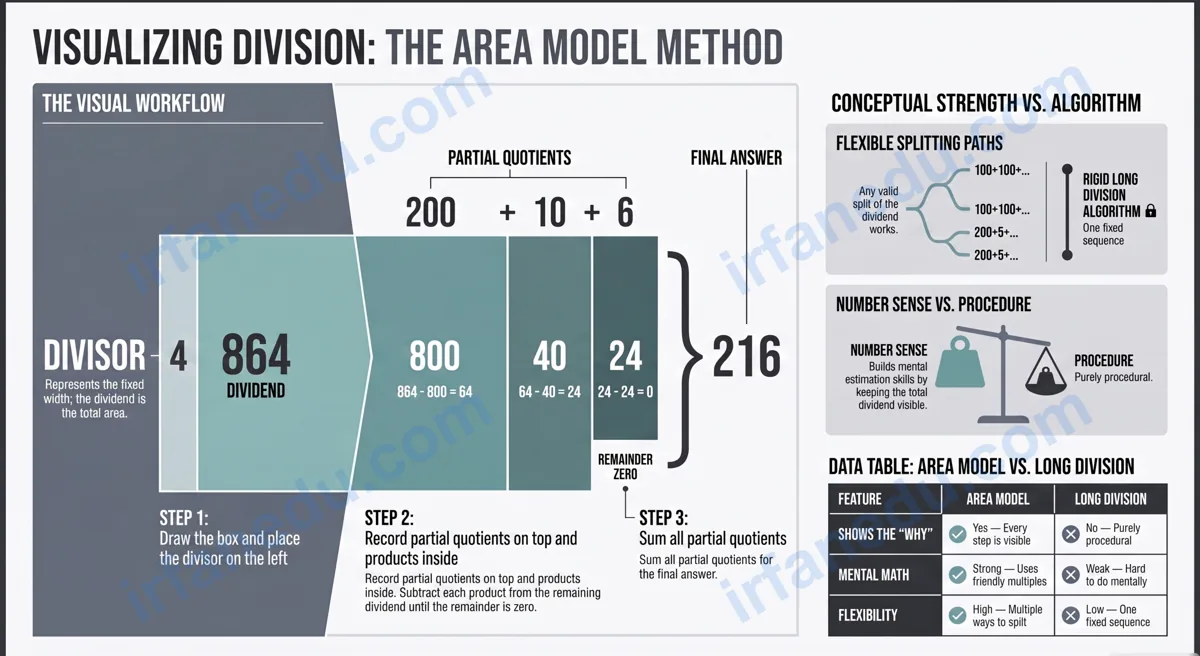
The area model for division is a visual strategy that uses a rectangle to represent the dividend. You break the dividend into friendly chunks, find how many times the divisor fits into each chunk (the partial quotients), then add those quotients together. It is the clearest way to see why division works, not just how to execute it.
Free Printable Worksheet (with Answer Key): 12 problems, easy to hard, ready to print or assign.
TL;DR — Quick Summary
- The area model uses a rectangle split into sections to show division visually.
- Each section holds a partial quotient (on top) and a partial product (inside).
- You subtract partial products from the dividend until nothing remains.
- Add all partial quotients to get the final answer.
- It works for 2-, 3-, and 4-digit dividends and 1- or 2-digit divisors.
- Any valid split of the dividend gives the same correct answer.
| Feature | Detail |
|---|---|
| Also called | Box method, rectangle method, partial quotients division |
| Grade level | Grades 4-5 (US Common Core 4.NBT.B.6, 5.NBT.B.6) |
| Core idea | Dividend = Divisor x (sum of partial quotients) + Remainder |
| Key skill needed | Multiplication facts and multiples of 10 |
| Works with remainders | Yes |
| Works with 2-digit divisors | Yes (5th grade extension) |
What Is the Area Model for Division?
The area model for division is a visual method that represents a division problem as the area of a rectangle. The divisor is the rectangle’s width (or height), and the dividend is its total area. Your job is to find the length — the quotient.
This connects directly to multiplication: if you know that 6 x 10 = 60, you can use that fact inside the rectangle to “use up” part of the dividend. That is the core insight. Division becomes a series of multiplication facts you already know.
The Core Rule (Pattern #47 — Formula First)
Dividend = Divisor × Partial Quotient1 + Divisor × Partial Quotient2 + … + Remainder
Final Quotient = Partial Quotient₁ + Partial Quotient₂ + ... (+ R if remainder exists)
This formula is the engine behind the rectangle. Every section of the box represents one term in that sum. Once you see it this way, the area model stops feeling like a drawing exercise and starts feeling like algebra you can do in your head.
In my experience teaching this to 4th and 5th graders, the students who struggle with long division almost always succeed with the area model within one lesson. The rectangle makes the abstract concrete.
How to Use the Area Model for Division: Step-by-Step
Follow these five steps for any division problem. I use 84 ÷ 6 as the running example.
- Draw an open rectangle. Write the divisor (6) to the left, outside the box. This represents the fixed width of every section.
- Choose a friendly partial quotient. Ask: “What easy multiple of 6 fits inside 84?” A good choice is 6 x 10 = 60. Write 10 above the first section of the rectangle.
- Record the partial product inside the section. Write 60 inside that first section. Subtract: 84 – 60 = 24 remaining.
- Draw a second section and repeat. Now ask: “What multiple of 6 fits inside 24?” Answer: 6 x 4 = 24. Write 4 above the second section and 24 inside it. Subtract: 24 – 24 = 0 remaining.
- Add the partial quotients. 10 + 4 = 14. So 84 ÷ 6 = 14.
Visual Solution: 84 ÷ 6 (ASCII Area Model)
  Divisor
    |
    6  |    10    |    4    |   <- Partial Quotients (add these)
       +----------+---------+
       |    60    |   24    |   <- Partial Products (6x10, 6x4)
       +----------+---------+

  Step 1: 84 - 60 = 24 remaining
  Step 2: 24 - 24 =  0 remaining
  Final:  10 + 4  = 14

  Answer: 84 / 6 = 14
Worked Examples: Area Model Division in Action
Example 1: 3-Digit Dividend — 195 ÷ 5
Worked Example 1
Problem: 195 ÷ 5
Step 1 — Choose first chunk: 5 x 30 = 150. Write 30 above section 1, 150 inside. Remaining: 195 - 150 = 45.
Step 2 — Choose second chunk: 5 x 9 = 45. Write 9 above section 2, 45 inside. Remaining: 45 - 45 = 0.
Add partial quotients: 30 + 9 = 39
Answer: 195 ÷ 5 = 39
Example 2: Problem with a Remainder — 137 ÷ 6
Worked Example 2 (with Remainder)
Problem: 137 ÷ 6
Step 1: 6 x 20 = 120. Write 20 above section 1, 120 inside. Remaining: 137 - 120 = 17.
Step 2: 6 x 2 = 12. Write 2 above section 2, 12 inside. Remaining: 17 - 12 = 5.
5 is less than 6, so it cannot fill another section. It is the remainder.
Add partial quotients: 20 + 2 = 22. Remainder = 5.
Answer: 137 ÷ 6 = 22 R5
Example 3: Two-Digit Divisor — 432 ÷ 16
Worked Example 3 (2-Digit Divisor)
Problem: 432 ÷ 16
Step 1: 16 x 20 = 320. Write 20 above section 1, 320 inside. Remaining: 432 - 320 = 112.
Step 2: 16 x 7 = 112. Write 7 above section 2, 112 inside. Remaining: 112 - 112 = 0.
Add partial quotients: 20 + 7 = 27
Answer: 432 ÷ 16 = 27
Notice that in Example 3, knowing that 16 x 20 = 320 is the key move. If you know your multiples of 10, two-digit divisors are no harder than one-digit ones.
Common Mistakes Students Make with the Area Model
These are the errors I see most often when reviewing student work. Each one has a clear fix.
| Wrong | Right |
|---|---|
| Writing the partial product above the section and the partial quotient inside | Partial quotient goes above; partial product goes inside the box |
| Forgetting to subtract after each section, so the remaining dividend is wrong | Always subtract the partial product from the current remaining dividend before drawing the next section |
| Choosing a partial quotient that makes the partial product larger than the remaining dividend | Check: Divisor x Partial Quotient must be ≤ remaining dividend |
| Stopping when a small number remains without checking if the divisor fits one more time | Keep going until the remainder is strictly less than the divisor |
| Adding the partial products instead of the partial quotients at the end | Add the numbers on top of the rectangle, not the numbers inside |
Unique Insight: Why the Area Model Beats Long Division for Building Number Sense
Most guides present the area model as a stepping stone to the standard long division algorithm — as if the goal is to graduate away from it. That framing is wrong. The area model is not a crutch; it is a flexible estimation tool that professional mathematicians and engineers use informally all the time. When you estimate how many 24-passenger buses you need for 432 students, you are doing area-model thinking: 24 x 10 = 240, 24 x 7 = 168, total 432, answer 17 buses. The standard algorithm gives you the same number but hides the reasoning. Students who only learn the algorithm cannot do that mental estimation. Students who learn the area model first can do both.
The second non-obvious point: there is no single correct way to split the rectangle. A student who splits 195 ÷ 5 into five sections of 5 x 7 each gets the same answer as one who uses two sections. This teaches a profound mathematical truth — that there are many valid paths to a correct answer — which the rigid long division algorithm never communicates.
Area Model vs. Long Division Algorithm: Which Should You Use?
Both methods produce the same answer. The difference is in what they show you and when each is faster.
| Feature | Area Model | Long Division Algorithm |
|---|---|---|
| Shows the "why" | Yes — every step is visible | No — steps are procedural |
| Flexible splitting | Yes — any valid split works | No — one fixed procedure |
| Speed for large numbers | Slower (more steps) | Faster once mastered |
| Works well for mental math | Yes | No |
| Builds number sense | Strong | Weak |
| Handles remainders clearly | Yes | Yes |
| Common Core alignment | 4.NBT.B.6, 5.NBT.B.6 | 5.NBT.B.6 (standard algorithm) |
Practice Worksheet: Area Model for Division (12 Problems)
Use the area model (rectangle/box method) to solve each problem below. Show your partial quotients above the rectangle sections and your partial products inside. Check your answers with the key below.
- 48 ÷ 4 = ___
- 63 ÷ 3 = ___
- 84 ÷ 6 = ___
- 96 ÷ 8 = ___
- 126 ÷ 6 = ___
- 144 ÷ 12 = ___
- 195 ÷ 5 = ___
- 252 ÷ 7 = ___
- 312 ÷ 8 = ___
- 432 ÷ 16 = ___
- 575 ÷ 25 = ___
- 864 ÷ 24 = ___
Show Answer Key
- 48 ÷ 4 = 12
- 63 ÷ 3 = 21
- 84 ÷ 6 = 14
- 96 ÷ 8 = 12
- 126 ÷ 6 = 21
- 144 ÷ 12 = 12
- 195 ÷ 5 = 39
- 252 ÷ 7 = 36
- 312 ÷ 8 = 39
- 432 ÷ 16 = 27
- 575 ÷ 25 = 23
- 864 ÷ 24 = 36
How to use this worksheet: Print it or work on screen. Solve each problem by drawing the rectangle, labeling partial quotients on top, and partial products inside. When done, open the answer key above to self-check. For any wrong answer, re-draw the rectangle and find where your subtraction went off.
Download the printable version: Includes all 12 problems on a clean print-ready page plus a separate Answer Key section.
Reveal-on-Click Practice Problems
Practice 1: 72 ÷ 4 — Click to see the solution
Step 1: 4 x 10 = 40. Remaining: 72 - 40 = 32.
Step 2: 4 x 8 = 32. Remaining: 32 - 32 = 0.
Answer: 10 + 8 = 18. So 72 ÷ 4 = 18.
Practice 2: 156 ÷ 12 — Click to see the solution
Step 1: 12 x 10 = 120. Remaining: 156 - 120 = 36.
Step 2: 12 x 3 = 36. Remaining: 36 - 36 = 0.
Answer: 10 + 3 = 13. So 156 ÷ 12 = 13.
Practice 3: 245 ÷ 7 — Click to see the solution
Step 1: 7 x 30 = 210. Remaining: 245 - 210 = 35.
Step 2: 7 x 5 = 35. Remaining: 35 - 35 = 0.
Answer: 30 + 5 = 35. So 245 ÷ 7 = 35.
Quick Quiz: Test Your Understanding
Q1. In the area model for 96 ÷ 8, a student uses 8 x 10 = 80 as the first section. What is the partial quotient for the second section?
Show Answer
Correct answer: A) 2. After using 80, the remaining dividend is 96 - 80 = 16. Since 8 x 2 = 16, the second partial quotient is 2. Final answer: 10 + 2 = 12.
Q2. Which numbers go on top of the rectangle sections in the area model?
Show Answer
Correct answer: B) Partial quotients. The partial quotients sit above the rectangle. The partial products (divisor x partial quotient) go inside each section.
Q3. A student solves 137 ÷ 6 using the area model and gets sections of 20 and 2, with 5 left over. What is the correct final answer?
Show Answer
Correct answer: B) 22 R5. The partial quotients 20 + 2 = 22. The leftover 5 is less than the divisor 6, so it becomes the remainder.
Frequently Asked Questions
What is the area model for division?
The area model for division is a visual strategy that uses a rectangle to represent the dividend. You split the rectangle into sections, each representing a partial quotient. The partial product (divisor x partial quotient) goes inside each section. You subtract as you go and add all partial quotients at the end to find the final answer.
How is the area model different from long division?
Long division uses a compact step-by-step algorithm: divide, multiply, subtract, bring down. The area model makes each of those steps visible by drawing a rectangle. The area model is slower but builds a deeper understanding of what division actually means. Long division is faster once the algorithm is memorized.
What grade level uses the area model for division?
The area model for division is typically introduced in 4th grade for 2- to 3-digit dividends divided by 1-digit divisors (Common Core 4.NBT.B.6). In 5th grade it extends to larger dividends and 2-digit divisors (5.NBT.B.6). Some curricula introduce it in 3rd grade for simple problems.
Can the area model handle remainders?
Yes. When you finish all sections and the leftover amount is smaller than the divisor, that leftover is the remainder. Write it as "R" followed by the number. For example, 137 ÷ 6 = 22 R5. The area model makes remainders easy to spot because you simply cannot fill another full section.
What is another name for the area model of division?
The area model for division is also called the box method, the rectangle method, or partial quotients division. All three names describe the same visual strategy of splitting the dividend into friendly chunks inside a drawn rectangle. Your textbook may use any of these terms.
How do I choose how to split the dividend in the area model?
Choose multiples of the divisor that are easy to work with mentally, such as 10x, 20x, or 100x the divisor. Start with the largest friendly multiple that fits inside the remaining dividend and work down. There is no single correct split — any combination of partial quotients that adds to the full dividend (minus the remainder) is valid.
Does the area model work with 2-digit divisors?
Yes. For a 2-digit divisor like 16, you use the same process: find multiples of 16 that fit inside the dividend (16 x 20 = 320, 16 x 7 = 112, etc.), record them in sections, subtract, and add the partial quotients. The only extra challenge is knowing your multiples of the 2-digit divisor, which is why multiplication fluency matters.
Key Takeaways
- The area model represents division as the area of a rectangle split into partial-quotient sections.
- Partial quotients go above the rectangle; partial products go inside.
- Subtract each partial product from the running dividend until the remainder is less than the divisor.
- Add all partial quotients for the final answer.
- Any valid split of the dividend gives the same correct answer — there is no single "right" way to draw the box.
- The area model builds mental math and number sense that the standard algorithm does not.
- Use the free printable worksheet above to practice all 12 problems with the answer key.