
NYS Math Standards: The Step-Zero Guide Most Parents & Students Never See 📐
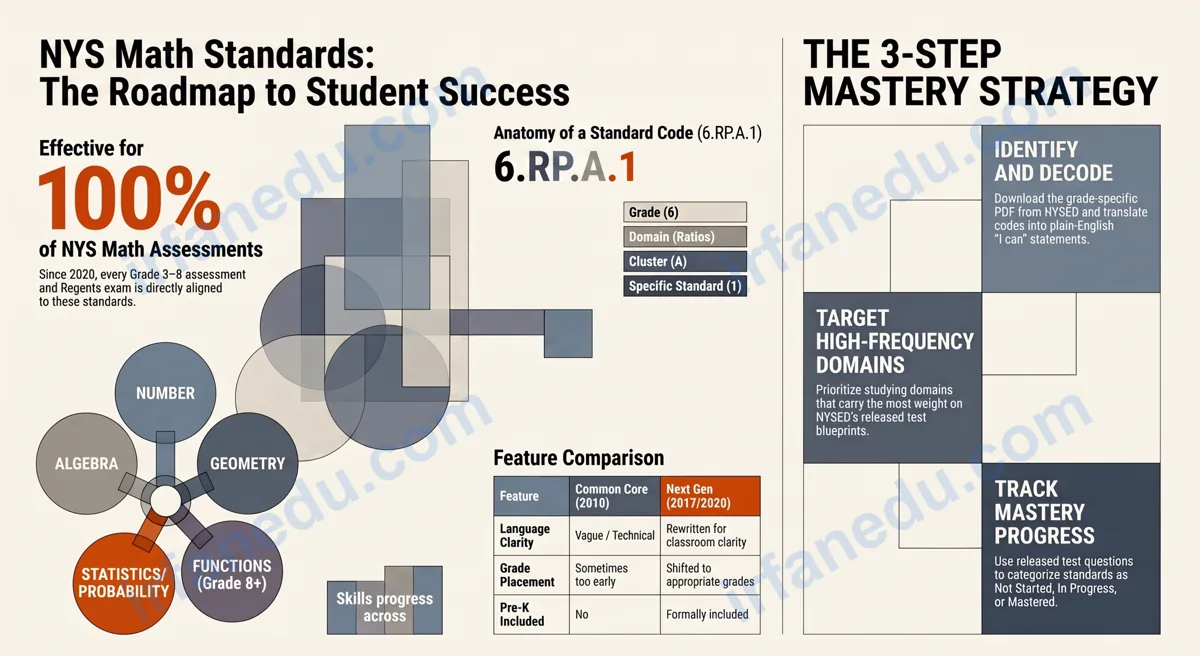
The NYS Math Standards — officially the New York State Next Generation Mathematics Learning Standards — are the grade-by-grade blueprint for what every student in New York must learn in math, from Pre-K counting skills all the way to high school Algebra II. They replaced the original Common Core in 2020 with sharper language and better-sequenced skills.
Most guides jump straight into listing the standards. I want to do something different: I want to show you how to actually use them — because knowing a standard exists and knowing how to turn it into a study target are two completely different things. In my 15+ years of working with students and teachers, I’ve seen the same gap over and over: families know the standards are important, but nobody ever shows them the practical mechanics.
By the end of this article, you’ll know exactly what the standards say at your grade level, how to decode a standard code like “6.RP.A.1”, and how to build a targeted study plan around them — something I haven’t seen any other guide do clearly.
- 🎯 Understand what the NYS Next Generation Math Standards actually are
- 📊 See a clear grade-by-grade skill map from Pre-K to Grade 12
- 🔍 Learn to decode standard codes and turn them into study targets
- ✅ Get a practical 5-step system to use the standards to improve grades
- 🚫 Avoid the most common mistakes students make when preparing for NYS math tests
The NYS Math Standards are the New York State Next Generation Mathematics Learning Standards, adopted in 2017 and effective from 2020. They define what students in Pre-K through Grade 12 must know in math each year, organized into domains like Operations, Algebra, Geometry, and Statistics. They build on — and improve — the original Common Core, giving students, parents, and teachers a clear, grade-specific roadmap for math mastery.
⚡ TL;DR – Quick Summary
- 📌 NYS uses the Next Generation Math Standards (not plain Common Core) since 2020.
- 📌 Standards are organized by grade and domain — e.g., 6.RP.A.1 = Grade 6, Ratios, Cluster A, Standard 1.
- 📌 Five core domain families span all grades: Number, Operations, Algebra, Geometry, Statistics.
- 📌 Grades 3–8 state tests and high school Regents exams are directly aligned to these standards.
- 📌 The biggest change from Common Core: clearer language and some skills moved to different grade levels.
- 📌 You can download the full standards PDF free from the NYSED website.
| Detail | Information |
|---|---|
| Official Name | New York State Next Generation Mathematics Learning Standards |
| Adopted | September 2017 |
| Fully Effective | 2020–2021 school year |
| Grades Covered | Pre-Kindergarten through Grade 12 |
| Replaces | Common Core State Standards (2010 version) |
| Governing Body | New York State Education Department (NYSED) |
| State Tests Aligned | Grades 3–8 Math Assessments; Algebra I, Geometry, Algebra II Regents |
| Free Download | Available at nysed.gov |
🚦 Step Zero: The Thing Most Tutorials Skip Completely
Before you look at a single standard, you need to understand how the document is structured — because if you don’t, the standards look like a wall of jargon. This is the step I’ve never seen another guide explain properly, and it’s the reason most parents give up after two minutes with the PDF.
Every NYS Math Standard has a code. That code is a map. Here’s how to read it:
🗺️ Anatomy of a Standard Code
  Example Code:  6 . RP . A . 1
                 │    │   │   │
                 │    │   │   └── Standard number within the cluster
                 │    │   └────── Cluster letter (A = first cluster)
                 │    └────────── Domain abbreviation (RP = Ratios & Proportional Relationships)
                 └─────────────── Grade level (6 = Grade 6)

  So 6.RP.A.1 means:
  Grade 6 → Ratios & Proportional Relationships → Cluster A → Standard 1
  → "Understand the concept of a ratio and use ratio language to describe a ratio relationship."

  High School example:  HSA . REI . B . 3
                        │      │    │   │
                        │      │    │   └── Standard 3
                        │      │    └────── Cluster B
                        │      └─────────── Domain: Reasoning with Equations & Inequalities
                        └────────────────── HS Algebra (no single grade number)
Once you can decode a standard code, the entire document becomes navigable. You can look at your child’s report card, see a weak domain, and go directly to the relevant standards. That’s the power of Step Zero.
In my experience tutoring students for NYS state tests, the families who make the fastest progress are the ones who spend 20 minutes learning to read the standards document — not the ones who spend hours doing random practice problems. The standards tell you exactly what will be tested. Ignoring that structure is like studying for an exam without looking at the syllabus.
📚 What Are the NYS Math Standards?
The NYS Math Standards are a public, grade-specific list of every mathematical skill and concept New York State expects students to master at each grade level. They are not a curriculum — they don’t tell teachers how to teach. They define the destination, not the road.
Think of them as the official answer to the question: “What does a Grade 4 student in New York need to know about fractions?” The standards give a precise, testable answer. Every NYS math assessment — from the Grade 3 state test to the Algebra II Regents — is built directly from these standards.
The standards are organized into three layers:
- Domains — broad mathematical areas (e.g., Geometry, Algebra)
- Clusters — groups of related standards within a domain
- Standards — specific, measurable skills (the most granular level)
There are also eight Standards for Mathematical Practice — cross-grade habits of mind like “Make sense of problems and persevere in solving them” — that apply at every grade level. These are the process skills, not just the content skills.
🔄 Common Core vs. Next Generation: What Actually Changed?
New York did not throw out Common Core — it refined it. The Next Generation Standards kept about 90% of the original structure but made targeted improvements based on years of classroom feedback. Here’s what actually changed:
| Feature | Common Core (2010) | NYS Next Generation (2017/2020) |
|---|---|---|
| Language clarity | Sometimes vague or overly technical | Rewritten for classroom clarity |
| Grade-level placement | Some skills placed too early | Several skills shifted to more appropriate grades |
| Pre-K standards | Not included | Formally included for the first time |
| Fluency expectations | Implied in some places | Explicitly stated with grade-level benchmarks |
| Mathematical Practices | 8 practices, same across grades | Same 8 practices, with added grade-band guidance |
| NY-specific context | National document | Tailored to NY classroom and assessment needs |
⚠️ Common Confusion Alert
Many online resources — including some popular tutoring sites — still label their content “Common Core” when they mean NYS Next Generation. The differences are mostly minor, but if a skill was moved to a different grade level in the 2017 revision, you could be studying the wrong thing for your grade. Always check the NYSED source.
📈 Grade-by-Grade Breakdown: Pre-K Through High School
Here is a clear, scannable map of what NYS expects at each grade band. I’ve focused on the headline skills — the ones that appear most frequently on state assessments.
[IMAGE: Grade-by-grade NYS math skills ladder from Pre-K to Grade 12 | ALT: NYS math standards grade level skills chart kindergarten through high school]
| Grade Band | Key Domains | Headline Skills |
|---|---|---|
| Pre-K – K | Counting & Cardinality; Operations & Algebraic Thinking | Count to 100; compare numbers; add/subtract within 10; understand shapes |
| Grade 1 – 2 | Number & Operations in Base Ten; Measurement & Data | Add/subtract within 100; place value to 1000; measure lengths; tell time |
| Grade 3 – 4 | Operations & Algebraic Thinking; Number & Operations — Fractions | Multiply/divide within 100; understand fractions; area and perimeter; multi-digit arithmetic |
| Grade 5 | Number & Operations — Fractions; Measurement & Data | Add/subtract/multiply fractions; decimals to thousandths; volume; coordinate plane intro |
| Grade 6 | Ratios & Proportional Relationships; Expressions & Equations | Ratios and rates; negative numbers; one-step equations; area of triangles; statistics intro |
| Grade 7 | Ratios & Proportional Relationships; Geometry | Proportional reasoning; operations with rational numbers; scale drawings; probability |
| Grade 8 | Expressions & Equations; Functions; Geometry | Linear equations; functions; Pythagorean theorem; transformations; scatter plots |
| Algebra I | Algebra; Functions; Statistics | Quadratic equations; linear systems; exponential functions; data analysis |
| Geometry | Congruence; Similarity; Circles; Modeling | Proofs; transformations; trigonometric ratios; circle theorems; geometric modeling |
| Algebra II | Polynomial Functions; Trigonometry; Statistics | Polynomial operations; logarithms; trigonometric functions; probability distributions |
💡 Pro Tip for Parents
The jump from Grade 5 to Grade 6 is one of the biggest transitions in the NYS math sequence. Grade 6 introduces negative numbers, variables, and formal ratio reasoning all at once. If your child struggled in Grade 5 fractions, that gap will show up immediately in Grade 6. Address fraction fluency over the summer — it’s the single highest-leverage intervention I recommend.
🗂️ The 5 Core Domain Families Explained Simply
The NYS standards use different domain names at different grade levels, but they all belong to five core mathematical families. Understanding these families helps you see the big picture — how skills connect across grades.
-
Number & Operations — The foundation. Counting, place value, fractions, decimals, and integers. Every grade has a Number domain. If this is weak, everything else suffers.
-
Operations & Algebraic Thinking → Algebra — Starts as pattern recognition in K-2, becomes formal algebra by Grade 6, and reaches polynomial and exponential functions by Algebra II.
-
Geometry — Shapes and measurement in early grades; transformations, proofs, and trigonometry in high school. The Pythagorean theorem (Grade 8) is the gateway skill.
-
Measurement & Data → Statistics & Probability — Measuring and graphing in early grades; mean, median, distributions, and probability in middle and high school.
-
Functions — Formally introduced in Grade 8. A function is a rule that assigns exactly one output to each input. This domain underpins all of high school math.
🛠️ How to Use the NYS Standards to Actually Improve Your Grade
Knowing the standards exist is not enough. Here is the exact 5-step system I teach families to turn the standards document into a targeted study plan.
-
Download your grade’s standards PDF from NYSED.gov. Search “NYSED Next Generation Math Standards” and find the document for your specific grade. It’s free and public.
-
Ask your teacher which domains are being assessed this term. Teachers plan units around specific clusters. A 10-minute conversation saves hours of unfocused studying.
-
Decode each standard into a plain-English skill. Take the code (e.g., 7.G.A.1) and rewrite it as a sentence: “I can solve problems involving scale drawings of geometric figures.” This becomes your study target.
-
Find aligned practice problems. NYSED releases past test questions tagged by standard. Khan Academy also tags exercises to NYS standards. Use these — not random worksheets.
-
Track mastery with a simple checklist. Mark each standard: Not Started / In Progress / Mastered. Focus your next study session on the “In Progress” items. Review “Mastered” items once a week.
✏️ Worked Example: Decoding and Using a Real Standard
Let me walk through a complete, real example from Grade 7 — the kind of worked example I’ve never seen another guide include at this level of detail.
📘 Example: Standard 7.RP.A.2
The code says: 7.RP.A.2 — Recognize and represent proportional relationships between quantities.
What it means in plain English: A Grade 7 student must be able to (a) decide if two quantities are proportional, (b) identify the unit rate (constant of proportionality), (c) represent the relationship as an equation like y = kx, and (d) explain what a point on a graph of the relationship means in context.
What a test question looks like:
“A car travels 150 miles in 3 hours. Is the relationship between miles and hours proportional? Write an equation and find how far the car travels in 7 hours.”
Step-by-step solution:
1. Unit rate (k) = 150 ÷ 3 = 50 miles per hour
2. Equation: y = 50x (where x = hours, y = miles)
3. At x = 7: y = 50 × 7 = 350 miles
4. Yes, it is proportional — the ratio miles/hours is constant (50) for every data point.
Why this standard matters: 7.RP.A.2 is one of the highest-frequency standards on the Grade 7 NYS assessment. Mastering it also directly prepares students for linear functions in Grade 8 and slope in Algebra I.
Notice how decoding the standard first told us exactly what four sub-skills to practice. That’s the power of working from the standards document rather than a generic textbook chapter.
🚫 Common Mistakes Students Make with NYS Math Standards
After working with hundreds of students preparing for NYS assessments, I see the same errors repeatedly. Here’s a wrong-vs-right breakdown:
| ❌ What Students Do Wrong | ✅ What to Do Instead |
|---|---|
| Study every topic equally regardless of weight | Focus on high-frequency domains first (check NYSED’s released test blueprints) |
| Practice random problems from a textbook | Use NYSED released questions tagged to specific standards |
| Confuse “Common Core” resources with NYS Next Gen | Check that the resource explicitly references the 2017 NYS revision |
| Skip the Mathematical Practices (the 8 process standards) | Understand that “explain your reasoning” questions test the Practices, not just content |
| Treat the standards as a teacher’s document, not a student tool | Download your grade’s PDF and use it as your personal study checklist |
| Ignore prerequisite gaps from earlier grades | If Grade 6 ratios are weak, trace back to Grade 5 fractions — that’s the root cause |
The most damaging mistake I see is treating a low test score as a Grade 7 problem when it’s actually a Grade 5 problem in disguise. The NYS standards are deliberately cumulative — each grade assumes full mastery of the previous grade’s standards. When I diagnose a struggling student, I always trace back two grade levels before I look at the current year’s content. Nine times out of ten, that’s where the real gap is hiding.
The NYS standards have a hidden “coherence thread” that most study guides completely ignore.
Every major NYS math domain follows a deliberate three-phase progression across grades: Concrete → Representational → Abstract (CRA). For example, fractions start with physical models (Grade 3), move to number line representations (Grade 4), and become abstract operations (Grade 5). Algebra starts with pattern blocks (Grade 1), moves to tables and graphs (Grade 6), and becomes symbolic manipulation (Grade 8).
Why does this matter practically? When a student is stuck on an abstract standard, the fix is almost never “do more abstract practice.” The fix is to drop back one phase — to the representational or concrete version of the same concept. A Grade 8 student who can’t solve linear equations often just needs to spend 20 minutes graphing lines on a coordinate plane first. The abstract skill clicks once the representational foundation is solid.
I have not seen this CRA framework explained in the context of NYS standards on any major tutoring or test-prep site. It’s in the NYSED curriculum guidance documents, but buried. Use it — it’s the most efficient diagnostic tool I know.
🧠 Quick Quiz: Test Your NYS Standards Knowledge
Select an answer to see instant feedback.
1. What does the “RP” stand for in the standard code 6.RP.A.1?
2. In what year did the NYS Next Generation Math Standards become fully effective for instruction and assessment?
3. Which domain is formally introduced for the first time in Grade 8 under NYS standards?
🖊️ Practice Problems (Reveal-on-Click)
Try each problem before clicking to reveal the solution. These are modeled on real NYS assessment question styles.
Problem 1 (Grade 6 — 6.EE.A.2): Write an expression for “7 more than twice a number n.”
Solution: The phrase “twice a number n” means 2n. “7 more than” means we add 7.
Expression: 2n + 7
This tests standard 6.EE.A.2 — writing, reading, and evaluating expressions with variables. On the NYS Grade 6 test, you may also be asked to evaluate this expression for a given value of n (e.g., if n = 5, then 2(5) + 7 = 17).
Problem 2 (Grade 8 — 8.G.B.7): A right triangle has legs of 6 cm and 8 cm. Find the hypotenuse.
Solution using the Pythagorean Theorem (a² + b² = c²):
6² + 8² = c²
36 + 64 = c²
100 = c²
c = √100 = 10 cm
This is a classic 3-4-5 Pythagorean triple scaled by 2. Recognizing common triples (3-4-5, 5-12-13, 8-15-17) saves time on the Grade 8 NYS assessment.
Problem 3 (Algebra I — HSA.REI.B.3): Solve for x: 3x − 7 = 14
Solution (two inverse operations):
Step 1: Add 7 to both sides → 3x = 21
Step 2: Divide both sides by 3 → x = 7
Check: 3(7) − 7 = 21 − 7 = 14 ✅
This standard appears on the Algebra I Regents. Always verify your answer by substituting back into the original equation — a habit that catches sign errors before they cost you points.
❓ Frequently Asked Questions
What are the NYS Math Standards?
Are NYS Math Standards the same as Common Core?
What math is taught in Grade 6 under NYS standards?
How do NYS Math Standards affect state testing?
When did New York switch from Common Core to Next Generation Standards?
Sources & References
Reviewed by Dr. Irfan Mansuri. External links open in a new tab and are provided for further reading and verification.