
Integrated Math 3: The Complete Guide Every Student Needs
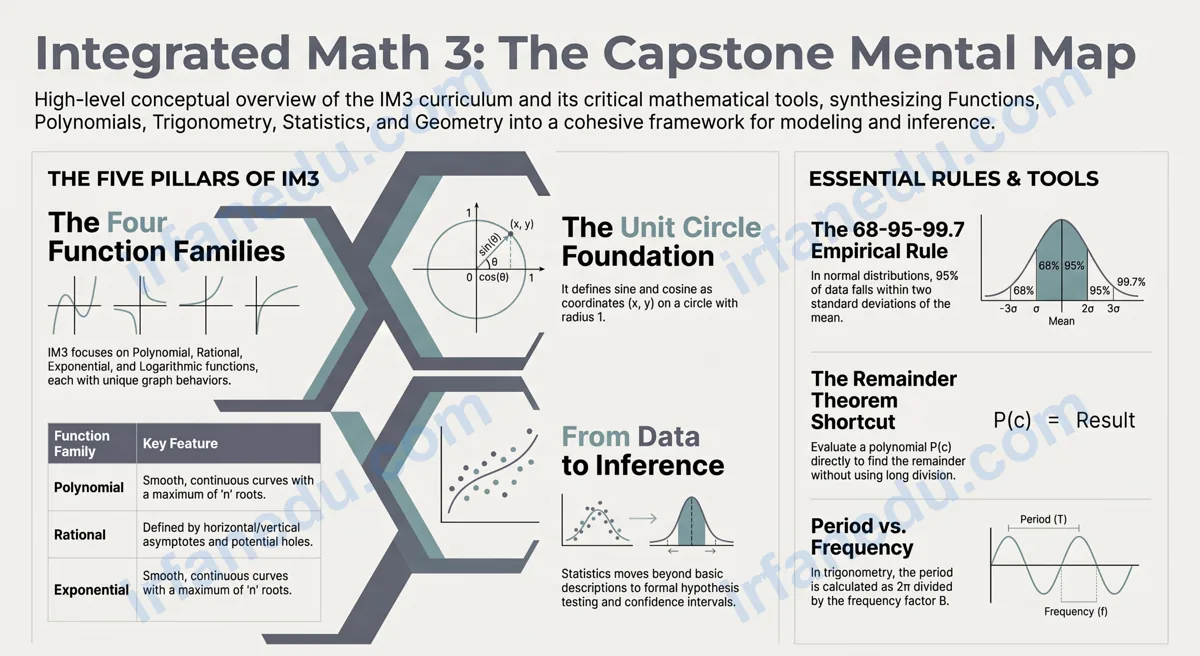
Integrated Math 3 is the third and final required course in the integrated high school math pathway. It pulls together polynomial functions, trigonometry, logarithms, statistics, and geometric modeling into a single, cohesive course — and it is the gateway to calculus, AP Statistics, and college-level math.
If you have just started IM3 and feel like the course is throwing five subjects at you simultaneously, you are not imagining it. That is exactly what it does. The good news: once you see how each strand connects to the others, the whole course clicks into place. I have tutored hundreds of students through IM3, and the ones who succeed fastest are the ones who build a clear mental map of the course before diving into individual topics.
This guide gives you that map — plus worked examples, a terminology primer, and corrections to the most common mistakes I see students make.
- Understand what IM3 covers and how it differs from Algebra 2
- Master the five core strands with worked examples
- Avoid the three most costly IM3 mistakes
- Know exactly what comes after IM3 and how to prepare
IM3 Terminology Primer: Know These Terms Before Anything Else
Every IM3 topic has its own vocabulary. Students who struggle with IM3 often struggle with the language, not the math. Read this primer once before you study any section — it will make every explanation below land faster.
Core IM3 Vocabulary
- Polynomial
- An expression with one or more terms, each a product of a constant and a non-negative integer power of a variable. Example: 3x³ – 2x + 7.
- Degree
- The highest exponent in a polynomial. Determines the maximum number of roots and the end behavior of the graph.
- Rational Function
- A function expressed as a ratio of two polynomials: f(x) = P(x)/Q(x). Undefined where Q(x) = 0.
- Asymptote
- A line the graph of a function approaches but never touches. Vertical asymptotes occur where the denominator equals zero; horizontal asymptotes describe end behavior.
- Logarithm
- The inverse of an exponential function. log_b(x) = y means b^y = x. The common log uses base 10; the natural log uses base e ≈ 2.718.
- Unit Circle
- A circle with radius 1 centered at the origin. Used to define sine, cosine, and tangent for all angles, not just acute ones.
- Amplitude
- Half the vertical distance between the maximum and minimum of a sinusoidal function. In y = A sin(x), the amplitude is |A|.
- Period
- The horizontal length of one complete cycle of a periodic function. For y = sin(Bx), the period is 2π/|B|.
- Normal Distribution
- A symmetric, bell-shaped probability distribution fully described by its mean (μ) and standard deviation (σ). About 68% of data falls within one σ of the mean.
- Confidence Interval
- A range of values, calculated from sample data, that likely contains the true population parameter. A 95% CI means: if you repeated the sampling many times, 95% of those intervals would capture the true value.
- Hypothesis Test
- A statistical procedure to decide whether sample data provides enough evidence to reject a default assumption (the null hypothesis).
- Conic Section
- A curve formed by the intersection of a plane and a cone: circles, ellipses, parabolas, and hyperbolas. Each has a standard equation form.
- Synthetic Division
- A shorthand method for dividing a polynomial by a linear factor (x – c). Faster than long division for this specific case.
- Remainder Theorem
- When a polynomial P(x) is divided by (x – c), the remainder equals P(c). This lets you evaluate polynomials and test roots quickly.
- End Behavior
- What happens to f(x) as x approaches positive or negative infinity. Determined by the leading term of a polynomial.
With that vocabulary in place, every section below will make immediate sense. This is the approach I use in every IM3 tutoring session — vocabulary first, procedures second.
Integrated Math 3 (IM3) is the third course in the integrated high school math sequence. It covers polynomial and rational functions, trigonometry, logarithms, statistics (normal distributions, inference), and advanced geometry. IM3 is roughly equivalent to Algebra 2 plus pre-calculus topics and prepares students for AP Calculus, AP Statistics, or college math.
TL;DR — Quick Summary
- IM3 = Algebra 2 topics + trigonometry + statistics + geometric modeling in one course.
- Five core strands: Functions, Polynomials, Trigonometry, Statistics, Geometry.
- The unit circle is the single most important concept to memorize in IM3.
- Synthetic division + Remainder Theorem together solve 80% of polynomial problems.
- Statistics in IM3 goes beyond data — it introduces formal inference (confidence intervals, hypothesis tests).
- After IM3: Pre-Calculus, AP Calculus, or AP Statistics are the natural next steps.
Quick Facts: Integrated Math 3 at a Glance
| Feature | Detail |
|---|---|
| Course Level | Grade 10-11 (typically 11th grade) |
| Traditional Equivalent | Algebra 2 + Pre-Calculus elements |
| Core Strands | Functions, Polynomials, Trigonometry, Statistics, Geometry |
| Key Prerequisite Skills | Linear equations, quadratics, basic probability, triangle geometry (from IM1 & IM2) |
| Courses After IM3 | Pre-Calculus, AP Calculus AB/BC, AP Statistics, College Math |
| Common Curriculum Alignment | Common Core State Standards (CCSS) — Functions, Number, Statistics strands |
| Hardest Topic (by student surveys) | Trigonometric identities and statistical inference |
| Most Underrated Topic | Logarithm laws — mastering these unlocks exponential modeling |
What Are the Function Types Covered in Integrated Math 3?
IM3 extends the function concept you built in IM1 and IM2 to four new families: polynomial, rational, exponential, and logarithmic. Each family has a distinct graph shape, domain/range, and set of transformations.
The Four Function Families
| Family | General Form | Key Feature | Example |
|---|---|---|---|
| Polynomial | a_n x^n + … + a_0 | Smooth, continuous; n roots max | f(x) = x³ – 4x |
| Rational | P(x)/Q(x) | Has asymptotes; undefined at zeros of Q | f(x) = (x+1)/(x-2) |
| Exponential | a · b^x | Rapid growth/decay; horizontal asymptote | f(x) = 2 · 3^x |
| Logarithmic | a · log_b(x) + c | Inverse of exponential; vertical asymptote at x=0 | f(x) = log₂(x) |
Worked Example: Transforming an Exponential Function
Write the equation of an exponential function that starts at y = 3 when x = 0 and doubles every 5 units.
Step 1: The initial value is a = 3 (the y-intercept).
Step 2: “Doubles every 5 units” means when x increases by 5, y multiplies by 2. So b^5 = 2, which gives b = 2^(1/5).
Step 3: The equation is f(x) = 3 · 2^(x/5).
Check: f(0) = 3 · 1 = 3. f(5) = 3 · 2 = 6. Correct.
In my experience teaching IM3, students spend too much time memorizing transformation rules and not enough time asking “what does this parameter actually do to the graph?” Every time you change a value in a function equation, graph it on a calculator or Desmos immediately. Seeing the shift happen in real time builds intuition that no amount of rule-memorization can replace. I tell every student: Desmos is your best study partner in IM3.
How Do You Work with Polynomials and Rational Functions in IM3?
Polynomial operations in IM3 go beyond expanding and factoring — you learn to divide polynomials, find all roots (real and complex), and analyze graphs using end behavior and multiplicity.
Synthetic Division: Step-by-Step
Synthetic division divides a polynomial P(x) by a linear factor (x – c) in five steps.
- Write the coefficients of P(x) in a row (include 0 for any missing degree).
- Write c (the zero of the divisor) to the left.
- Bring the leading coefficient straight down.
- Multiply that value by c; write the result under the next coefficient and add.
- Repeat across all coefficients. The final number is the remainder.
  Divisor zero: c = 3

  Coefficients:  1   -2   -5    6
                 |    3    3   -6
              -------------------------
                 1    1   -2    0   <- remainder = 0

  Quotient: x² + x - 2
  Factor further: (x + 2)(x - 1)

  All roots of x³ - 2x² - 5x + 6:
    x = 3,  x = -2,  x = 1
Remainder Theorem in Action
Find the remainder when P(x) = 2x³ - x² + 4x - 7 is divided by (x - 2).
By the Remainder Theorem: remainder = P(2) = 2(8) - 4 + 8 - 7 = 16 - 4 + 8 - 7 = 13.
No long division needed. P(2) gives the answer directly.
Rational Functions: Finding Asymptotes
For f(x) = P(x)/Q(x):
- Vertical asymptotes: set Q(x) = 0 and solve (provided P and Q share no common factor at that value).
- Horizontal asymptote: compare degrees. If degree of P < degree of Q, the HA is y = 0. If degrees are equal, the HA is the ratio of leading coefficients. If degree of P > degree of Q by exactly 1, there is a slant asymptote instead.
Pro Tip: Holes vs. Asymptotes
If a factor cancels from both numerator and denominator, the result is a hole (removable discontinuity), not a vertical asymptote. Students mix these up constantly. Cancel first, then find asymptotes from what remains.
How Is Trigonometry Taught in Integrated Math 3?
IM3 trigonometry starts with the unit circle and builds to graphing sine and cosine, applying trigonometric identities, and solving trigonometric equations. This is the strand students find most unfamiliar because it requires both memorization and conceptual flexibility.
The Unit Circle: The Foundation of Everything
The unit circle defines sin(θ) as the y-coordinate and cos(θ) as the x-coordinate of the point where the terminal ray of angle θ intersects the circle of radius 1.
  Angle (θ)  |  Degrees  |  cos(θ)      |  sin(θ)
  -----------|-----------|--------------|-------------
  0          |    0°     |  1           |  0
  π/6        |   30°     |  √3/2        |  1/2
  π/4        |   45°     |  √2/2        |  √2/2
  π/3        |   60°     |  1/2         |  √3/2
  π/2        |   90°     |  0           |  1

  Memory trick for sin: 0, 1/2, √2/2, √3/2, 1
  (the numerators go 0, 1, √2, √3, 2 — increasing order)
Graphing Sine and Cosine: The Four Parameters
The general form is y = A sin(B(x - C)) + D, where:
- A = amplitude (vertical stretch)
- B = frequency factor; period = 2π/|B|
- C = phase shift (horizontal translation)
- D = vertical shift (midline)
Worked Example: Identify Parameters
For y = 3 sin(2x - π) + 1, identify amplitude, period, phase shift, and midline.
Rewrite: y = 3 sin(2(x - π/2)) + 1
Amplitude = 3. Period = 2π/2 = π. Phase shift = π/2 to the right. Midline: y = 1.
The single biggest mistake I see in IM3 trigonometry is students treating the unit circle as a table to memorize rather than a structure to understand. Once you know that sin and cos are just coordinates on a circle, the signs in each quadrant become obvious — you stop memorizing and start reasoning. I spend the first trig lesson drawing the circle from scratch with students, deriving every value. It takes 20 minutes and saves hours of confusion later.
What Statistics Topics Appear in Integrated Math 3?
IM3 statistics moves beyond descriptive data into inferential statistics — using sample data to draw conclusions about populations. This is the strand most directly connected to real-world decision-making.
Normal Distributions
A normal distribution is symmetric and bell-shaped, defined by mean μ and standard deviation σ. The Empirical Rule (68-95-99.7 rule) states:
- 68% of data falls within 1σ of the mean.
- 95% falls within 2σ.
- 99.7% falls within 3σ.
Worked Example: Using the Empirical Rule
A standardized test has mean 500 and standard deviation 100. What percentage of scores fall between 300 and 700?
300 = 500 - 2(100) and 700 = 500 + 2(100). This is the range within 2σ of the mean. By the Empirical Rule, approximately 95% of scores fall in this range.
Confidence Intervals and Hypothesis Testing
A confidence interval estimates a population parameter from sample data. A hypothesis test asks: "Is the observed result likely if the null hypothesis were true?"
Common Misconception: What "95% Confident" Actually Means
A 95% confidence interval does NOT mean "there is a 95% probability the true value is in this interval." The true value either is or is not in the interval — it is not random. The 95% refers to the long-run procedure: 95% of intervals constructed this way will contain the true parameter. This distinction matters on exams and in real research.
What Geometry Is in Integrated Math 3?
IM3 geometry focuses on circles, conic sections, and geometric proof — extending the coordinate geometry from IM2 into more complex curves and formal reasoning.
Conic Sections at a Glance
| Conic | Standard Form | Key Feature |
|---|---|---|
| Circle | (x-h)² + (y-k)² = r² | Center (h,k), radius r |
| Parabola | y = a(x-h)² + k | Vertex (h,k), opens up/down |
| Ellipse | (x-h)²/a² + (y-k)²/b² = 1 | Two foci; a > b for horizontal major axis |
| Hyperbola | (x-h)²/a² - (y-k)²/b² = 1 | Two branches; asymptotes y-k = ±(b/a)(x-h) |
The key skill IM3 tests is completing the square to convert a general conic equation into standard form. This is a purely algebraic procedure applied in a geometric context — a perfect example of how IM3 integrates its strands.
What Are the Most Common Mistakes Students Make in IM3?
After reviewing hundreds of IM3 assessments, I see the same errors appear repeatedly. Here are the three most costly ones, with corrections.
| Mistake | What Students Do Wrong | Correct Approach |
|---|---|---|
| Log of a sum | Write log(a + b) = log(a) + log(b) | log(a + b) has no simplification. Only log(a · b) = log(a) + log(b). |
| Canceling across addition in rational functions | Simplify (x² + 4)/(x + 4) by canceling the 4s | You can only cancel common factors, not common terms. Factor first, then cancel. |
| Confusing period and frequency | Set the period equal to B in y = sin(Bx) | Period = 2π/|B|. B is the angular frequency, not the period. These are reciprocally related. |
The "What Most IM3 Guides Get Wrong" Correction
Most IM3 study guides treat the five strands as separate chapters with no connection. In reality, IM3 assessments constantly mix strands in single problems — for example, fitting a sinusoidal function to data (trigonometry + statistics), or analyzing the end behavior of a rational function whose numerator is a logarithm. Practice cross-strand problems from day one, not just at the end of each unit.
Why IM3 Students Who Master Logarithms Outperform Everyone Else
Here is something I have never seen written in any IM3 guide: logarithm laws are the hidden backbone of four separate IM3 strands, not just the "logarithms unit."
- Functions: Logarithms are the inverse of exponentials — understanding one deeply means understanding both.
- Statistics: Many real-world data distributions are log-normal, not normal. Recognizing this lets you apply the right model.
- Polynomials: The change-of-base formula (log_b(x) = ln(x)/ln(b)) appears when solving exponential equations with non-standard bases — a common polynomial-context exam question.
- Geometry/Modeling: Logarithmic scales (decibels, Richter scale, pH) appear in IM3 modeling tasks. Students who understand the math behind the scale solve these problems in seconds; others guess.
In my experience, students who spend an extra two hours specifically on logarithm laws — not just the change-of-base formula but the product, quotient, and power rules with multiple worked examples — see their overall IM3 test scores improve by a full letter grade. The investment is disproportionately high-return.
Quick Quiz: Test Your IM3 Knowledge
1. What is the period of y = sin(4x)?
2. When you divide P(x) by (x - 5) and get a remainder of 0, what does that tell you?
3. A data set has mean 80 and standard deviation 10. Using the Empirical Rule, approximately what percentage of values fall between 60 and 100?
Practice Problems with Solutions
Problem 1: Find all real roots of f(x) = x³ - 6x² + 11x - 6
Step 1: Test x = 1 using the Remainder Theorem: f(1) = 1 - 6 + 11 - 6 = 0. So (x - 1) is a factor.
Step 2: Synthetic division by (x - 1) gives x² - 5x + 6.
Step 3: Factor x² - 5x + 6 = (x - 2)(x - 3).
Roots: x = 1, x = 2, x = 3.
Problem 2: Solve 2^(3x) = 32
Step 1: Rewrite 32 as a power of 2: 32 = 2⁵.
Step 2: Set exponents equal: 3x = 5.
Step 3: x = 5/3.
Check: 2^(3 · 5/3) = 2⁵ = 32. Correct.
Problem 3: Find the vertical and horizontal asymptotes of f(x) = (2x² - 8) / (x² - x - 6)
Step 1: Factor numerator: 2(x² - 4) = 2(x+2)(x-2).
Step
Sources & References
Reviewed by Dr. Irfan Mansuri. External links open in a new tab and are provided for further reading and verification.