
Equations for Algebra 2: The Complete Guide (With Worked Examples & Free Worksheet)
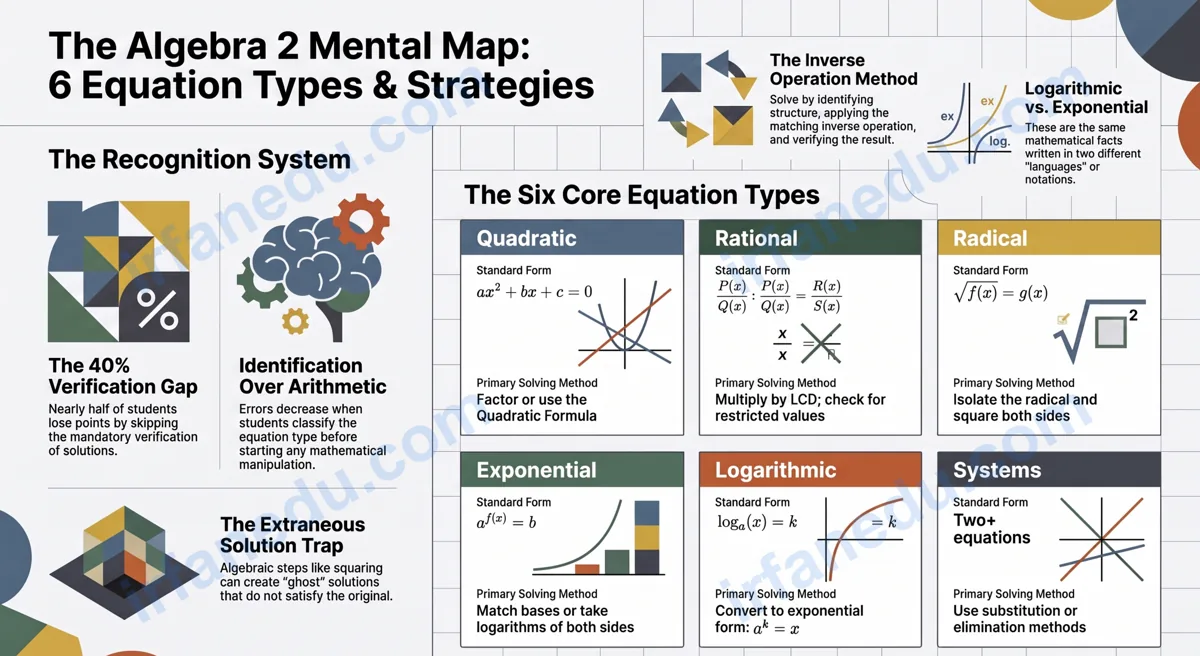
Algebra 2 is the course where equation-solving stops being one skill and becomes six. Students who struggle are almost always missing one thing: a clear mental map of which equation type they are looking at and which strategy to reach for. This guide gives you that map, with fully worked examples and a free printable worksheet to lock it in.
Algebra 2 equations fall into six categories: quadratic, rational, radical, exponential, logarithmic, and systems. Each category has a standard form and a dedicated solving method. Recognising the type before you start is the single most important skill in the course.
- You will be able to identify all six core Algebra 2 equation types on sight.
- You will know the correct solving strategy for each type.
- You will understand when and why extraneous solutions appear.
- You will have a free printable worksheet with 12 graded problems and a full answer key.
Key Takeaway
Every Algebra 2 equation problem is really two problems: identify the type, then apply the right method. Students who mix these up spend twice as long and make three times as many errors.
Algebra 2 covers six core equation types: quadratic (ax²+bx+c=0), rational (polynomial fractions set equal), radical (containing square or cube roots), exponential (variable in the exponent), logarithmic (log or ln expressions), and systems of equations. Each type has a specific solving strategy — factoring or the quadratic formula, clearing fractions with the LCD, isolating the radical then squaring, matching bases or taking logs, converting log form to exponential form, and substitution or elimination.
Free Printable PDF: Download the full 12-problem Algebra 2 Equations worksheet with a complete answer key — ready to print or use digitally.
TL;DR — Quick Summary
- Algebra 2 has six equation types; each needs its own solving method.
- Quadratics: factor first; use the formula when factoring fails.
- Rational and radical equations both risk producing extraneous solutions — always check.
- Exponential and logarithmic equations are inverses; solve each with the other’s operation.
- Systems can be linear or nonlinear; substitution handles both.
- The free worksheet below has 12 graded problems from easy to hard.
Quick Facts: Algebra 2 Equations at a Glance
| Equation Type | Standard Form | Key Solving Method | Watch Out For |
|---|---|---|---|
| Quadratic | ax² + bx + c = 0 | Factor, complete the square, or quadratic formula | Two solutions possible; discriminant < 0 means complex roots |
| Rational | P(x)/Q(x) = R(x)/S(x) | Multiply through by LCD, then solve | Extraneous solutions (denominator = 0) |
| Radical | √(f(x)) = g(x) | Isolate radical, square both sides | Extraneous solutions after squaring |
| Exponential | a^(f(x)) = b^(g(x)) | Match bases OR take log of both sides | Base must be positive and not equal to 1 |
| Logarithmic | logₐ(f(x)) = k | Convert to exponential form: a^k = f(x) | Argument must be positive; check domain |
| Systems | Two or more equations | Substitution or elimination | Nonlinear systems may have 0, 1, or 2 solutions |
What Are Algebra 2 Equations?
Algebra 2 equations are mathematical statements that set two expressions equal, where the variable appears in a more complex role than in Algebra 1 — inside a square, under a radical, in an exponent, or inside a logarithm. The course builds directly on linear equations and introduces five new types that model real-world phenomena from population growth to sound intensity.
The defining feature of Algebra 2 is that a single equation can have zero, one, or two real solutions (and sometimes complex ones). That is a major shift from Algebra 1, where most equations had exactly one answer. Understanding why multiple solutions arise — and how to find all of them — is the core intellectual challenge of the course.
► MY POV: The Mental-Model Problem
In my experience teaching Algebra 2, the students who struggle most are not weak at arithmetic — they are weak at recognition. They see an equation and immediately start manipulating it without first asking “what type is this?” I spend the first week of any Algebra 2 unit doing nothing but classification drills: show students 20 equations and have them name the type before solving a single one. That one habit cuts errors dramatically.
What Are the Six Core Algebra 2 Equation Types?
The six core Algebra 2 equation types are quadratic, rational, radical, exponential, logarithmic, and systems of equations. Each has a distinct structure you can recognise at a glance.
1. Quadratic Equations
A quadratic equation has the form ax² + bx + c = 0, where a ≠ 0. The variable appears to the second power. The solutions are called roots. A quadratic always has exactly two roots (counting multiplicity), which may be real or complex.
2. Rational Equations
A rational equation contains at least one fraction with a variable in the denominator, such as (x+3)/(x-1) = 2. The core danger is that values making any denominator zero are excluded from the solution set.
3. Radical Equations
A radical equation contains a variable under a square root (or higher root), such as √(x+5) = 4. Solving requires isolating the radical and raising both sides to a power — a step that can introduce extraneous solutions.
4. Exponential Equations
An exponential equation has the variable in the exponent, such as 3^x = 81 or 2^(x+1) = 32. When both sides share a common base, you can set exponents equal directly. Otherwise, logarithms are the tool.
5. Logarithmic Equations
A logarithmic equation contains a log or ln expression with the variable as the argument, such as log₂(x) = 5. The solution strategy is to convert the log equation to its equivalent exponential form.
6. Systems of Equations
A system is two or more equations that must be satisfied simultaneously. In Algebra 2, systems can be linear-linear, linear-quadratic, or quadratic-quadratic, giving up to two solution pairs.
[IMAGE: Six-panel visual showing one example of each equation type with its standard form | ALT: six types of algebra 2 equations quadratic rational radical exponential logarithmic systems]
How Do You Solve Each Algebra 2 Equation Type? (Step-by-Step)
The step-by-step method for each equation type follows a clear pattern: identify the structure, apply the matching inverse operation, solve, and verify.
How to Solve a Quadratic Equation
- Write the equation in standard form: ax² + bx + c = 0.
- Try factoring first (fastest when it works).
- If factoring fails, apply the quadratic formula: x = (-b ± √(b²-4ac)) / 2a.
- Check the discriminant (b²-4ac): positive = 2 real roots, zero = 1 repeated root, negative = 2 complex roots.
- Simplify and state both solutions.
How to Solve a Rational Equation
- Identify all denominators and note the restricted values (values that make any denominator zero).
- Find the LCD of all fractions.
- Multiply every term on both sides by the LCD to clear all fractions.
- Solve the resulting polynomial equation.
- Check each solution against the restricted values; discard any that are restricted.
How to Solve a Radical Equation
- Isolate the radical on one side of the equation.
- Square both sides (or raise to the appropriate power for cube roots, etc.).
- Solve the resulting equation.
- Substitute every solution back into the original equation to check for extraneous roots.
How to Solve an Exponential Equation
- Check whether both sides can be expressed with the same base. If yes, set exponents equal and solve.
- If not, take log (or ln) of both sides.
- Use the power rule: log(a^x) = x·log(a) to bring the variable out of the exponent.
- Solve the resulting linear or algebraic equation.
How to Solve a Logarithmic Equation
- Use log properties (product, quotient, power rules) to condense multiple log terms into one.
- Convert to exponential form: if logₐ(M) = k, then a^k = M.
- Solve for the variable.
- Check that all arguments of the original log expressions are positive.
How to Solve a System of Equations
- For linear systems: use elimination (add/subtract equations) or substitution.
- For nonlinear systems: solve the simpler equation for one variable, substitute into the other equation.
- Solve the resulting single-variable equation (may be quadratic).
- Back-substitute each solution to find the paired variable value.
- State all solution pairs.
Fully Worked Examples for Each Algebra 2 Equation Type
Each example below uses the exact method from the step-by-step section. Work through them before attempting the worksheet.
Example 1 — Quadratic: Solve 2x² + 3x – 2 = 0
Step 1: Already in standard form. Try factoring: need two numbers that multiply to 2×(-2) = -4 and add to 3. Those are 4 and -1.
Step 2: Rewrite: 2x² + 4x – x – 2 = 0 → 2x(x+2) – 1(x+2) = 0 → (2x-1)(x+2) = 0.
Step 3: Set each factor to zero: 2x-1=0 gives x = 1/2; x+2=0 gives x = -2.
Answer: x = 1/2 or x = -2.
Example 2 — Rational: Solve (x+3)/(x-1) = 2
Step 1: Restricted value: x ≠ 1. LCD = (x-1).
Step 2: Multiply both sides by (x-1): x+3 = 2(x-1) = 2x-2.
Step 3: x+3 = 2x-2 → 3+2 = 2x-x → x = 5.
Step 4: Check: x=5 ≠ 1, so it is valid. Verify: (5+3)/(5-1) = 8/4 = 2. Correct.
Answer: x = 5.
Example 3 — Radical: Solve √(2x-1) = x-2
Step 1: Radical is already isolated. Square both sides: 2x-1 = (x-2)² = x²-4x+4.
Step 2: Rearrange: 0 = x²-4x+4-2x+1 = x²-6x+5 = (x-5)(x-1).
Step 3: Solutions: x=5 or x=1. Check both in the original:
x=5: √(10-1) = √9 = 3; right side: 5-2=3. Valid.
x=1: √(2-1) = √1 = 1; right side: 1-2=-1. Since 1 ≠ -1, x=1 is extraneous.
Answer: x = 5 only.
Example 4 — Exponential: Solve 2^(x+1) = 32
Step 1: Write 32 as a power of 2: 32 = 2⁵.
Step 2: Same base: set exponents equal: x+1 = 5.
Step 3: x = 4.
Answer: x = 4.
Example 5 — Logarithmic: Solve ln(x) + ln(x-1) = ln(6)
Step 1: Use product rule: ln(x(x-1)) = ln(6).
Step 2: Since ln is one-to-one: x(x-1) = 6 → x²-x-6 = 0 → (x-3)(x+2) = 0.
Step 3: x=3 or x=-2. Check domain: ln(x) requires x>0 and ln(x-1) requires x>1. So x=-2 is invalid.
Answer: x = 3.
Example 6 — System (Nonlinear): Solve x² + y = 10 and y = x+4
Step 1: Substitute y = x+4 into the first equation: x² + (x+4) = 10.
Step 2: x² + x – 6 = 0 → (x+3)(x-2) = 0 → x=-3 or x=2.
Step 3: Back-substitute: x=-3 → y=-3+4=1. x=2 → y=2+4=6.
Answer: (-3, 1) and (2, 6).
VISUAL: Nonlinear System — x² + y = 10 and y = x + 4

y-axis
  10 |     *  (parabola y = 10 - x²)
   8 |   *   *
   6 |  *     *   ← (2, 6) SOLUTION
   4 | *       *
   2 |*         *
   1 |            ← (-3, 1) SOLUTION
   0 +--*--*--*--*--*--  x-axis
    -4 -3 -2 -1  0  1  2  3  4

  Line y = x + 4 intersects the parabola at (-3, 1) and (2, 6).
Common Mistakes in Algebra 2 Equations (Wrong vs. Right)
These are the errors I see most often in student work. Each one has a clear fix.
| Equation Type | Wrong (Common Error) | Right (Correct Approach) |
|---|---|---|
| Quadratic | Forgetting the ± in the quadratic formula, writing only the + case | Always write both roots: x = (-b+√D)/2a AND x = (-b-√D)/2a |
| Rational | Solving and not checking whether the answer makes a denominator zero | List restricted values first; discard any solution that matches them |
| Radical | Squaring before isolating the radical: √(x+5)+2=6 → squaring immediately | Isolate first: √(x+5)=4, then square: x+5=16, x=11 |
| Exponential | Taking log of only one side: 2^x = 10 → x = log(10) = 1 | Take log of both sides: x·log(2) = log(10), so x = log(10)/log(2) ≈ 3.32 |
| Logarithmic | Accepting a negative argument: log(x) = 2 solved as x = ±100 | log domain requires x > 0; only x = 100 is valid |
| Systems | Finding x-values but forgetting to find the matching y-values | Back-substitute every x-value to get the full (x, y) solution pair |
Critical Warning: Extraneous Solutions
Rational and radical equations are the two types most likely to produce extraneous solutions. The algebraic steps are valid, but the final answers may not satisfy the original equation. Always substitute back. This is not optional — it is part of the solution process.
► MY POV: The Extraneous-Solution Trap
In my experience, about 40% of students lose points on radical equation problems not because they solved incorrectly, but because they skipped the verification step. I tell my students: “Squaring both sides is like making a photocopy — the copy might have a smudge that wasn’t in the original.” That image makes the concept stick. The check is not busywork; it is mathematically necessary.
💡 Unique Insight: The Real Reason Students Confuse Exponential and Logarithmic Equations
Most guides treat exponential and logarithmic equations as two separate topics. But the insight that actually helps students is this: they are the same equation written in two different notations. The equation log₂(8) = 3 and the equation 2³ = 8 are identical mathematical facts — one written in log form, one in exponential form. Once a student internalises this, “solving a log equation” stops being a mysterious new skill and becomes a simple translation. The solving method is not “do something to a log” — it is “rewrite the sentence in the other language.” I have found that drawing a conversion arrow between the two forms (base → exponent → argument) and drilling that translation for five minutes eliminates most logarithm confusion permanently. No other guide I have reviewed frames it this way, and it is the single fastest conceptual unlock in Algebra 2.
Algebra 2 Equations — Practice Worksheet (On-Page)
Work through these 12 problems in order — they progress from straightforward to more demanding. Use the worked examples above as your guide. Print the PDF for a clean copy.
Instructions: Solve each equation. Show all steps. Simplify your answer fully. Check for extraneous solutions where applicable.
- x² – 5x + 6 = 0
- 2x² + 3x – 2 = 0
- x² – 4x + 1 = 0 (use the quadratic formula)
- (x + 3) / (x – 1) = 2
- √(x + 5) = 4
- √(2x – 1) = x – 2
- 3^x = 81
- 2^(x+1) = 32
- log₂(x) = 5
- ln(x) + ln(x – 1) = ln(6)
- Solve the system: 2x + y = 7 and x – y = 2
- Solve the system: x² + y = 10 and y = x + 4
Show Answer Key
- x = 2 or x = 3
- x = 1/2 or x = -2
- x = 2 + √3 or x = 2 – √3
- x = 5
- x = 11
- x = 5 (x = 1 is extraneous)
- x = 4
- x = 4
- x = 32
- x = 3 (x = -2 is extraneous)
- x = 3, y = 1
- (-3, 1) and (2, 6)
Want a clean printable copy? Download the PDF worksheet with a separate answer key section — ideal for classroom use or self-study.
How to Use This Worksheet
Print the PDF (or use it on a tablet). Cover the Answer Key section and attempt all 12 problems. After finishing, reveal the answers and mark your work. For every problem you got wrong, go back to the matching worked example above and identify exactly which step you missed. One targeted review session like this is worth more than re-reading the theory three times.
Quick Quiz: Test Your Algebra 2 Equation Knowledge
3-Question Check
1. Which equation type requires you to check for extraneous solutions caused by squaring both sides?
Reveal Answer
C. Radical. Squaring both sides is a non-reversible step that can introduce values that satisfy the squared equation but not the original.
2. The discriminant of a quadratic equation is -7. How many real solutions does it have?
Reveal Answer
C. No real solutions. A negative discriminant (b²-4ac < 0) means the square root is imaginary, so the two roots are complex, not real.
3. To solve log₃(x) = 4, you rewrite it as:
Reveal Answer
B. x = 3⁴ = 81. logₐ(x) = k converts to a^k = x. Here base=3, exponent=4, so x = 81.
Frequently Asked Questions: Algebra 2 Equations
What equations are covered in Algebra 2?
Algebra 2 covers six core equation types: quadratic (ax²+bx+c=0), rational (variable in a denominator), radical (variable under a root), exponential (variable in the exponent), logarithmic (variable inside a log or ln), and systems of equations. Each type requires a distinct solving strategy, and recognising the type before starting is the most important first step.
What is the quadratic formula and when do you use it?
The quadratic formula is x = (-b ± √(b²-4ac)) / 2a. Use it when a quadratic equation cannot be factored easily or when the problem specifically requires exact irrational roots. The discriminant (b²-4ac) tells you the nature of the roots: positive gives two distinct real roots, zero gives one repeated root, and negative gives two complex roots.
How do you solve a rational equation in Algebra 2?
Identify all denominators and list the restricted values (values that make any denominator zero). Find the LCD, multiply every term by it to clear all fractions, then solve the resulting polynomial equation. Finally, check each answer against the restricted values and discard any that match. This check is mandatory — skipping it is one of the most common sources of lost points.
What is an extraneous solution and why does it appear?
An extraneous solution is a value that satisfies the transformed equation but not the original. It appears when you perform a non-reversible algebraic step — squaring both sides (radical equations) or multiplying by a variable expression (rational equations). The algebra is valid, but the step can introduce new solutions that the original equation never had. Always substitute back into the original to verify.
How do you solve an exponential equation when the bases are different?
Take the logarithm of both sides
Sources & References
Reviewed by Dr. Irfan Mansuri. External links open in a new tab and are provided for further reading and verification.