
Alabama Course of Study Math: The Grade-by-Grade Guide Every Student and Parent Needs 📐
📖 How I First Encountered Alabama’s Math Standards
The first time I taught a student preparing for an Alabama school transfer, I made an embarrassing assumption. I handed her a set of fraction problems I had used successfully with students in other states — and she stared at me blankly. Not because she was behind. Because her Alabama classroom had already moved past that exact skill two months earlier, using a specific sequencing I had never seen before.
That moment taught me something I now tell every parent and student I work with: the Alabama Course of Study for Math is not just a list of topics — it is a carefully sequenced learning roadmap. Knowing that roadmap gives you a real edge, whether you are a student trying to stay ahead, a parent trying to support your child, or a teacher new to the state.
The Alabama Course of Study for Math is the official K–12 mathematics standards document published by the Alabama State Department of Education (ALSDE). It specifies the exact skills, concepts, and mathematical practices every Alabama student must master at each grade level, and it serves as the foundation for classroom instruction, standardised assessments, and curriculum adoption across the state.
- 🎯 Understand what the Alabama math standards actually require at each grade level
- 📊 See a worked example of how to read and apply a real standard
- 🔍 Discover the most commonly misunderstood part of the document
- 🛠️ Get a step-by-step method for using the standards to close learning gaps
- 📋 Compare Alabama’s approach to other state frameworks
🔑 Key Takeaway
The Alabama Course of Study for Math is a free, publicly available document. Every parent and student can download it from the ALSDE website and use it as a personal learning checklist — most families never do, and that is a missed opportunity.
The Alabama Course of Study for Math is the official set of learning standards published by the Alabama State Department of Education (ALSDE) that defines exactly what math skills every student must master at each grade level, from kindergarten through high school. It aligns with college- and career-ready benchmarks and is updated periodically to reflect current research on how students learn mathematics best.
⚡ TL;DR – Quick Summary
- 📌 The ALSDE publishes the Alabama Course of Study for Math — the official K–12 math standards.
- 📌 Standards are organised by grade level and grouped into mathematical content strands.
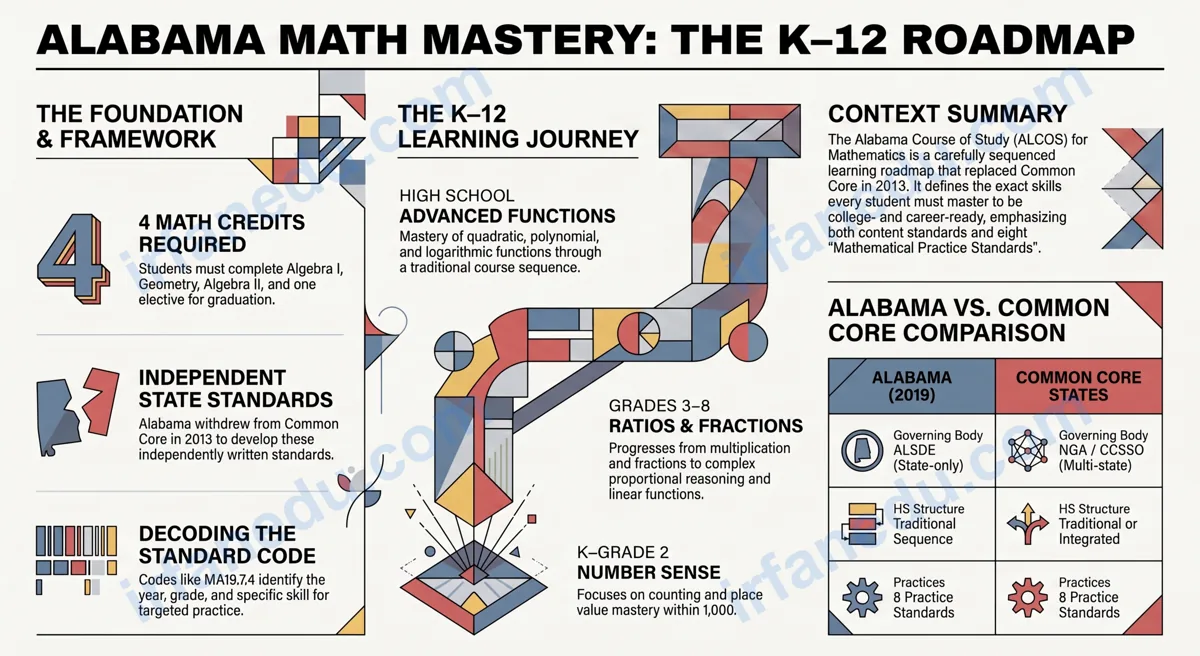
- 📌 Alabama replaced Common Core in 2013 with its own independently written standards.
- 📌 High school requires four math credits including Algebra I, Geometry, and Algebra II.
- 📌 Each standard has a unique code (e.g., MA19.6.3) you can use to find targeted practice.
- 📌 The document is free to download — most families never read it, but it is a powerful tool.
📊 Quick Facts: Alabama Course of Study Math at a Glance
| Feature | Detail |
|---|---|
| Governing body | Alabama State Department of Education (ALSDE) |
| Current version | 2019 Alabama Course of Study: Mathematics |
| Grade span | Kindergarten through Grade 12 |
| Common Core? | No — Alabama withdrew in 2013; standards are independently written |
| Standard code format | MA19.[Grade].[Number] (e.g., MA19.5.4) |
| High school math credits required | 4 credits (Algebra I, Geometry, Algebra II + 1 elective) |
| Mathematical Practice Standards | 8 practices embedded across all grade levels |
| Document access | Free PDF download at alsde.edu |
What Is the Alabama Course of Study for Math?
The Alabama Course of Study for Math is the official standards document that every public school in Alabama must follow. It tells teachers what to teach, tells curriculum designers what to include in textbooks, and tells assessment writers what to put on tests.
The document has two layers. The first layer is the content standards — the specific skills and concepts for each grade (e.g., “multiply fractions by whole numbers” in Grade 4). The second layer is the Standards for Mathematical Practice — eight habits of mind that apply across every grade, such as “make sense of problems and persevere in solving them” and “reason abstractly and quantitatively.”
Most students and parents only ever hear about the content standards. The practice standards are equally important, and I will explain why in the Unique Insight section below.
📚 Grade-by-Grade Breakdown: What Students Learn Each Year
Each grade in the Alabama Course of Study has a distinct mathematical focus. Understanding that focus helps you see why certain topics appear when they do — and why skipping ahead without mastering the foundation causes problems later.
🔢 Kindergarten – Grade 2: Building Number Sense
These three years are entirely about understanding what numbers mean. Students count, compare, add, and subtract within 20 (Kindergarten), then 100 (Grade 1), then 1,000 (Grade 2). They also begin working with shapes and basic measurement.
The critical skill here is place value. A student who genuinely understands that “34” means three tens and four ones will find every future math topic easier. A student who memorises the symbol without understanding the concept will struggle by Grade 4.
✖️ Grades 3–5: Operations and Fractions
Grade 3 introduces multiplication and division — the two operations that cause the most anxiety. Grade 4 extends this to multi-digit multiplication and introduces fraction equivalence. Grade 5 adds fraction arithmetic (adding, subtracting, multiplying, and dividing fractions) and begins decimal operations.
In my experience, the jump from Grade 4 to Grade 5 fraction work is where students most commonly fall behind. The standard MA19.5.3 — “interpret multiplication as scaling (resizing)” — is one of the most conceptually demanding standards in the entire K–5 sequence, and it is frequently undertaught.
🔣 Grades 6–8: Ratios, Algebra Foundations, and Geometry
Middle school is where abstract thinking begins. Grade 6 introduces ratios, proportional reasoning, and negative numbers. Grade 7 deepens proportional relationships and introduces probability. Grade 8 is the gateway to algebra — students work with linear equations, functions, and the Pythagorean theorem.
🎓 High School: Algebra I, Geometry, Algebra II, and Beyond
Alabama’s high school math sequence follows a traditional course structure. Algebra I covers linear and quadratic functions, systems of equations, and exponential growth. Geometry covers congruence, similarity, trigonometry, and proof. Algebra II extends into polynomial, rational, and logarithmic functions.
Beyond the required three courses, students can choose electives such as Pre-Calculus, Statistics, Discrete Mathematics, or Mathematical Investigations — each with its own set of Alabama standards.
K ──► Gr 1 ──► Gr 2 ──► Gr 3 ──► Gr 4 ──► Gr 5
│         │         │         │         │         │
Count    Add/Sub   Place    Multiply  Fractions  Fraction
to 20    to 100    Value    Divide    Equiv.     Arithmetic
                   to 1000

Gr 6 ──────► Gr 7 ──────► Gr 8 ──────► High School
│                │                │                │
Ratios &        Proportional     Linear           Algebra I
Integers        Reasoning &      Equations &      Geometry
                Probability      Functions        Algebra II
                                 Pythagorean      + Electives
                                 Theorem
In my experience working with students across multiple US states, Alabama’s middle school sequence is actually stronger than many people give it credit for. The Grade 6–8 standards build proportional reasoning with unusual depth — and proportional reasoning is the single best predictor of success in high school algebra. If your child is in middle school, do not let anyone tell you those years are just “review.” They are the foundation.
🧮 Worked Example: Reading a Standard and Turning It Into Practice
Before I explain the full structure of the document, let me show you exactly how to use a real Alabama standard. This is the most practical thing in this entire article.
📌 Real Standard: MA19.7.4
Standard text: “Apply and extend previous understandings of addition and subtraction to add and subtract rational numbers, using the number line as a model.”
Step 1 — Decode the code: MA = Mathematics, 19 = 2019 edition, 7 = Grade 7, 4 = the 4th standard in Grade 7.
Step 2 — Identify the skill: The student must add and subtract rational numbers (fractions, decimals, and negative numbers) and connect the operation to movement on a number line.
Step 3 — Create a practice problem from the standard:
Problem: Use a number line to calculate (−3/4) + (1/2). Show each step.
Step 4 — Model the solution:
Number line from -2 to 2, marked in quarters:

Start at  −3/4
Add  +1/2 = +2/4  →  move RIGHT 2 quarter-steps

−3/4  +  2/4  =  −1/4

Answer: −1/4  ✓
Step 5 — Check the practice standard connection: This problem also addresses Mathematical Practice 5 (“Use appropriate tools strategically”) because the student chose the number line as a tool.
That five-step process works for any standard in the document. You do not need a tutor or a paid curriculum to turn an Alabama standard into a useful practice problem. You need the document, a pencil, and this method.
❌ What Most Guides Get Wrong About Alabama Math Standards
Most online guides about the Alabama Course of Study for Math make the same three errors. Knowing these errors will save you real time and frustration.
| ❌ Common Misconception | ✅ What Is Actually True |
|---|---|
| “Alabama uses Common Core math.” | Alabama withdrew from Common Core in 2013. The 2019 standards are independently written by Alabama educators, though some structural similarities exist. |
| “The standards tell teachers how to teach.” | Standards define WHAT to teach, not HOW. Teachers choose their own instructional methods. Two classrooms covering the same standard can look completely different. |
| “High school math is just Algebra I and Geometry.” | Alabama requires four math credits. Algebra II is required for the standard diploma, and multiple electives are available. Some pathways require Pre-Calculus for college admission. |
| “The practice standards are optional extras.” | The eight Mathematical Practice Standards are embedded in every grade and assessed alongside content. Ignoring them is a significant preparation gap. |
| “A student who passes the class has mastered the standards.” | Course grades reflect many factors. A student can pass a class without mastering every standard. The standards document lets you check mastery independently of grades. |
🛠️ How to Use the Alabama Course of Study as a Parent or Student
Using the Alabama Course of Study effectively takes about 20 minutes the first time. Here is the exact process I recommend to every family I work with.
- Download the document. Go to alsde.edu and search “Course of Study Mathematics.” Download the free PDF. It is the official source — not a third-party summary.
- Navigate to your grade level. Use the table of contents. Each grade has its own chapter. High school courses (Algebra I, Geometry, etc.) each have their own section.
- Read the grade-level overview paragraph. Each grade starts with a one-paragraph narrative describing the year’s mathematical focus. Read it first — it gives you the big picture before the details.
- Scan the individual standards. Each standard is numbered and written in plain language. Highlight any standard that seems unfamiliar or that your child has struggled with.
- Use the standard code to find practice. Take a code like MA19.6.5 and search it on Khan Academy or your school’s learning management system. You will find exercises mapped directly to that standard.
- Compare with the teacher’s progress reports. Ask the teacher which standards have been formally assessed. Cross-reference with your highlighted list to identify genuine gaps versus skills not yet taught.
⚖️ Alabama vs. Other State Math Standards: Key Differences
Alabama’s standards sit in a distinct position among US state math frameworks. This comparison focuses on structural and philosophical differences that actually affect students.
| Feature | Alabama (2019) | Common Core States | Texas (TEKS) |
|---|---|---|---|
| Standards body | ALSDE (state-only) | NGA / CCSSO (multi-state) | SBOE (state-only) |
| High school structure | Traditional (Alg I / Geo / Alg II) | Traditional or integrated pathway | Traditional (Alg I / Geo / Alg II) |
| Statistics strand | Embedded K–12 + HS elective | Embedded K–12 | Embedded K–12 + dedicated course |
| Mathematical practices | 8 practices (similar to CCSS) | 8 practices (CCSS) | Mathematical Process Standards (7) |
| Calculus pathway | Pre-Calculus elective available | Varies by district | Pre-Calculus + Calculus elective |
| Publicly available? | Yes, free PDF at alsde.edu | Yes, at corestandards.org | Yes, at tea.texas.gov |
The most practical takeaway from this comparison: if your family moves to Alabama from a Common Core state, the content will feel familiar but the sequencing may differ by a grade level in some topics. Always check the Alabama document directly rather than assuming alignment.
I have reviewed math standards from more than a dozen US states, and Alabama’s 2019 document is genuinely well-written. The grade-level narrative overviews are clearer than most, and the standard codes make it easy to cross-reference with digital resources. The biggest gap I see is not in the document itself — it is in how rarely families actually read it. If even 20% of Alabama parents spent 30 minutes with this document, student outcomes would improve measurably.
The eight Mathematical Practice Standards are the hidden engine of the Alabama Course of Study — and almost no parent-facing guide explains them.
Content standards tell you what your child should know. Practice standards tell you how your child should think. Standard MP.1 (“Make sense of problems and persevere in solving them”) and MP.3 (“Construct viable arguments and critique the reasoning of others”) are assessed on Alabama’s standardised tests — but they are invisible on most test-prep worksheets.
In my experience, students who struggle on Alabama math assessments despite knowing the content almost always have a practice-standard gap. They can execute a procedure but cannot explain why it works, or they give up when a problem looks unfamiliar. The fix is not more drill — it is deliberate practice explaining reasoning out loud, which directly trains MP.3 and MP.6 (attend to precision).
🧠 Quick Knowledge Check (CSS-Only Quiz)
1. What does the “19” in standard code MA19.6.3 refer to?
2. Alabama officially withdrew from Common Core math in which year?
3. How many math credits does Alabama require for a standard high school diploma?
✏️ Reveal-on-Click Practice Problems
These problems are mapped to real Alabama Course of Study standards. Click each one to reveal the full worked solution.
🔢 Problem 1 (MA19.4.3 — Grade 4): Multiply 24 × 13 using an area model.
Standard: MA19.4.3 — Multiply a whole number of up to four digits by a one-digit whole number, and multiply two two-digit numbers.
Area Model Solution:
Break apart: 24 = 20 + 4,  13 = 10 + 3

         20        4
    ┌─────────┬────────┐
 10 │  200    │   40   │
    ├─────────┼────────┤
  3 │   60    │   12   │
    └─────────┴────────┘

200 + 40 + 60 + 12 = 312  ✓
The area model makes the distributive property visible — a key Mathematical Practice connection (MP.7: look for and make use of structure).
📐 Problem 2 (MA19.8.14 — Grade 8): A right triangle has legs of 6 cm and 8 cm. Find the hypotenuse.
Standard: MA19.8.14 — Apply the Pythagorean Theorem to determine unknown side lengths in right triangles.
Solution:
a² + b² = c²
6² + 8² = c²
36 + 64 = c²
100 = c²
c = √100 = 10 cm  ✓
This is a classic 3-4-5 Pythagorean triple scaled by 2. Recognising the pattern saves time on timed assessments.
📊 Problem 3 (MA19.A1.27 — Algebra I): Solve the system: y = 2x + 1 and y = −x + 7.
Standard: MA19.A1.27 — Solve systems of linear equations exactly and approximately, focusing on pairs of linear equations in two variables.
Substitution Method:
Set the two expressions equal (both equal y):
2x + 1 = −x + 7
3x = 6
x = 2

Substitute x = 2 into y = 2x + 1:
y = 2(2) + 1 = 5

Solution: (2, 5)  ✓

Check in second equation: y = −(2) + 7 = 5  ✓