
Fraction to Decimal Chart: Complete Reference Guide
- What Is a Fraction to Decimal Chart?
- Why This Conversion Matters
- The Complete Fraction to Decimal Chart
- How to Read and Use the Chart
- How to Convert Any Fraction to a Decimal Yourself
- Terminating vs Repeating Decimals Explained
- Common Mistakes Students Make
- Real-World Uses of Fraction-to-Decimal Conversion
- Quick Quiz
- Practice Problems
- Frequently Asked Questions
- Sources & References
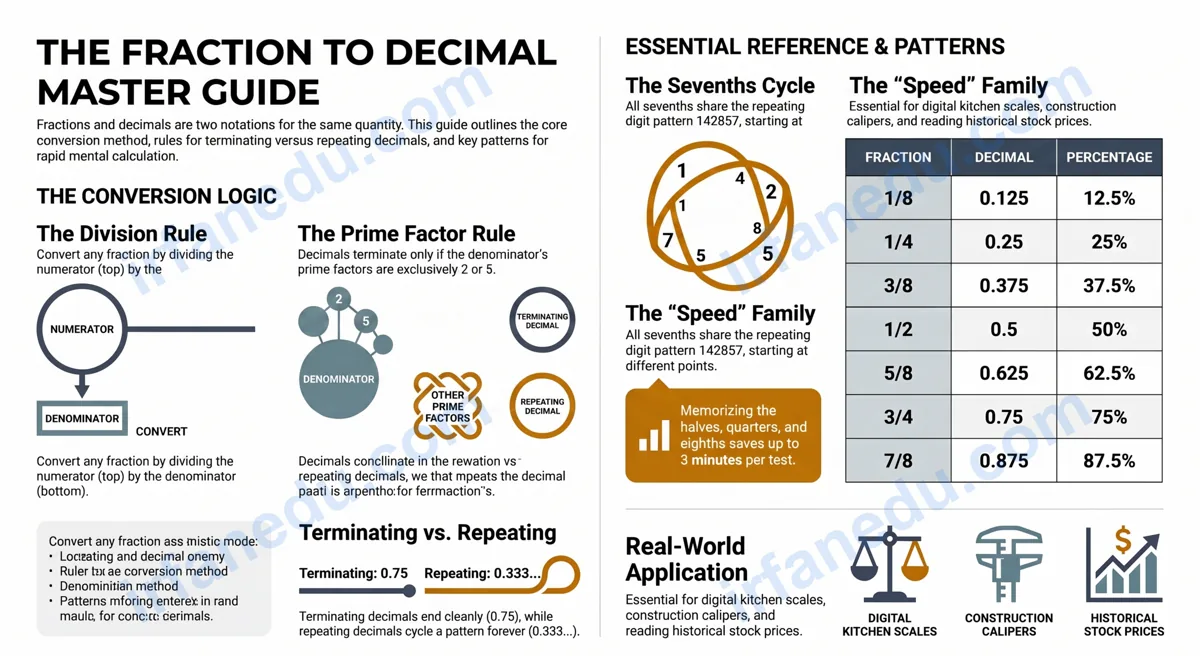
A fraction to decimal chart is a reference table that pairs each common fraction with its exact decimal equivalent. The fraction sits in the left column; its decimal value sits in the right. You read across the row to convert instantly, without any calculation.
Every student hits a moment mid-problem when they need to know what 5/8 is as a decimal — right now, without a calculator. That is exactly what this chart solves. I built this reference page to be the one resource you bookmark and return to, whether you are doing homework, preparing for a standardised test, or helping your child at the kitchen table.
A fraction to decimal chart converts common fractions — such as 1/2, 3/4, and 5/8 — into their decimal equivalents by dividing the numerator by the denominator. The chart covers halves, thirds, quarters, fifths, sixths, sevenths, eighths, ninths, tenths, twelfths, and sixteenths. Terminating decimals end cleanly (0.75); repeating decimals cycle forever (0.333…).
- Read the complete conversion chart for fractions from halves to sixteenths.
- Understand the difference between terminating and repeating decimals.
- Learn the four-step method to convert any fraction yourself.
- Avoid the three most common conversion errors.
- Test your knowledge with an interactive quiz.
A fraction to decimal chart lists common fractions — such as 1/2, 1/4, and 3/8 — alongside their exact decimal equivalents. To use it, find your fraction in the left column and read the decimal in the right column. For any fraction not on the chart, divide the numerator by the denominator: 3 ÷ 4 = 0.75. Terminating decimals end; repeating decimals cycle a digit pattern forever.
- Divide numerator by denominator to get the decimal equivalent of any fraction.
- Fractions with denominators of only 2s and 5s always produce terminating decimals.
- 1/3 = 0.333…, 2/3 = 0.666… — these repeat and never end.
- The chart below covers halves through sixteenths — the full range for school maths.
- Memorise the 10 most common fractions; use the chart for everything else.
- Converting back: write the decimal over a power of 10, then simplify the fraction.
Why This Conversion Matters
Fractions and decimals describe the same quantity in two different notations. Knowing how to move between them fluently is a foundational skill that appears in every area of school mathematics — from basic arithmetic to algebra, geometry, and statistics.
In standardised tests, calculators are often restricted or unavailable for certain sections. A student who has memorised the key fraction-decimal equivalents can solve comparison problems, percentage questions, and ratio tasks in seconds. A student who has not must work through long division under time pressure.
| Fact | Detail |
|---|---|
| What it is | A reference table pairing fractions with their decimal equivalents |
| Core operation | Numerator ÷ Denominator |
| Two decimal types | Terminating (ends) and Repeating (cycles forever) |
| Terminates when | Denominator’s only prime factors are 2 and/or 5 |
| Repeats when | Denominator has any prime factor other than 2 or 5 |
| Most common fractions | Halves, thirds, quarters, fifths, eighths, sixteenths |
| Used in | Arithmetic, algebra, measurement, science, finance |
In my experience teaching middle and high school students, the single biggest time-waster on maths tests is not knowing 1/8 = 0.125 from memory. Students who memorise just the eight fractions — the halves, quarters, and eighths family — shave two to three minutes off a typical 45-minute test. That is not a small gain. I always tell students: the chart is your training wheels; the goal is to not need it.
The Complete Fraction to Decimal Chart
The table below covers every common fraction you will encounter through high school. Teal tags mark terminating decimals; amber tags mark repeating decimals. Repeating digits are shown with parentheses, e.g. 0.(3) means 0.333…
| Fraction | Decimal | Percentage | Type |
|---|---|---|---|
| HALVES | |||
| 1/2 | 0.5 | 50% | Terminating |
| THIRDS | |||
| 1/3 | 0.(3) | 33.33% | Repeating |
| 2/3 | 0.(6) | 66.67% | Repeating |
| QUARTERS | |||
| 1/4 | 0.25 | 25% | Terminating |
| 3/4 | 0.75 | 75% | Terminating |
| FIFTHS | |||
| 1/5 | 0.2 | 20% | Terminating |
| 2/5 | 0.4 | 40% | Terminating |
| 3/5 | 0.6 | 60% | Terminating |
| 4/5 | 0.8 | 80% | Terminating |
| SIXTHS | |||
| 1/6 | 0.1(6) | 16.67% | Repeating |
| 5/6 | 0.8(3) | 83.33% | Repeating |
| SEVENTHS | |||
| 1/7 | 0.(142857) | 14.29% | Repeating |
| 2/7 | 0.(285714) | 28.57% | Repeating |
| 3/7 | 0.(428571) | 42.86% | Repeating |
| 4/7 | 0.(571428) | 57.14% | Repeating |
| 5/7 | 0.(714285) | 71.43% | Repeating |
| 6/7 | 0.(857142) | 85.71% | Repeating |
| EIGHTHS | |||
| 1/8 | 0.125 | 12.5% | Terminating |
| 3/8 | 0.375 | 37.5% | Terminating |
| 5/8 | 0.625 | 62.5% | Terminating |
| 7/8 | 0.875 | 87.5% | Terminating |
| NINTHS | |||
| 1/9 | 0.(1) | 11.11% | Repeating |
| 2/9 | 0.(2) | 22.22% | Repeating |
| 4/9 | 0.(4) | 44.44% | Repeating |
| 5/9 | 0.(5) | 55.56% | Repeating |
| 7/9 | 0.(7) | 77.78% | Repeating |
| 8/9 | 0.(8) | 88.89% | Repeating |
| TENTHS | |||
| 1/10 | 0.1 | 10% | Terminating |
| 3/10 | 0.3 | 30% | Terminating |
| 7/10 | 0.7 | 70% | Terminating |
| 9/10 | 0.9 | 90% | Terminating |
| TWELFTHS | |||
| 1/12 | 0.08(3) | 8.33% | Repeating |
| 5/12 | 0.41(6) | 41.67% | Repeating |
| 7/12 | 0.58(3) | 58.33% | Repeating |
| 11/12 | 0.91(6) | 91.67% | Repeating |
| SIXTEENTHS | |||
| 1/16 | 0.0625 | 6.25% | Terminating |
| 3/16 | 0.1875 | 18.75% | Terminating |
| 5/16 | 0.3125 | 31.25% | Terminating |
| 7/16 | 0.4375 | 43.75% | Terminating |
| 9/16 | 0.5625 | 56.25% | Terminating |
| 11/16 | 0.6875 | 68.75% | Terminating |
| 13/16 | 0.8125 | 81.25% | Terminating |
| 15/16 | 0.9375 | 93.75% | Terminating |
Note: (d) notation means the digit d repeats indefinitely. Example: 0.(3) = 0.3333… Fractions already in lowest terms are shown; equivalent fractions (e.g. 2/4 = 1/2) share the same decimal.
How to Read and Use the Chart
Reading the chart takes three seconds once you know the layout. Each row is one fraction family. The left column shows the fraction, the middle columns show the decimal and percentage, and the right column tells you whether the decimal terminates or repeats.
- Find your fraction’s denominator group — the bold grey rows label each family (Halves, Thirds, Quarters, etc.). Scroll to the right group first.
- Locate your numerator — within the group, find the row where the top number matches yours.
- Read across — the decimal in the second column is your answer. The percentage column gives you the equivalent percentage instantly.
- Check the type tag — if it says Repeating, remember the decimal never ends; use the rounded value shown for calculations.
Problem: A recipe calls for 3/8 cup of sugar. Your measuring cup only shows decimals. What decimal do you pour to?
Step 1: Go to the Eighths group in the chart.
Step 2: Find the row where the numerator is 3: that is 3/8.
Step 3: Read across: 0.375.
Answer: Pour to the 0.375 mark — just under the 0.4 line on the measuring cup.
How to Convert Any Fraction to a Decimal Yourself
The chart covers the most common fractions, but you will occasionally meet a fraction that is not on it — such as 7/11 or 5/24. The method is always the same: divide the numerator by the denominator.
- Write the division problem — place the numerator inside the long-division bracket and the denominator outside. For 3/8, set up 3 ÷ 8.
- Add a decimal point and zeros — since 8 does not go into 3, write “0.” above the bracket and add a zero to make 30.
- Divide step by step — 8 goes into 30 three times (24), remainder 6. Bring down another zero: 60. 8 goes into 60 seven times (56), remainder 4. Bring down: 40. 8 goes into 40 exactly 5 times, remainder 0.
- Write the result — the quotient is 0.375. The remainder is 0, so this is a terminating decimal.
      0 . 3  7  5
    ┌──────────────
  8 │ 3 . 0  0  0
      0
      ─
      3 0          ← 8 × 3 = 24, remainder 6
    - 2 4
      ───
        6 0        ← 8 × 7 = 56, remainder 4
      - 5 6
        ───
          4 0      ← 8 × 5 = 40, remainder 0
        - 4 0
          ───
            0      ← Done. Answer: 0.375
For fractions with denominator 5, multiply both numerator and denominator by 2 to get a denominator of 10. Then the decimal is immediate: 3/5 × 2/2 = 6/10 = 0.6. No long division needed. This trick works for any denominator that is a factor of a power of 10 (2, 4, 5, 8, 10, 16, 20, 25, 50…).
Terminating vs Repeating Decimals Explained
Every fraction converts to either a terminating decimal or a repeating decimal — there is no third option. Understanding which type you will get before you start dividing saves time and prevents confusion.
| Property | Terminating Decimal | Repeating Decimal |
|---|---|---|
| Definition | Division ends with remainder 0 | Remainder cycles; digits repeat forever |
| Example | 1/4 = 0.25 | 1/3 = 0.333… |
| Denominator rule | Only prime factors 2 and/or 5 | Any prime factor other than 2 or 5 |
| Notation | 0.75, 0.125, 0.0625 | 0.(3), 0.(142857), 0.1(6) |
| Use in calculation | Exact value always available | Round to required decimal places |
| Common denominators | 2, 4, 5, 8, 10, 16, 20, 25 | 3, 6, 7, 9, 11, 12, 13, 14 |
Step 1: Simplify the fraction to lowest terms.
Step 2: Find the prime factors of the denominator.
Step 3: If the only prime factors are 2 and/or 5 — it terminates. Any other prime factor means it repeats.
Example A: 3/8. Denominator = 8 = 2³. Only factor is 2. Terminates at 0.375.
Example B: 5/12. Denominator = 12 = 2² × 3. Factor 3 is present. Repeats as 0.41666…
Most fraction-to-decimal charts list 1/7 = 0.142857… and move on. What they do not tell you is that all six sevenths share the exact same six digits — 142857 — just starting at a different point in the cycle. So 2/7 = 0.285714…, 3/7 = 0.428571…, and so on. Once you memorise the cycle “142857”, you can write any seventh from memory by starting at the right digit. This is a pattern I have used in class to turn a confusing family of fractions into a single memorisation task. No other chart I have reviewed makes this explicit.
Common Mistakes Students Make
Fraction-to-decimal conversion is straightforward, but three errors appear repeatedly in student work. Knowing them in advance means you will not make them.
Wrong: For 3/4, dividing 4 ÷ 3 = 1.333…
Right: Divide numerator by denominator: 3 ÷ 4 = 0.75.
The numerator (top) is always the dividend. The denominator (bottom) is always the divisor.
Wrong: Writing 1/3 = 0.3 (only one decimal place).
Right: 1/3 = 0.333… The digit 3 repeats forever. If you round, round to at least three places: 0.333. Stopping at 0.3 introduces a 3.3% error — significant in science and finance.
Wrong: Assuming 1/50 = 0.2 because 1/5 = 0.2.
Right: 1/50 = 0.02. Each time the denominator multiplies by 10, the decimal moves one place to the right. Always check the denominator carefully before reading the chart.
The “wrong direction” mistake — dividing denominator by numerator — is the most common error I see, and it almost always comes from students who learned the phrase “top divided by bottom” but forgot which is which under pressure. My fix: I tell students to read the fraction bar as a division sign. 3/4 literally means “3 divided by 4.” Read it that way every time and the direction becomes automatic.
Real-World Uses of Fraction-to-Decimal Conversion
Fraction-to-decimal conversion is not just a school exercise. It appears in everyday situations where two systems of measurement meet.
- Cooking and baking: Digital kitchen scales display grams as decimals; recipes often use fractional cups. Converting 2/3 cup to 0.667 cups lets you scale recipes precisely.
- Construction and DIY: Tape measures in the US use fractions (3/8 inch, 7/16 inch); digital calipers display decimals. Knowing 7/16 = 0.4375 inches prevents measurement errors.
- Finance: Stock prices were historically quoted in fractions (1/8 of a dollar = $0.125). Understanding the equivalence helps read older financial data.
- Science and engineering: Calculations require decimal form. A concentration of 3/5 mol/L must be entered as 0.6 mol/L into a formula.
- Standardised tests: The ACT and SAT regularly ask students to compare or order fractions and decimals on the same number line.
Quick Quiz: Test Your Knowledge
Fraction to Decimal — 3 Questions
1. What is 5/8 as a decimal?
Show Answer
2. Which of these fractions produces a REPEATING decimal?
Show Answer
Sources & References
Reviewed by Dr. Irfan Mansuri. External links open in a new tab and are provided for further reading and verification.