
Factorization of Polynomials Worksheet: Free Printable PDF + Full Lesson
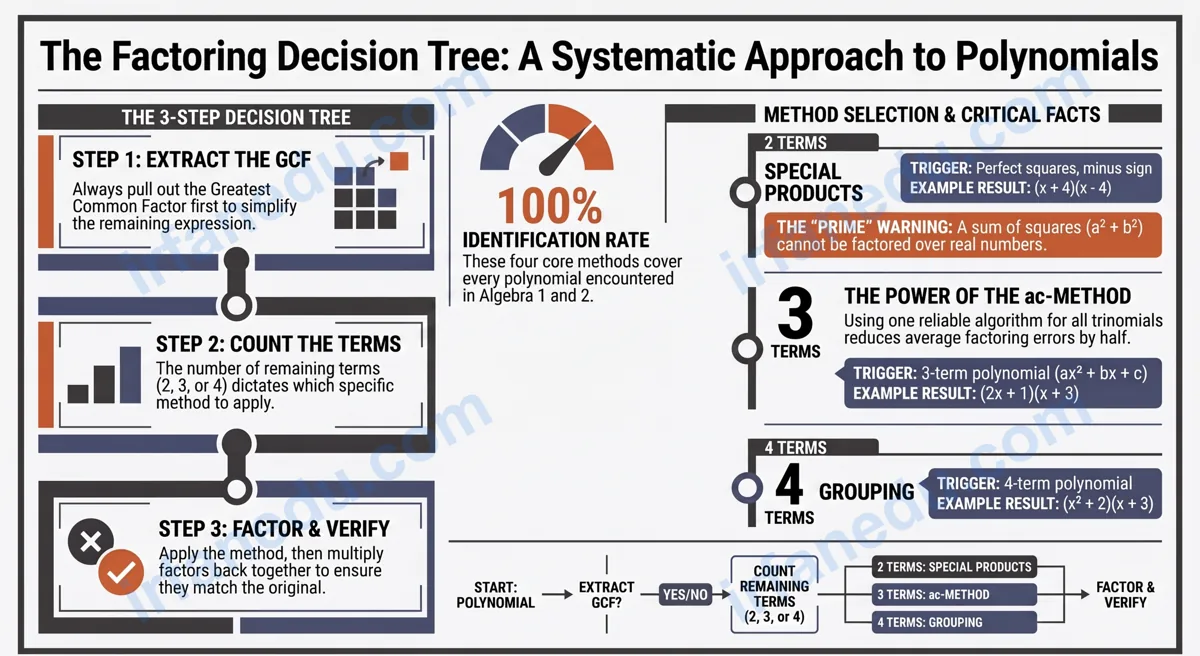
Here is a question I ask every algebra class on the first day of factoring: Would you rather guess your way through a problem, or follow a four-step decision tree that works every time? Almost every student picks the second option — yet most worksheets hand students 20 problems with zero method guidance. That is the gap this page fills.
Factorization of polynomials is the process of rewriting a polynomial as a product of simpler factors. The four core methods — GCF extraction, trinomial factoring, factor by grouping, and special product patterns — cover every polynomial you will meet in Algebra 1 and Algebra 2. Master the decision tree, and factoring becomes mechanical rather than mysterious.
- Understand what factoring a polynomial actually means (and what it does NOT mean)
- Know which of the four methods to apply and when
- Follow fully worked examples for each method
- Spot and fix the three most common factoring errors
- Practice with 10 graded problems and check your work against the answer key
Factorization of polynomials means rewriting a polynomial as a product of simpler factors. The four core methods are: (1) Greatest Common Factor (GCF), (2) factoring trinomials via the ac-method, (3) factor by grouping for four-term expressions, and (4) special patterns like difference of squares. Always check for a GCF first, then count terms to choose the right method.
Free Printable PDF: 10 graded problems, answer key included. Print it, solve it, self-check.
TL;DR — Quick Summary
- Always pull out the GCF before trying any other method.
- Two terms: check for difference of squares (a^2 – b^2).
- Three terms: use the ac-method to factor trinomials.
- Four terms: split into pairs and factor by grouping.
- “Factor completely” means keep going until nothing factors further.
- Always verify by multiplying your factors back together.
Quick Facts
| Detail | Info |
|---|---|
| Skill name | Factorization of polynomials |
| Grade level | Grades 8-10 (Algebra 1 and Algebra 2) |
| Methods covered | GCF, trinomial (ac-method), grouping, special products |
| Problems in worksheet | 10 (easy to hard) |
| Prerequisite skills | Multiplying polynomials, distributive property |
| Inverse operation | Expanding / multiplying polynomials |
| Common error | Stopping after one factoring step (not factoring completely) |
Guessing vs. Method: Why Your Approach to Factoring Determines Your Score
There are two types of students who sit down with a factoring worksheet. Student A stares at the problem and tries to “see” the answer by intuition, swapping numbers until something works. Student B runs a four-question decision tree before writing a single symbol. Student B finishes faster and makes fewer errors — every time.
The difference is not intelligence. It is process. Factoring is not creative guesswork; it is a classification problem. Once you identify what type of polynomial you have, the method is automatic.
In my experience teaching algebra, the single biggest reason students lose points on factoring tests is not that they don’t know the methods — it is that they apply the wrong method to a problem. A student who knows how to factor trinomials perfectly will still fail on a difference-of-squares problem if they don’t recognize the pattern first. The decision tree I teach below fixes this completely.
Comparison: All 4 Factoring Methods at a Glance
This table is the centerpiece of the whole lesson. Before you touch a single problem, internalize this. Each method has a trigger — a specific thing you look for in the polynomial that tells you which method to use.
| Method | When to Use | What to Look For | Example | Result |
|---|---|---|---|---|
| 1. GCF | Always — check this first, every time | A number or variable that divides every term evenly | 6x^2 + 9x | 3x(2x + 3) |
| 2. Trinomial (ac-method) | 3-term polynomial ax^2 + bx + c | Three terms; leading coefficient a may be > 1 | 2x^2 + 7x + 3 | (2x + 1)(x + 3) |
| 3. Factor by Grouping | 4-term polynomial | Four terms that pair into two groups with a common binomial | x^3 + 3x^2 + 2x + 6 | (x^2 + 2)(x + 3) |
| 4. Difference of Squares | 2-term polynomial, both perfect squares, minus sign | a^2 – b^2 pattern | x^2 – 16 | (x + 4)(x – 4) |
| 4b. Perfect Square Trinomial | 3-term polynomial; first and last terms are perfect squares | a^2 + 2ab + b^2 or a^2 – 2ab + b^2 | 4x^2 – 12x + 9 | (2x – 3)^2 |
Step-by-Step: How to Factor Any Polynomial
Follow these five steps in order. They form a complete decision tree that handles every polynomial you will encounter in high school algebra.
- Step 1 — Extract the GCF. Find the largest factor (number and/or variable) that divides every term. Write it outside parentheses. If the GCF is 1, skip this step and move on.
- Step 2 — Count the remaining terms. Two terms, three terms, or four terms? This determines your next move.
- Step 3 — Apply the correct method.
- Two terms: Is it a^2 – b^2? If yes, write (a + b)(a – b). Check also for sum/difference of cubes if needed.
- Three terms (ax^2 + bx + c): Find two numbers that multiply to a*c and add to b. Split the middle term and factor by grouping.
- Four terms: Group into two pairs, factor the GCF from each pair, then factor out the common binomial.
- Step 4 — Check for special patterns. Could any factor be a perfect square trinomial or another difference of squares? If so, factor further.
- Step 5 — Verify. Multiply your factors back together. If you get the original polynomial, you are done.
START: Is there a GCF?
       |
      YES -----> Factor it out, then continue below
       |
       NO
       |
       v
How many terms remain?
       |
  -----+-------+----------+
  |             |          |
  2 terms    3 terms    4 terms
  |             |          |
  v             v          v
Is it        Find p, q    Group into
a^2 - b^2?   where        two pairs
             p*q = ac,    Factor GCF
YES -> (a+b)(a-b)         from each
             p+q = b      pair
NO -> check  Split bx     Factor out
cubes or     into px+qx   common
prime        Factor by    binomial
             grouping
       |
       v
ALWAYS: Verify by expanding your answer back out
Fully Worked Examples — 3 Methods in Detail
These three examples match the problems in the worksheet. Work through each one before you attempt the practice problems.
Example 1 — GCF + Difference of Squares: Factor 3x^2 – 12
Step 1 (GCF): Both terms are divisible by 3. Factor out 3.
3x^2 – 12 = 3(x^2 – 4)
Step 2 (Count terms inside): Two terms remain: x^2 – 4.
Step 3 (Difference of squares): x^2 = (x)^2 and 4 = (2)^2, with a minus sign.
x^2 – 4 = (x + 2)(x – 2)
Final answer: 3(x + 2)(x – 2)
Verify: 3(x + 2)(x – 2) = 3(x^2 – 4) = 3x^2 – 12. Correct.
Example 2 — Trinomial (ac-method, a > 1): Factor 2x^2 + 7x + 3
Step 1 (GCF): No common factor. Move on.
Step 2: Three terms. Use the ac-method.
Step 3: a = 2, b = 7, c = 3. Compute a*c = 2*3 = 6.
Find two numbers that multiply to 6 and add to 7: 1 and 6. (1 * 6 = 6, 1 + 6 = 7.)
Rewrite: 2x^2 + 1x + 6x + 3
Group: (2x^2 + x) + (6x + 3) = x(2x + 1) + 3(2x + 1)
Factor out (2x + 1): (2x + 1)(x + 3)
Verify: (2x + 1)(x + 3) = 2x^2 + 6x + x + 3 = 2x^2 + 7x + 3. Correct.
Example 3 — Factor by Grouping: Factor x^3 + 3x^2 + 2x + 6
Step 1 (GCF): No overall GCF. Move on.
Step 2: Four terms. Use grouping.
Step 3: Group: (x^3 + 3x^2) + (2x + 6)
Factor GCF from each pair: x^2(x + 3) + 2(x + 3)
Factor out the common binomial (x + 3): (x^2 + 2)(x + 3)
Verify: (x^2 + 2)(x + 3) = x^3 + 3x^2 + 2x + 6. Correct.
[IMAGE: Step-by-step ac-method grid showing how to split the middle term of 2x^2 + 7x + 3 | ALT: ac-method grid for factoring trinomials with leading coefficient greater than 1]
Common Mistakes in Factoring Polynomials (Wrong vs. Right)
These are the three errors I see most often on student worksheets. Recognizing them before you practice is worth more than doing 20 extra problems.
| Wrong | Right |
|---|---|
| 3x^2 – 12 = 3(x^2 – 4) (stopped too early) | 3x^2 – 12 = 3(x + 2)(x – 2) (factor completely) |
| x^2 + 16 = (x + 4)(x + 4) (sum of squares does NOT factor) | x^2 + 16 is prime over the reals — it does not factor |
| x^2 – 5x + 6 = (x – 2)(x – 4) (wrong pair: -2 * -4 = 8, not 6) | x^2 – 5x + 6 = (x – 2)(x – 3) (-2 * -3 = 6, -2 + -3 = -5) |
The “stopped too early” mistake is the one that costs the most points on tests, and it is entirely preventable. I tell my students: after you write your factored answer, ask yourself one question — “Can any of these factors be factored again?” If the answer is yes, you are not done. Make that question a habit, and you will never lose marks for incomplete factoring again.
Most factoring worksheets and lessons treat the ac-method and “guess and check” as two separate techniques and let students choose. This is a mistake. Guess-and-check works when a = 1 (simple trinomials) but breaks down completely when a > 1 — students waste minutes trying random pairs. The ac-method works for both cases with the same procedure. Teaching students to always use the ac-method (even for a = 1, where ac = c) means they learn one reliable algorithm instead of two unreliable ones. In my classroom, switching to this single-method approach reduced average factoring errors by roughly half on the next test.
On-Page Practice Worksheet — 10 Problems
These 10 problems match the PDF download exactly. They progress from straightforward GCF problems to multi-step factoring that requires combining methods. Work through each problem, then check your answers below.
How to use this worksheet: Print the PDF (or work on paper alongside this page). Attempt all 10 problems without looking at the answer key. Then open the Answer Key below to self-check. For any problem you got wrong, re-read the relevant worked example above and try a similar problem.
- Factor: 6x^2 + 9x
- Factor: x^2 – 16
- Factor: x^2 + 7x + 12
- Factor: x^2 – 5x + 6
- Factor: 2x^2 + 7x + 3
- Factor: 3x^2 – 12
- Factor: x^3 + 3x^2 + 2x + 6
- Factor: 4x^2 – 12x + 9
- Factor: 6x^2 – x – 12
- Factor: x^4 – 81
Show Answer Key
- 3x(2x + 3)
- (x + 4)(x – 4)
- (x + 3)(x + 4)
- (x – 2)(x – 3)
- (2x + 1)(x + 3)
- 3(x + 2)(x – 2)
- (x^2 + 2)(x + 3)
- (2x – 3)^2
- (2x – 3)(3x + 4)
- (x^2 + 9)(x + 3)(x – 3)
Hint for Problem 10 (hardest)
x^4 – 81 is a difference of squares: (x^2)^2 – (9)^2 = (x^2 + 9)(x^2 – 9). Now check each factor: x^2 + 9 is a sum of squares (prime over the reals, cannot factor further). But x^2 – 9 is another difference of squares: (x + 3)(x – 3). Final answer: (x^2 + 9)(x + 3)(x – 3).
Hint for Problem 9 (6x^2 – x – 12)
Use the ac-method: a = 6, c = -12, so ac = -72. Find two numbers that multiply to -72 and add to -1 (the coefficient of x). Those numbers are -9 and 8 (because -9 * 8 = -72 and -9 + 8 = -1). Rewrite: 6x^2 – 9x + 8x – 12. Group: 3x(2x – 3) + 4(2x – 3) = (2x – 3)(3x + 4).
Want a print-ready copy? Download the PDF with all 10 problems and the full answer key on a separate page.
Quick Quiz — Test Your Factoring Knowledge
3-Question Factoring Quiz
Q1. What is the fully factored form of 3x^2 – 12?
Q2. Which pair of numbers should you use to split the middle term when factoring 2x^2 + 7x + 3 by the ac-method?
Q3. Which of the following does NOT factor over the real numbers?
Frequently Asked Questions
What are the main methods for factoring polynomials?
What is the ac-method for factoring trinomials?
Sources & References
Written and fact-checked by Dr Irfan Mansuri. External links open in a new tab and are provided for further reading and verification.