
Fraction Decomposition Calculator: Partial Fractions Solved
Last Updated: July 2026
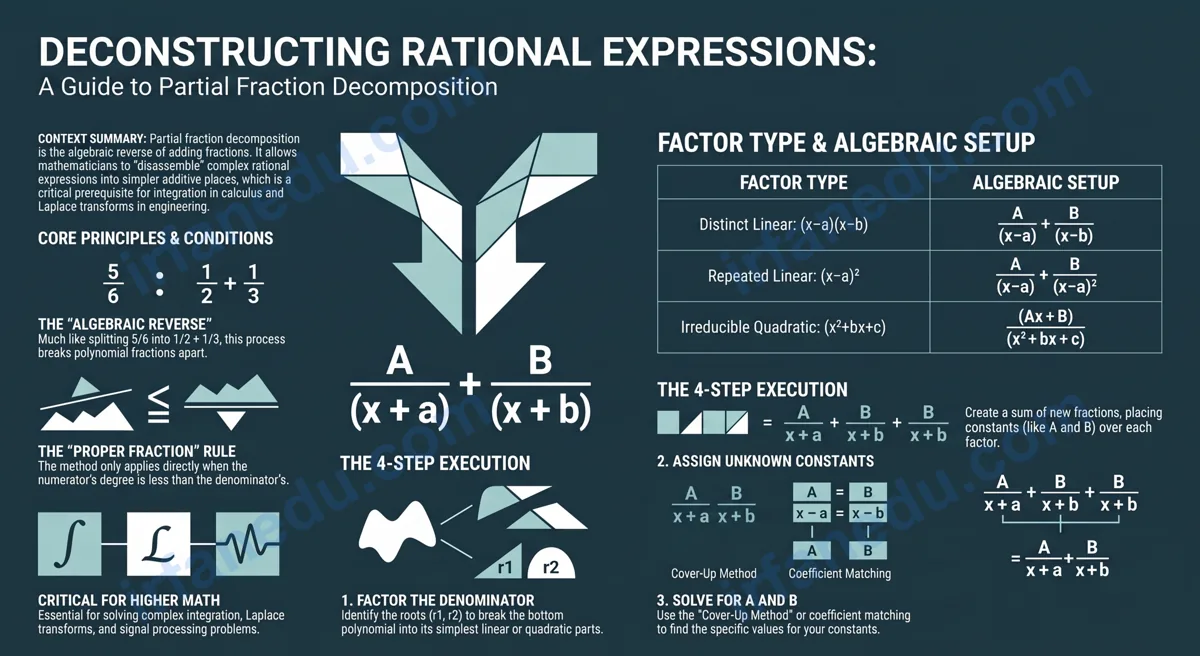
This idea goes back to the 17th century, when mathematicians like Johann Bernoulli needed a systematic way to integrate rational functions — fractions built from polynomials. They discovered that any such fraction could be broken into a sum of simpler pieces, each easy to integrate. That insight became what we now call partial fraction decomposition, and it is just as useful today in algebra, calculus, and engineering.
The calculator below handles the most common student case — a linear numerator over two distinct linear factors — and shows every step so you can follow along and learn the method, not just copy an answer.
Fraction decomposition (partial fraction decomposition) is the process of rewriting a rational expression as a sum of simpler fractions. You factor the denominator, assign an unknown constant to each factor, clear the denominators, and solve for the constants. The result makes integration, Laplace transforms, and algebraic simplification far easier.
- Understand what partial fraction decomposition is and why it matters.
- Use the interactive calculator to get instant step-by-step solutions.
- Follow worked examples for distinct linear, repeated, and quadratic factor cases.
- Avoid the four most common mistakes students make.
TL;DR – Quick Summary
- Partial fraction decomposition splits one complex fraction into simpler additive pieces.
- It only works directly when the numerator degree is less than the denominator degree.
- Factor the denominator first — the factor type determines the setup.
- Solve for constants using the cover-up method or coefficient matching.
- Essential for calculus integration and Laplace transform problems.
- The calculator below shows every algebra step with your actual numbers.
| Feature | Detail |
|---|---|
| Full name | Partial Fraction Decomposition |
| Also called | Partial fraction expansion, fraction decomposition |
| Prerequisite | Polynomial factoring, solving linear systems |
| First appears in curriculum | Algebra 2 / Precalculus |
| Critical for | Calculus integration, Laplace transforms, signal processing |
| Condition to apply directly | deg(numerator) < deg(denominator) |
| Main factor types | Distinct linear, repeated linear, irreducible quadratic |
Fraction Decomposition Calculator
Fraction Decomposition Calculator
Distinct linear factors — step-by-step solution
Enter a rational expression of the form (Px + Q) / [(x − r₁)(x − r₂)] where r₁ ≠ r₂.
Step-by-Step Solution
| Symbol | Meaning | Notes |
|---|---|---|
| P, Q | Numerator coefficients | P is the coefficient of x; Q is the constant |
| r₁, r₂ | Roots of the denominator factors | Must be distinct (r₁ ≠ r₂) |
| A | Constant for first partial fraction | A = (P·r₁ + Q) / (r₁ − r₂) |
| B | Constant for second partial fraction | B = (P·r₂ + Q) / (r₂ − r₁) |
Condition: deg(numerator) < deg(denominator). If not, perform polynomial long division first.
Partial fraction decomposition is an algebraic technique that rewrites a proper rational expression as a finite sum of simpler rational expressions. Each simpler fraction has a factor of the original denominator as its own denominator. The method was formalized in the 17th century and is now a standard tool in algebra, calculus, and engineering mathematics.
Proper vs. improper: A rational expression is proper when the numerator degree is strictly less than the denominator degree. Decomposition applies directly only to proper fractions. An improper fraction must first be divided using polynomial long division.
How to Use This Fraction Decomposition Calculator
The calculator handles rational expressions with two distinct linear factors in the denominator. Here is exactly what to enter:
- Identify P and Q. Write your numerator in the form Px + Q. For example, if your numerator is 3x + 5, enter P = 3 and Q = 5. If the numerator is just a constant like 7, enter P = 0 and Q = 7.
- Identify r1 and r2. Factor your denominator into (x – r1)(x – r2). For (x + 1)(x + 2), the roots are r1 = -1 and r2 = -2. Enter those values.
- Click Calculate. The result card shows the decomposed form and a numbered step-by-step solution using your actual numbers.
- Check the verify step. Step 8 in the solution tells you how to confirm the answer by recombining the fractions.
- Click Reset to clear all fields for a new problem.
What Is Fraction Decomposition?
Fraction decomposition is the process of splitting a single rational expression into a sum of simpler fractions, each with a factor of the original denominator. It is the algebraic reverse of adding fractions over a common denominator.
The formal name is partial fraction decomposition or partial fraction expansion. The technique applies to any proper rational function — one where the numerator polynomial has a lower degree than the denominator polynomial.
Think of it this way: you know that 1/6 = 1/2 – 1/3. That is fraction decomposition at its simplest. The same idea scales up to polynomial fractions: (3x + 5) / [(x+1)(x+2)] can be split into two simpler fractions, each easy to work with individually.
In my experience teaching this topic, the biggest confusion students face is not the algebra — it is not knowing why they are doing it. I always tell students: think of partial fractions as a disassembly tool. You break a complex machine into parts so each part is easy to handle. In calculus, those “parts” are fractions you can integrate in one line. Once students see the purpose, the method clicks immediately.
The Partial Fraction Decomposition Formula Explained
The general setup depends on the type of factors in the denominator. The most common case in high school and early college is two distinct linear factors.
| Denominator Factor Type | Partial Fraction Setup | Number of Constants |
|---|---|---|
| Two distinct linear: (x-a)(x-b) | A/(x-a) + B/(x-b) | 2 |
| Repeated linear: (x-a)² | A/(x-a) + B/(x-a)² | 2 |
| Irreducible quadratic: (x²+bx+c) | (Ax+B)/(x²+bx+c) | 2 |
| Linear + irreducible quadratic | A/(x-a) + (Bx+C)/(x²+bx+c) | 3 |
The Cover-Up Method for Distinct Linear Factors
For the case (Px + Q) / [(x – r1)(x – r2)], the cover-up method gives you A and B directly:
  (Px + Q)
  ─────────────────  =  A/(x-r1)  +  B/(x-r2)
  (x-r1)(x-r2)

  To find A: "cover up" (x-r1) in the original,
             then substitute x = r1:

         A  =  (P·r1 + Q) / (r1 - r2)

  To find B: "cover up" (x-r2) in the original,
             then substitute x = r2:

         B  =  (P·r2 + Q) / (r2 - r1)

  Note: A + B must equal P (coefficient check).
The cover-up method works because substituting x = r1 makes the (x – r1) factor zero on the right side, leaving only A times the remaining factor — a single equation you solve instantly.
| Symbol | Meaning | Domain |
|---|---|---|
| P, Q | Numerator polynomial coefficients | Real numbers |
| r1, r2 | Roots of denominator (r1 ≠ r2) | Real numbers |
| A, B | Partial fraction constants | Real numbers |
| x | Independent variable | Real numbers, x ≠ r1, r2 |
Worked Examples: Fraction Decomposition Step by Step
These three examples mirror exactly what the calculator produces, so you can verify your understanding against the tool.
Example 1: (3x + 5) / [(x + 1)(x + 2)]
Setup: P = 3, Q = 5, r1 = -1, r2 = -2.
- Degree check: numerator degree 1 < denominator degree 2. Proceed.
- Write: (3x + 5) / [(x+1)(x+2)] = A/(x+1) + B/(x+2)
- Multiply both sides by (x+1)(x+2): 3x + 5 = A(x+2) + B(x+1)
- Find A: set x = -1: 3(-1)+5 = A(-1+2) = A(1). So A = 2.
- Find B: set x = -2: 3(-2)+5 = B(-2+1) = B(-1). So -1 = -B, B = 1.
- Answer: 2/(x+1) + 1/(x+2)
- Verify: [2(x+2) + 1(x+1)] / [(x+1)(x+2)] = (3x+5)/[(x+1)(x+2)]. Correct.
Example 2: 7 / [(x – 1)(x + 3)] (constant numerator)
Setup: P = 0, Q = 7, r1 = 1, r2 = -3.
- Write: 7 / [(x-1)(x+3)] = A/(x-1) + B/(x+3)
- Multiply through: 7 = A(x+3) + B(x-1)
- Find A: x = 1: 7 = A(4). A = 7/4.
- Find B: x = -3: 7 = B(-4). B = -7/4.
- Answer: (7/4)/(x-1) – (7/4)/(x+3)
Example 3 (Manual — Repeated Factor): 1 / (x – 2)²
The calculator handles distinct factors; this example shows the repeated-factor setup you handle manually.
- Write: 1/(x-2)² = A/(x-2) + B/(x-2)²
- Multiply through: 1 = A(x-2) + B
- Match constant terms: B = 1.
- Match x-coefficients: A = 0.
- Answer: 0/(x-2) + 1/(x-2)² = 1/(x-2)² (already in simplest form — the decomposition confirms no further split is possible here).
Most textbooks and online guides present the cover-up method as a “trick” without explaining why it works. Here is the real reason: when you substitute x = r1, the factor (x – r1) becomes zero. On the right side, the term B/(x – r2) multiplied by (x – r1) also becomes zero. You are left with A times the remaining factor evaluated at r1 — a single equation. The cover-up method is not a shortcut; it is a direct consequence of the zero-product property. Understanding this means you can extend the idea to any number of distinct linear factors, not just two.
Common Mistakes in Fraction Decomposition
These four errors appear most often in student work. Recognizing them saves points on exams.
Wrong: Decomposing (x² + 3x + 2) / (x² + 3x + 2) directly.
Right: Perform polynomial long division first. Only decompose the remainder fraction.
Sources & References
Reviewed by Dr. Irfan Mansuri. External links open in a new tab and are provided for further reading and verification.