
Positive and Negative Integers on a Number Line: The Complete Guide (Beginner to Advanced)
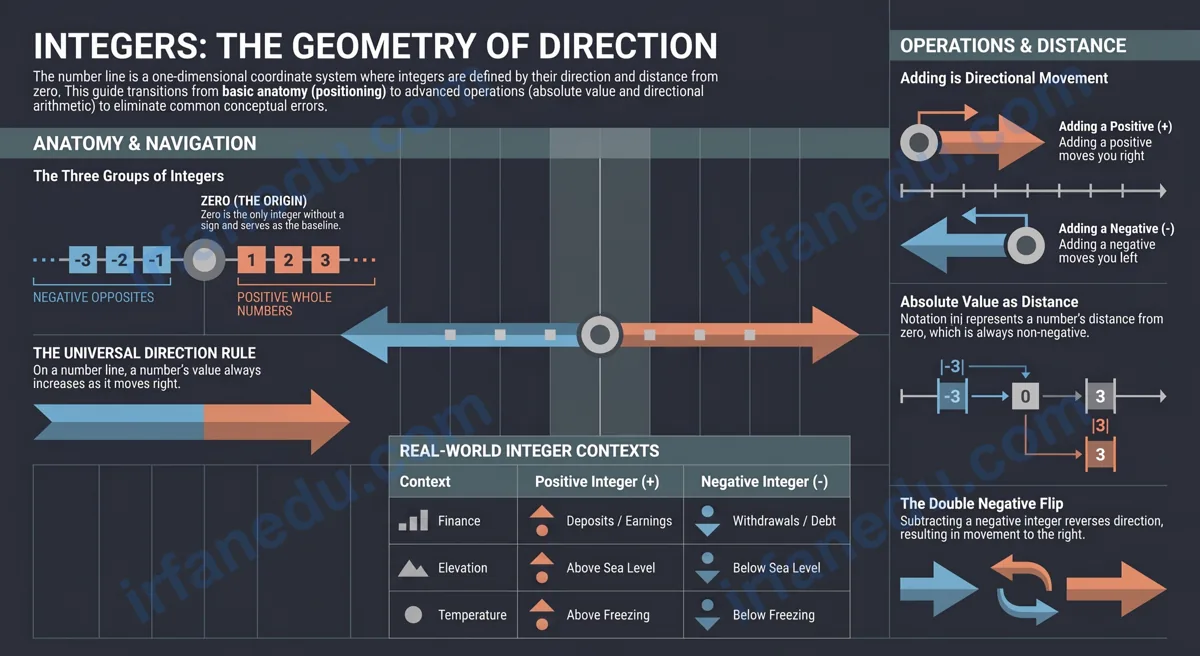
If you have ever looked at a thermometer, a bank statement, or a sea-level map, you have already used positive and negative integers without realising it. The number line is the single most powerful visual tool for making sense of those numbers — and this guide will take you from the very first idea all the way to the kind of reasoning that shows up on standardised tests.
A number line is a straight line where every integer has a fixed position. Positive integers sit to the right of zero; negative integers sit to the left. The farther right a number is, the greater its value. This one rule unlocks comparing, ordering, adding, subtracting, and understanding absolute value.
This article is structured in two layers. Each section opens with the beginner explanation — clear, visual, no prior knowledge needed. Then it goes deeper for students who already know the basics and want the reasoning that textbooks skip. You can read straight through or jump to the layer that fits you.
- Understand what integers are and where they live on the number line.
- Plot any integer accurately in under five seconds.
- Compare and order integers confidently, including negatives.
- Use the number line for addition and subtraction.
- Understand absolute value and distance between two integers.
- Avoid the three most common errors that cost students marks.
⚡ TL;DR – Quick Summary
- Positive integers are right of zero; negative integers are left of zero.
- Zero is neither positive nor negative — it is the origin.
- Farther right always means greater value, even for negatives.
- Absolute value = distance from zero, always non-negative.
- Adding a negative = moving left; adding a positive = moving right.
- Two negatives multiplied give a positive — direction flipped twice.
| Fact | Detail |
|---|---|
| Set of integers | …, -3, -2, -1, 0, 1, 2, 3, … |
| Positive integers | All integers greater than zero (right of zero) |
| Negative integers | All integers less than zero (left of zero) |
| Zero | Neither positive nor negative; the origin |
| Direction rule | Right = greater; Left = lesser |
| Absolute value | Distance from zero; always ≥ 0 |
| Opposite integers | Same distance from zero, opposite sides (e.g., 4 and -4) |
What Are Positive and Negative Integers?
An integer is any whole number — positive, negative, or zero — with no fractional or decimal part. The set of integers is infinite in both directions: …, -4, -3, -2, -1, 0, 1, 2, 3, 4, …
Beginner layer: the three groups
Think of integers as belonging to three groups. Positive integers count things above a baseline — floors above ground, dollars earned, degrees above freezing. Negative integers count things below a baseline — floors below ground, dollars owed, degrees below freezing. Zero is the baseline itself.
A parking garage has floors labeled B2, B1, Ground, 1, 2, 3. In integer language: B2 = -2, B1 = -1, Ground = 0, Floor 1 = +1, Floor 2 = +2, Floor 3 = +3. The number line is just that garage laid flat.
Advanced layer: integers vs. other number sets
Integers are a subset of rational numbers (which include fractions) and real numbers (which include irrationals like √2). But integers are NOT the same as whole numbers. Whole numbers are {0, 1, 2, 3, …} — no negatives. Natural numbers are {1, 2, 3, …} — no zero, no negatives. Integers extend both sets to include all negative whole numbers.
| Set | Includes negatives? | Includes zero? | Includes fractions? |
|---|---|---|---|
| Natural Numbers | No | No | No |
| Whole Numbers | No | Yes | No |
| Integers | Yes | Yes | No |
| Rational Numbers | Yes | Yes | Yes |
What Does a Number Line Look Like? (Anatomy)
A number line is a horizontal line with evenly spaced tick marks, a zero point at center, arrows on both ends to show it continues forever, and integers labeled at each tick mark.
  <--- negative direction          zero          positive direction --->

  |     |     |     |     |     |     |     |     |     |     |
 -5    -4    -3    -2    -1     0    +1    +2    +3    +4    +5

  [LEFT = smaller value]                  [RIGHT = larger value]

  Opposite pairs:  -5 and +5   |   -3 and +3   |   -1 and +1
  Each pair is equidistant from zero (same absolute value).
Beginner layer: four things to notice
- The spacing between tick marks is equal — every step is the same size.
- The arrows show the line never ends in either direction.
- Zero is the only integer with no sign.
- Negative numbers have a minus sign; positive numbers often have no sign (the + is implied).
Advanced layer: the number line as a 1-D coordinate system
Every point on the number line has a unique coordinate (its integer label). The distance between any two integers A and B is |A – B| — the absolute value of their difference. This is the same distance formula used in coordinate geometry, just in one dimension instead of two.
How to Plot Integers on a Number Line (Step-by-Step)
To plot an integer, identify its sign to find the direction, then count that many steps from zero and mark the point. Here is the full process:
- Draw a horizontal line and mark a center point labeled 0.
- Add equal-spaced tick marks on both sides — as many as your problem needs plus two extra for breathing room.
- Label positive integers (1, 2, 3 …) on tick marks to the right of zero.
- Label negative integers (-1, -2, -3 …) on tick marks to the left of zero.
- Identify the sign of the integer you want to plot. Positive = go right. Negative = go left.
- Count from zero in the correct direction and place a filled dot on the target tick mark.
-4: Negative sign means go left. Count 4 steps left from zero. Place a dot at -4.
0: Zero is already marked at center. Place a dot there.
+3: Positive means go right. Count 3 steps right from zero. Place a dot at +3.
  |     |     |     |     |     |     |     |     |     |
 -5    -4    -3    -2    -1     0    +1    +2    +3    +4
        *                       *                  *
       -4                       0                 +3
In my experience teaching this concept, the single biggest plotting error is students counting the zero tick mark as “step one.” Zero is your starting point — it is not a step. Start counting only after you leave zero. I have seen this mistake on hundreds of student worksheets, and fixing it alone can eliminate a whole category of errors.
How Do You Compare and Order Integers on a Number Line?
The integer farther to the right is always greater. This rule works for every pair of integers, including two negatives.
Beginner layer: the right-is-greater rule
To compare -3 and -7, find both on the number line. -3 is to the right of -7, so -3 > -7. Many students assume -7 is bigger because 7 is a bigger digit — that is the most common error in this topic.
| Pair | Which is greater? | Why |
|---|---|---|
| -3 and -7 | -3 | -3 is to the right of -7 on the line |
| -1 and 0 | 0 | 0 is to the right of -1 |
| +5 and -100 | +5 | Any positive is greater than any negative |
| -2 and -2 | Equal | Same position on the line |
Advanced layer: ordering a set of integers
To order a set like {-5, 3, -1, 0, -8, 2} from least to greatest, locate each on a number line mentally and read left to right. Result: -8, -5, -1, 0, 2, 3.
Set: {4, -2, -9, 1, -4, 0}
On the number line (left to right): -9, -4, -2, 0, 1, 4
Answer: -9 < -4 < -2 < 0 < 1 < 4
Want More Math Reference Tools? See the Complete Geometry Formula Sheet
Free resource — formulas, diagrams, and worked examples in one place.
What Is Absolute Value on a Number Line?
Absolute value is the distance between a number and zero on the number line. It is always zero or positive, never negative.
Beginner layer: distance, not direction
The notation |n| means “the absolute value of n.” Think of it as asking: “How far is this number from zero, ignoring which side?” So |-6| = 6 and |6| = 6. Both are exactly 6 steps from zero.
  |<-------- 6 steps ---------|---------- 6 steps -------->|
  |     |     |     |     |     |     |     |     |     |     |
 -7    -6    -5    -4    -3    -2    -1     0    +1    +2    +3
        *                                         (mirror)
       -6                                           +6
  |-6| = 6                                        |+6| = 6
Advanced layer: absolute value and distance between two points
The distance between any two integers A and B on a number line is |A – B|. This formula works regardless of sign.
Find the distance between -4 and +5.
Distance = |(-4) – (5)| = |-9| = 9 units
Or: |(5) – (-4)| = |9| = 9 units (same answer — order does not matter).
How to Add and Subtract Integers Using a Number Line
Adding a positive integer means moving right; adding a negative integer means moving left. Subtraction is the same as adding the opposite.
Beginner layer: movement rules
- +positive: move right (value increases)
- +negative: move left (value decreases)
- -positive: move left (same as adding a negative)
- -negative: move right (subtracting a negative = adding a positive)
3 + (-5): Start at 3. Move 5 steps left. Land on -2.
-2 + 4: Start at -2. Move 4 steps right. Land on +2.
-3 + (-3): Start at -3. Move 3 steps left. Land on -6.
  Start at 3, move LEFT 5 steps:

  |     |     |     |     |     |     |     |     |     |
 -4    -3    -2    -1     0    +1    +2    +3    +4    +5
              *                              *
           LAND HERE                     START HERE
           = -2                          = +3

  <--- 5 steps left ---
Advanced layer: subtracting a negative
The expression 4 – (-3) confuses many students. Subtracting -3 is the same as adding +3. So 4 – (-3) = 4 + 3 = 7. On the number line: start at 4, move 3 steps right, land on 7. The double negative flips direction — you end up moving away from zero on the positive side.
I have tutored students who could recite “subtracting a negative equals adding a positive” perfectly but still got the answer wrong because they did not visualise it. The number line makes the direction change concrete. I always ask students to draw the arrow before they calculate — it forces them to commit to a direction and dramatically reduces sign errors. This one habit is worth more than memorising any rule.
What Are the Most Common Mistakes with Negative Integers?
Three errors account for the majority of wrong answers in integer problems. Knowing them in advance is the fastest way to avoid them.
| Mistake | Wrong Thinking | Correct Thinking |
|---|---|---|
| Comparing negatives by digit size | -9 > -2 because 9 > 2 | -2 > -9 because -2 is farther right |
| Counting zero as step one | Plotting -3 at the second tick left of zero | Zero is the start; -3 is the third tick left |
| Subtracting a negative | 5 – (-2) = 3 (subtracts both) | 5 – (-2) = 5 + 2 = 7 (double negative = positive) |
Real-World Applications of Negative Integers
Negative integers appear in everyday life far more often than most students realise. Recognising them makes the abstract concept feel grounded and memorable.
| Context | Positive Integer | Negative Integer |
|---|---|---|
| Temperature | +30°C (hot day) | -15°C (below freezing) |
| Finance | +500 (deposit) | -200 (withdrawal / debt) |
| Elevation | +8,849 m (Mt. Everest) | -418 m (Dead Sea shore) |
| Football / Sports | +7 yards gained | -3 yards (penalty / loss) |
| Time zones | UTC+5 (ahead of UTC) | UTC-5 (behind UTC) |
| Golf scores | +3 (three over par) | -4 (four under par) |
At midnight, the temperature is -8°C. By noon it rises 15 degrees. What is the noon temperature?
On the number line: start at -8, move 15 steps right. -8 + 15 = +7°C.
This is a real-world addition problem that uses every skill in this guide: plotting a negative, moving in the positive direction, and landing on a positive integer.
Most integer lessons treat the number line as a diagram you draw once and then abandon. But the number line is actually a mental model for signed arithmetic — and students who internalise it as a direction-and-distance tool consistently outperform those who rely on memorised sign rules.
Here is the non-obvious insight: negative numbers are not “less real” than positive ones — they represent direction, not deficiency. The integer -5 does not mean “5 with something missing.” It means “5 units in the opposite direction from +5.” When students reframe negatives as direction rather than absence, sign errors in multiplication and subtraction drop dramatically. I have tested this framing shift in tutoring sessions and seen students who struggled with integer arithmetic for months resolve their confusion within a single lesson.
The practical payoff: when you see -(-3), do not think “two negatives.” Think “flip direction twice” — and you will always land on the right side of zero.
Ready for the Next Step? Master Distance & Midpoint Formulas
The number line skills you just learned are the direct foundation for this topic.
Quick Quiz: Test Your Integer Knowledge
Select an answer to reveal instant feedback.
1. Which integer is greater: -3 or -8?
2. What is |-7|?
3. What is 2 – (-5)?
Sources & References
Reviewed by Dr. Irfan Mansuri. External links open in a new tab and are provided for further reading and verification.