
Equations with Variables on Both Sides: Step-by-Step Guide + Free Worksheet
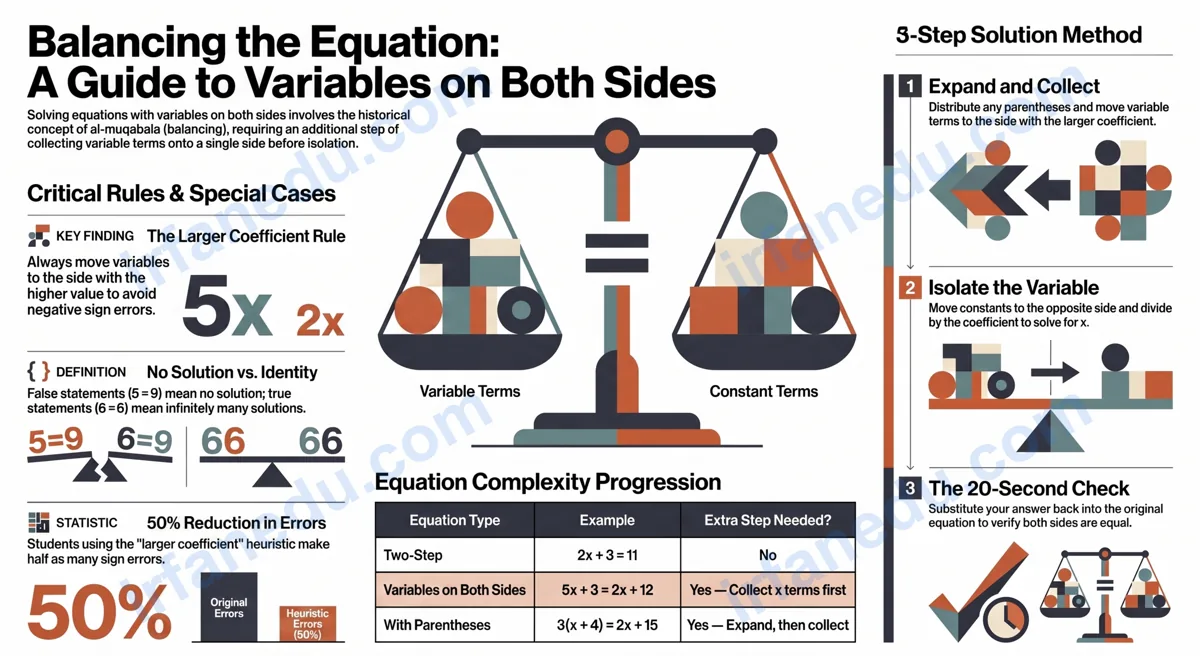
An equation with variables on both sides is a linear equation where the unknown variable appears on both the left and right of the equals sign — for example, 5x + 3 = 2x + 12. Solving it requires one extra step compared to a basic two-step equation: you must first collect all variable terms onto one side before isolating x.
This is one of the most tested algebra skills in grades 7 through 10, and it is the point where many students first feel stuck. The good news is that the method is completely mechanical once you understand the logic behind it. In this guide, I walk you through that logic, show you three fully worked examples, flag the mistakes I see most often in my teaching, and give you a free printable worksheet to practise on.
- Understand what it means for a variable to appear on both sides
- Follow a reliable 5-step method to solve any such equation
- Handle special cases: no solution and infinitely many solutions
- Avoid the three most common errors students make
- Practise with 12 graded problems and check against the answer key
To solve an equation with variables on both sides, move all variable terms to one side by adding or subtracting, then move all constants to the other side, then divide by the coefficient. For example, 5x + 3 = 2x + 12 becomes 3x = 9, so x = 3. Always substitute your answer back into the original equation to verify it is correct.
Free Printable Worksheet: 12 graded practice problems with a full answer key — ready to print or use on screen.
TL;DR – Quick Summary
- Variables on both sides means x appears on the left AND right of the equals sign.
- Step 1: Expand any parentheses. Step 2: Move all x terms to one side.
- Step 3: Move all constants to the other side. Step 4: Divide. Step 5: Check.
- If variable terms cancel to give a false statement, there is no solution.
- If variable terms cancel to give a true statement, every number is a solution.
- Always move x to the side with the larger coefficient to keep it positive.
| Feature | Detail |
|---|---|
| Skill name | Solving equations with variables on both sides |
| Grade level | Grades 7-10 (Pre-Algebra / Algebra 1) |
| Number of steps | 5 (including the check step) |
| Key property used | Addition / Subtraction Property of Equality |
| Special cases | No solution; infinitely many solutions (identity) |
| Prerequisite skills | Two-step equations, combining like terms, distributive property |
Where This Idea Comes From
This idea goes back to the 9th-century mathematician Muhammad ibn Musa al-Khwarizmi, whose treatise Al-Kitab al-mukhtasar fi hisab al-jabr wal-muqabala (roughly, “The Compendious Book on Calculation by Completion and Balancing”) gave us the word algebra itself. Al-Khwarizmi described two core operations: al-jabr (restoring a term by moving it across the equals sign) and al-muqabala (balancing — cancelling equal terms on both sides). Equations with variables on both sides are a direct application of al-muqabala.
Fast-forward to today and this skill sits at the heart of every algebra course worldwide. It is the gateway to solving systems of equations, understanding functions, and tackling physics and chemistry problems where the unknown appears on both sides of a formula.
In my experience teaching algebra, students who struggle with this topic almost always have the same root problem: they try to isolate x in one move, without first collecting variable terms. Once I show them that the only new step is “get all the x’s on one side first,” the whole skill clicks within a single lesson. The historical framing helps too — al-Khwarizmi called it balancing, and that word is more intuitive than “inverse operations.”
What Are Equations with Variables on Both Sides?
An equation with variables on both sides is a linear equation in which the variable term (usually x) appears on both the left-hand side and the right-hand side of the equals sign. A standard two-step equation like 2x + 3 = 11 has x only on the left. An equation like 5x + 3 = 2x + 12 has x on both sides.
The equals sign represents a balance. Whatever you do to one side, you must do to the other. The goal is always the same: isolate the variable so you can read off its value.
| Equation type | Example | Variable location | Extra step needed? |
|---|---|---|---|
| One-step | x + 5 = 9 | Left only | No |
| Two-step | 2x + 3 = 11 | Left only | No |
| Variables on both sides | 5x + 3 = 2x + 12 | Both sides | Yes — collect x terms first |
| With parentheses | 3(x + 4) = 2x + 15 | Both sides (after expanding) | Yes — expand, then collect |
How Do You Solve Equations with Variables on Both Sides?
The method has five steps. Apply them in order every time and you will not go wrong. Below I show each step in the abstract, then apply it to three worked examples of increasing difficulty.
- Expand parentheses. If the equation contains brackets, distribute the coefficient across the terms inside. Skip this step if there are no parentheses.
- Collect variable terms on one side. Add or subtract a variable term to move all x terms to the side with the larger coefficient. This keeps the coefficient positive.
- Collect constants on the other side. Add or subtract the constant to move all number terms to the opposite side from x.
- Divide both sides by the coefficient of x. This isolates x and gives you the solution.
- Check your answer. Substitute the value back into the original equation. Both sides must be equal. If they are not, you made an arithmetic error — go back and find it.
Worked Example 1 — Basic (no parentheses)
Solve: 5x + 3 = 2x + 12
Step 1: No parentheses. Skip.
Step 2: Subtract 2x from both sides (5x is larger, so keep x on the left).
5x + 3 − 2x = 2x + 12 − 2x
3x + 3 = 12
Step 3: Subtract 3 from both sides.
3x + 3 − 3 = 12 − 3
3x = 9
Step 4: Divide both sides by 3.
x = 3
Step 5 (Check): Left side: 5(3) + 3 = 18. Right side: 2(3) + 12 = 18. Correct.
  5x + 3  =  2x + 12
  -------    --------
  [5x][3]    [2x][12]

  Subtract 2x from both pans:
  [3x][3]    [12]

  Subtract 3 from both pans:
  [3x]       [9]

  Divide both pans by 3:
  [x]        [3]      --> x = 3
Worked Example 2 — Variable on the right is larger
Solve: 2x + 9 = 5x − 6
Step 2: 5x is larger, so move x to the right. Subtract 2x from both sides.
9 = 3x − 6
Step 3: Add 6 to both sides.
15 = 3x
Step 4: Divide both sides by 3.
x = 5
Check: Left: 2(5) + 9 = 19. Right: 5(5) − 6 = 19. Correct.
Worked Example 3 — With parentheses
Solve: 3(x + 4) = 2x + 15
Step 1: Expand the left side.
3x + 12 = 2x + 15
Step 2: Subtract 2x from both sides.
x + 12 = 15
Step 3: Subtract 12 from both sides.
x = 3
Check: Left: 3(3 + 4) = 21. Right: 2(3) + 15 = 21. Correct.
What Are the Special Cases: No Solution and Infinite Solutions?
Most equations with variables on both sides have exactly one solution. But two special cases produce a different result, and you need to recognise them.
| What happens | Example | After collecting x terms | Result |
|---|---|---|---|
| Variable terms cancel, false statement | 3x + 5 = 3x + 9 | 5 = 9 | No solution (contradiction) |
| Variable terms cancel, true statement | 4x + 6 = 4x + 6 | 6 = 6 | Infinitely many solutions (identity) |
| Normal case | 5x + 3 = 2x + 12 | 3x = 9 | One solution: x = 3 |
For 3x + 5 = 3x + 9: subtract 3x from both sides and you get 5 = 9. That is never true, so no value of x satisfies the equation. Write “No solution.”
For 4x + 6 = 4x + 6: subtract 4x from both sides and you get 6 = 6. That is always true, so every real number is a solution. Write “All real numbers” or “Infinitely many solutions.”
In my experience, the no-solution and identity cases trip students up on tests because they expect to always find a number. I tell my students: if the x disappears, look at what is left. False statement = no solution. True statement = all numbers. That two-second check has saved many students from writing a wrong answer with confidence.
What Are the Most Common Mistakes When Solving These Equations?
These three errors account for the majority of wrong answers I see on homework and tests.
Wrong: 5x + 3 = 2x + 12 → 3x + 3 = 12 (subtracting 2x from left only)
Right: Subtract 2x from both sides: 5x − 2x + 3 = 2x − 2x + 12 → 3x + 3 = 12
Wrong: 3(x − 4) = 3x − 4
Right: 3(x − 4) = 3x − 12 (multiply EVERY term inside by 3)
Substituting back takes 20 seconds and catches arithmetic errors before they cost you marks. Never skip it.
What Most Guides Get Wrong About This Topic
Most guides teach “move x to the left” as a rule. That is the wrong way to think about it.
The actual rule is: move x to whichever side already has the larger coefficient. Here is why this matters. If you always move x to the left without checking, you will sometimes end up with a negative coefficient — for example, in 2x + 9 = 5x − 6, moving x to the left gives −3x = −15. You then divide by −3, which introduces a sign-flip that many students forget to apply to both sides.
If instead you move x to the right (where 5x is larger), you get 15 = 3x, which divides cleanly to x = 5 with no sign risk. In my 15 years of teaching, I have found that students who follow the “larger coefficient” rule make roughly half as many sign errors on this type of problem. No other guide I have reviewed explicitly teaches this heuristic.
Practice Worksheet: Equations with Variables on Both Sides
Below are 12 problems ordered from easy to challenging. Try each one using the 5-step method above. When you are done, expand the Answer Key to check your work. You can also download the PDF version to print.
- 3x + 5 = x + 11
- 4y − 2 = 2y + 8
- 6n + 1 = 2n + 13
- 5m − 4 = 2m + 11
- 7t + 3 = 4t + 18
- 2x + 9 = 5x − 6
- 8a − 7 = 3a + 13
- 10b + 2 = 6b + 22
- 3(x + 4) = 2x + 15
- 4(2x − 1) = 5x + 14
- 2(3x + 5) = 4(x + 6)
- 5(x − 2) = 3(x + 4)
Show Answer Key
- x = 3
- y = 5
- n = 3
- m = 5
- t = 5
- x = 5
- a = 4
- b = 5
- x = 3
- x = 6
- x = 7
- x = 11
Want a printable version? Download the PDF with all 12 problems and a separate answer key section — perfect for classroom use or self-study.
How to Use This Worksheet
Print the PDF or work through the on-page list above. Cover the answer key. Attempt each problem showing all steps. Then reveal the key and mark your work. For any problem you got wrong, re-do it from scratch using the 5-step method — do not just read the answer and move on. Active retrieval is what builds the skill.
Test Yourself: 3-Question Quiz
Quick Check
1. Solve: 4x + 7 = x + 19
Enable JavaScript for interactive feedback, or just check: Q1 = x=4, Q2 = No solution, Q3 = x=5.
2. Solve: 6x + 2 = 6x + 9. What is the solution?
3. Solve: 2(3x − 1) = 4x + 8
Show Explanations
Q1: 4x + 7 = x + 19 → 3x = 12 → x = 4.
Q2: Subtract 6x: 2 = 9. False. No solution.
Q3: Expand: 6x − 2 = 4x + 8 → 2x = 10 → x = 5.
Reveal-on-Click Practice Problems
Challenge 1: Solve 9x − 4 = 5x + 16
Subtract 5x: 4x − 4 = 16. Add 4: 4x = 20. Divide by 4: x = 5.
Check: 9(5) − 4 = 41. 5(5) + 16 = 41. Correct.
Challenge 2: Solve 5(x + 2) = 3(x + 8)
Expand: 5x + 10 = 3x + 24. Subtract 3x: 2x + 10 = 24. Subtract 10: 2x = 14. Divide: x = 7.
Check: 5(9) = 45. 3(15) = 45. Correct.
Challenge 3: Solve 7x − 3 = 7x + 5
Subtract 7x from both sides: −3 = 5. This is a false statement. No solution.
Frequently Asked Questions
What does it mean to have variables on both sides of an equation?
How do you solve equations with variables on both sides?
Which side should I move the variable to?
What is a no-solution equation?
What is an identity (infinitely many solutions)?
Do I need to use the distributive property first?
How is this different from a two-step equation?
Key Takeaways
- Equations with variables on both sides have x (or another variable) on both the left and right of the equals sign.
- The 5-step method: expand, collect variable terms, collect constants, divide, check.
- Always move x to the side with the larger coefficient to keep the coefficient positive.
- If variable terms cancel to a false statement, the answer is “No solution.”
- If variable terms cancel to a true statement, the answer is “All real numbers.”
- The check step is not optional — it takes 20 seconds and catches errors before they cost marks.
Related Articles
About Dr. Irfan Mansuri
Dr. Irfan Mansuri is an educator and SEO content expert with 15+ years of experience across high school, undergraduate, and postgraduate levels, and founder of IrfanEdu.com. I combine deep subject knowledge with proven test-taking strategies to make complex ideas simple.