
Mixed Number Multiplication Worksheet: Free Printable PDF + Full Lesson
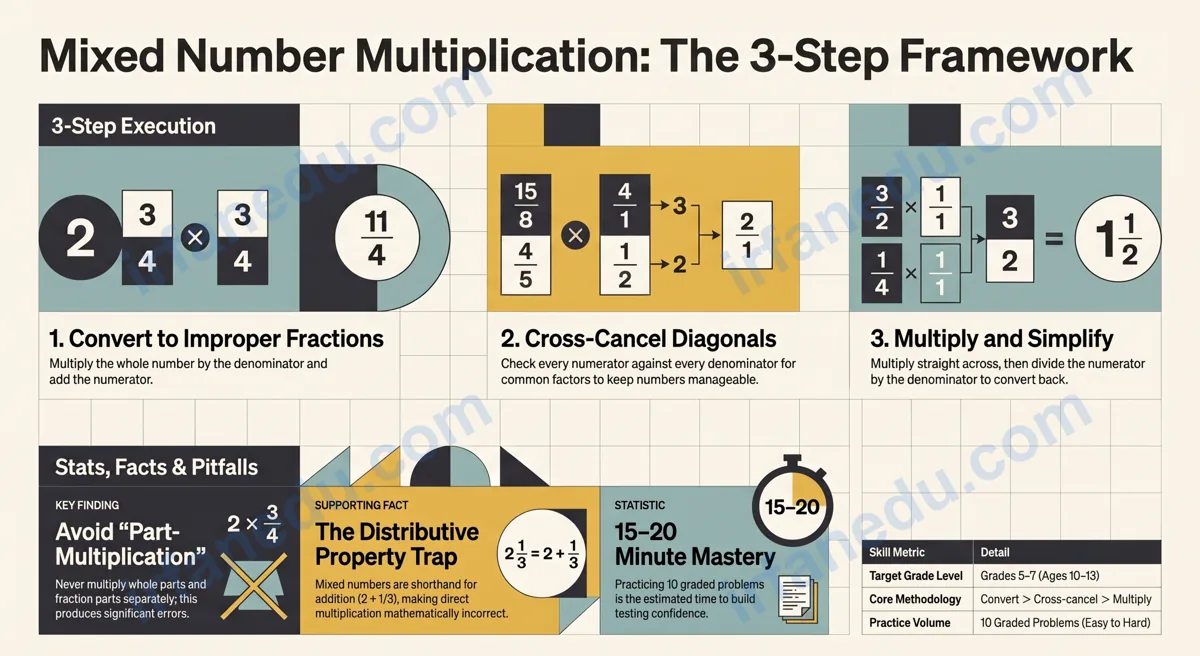
If your student stares at a problem like 2¼ × 1⅔ and freezes, this page fixes that — fast. I have taught fraction multiplication to hundreds of students across grades 5 through 7, and the single biggest unlock is always the same: stop treating mixed numbers as one object and start treating them as a disguised improper fraction.
To multiply mixed numbers, convert each one to an improper fraction, multiply straight across (numerator times numerator, denominator times denominator), simplify the result, and convert back. This three-step routine works for every problem on this worksheet — and on any test.
Below you will find a fast worked example, a slower detailed one, a table of common mistakes, a 10-problem printable worksheet, and a downloadable PDF with a full answer key. Everything you need is on this page.
- Understand what a mixed number is and why it must be converted first.
- Follow a clear four-step method with two fully worked examples.
- Spot and fix the three most common errors students make.
- Practise with 10 graded problems and check your work against the answer key.
Mixed number multiplication always starts with conversion. Once both numbers are improper fractions, the rest is straightforward fraction multiplication you already know.
To multiply mixed numbers: (1) convert each to an improper fraction, (2) cross-cancel any common factors, (3) multiply numerators together and denominators together, (4) simplify and convert back to a mixed number. Example: 1½ × 2⅓ = 3/2 × 7/3 = 21/6 = 3½. This worksheet provides 10 graded problems to practise this exact method.
Free Printable PDF: 10 graded problems + full answer key, formatted for A4 / US Letter. No sign-up required.
TL;DR — Quick Summary
- Convert each mixed number to an improper fraction before doing anything else.
- Multiply numerators together, then denominators together.
- Cross-cancel before multiplying to keep numbers small.
- Simplify the result and convert back to a mixed number.
- Never multiply whole parts and fraction parts separately — that is the top mistake.
- Use the 10-problem worksheet below to build speed and confidence.
| Feature | Detail |
|---|---|
| Skill name | Multiplying mixed numbers |
| Grade level | Grades 5–7 (ages 10–13) |
| Prerequisite skills | Improper fractions, fraction multiplication, simplifying fractions |
| Number of problems | 10 (easy to hard) |
| Estimated practice time | 15–20 minutes |
| PDF format | A4 / US Letter, printable, answer key included |
| Core method | Convert → Cross-cancel → Multiply → Simplify |
What Are Mixed Numbers — and Why Does Multiplication Require Conversion?
A mixed number is a whole number combined with a proper fraction, such as 3¼ or 2⅗. It represents a quantity greater than one whole.
The reason you must convert to an improper fraction before multiplying is that the standard fraction-multiplication rule — multiply numerators, multiply denominators — only works when both values are expressed as single fractions. A mixed number like 2⅓ is actually shorthand for 2 + 1/3, which equals 7/3. If you try to multiply the whole parts and fraction parts separately, you are applying the distributive property incorrectly and will get the wrong answer every time.
Once both mixed numbers are improper fractions, you are doing ordinary fraction multiplication — a skill students already have. The conversion step is the only new piece.
How to Multiply Mixed Numbers: 4-Step Method
Follow these four steps for every problem on this worksheet. I have used this exact sequence with students for over a decade — it is the clearest path from problem to answer.
- Convert: Change each mixed number to an improper fraction using (whole × denominator + numerator) / denominator.
- Cross-cancel: Before multiplying, check whether any numerator shares a factor with either denominator. Divide both by that factor. This is optional but saves simplification work later.
- Multiply: Multiply the two numerators together. Multiply the two denominators together. Write the result as a single fraction.
- Simplify and convert: Reduce the fraction to lowest terms, then divide the numerator by the denominator to get a mixed number (or whole number).
  STEP 1          STEP 2           STEP 3          STEP 4
  Convert         Cross-cancel     Multiply        Simplify

  2 1/4           9/4              9   5           45        1
  -----   -->     ---    -->      --- x --- = ---  -->  5 ---
  1 2/3           5/3              4   3           12        4

  (2x4+1)/4 = 9/4
  (1x3+2)/3 = 5/3

  GCF check: 9 & 3 share factor 3  -->  3/4 x 5/1 = 15/4 = 3 3/4
The visual above shows cross-cancelling in action: 9 and 3 share a factor of 3, so you divide both by 3 before multiplying. The numbers stay smaller and the final simplification is trivial.
Worked Example 1: Quick Walkthrough (1½ × 2⅓)
This is the fastest version of the method — ideal for students who already understand the concept and want to see the steps at speed.
Problem: 1½ × 2⅓
Total time for a practised student: under 30 seconds. The cross-cancel in step 2 is what keeps the numbers manageable.
In my experience, students who skip the cross-cancel step are not wrong — they just create harder arithmetic for themselves at the end. I always tell my students: cross-cancelling is not a shortcut, it is a time-saver. On a timed test, those saved seconds add up. Make it a habit from problem one.
Worked Example 2: Full Detailed Solution (3¾ × 2⅖)
This example uses larger numbers and shows every sub-step explicitly — useful for students who are still building confidence with the method.
Problem: 3¾ × 2⅖
Convert 2⅖: whole 2 × denominator 5 = 10. Add numerator 2: 10 + 2 = 12. Result: 12/5.
• 15 and 5 share a factor of 5: 15 ÷ 5 = 3; 5 ÷ 5 = 1.
• 4 and 12 share a factor of 4: 12 ÷ 4 = 3; 4 ÷ 4 = 1.
After cross-cancelling: 3/1 × 3/1.
Notice that aggressive cross-cancelling turned what looked like a messy problem into 3 × 3 = 9. This is the payoff of step 2 — and it is the kind of result that surprises students who expected a complicated fraction at the end.
You will find this exact problem as Problem 6 on the worksheet below (3¾ × 2⅖ = 9). Check your work against it.
Common Mistakes: What Goes Wrong and How to Fix It
These three errors appear in almost every batch of student work I mark. Recognising them is half the battle.
| Wrong approach | Correct approach |
|---|---|
| Multiplying parts separately: 2½ × 3¼ treated as (2×3) + (½×¼) = 6⅛ (wrong) | Convert first: 5/2 × 13/4 = 65/8 = 8⅛ (correct) |
| Forgetting to convert back: leaving the answer as 21/6 instead of simplifying to 3½ | Always divide numerator by denominator and express as a mixed number or whole number |
| Cross-cancelling across the same fraction: cancelling numerator and denominator of the same fraction (that is just simplifying, not cross-cancelling) | Cross-cancel only between a numerator of one fraction and a denominator of the other fraction |
Most worksheet sites teach cross-cancelling as a single diagonal move (top-left with bottom-right). In my experience, this framing causes students to miss the second cancellation opportunity — between the other diagonal (top-right with bottom-left). The correct mental model is: check every numerator against every denominator, not just one pair. In Example 2 above, both diagonals cancel, turning 15/4 × 12/5 into 3/1 × 3/1 = 9 in two moves. Students who only check one diagonal would have multiplied 15 × 12 = 180 and 4 × 5 = 20, then simplified 180/20 — arriving at the same answer but doing far more work. Teaching both diagonals explicitly is the single biggest time-saving upgrade for this skill.
On-Page Practice Worksheet (10 Problems)
Work through all 10 problems below. Show your steps — convert, cross-cancel, multiply, simplify. Problems are ordered easy to hard. When you are done, open the answer key to check your work.
Instructions: Multiply each pair of mixed numbers. Convert to improper fractions first. Simplify all answers and write them as mixed numbers (or whole numbers where appropriate).
- 1½ × 2⅓ = ___
- 2¼ × 1⅓ = ___
- 1¾ × 2⅖ = ___
- 3½ × 1&frac27; = ___
- 2⅔ × 1½ = ___
- 3¾ × 2⅖ = ___
- 4½ × 2⅔ = ___
- 2⅚ × 3⅗ = ___
- 5⅓ × 2⅝ = ___
- 3⅞ × 4⅘ = ___
Show Answer Key
- 3½
- 3
- 4⅕
- 4½
- 4
- 9
- 12
- 10⅕
- 14
- 18⅗
How to use this worksheet: print the PDF (or work on-screen), attempt all problems without looking at the answers, then open the answer key to self-check. For any problem you got wrong, re-work it step by step using the method above before moving on.
Want a clean printable copy? Download the free PDF — 10 problems on page 1, full answer key on page 2. No sign-up needed.
Reveal-and-Check Practice Problems
Try each problem on your own first, then click to reveal the full worked solution.
Practice: 2¼ × 1⅓ — click to see full solution
Step 2 — Cross-cancel: 9 and 3 share factor 3: 9÷3=3, 3÷3=1. Also 4 and 4 share factor 4: 4÷4=1, 4÷4=1. New: 3/1 × 1/1
Step 3 — Multiply: 3×1=3, 1×1=1. Result: 3/1
Step 4 — Convert: 3/1 = 3 (whole number)
Practice: 2⅚ × 3⅗ — click to see full solution
Step 2 — Cross-cancel: 17 is prime, no cancellation with 5. 18 and 6 share factor 6: 18÷6=3, 6÷6=1. New: 17/1 × 3/5
Step 3 — Multiply: 17×3=51, 1×5=5. Result: 51/5
Step 4 — Convert: 51÷5 = 10 remainder 1. Answer: 10⅕
Practice: 3⅞ × 4⅘ — click to see full solution
Step 2 — Cross-cancel: 31 is prime. 24 and 8 share factor 8: 24÷8=3, 8÷8=1. New: 31/1 × 3/5
Step 3 — Multiply: 31×3=93, 1×5=5. Result: 93/5
Step 4 — Convert: 93÷5 = 18 remainder 3. Answer: 18⅗
Build on your fraction skills with geometry formulas — another high-value free resource on IrfanEdu.
Quick Quiz: Test Your Understanding
Q1. What is the first step when multiplying two mixed numbers?
Q2. What is 1½ × 2⅓?
Q3. A student calculates 2½ × 3¼ as (2×3) + (½×¼) = 6⅛. What error did they make?
I have seen students ace fraction addition and subtraction but stumble on multiplication because they assume the rules work the same way. They do not. Fraction addition needs a common denominator; fraction multiplication does not. The convert-and-multiply method is actually simpler — but only if you commit to the conversion step every single time. My advice: write the improper fractions on the line above the problem before you do anything else. That physical act prevents the “multiply parts separately” error almost entirely.
Frequently Asked Questions
How do you multiply mixed numbers step by step?
Convert each mixed number to an improper fraction using (whole × denominator + numerator) / denominator. Then cross-cancel any common factors between numerators and denominators. Multiply the numerators together and the denominators together. Finally, simplify the resulting fraction and convert it back to a mixed number by dividing numerator by denominator.
Can you multiply mixed numbers without converting to improper fractions?
You can use the distributive property — for example, 2⅓ × 1½ = (2 + 1/3) × 3/2 — but this approach is slower and more error-prone. The convert-first method is the standard taught in schools because it is reliable and fast. I recommend the conversion method for all students up to grade 9.
What grade level is mixed number multiplication?
Mixed number multiplication is typically introduced in Grade 5 and consolidated in Grades 6 and 7. It builds directly on improper fractions and fraction multiplication (Grade 4–5 skills) and feeds into ratio, proportion, and algebraic expressions in Grades 7–8. This worksheet targets the Grade 5–7 range.
How do you simplify before multiplying mixed numbers?
After converting to improper fractions, look for a common factor between any numerator and any denominator — including across the two fractions (cross-cancelling). Divide both numbers by that factor. You can do this for both diagonals. This reduces the size of numbers you multiply and often eliminates the need for a separate simplification step at the end.