
One Grand Central Place: The Complete Place Value Guide
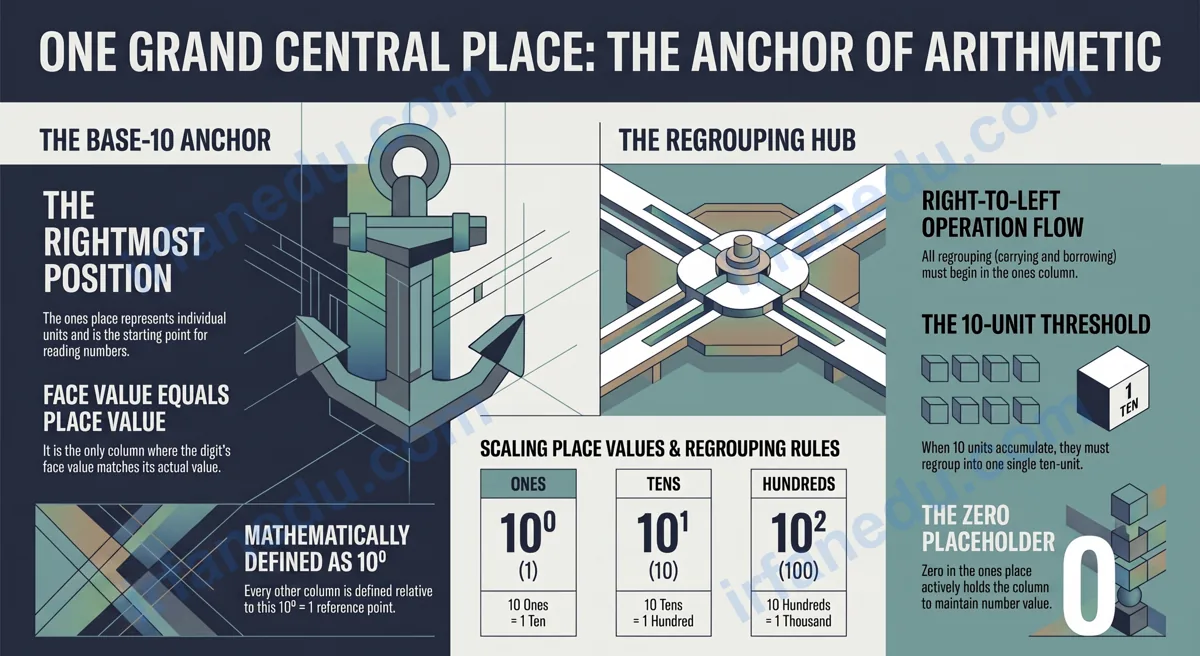
One grand central place is the ones column on a place value mat — the rightmost position in any whole number. Every digit placed there represents that many individual units. It is the starting point for reading, writing, and calculating with numbers in the base-10 system.
If you have ever watched a student confidently write “30” when they meant “3,” or seen a child add 47 + 35 and get 712, the ones place is almost always where the confusion began. Understanding the ones column is not just a kindergarten milestone — it is the foundation every multi-digit calculation stands on.
In my experience teaching elementary and middle school math, students who truly understand the ones place make far fewer errors in addition, subtraction, and even long division. This guide walks through the concept from the simplest definition all the way to regrouping in multi-digit arithmetic, using a progressive-difficulty structure so you can start exactly where you need to.
- Understand what “one grand central place” means and where it sits on a number line and place value mat.
- See why the ones place anchors the entire base-10 number system.
- Follow step-by-step instructions for using a place value mat correctly.
- Work through examples from single-digit numbers up to regrouping in four-digit addition.
- Identify and correct the six most common ones-place mistakes students make.
The ones place is not just the “first column” — it is the reference point from which every other place value is defined. Master it here, and every column to the left becomes predictable.
One grand central place is the ones place — the rightmost column on a place value mat. A digit there represents that many single units (ones), with no multiplication by ten. It anchors the entire base-10 system: tens, hundreds, and thousands are simply the ones place scaled by successive powers of ten. Regrouping in addition and subtraction always starts here.
⚡ TL;DR – Quick Summary
- The ones place is the rightmost digit in any whole number.
- A digit there equals its face value — no multiplication needed.
- All other place values are the ones place times a power of ten.
- Regrouping (carrying/borrowing) always starts in the ones column.
- A place value mat makes the ones column concrete and visual.
- Misreading the ones place is the root cause of most early arithmetic errors.
Quick Facts: The Ones Place at a Glance
| Property | Detail |
|---|---|
| Position on place value mat | Rightmost column (position 1) |
| Place value multiplier | 10⁰ = 1 |
| Valid digits | 0, 1, 2, 3, 4, 5, 6, 7, 8, 9 |
| Regrouping threshold | 10 ones = 1 ten (carry left) |
| Also called | Units place, ones column, units digit |
| Grade level introduced | Kindergarten / Grade 1 (US curriculum) |
| Common classroom tool | Place value mat, base-ten blocks, abacus |
Level 1 — What Is the Ones Place?
The ones place is the rightmost digit in any whole number, and it tells you how many single units that number contains beyond any groups of ten. In the number 6, the digit 6 sits in the ones place and means exactly six individual things — six apples, six steps, six seconds.
The term “one grand central place” is a classroom phrase used in US elementary curricula to make the ones column memorable. Think of it like a busy train station: all number traffic — adding, subtracting, regrouping — starts and ends at the ones column before moving left to tens and hundreds.
Simple Example: The Number 9
Write the number 9 on a place value mat. There is only one column needed: the ones column. The digit 9 means nine individual units. No tens, no hundreds — just nine ones.
Now write 19. The 9 is still in the ones place (nine units), and the 1 moves to the tens place (one group of ten). The ones digit did not change its meaning — it still means nine single units.
This is the most important early insight: a digit’s meaning depends entirely on which column it occupies. The digit 9 in the ones place = 9. The digit 9 in the tens place = 90. Same digit, completely different value.
[IMAGE: A simple place value mat showing the number 19 with 1 in the tens column and 9 in the ones column, labeled clearly | ALT: place value mat showing 19 with ones and tens columns labeled for students]
Level 2 — Why Is the Ones Place the Anchor of the Number System?
The ones place is the anchor because every other place value is defined relative to it. The tens place is 10 times the ones place. The hundreds place is 100 times the ones place. The thousands place is 1,000 times the ones place. Remove the ones column and the entire structure collapses.
Mathematically, the ones place corresponds to 10⁰ = 1. Every place to the left is 10¹, 10², 10³, and so on. This exponential pattern is what makes base-10 arithmetic so efficient — you only need ten symbols (0–9) to represent any number, no matter how large.
In my experience, the “grand central” metaphor works because students already understand that a central hub is where everything connects. When I tell a class that the ones column is the Grand Central Station of math — where all regrouping trains depart and arrive — they immediately grasp why we start addition and subtraction there, not in the middle of a number. It turns an abstract rule into a spatial story.
Here is the key structural fact: the ones place is the only column where the digit’s face value and place value are identical. A 7 in the ones place is worth exactly 7. A 7 in the tens place is worth 70. A 7 in the hundreds place is worth 700. The ones place is the one place where what you see is exactly what you get.
Level 3 — How to Use a Place Value Mat (Step-by-Step)
A place value mat is a labeled grid with columns for Ones, Tens, Hundreds, Thousands, and beyond, used to build and read numbers by placing digit tiles or counters in the correct columns. Here is how to use it correctly.
- Set up the mat. Lay out a place value mat with columns labeled from right to left: Ones, Tens, Hundreds, Thousands. The ones column is always on the right.
- Write or say the number. Take the number 347. Identify each digit: 3, 4, 7.
- Find the ones digit. The rightmost digit is 7. Place a tile labeled “7” in the Ones column.
- Fill the remaining columns. Place “4” in the Tens column and “3” in the Hundreds column.
- Read the number aloud. Read left to right: 3 hundreds, 4 tens, 7 ones = three hundred forty-seven.
- Check by expanding. Write the expanded form: 300 + 40 + 7 = 347. The ones digit (7) contributes exactly 7 to the total.
When reading a number, start from the leftmost digit (highest place value) and move right. When adding or subtracting, start from the rightmost digit (ones place) and move left. These two directions are opposite — and confusing them is one of the most common student errors.
┌──────────────┬──────────────┬──────────────┐
│  HUNDREDS    │    TENS      │    ONES      │
│              │              │  ← Grand     │
│      3       │      4       │  Central     │
│              │              │      7       │
├──────────────┼──────────────┼──────────────┤
│  3 × 100     │  4 × 10      │  7 × 1       │
│  = 300       │  = 40        │  = 7         │
└──────────────┴──────────────┴──────────────┘
   300    +      40      +      7   =  347
Level 4 — Worked Examples: Reading the Ones Place in Real Numbers
Reading the ones place correctly is the first skill — here are four worked examples at increasing complexity so you can see the pattern at every level.
Example 1: Single-Digit Number — 8
The number 8 has only one digit. That digit sits in the ones place. Its value = 8 × 1 = 8. There are no tens or hundreds.
Example 2: Two-Digit Number — 53
In 53, the digit 3 is in the ones place. Its value = 3 × 1 = 3. The digit 5 is in the tens place and contributes 50. Total: 50 + 3 = 53.
Example 3: Three-Digit Number — 209
In 209, the digit 9 is in the ones place (value = 9). The digit 0 is in the tens place (value = 0). The digit 2 is in the hundreds place (value = 200). Total: 200 + 0 + 9 = 209. Notice: the zero in the tens place is a placeholder — it holds the column open so the 2 stays in hundreds, not tens.
Example 4: Four-Digit Number — 4,071
In 4,071, the digit 1 is in the ones place (value = 1). The digit 7 is in the tens place (value = 70). The digit 0 is in the hundreds place (value = 0 — placeholder). The digit 4 is in the thousands place (value = 4,000). Total: 4,000 + 0 + 70 + 1 = 4,071.
Level 5 — Regrouping from the Ones Place (Carrying and Borrowing)
Regrouping is what happens when the ones column overflows during addition or runs short during subtraction — and it always starts in the ones place. This is the most important operational skill tied to the ones column.
Carrying (Addition)
When the sum of the ones digits is 10 or more, you carry 1 ten to the tens column and keep the remainder in the ones column.
Worked Example: 47 + 35
Step 1 — Add the ones: 7 + 5 = 12. That is 1 ten and 2 ones. Write 2 in the ones column, carry 1 to the tens column.
Step 2 — Add the tens: 4 + 3 + 1 (carried) = 8. Write 8 in the tens column.
Result: 82.
If a student writes 712 instead of 82, they forgot to regroup — they wrote both digits of 12 side by side instead of carrying the 1.
Borrowing (Subtraction)
When the ones digit of the top number is smaller than the ones digit of the bottom number, you borrow 1 ten from the tens column, converting it into 10 ones and adding them to the ones column.
Worked Example: 63 − 28
Step 1 — Check the ones: 3 − 8 is not possible without borrowing. Borrow 1 ten from the tens column. The tens digit drops from 6 to 5. The ones digit becomes 13.
Step 2 — Subtract the ones: 13 − 8 = 5. Write 5 in the ones column.
Step 3 — Subtract the tens: 5 − 2 = 3. Write 3 in the tens column.
Result: 35.
In my experience, the single most common regrouping error is not forgetting to carry — it is forgetting to reduce the tens digit after borrowing. Students borrow the 10 ones but leave the tens digit unchanged. I fix this by having students physically cross out the tens digit and write the new (smaller) number above it before touching the ones column. That physical act of crossing out makes the change visible and memorable.
Level 6 — Common Mistakes with the Ones Place (Wrong vs. Right)
These six mistakes account for the majority of place-value errors I have seen in student work. Each one has a clear fix.
| Mistake | What the Student Does | Correct Approach |
|---|---|---|
| Reversed digit order | Writes 73 when they mean 37 (swaps ones and tens) | Always write from the highest place value left to right; ones digit is always last (rightmost) |
| Skipping the zero placeholder | Writes 47 instead of 407 (drops the zero in tens) | Zero is a placeholder; it must fill any empty column between non-zero digits |
| Forgetting to carry | Adds 47 + 35 and writes 712 instead of 82 | When ones sum ≥ 10, write the units digit and carry the ten to the next column |
| Not reducing after borrowing | Borrows 10 ones but leaves tens digit unchanged | Cross out the tens digit and write the new (tens − 1) value before subtracting ones |
| Misidentifying the ones digit | In 4,071 thinks the ones digit is 4 (leftmost) | The ones digit is always the rightmost digit in a whole number |
| Confusing face value and place value | Says the 5 in 52 is worth 5 (not 50) | Only in the ones place does face value = place value; in all other columns, multiply by the place multiplier |
Zero in the ones place does not mean “no number” — it means “zero units.” The number 50 has a zero in the ones place, which is essential: without it, 50 would become 5. Zero is an active placeholder, not an absence.
Ones vs. Other Place Values: Full Comparison Table
This table shows how the ones place compares to every other column in a standard seven-digit number, making the pattern of powers of ten explicit and easy to memorize.
| Place Name | Position (from right) | Multiplier | Example digit: 3 | Regrouping rule |
|---|---|---|---|---|
| Ones | 1st | 10⁰ = 1 | 3 | 10 ones = 1 ten |
| Tens | 2nd | 10¹ = 10 | 30 | 10 tens = 1 hundred |
| Hundreds | 3rd | 10² = 100 | 300 | 10 hundreds = 1 thousand |
| Thousands | 4th | 10³ = 1,000 | 3,000 | 10 thousands = 1 ten-thousand |
| Ten-Thousands | 5th | 10⁴ = 10,000 | 30,000 | 10 ten-thousands = 1 hundred-thousand |
| Hundred-Thousands | 6th | 10⁵ = 100,000 | 300,000 | 10 hundred-thousands = 1 million |
| Millions | 7th | 10⁶ = 1,000,000 | 3,000,000 | 10 millions = 1 ten-million |
Notice the pattern: every column is exactly ten times the column to its right. The ones place (10⁰ = 1) is the base of this entire exponential tower. That is why it is called “grand central” — everything else is built on top of it.
💡 Unique Insight: What Most Place Value Guides Get Wrong
Most guides teach the ones place as simply “the last digit.” That framing is correct but incomplete — and it causes a subtle problem. Students learn to identify the ones digit by its position, but not by its meaning. When they later encounter decimals (0.7) or negative exponents, they have no conceptual anchor because they were never taught that the ones place is specifically 10⁰ = 1.
In my experience, teaching the ones place as “the column where the multiplier equals 1” from the very beginning — even in Grade 1, using the language “each block here is worth exactly one, no more, no less” — dramatically reduces confusion when decimals arrive. The tenths place (10⁻¹ = 0.1) then makes intuitive sense as “one step smaller than the ones place,” rather than appearing out of nowhere. The ones place is not just the rightmost whole-number column; it is the pivot point of the entire number line, with whole-number places to its left and decimal places to its right.
Quick Quiz: Test Your Ones-Place Knowledge
Q1. What is the value of the digit 6 in the number 364?
Q2. You add 58 + 27. What do you write in the ones column of the answer?
Q3. Which digit is in the ones place in the number 4,070?
Practice Problems (Click to Reveal)
Problem 1: What is the ones digit in 8,305?
Answer: 5.
In 8,305, reading right to left: 5 is in the ones place, 0 is in the tens place, 3 is in the hundreds place, and 8 is in the thousands place. The ones digit is 5, and its value = 5 × 1 = 5.
Problem 2: Add 76 + 48. Show the ones-column step.
Ones column: 6 + 8 = 14. Write 4 in the ones column, carry 1 to the tens column.
Tens column: 7 + 4 + 1 (carried) = 12. Write 2 in the tens column, carry 1 to the hundreds column.
Hundreds column: 0 + 0 + 1 (carried) = 1. Write 1 in the hundreds column.
Answer: 124.
Problem 3: Subtract 82 − 47. Show the borrowing step.
Ones column: 2 − 7 is not possible. Borrow 1 ten from the tens column. Tens digit drops from 8 to 7. Ones digit becomes 12.
Ones column (after borrowing): 12 − 7 = 5. Write 5 in the ones column.
Tens column: 7 − 4 = 3. Write 3 in the tens column.
Answer: 35.
Problem 4: Write 2,046 in expanded form. What does the ones digit contribute?
Expanded form: 2,000 + 0 + 40 + 6 = 2,046.
The ones digit is 6. Its contribution = 6 × 1 = 6. The zero in the hundreds place is a placeholder contributing 0 × 100 = 0.
Frequently Asked Questions
What is one grand central place in math?
One grand central place refers to the ones place — the rightmost column on a place value mat. A digit there represents that many single units. It is the anchor of the base-10 number system because every other place value is simply the ones place multiplied by a power of ten. Regrouping in addition and subtraction always starts here.
Why is the ones place called “grand central”?
The term “grand central” is a classroom metaphor — like a busy train hub, the ones place is where all regrouping traffic starts and ends. When you add or subtract, carrying and borrowing always begin in the ones column before moving left to tens, hundreds, and beyond. It makes the concept memorable for young students.
What is the value of the digit 7 in the ones place?
A digit in the ones place has a face value equal to its actual value. The digit 7 in the ones place equals exactly 7 (7 × 1 = 7). No multiplication by ten is applied. This is the only column in the place value system where face value and place value are identical.
How does the ones place relate to the tens place?
The tens place is the ones place scaled up by a factor of ten. When you collect 10 ones, they regroup into 1 ten. This regrouping rule — 10 of any place makes 1 of the next — is the core mechanic of the entire base-10 number system. Every column to the left is ten times the column to its right.
What is a place value mat and how does the ones column work on it?
A place value mat is a classroom tool with labeled columns (Ones, Tens, Hundreds, Thousands, etc.) where students place digit tiles or counters to build and read numbers. The ones column is always on the far right. Students place the rightmost digit of any number in this column, making abstract place value concrete and visual.
Can a digit in the ones place be greater than 9?
No. In standard base-10 notation, each place can only hold a single digit from 0 to 9. If you accumulate 10 or more ones during addition, you must regroup: 10 ones become 1 ten, which moves to the tens column. This is the carrying rule and it always starts in the ones place.
Sources & References
Written and fact-checked by Dr Irfan Mansuri. External links open in a new tab and are provided for further reading and verification.