
19th Century Painting: A Complete Student Guide to Every Major Movement
🗺️ Your Guided Tour — What’s Inside
- Introduction: Why This Century Changed Art Forever
- Quick Answer
- TL;DR – Quick Summary
- Quick Facts Table
- What Is 19th Century Painting?
- Stop 1 – Neoclassicism: Order and Ancient Ideals
- Stop 2 – Romanticism: Emotion and the Sublime
- Stop 3 – Realism: Painting the Ordinary
- Stop 4 – Impressionism: Light, Colour, and the Moment
- Stop 5 – Post-Impressionism: Personal Expression Takes Over
- Key Techniques Compared
- How to Analyse a 19th Century Painting (Step-by-Step)
- Common Mistakes Students Make
- 💡 Unique Insight
- Quick Quiz
- Practice Problems
- FAQ
- Key Takeaways
- Related Articles
- About the Author
- Sources & References
Don’t worry — 19th century painting is not as overwhelming as it looks in a textbook. I’m going to walk you through the whole century like a guided museum tour: five stops, five movements, and by the end you’ll be able to look at almost any painting from 1800–1900 and know exactly where it fits.
This century is one of the most dramatic in all of art history. In just 100 years, painting went from polished mythological scenes in the style of ancient Rome to wild swirls of colour that barely look like anything at all. That shift didn’t happen by accident — it was driven by revolution, industrialisation, and a complete rethinking of what art is for.
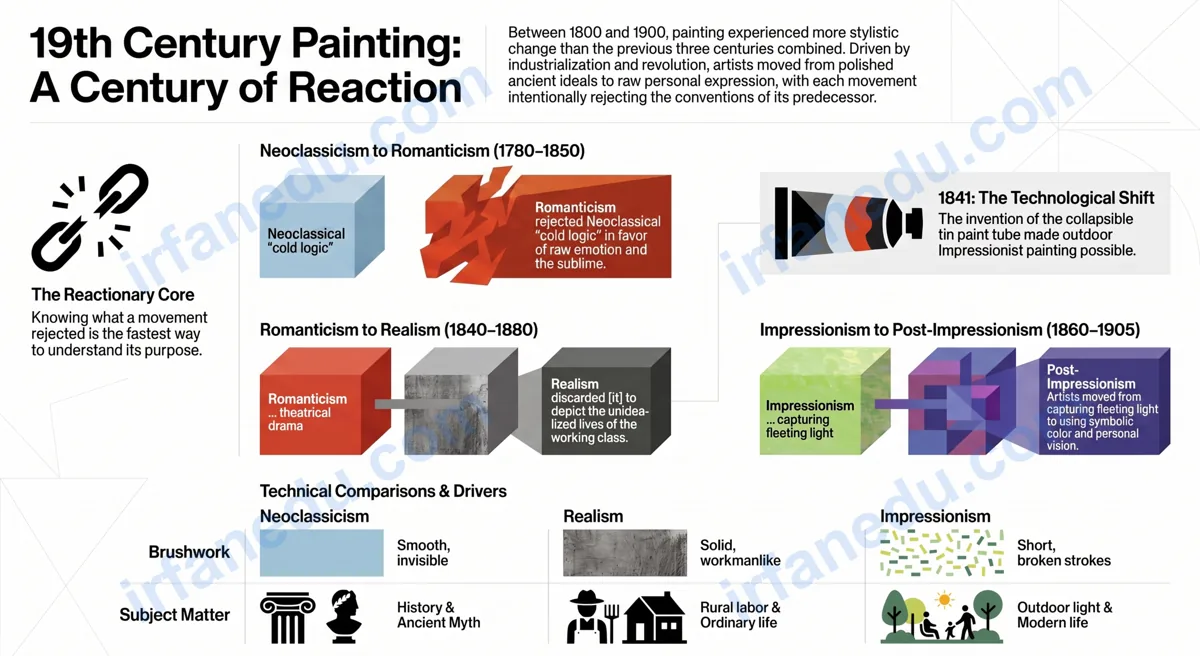
19th century painting (1800–1900) encompasses five major movements — Neoclassicism, Romanticism, Realism, Impressionism, and Post-Impressionism — each reacting against the one before it. Together they document how artists responded to industrialisation, political upheaval, and new scientific ideas about light and perception.
By the end of this guide, you will be able to:
- Name and describe all five major 19th century painting movements
- Identify key artists and signature works for each movement
- Explain the historical forces that drove each shift in style
- Analyse a painting using a clear five-step method
- Avoid the most common mistakes students make on art history exams
⚡ TL;DR – Quick Summary
- 🎨 Five major movements: Neoclassicism, Romanticism, Realism, Impressionism, Post-Impressionism
- 📅 Each movement spans roughly 20–40 years and overlaps with the next
- 🏛️ Neoclassicism = ancient Greece/Rome; Romanticism = emotion and nature
- 👷 Realism = working-class subjects; Impressionism = outdoor light and colour
- 🌀 Post-Impressionism = personal vision; seeds of modern art planted here
- 🔍 Every movement was a direct reaction to the social and political events of its time
📋 Quick Facts Table
| Period covered | 1800–1900 (19th century) |
| Number of major movements | 5 (Neoclassicism, Romanticism, Realism, Impressionism, Post-Impressionism) |
| Most influential country | France (Paris was the global art capital) |
| Key institution | The Paris Salon — official annual exhibition that controlled taste |
| Defining technology | The collapsible tin paint tube (invented 1841) — enabled outdoor painting |
| Most studied movement (US curriculum) | Impressionism |
| Bridge to modern art | Post-Impressionism (Cézanne directly influenced Cubism) |
What Is 19th Century Painting — and Why Does It Matter?
19th century painting is the body of visual art produced between 1800 and 1900, primarily in Europe and North America. It matters because this single century contains more stylistic change than the previous three centuries combined.
Before 1800, the dominant force in Western painting was the Royal Academy system — a network of official art schools and annual exhibitions that enforced strict rules about what “good” painting looked like. Subjects had to be noble: history, mythology, religion. Technique had to be smooth and invisible. The artist’s hand was not supposed to show.
The 19th century blew all of that apart. The French Revolution (1789), the Industrial Revolution, the rise of photography (1839), and a wave of democratic and nationalist movements all forced artists to ask a new question: If the old world is gone, what should art look like now?
The five movements that followed are each a different answer to that question.
[IMAGE: A timeline graphic showing five movements from 1800 to 1900 with one representative painting per movement | ALT: 19th century painting movements timeline Neoclassicism to Post-Impressionism]
Stop 1 – Neoclassicism: What Did Order and Ancient Ideals Look Like in Paint?
Neoclassicism (roughly 1780–1850) was the dominant style at the century’s opening, and it looked to ancient Greece and Rome for its ideals of beauty, order, and civic virtue. The style was already mature by 1800 but remained powerful well into the century, especially in official and academic painting.
The defining painter is Jacques-Louis David (1748–1825). His 1784 masterpiece Oath of the Horatii — painted before the century technically began — set the template: heroic male figures, a shallow stage-like composition, hard clear outlines, muted earthy tones, and a moral message about duty over personal feeling.
David painted his murdered friend Jean-Paul Marat as a secular martyr — calm, pale, almost Christ-like in a bathtub. The composition is deliberately simple: a dark upper half, a lit lower half, no distracting background. The smooth, almost sculptural brushwork makes Marat look like a Roman statue. This is Neoclassicism’s core trick: take a current political event and give it the visual weight of ancient history.
David’s student Jean-Auguste-Dominique Ingres (1780–1867) pushed Neoclassicism further into the century. Ingres was obsessed with line — he believed a perfectly drawn contour was the highest achievement in painting. His portraits and odalisques (reclining female figures) have a porcelain smoothness that almost looks like early photography.
Historical driver: Napoleon Bonaparte actively promoted Neoclassicism as state propaganda. Ancient Rome was the model for his empire, so Roman-style painting was politically useful. After Napoleon’s fall, Neoclassicism lost its political patron but survived in the academy system for decades.
Stop 2 – Romanticism: How Did Painters Capture Emotion and the Sublime?
Romanticism (roughly 1800–1850) was a direct revolt against Neoclassicism’s cool rationalism. Romantic painters believed that emotion, imagination, and the raw power of nature were more truthful than any ancient ideal.
In France, Eugène Delacroix (1798–1863) was the movement’s champion. His 1830 painting Liberty Leading the People is the most famous Romantic image in the world: a bare-breasted allegorical figure of Liberty charges over a barricade of dead bodies, French tricolour raised, smoke filling the air. The composition is chaotic, the colours are hot and clashing, and the brushwork is loose and energetic — everything Ingres hated.
► MY POV: In my experience teaching art history, students often think Romanticism means “romantic” as in love and roses. It doesn’t. The Romantic movement is about the sublime — the terrifying, awe-inspiring power of nature and human passion. Delacroix’s paintings feel like they’re about to explode off the canvas. That energy is the whole point.
In Germany, Caspar David Friedrich (1774–1840) took Romanticism in a quieter, more spiritual direction. His Wanderer above the Sea of Fog (c. 1818) shows a lone figure from behind, standing on a rocky peak above swirling clouds. The human is small; nature is vast and unknowable. Friedrich used landscape to explore existential questions about mortality and the individual’s place in the universe.
In Britain, J.M.W. Turner (1775–1851) pushed paint to its atmospheric limits. His late seascapes dissolve ships and storms into vortices of yellow and white light. Turner was so ahead of his time that Monet — seeing his work in London — later cited him as an influence on Impressionism.
Historical driver: The Napoleonic Wars, the failure of the French Revolution to deliver on its ideals, and the dehumanising early stages of the Industrial Revolution all fed Romanticism’s distrust of pure reason and its hunger for feeling, nature, and individual experience.
Stop 3 – Realism: Why Did Painters Start Depicting Ordinary People?
Realism (roughly 1840–1880) rejected both the ancient grandeur of Neoclassicism and the theatrical emotion of Romanticism. Realist painters looked at the world around them — specifically at the working class and rural poor — and painted what they saw, without flattery or drama.
Gustave Courbet (1819–1877) is Realism’s defining figure. His 1849–50 painting A Burial at Ornans caused a scandal at the Paris Salon: it depicted an ordinary village funeral at the monumental scale (over 21 feet wide) previously reserved for historical and religious subjects. Critics were outraged. Courbet was delighted. He called himself a “Realist” as a provocation — a declaration that peasants and gravediggers deserved the same artistic attention as emperors and gods.
Jean-François Millet painted three peasant women bent over a harvested field, picking up leftover grain. The composition is low and horizontal; the women’s backs are turned to us; there is no heroism, no drama. The earthy palette — ochre, brown, dusty gold — matches the labour. Middle-class Salon visitors found it politically threatening. Millet found it simply true. This is Realism’s core argument: truth is more powerful than beauty.
In the United States, Winslow Homer (1836–1910) brought Realism to scenes of Civil War soldiers and New England fishermen. His work shows that Realism was a global attitude, not just a French one.
Historical driver: The 1848 revolutions across Europe, the rapid growth of industrial cities, and the rise of socialist political thought all pushed artists to look at who was actually doing the work of society — and to ask why they had never been the subject of serious art.
Stop 4 – Impressionism: How Did Painters Capture Light and the Fleeting Moment?
Impressionism (roughly 1860–1890) is the most widely recognised 19th century movement, and it changed painting more fundamentally than anything before it. Impressionist painters moved out of the studio and into the open air, trying to capture the way light actually looks at a specific moment — not how an object “really” is, but how it appears to the eye right now.
Claude Monet (1840–1926) is the movement’s most iconic figure. His Impression, Sunrise (1872) — a hazy harbour scene in orange and blue — gave the movement its name when a critic used it as a mockery. Monet spent decades painting the same subjects (haystacks, Rouen Cathedral, water lilies) at different times of day to show how light, not form, is the true subject of painting.
Pierre-Auguste Renoir (1841–1919) brought Impressionism to scenes of Parisian social life — outdoor cafés, dance halls, boating parties. His Luncheon of the Boating Party (1880–81) is a masterclass in dappled light and relaxed human warmth.
Berthe Morisot (1841–1895) and Mary Cassatt (1844–1926) are essential Impressionists whose work is often underrepresented in textbooks. Morisot’s domestic scenes and Cassatt’s intimate mother-and-child paintings brought Impressionism’s techniques to subjects that male painters rarely explored with the same depth.
► MY POV: Most guides focus on Monet and Renoir and leave it there. But in my experience, the most interesting Impressionist for students to study is Edgar Degas (1834–1917). Degas rejected the “en plein air” label — he worked mostly indoors, under artificial light, painting ballet dancers and café scenes with a photographer’s eye for unusual angles and cropped compositions. He proves that Impressionism was never one thing; it was a shared attitude toward observation, not a single technique.
The key technical innovation: The collapsible tin paint tube, invented in 1841, made outdoor painting practical for the first time. Before tubes, paint came in animal bladders that dried out quickly. This single piece of technology helped make Impressionism physically possible.
Historical driver: The invention of photography (1839) forced painters to ask: if a machine can record reality perfectly, what is painting for? The Impressionists’ answer was: painting can show what the camera cannot — the subjective, sensory, emotional experience of seeing.
Stop 5 – Post-Impressionism: How Did Personal Expression Take Over?
Post-Impressionism (roughly 1880–1905) is not a single movement but a label for the generation of painters who built on Impressionism and then pushed far beyond it. Each Post-Impressionist took a different path, and together they planted the seeds of every major 20th century art movement.
Vincent van Gogh (1853–1890) used colour and brushwork as pure emotional language. His The Starry Night (1889) is not a realistic sky — it is a psychological state. The swirling lines and intense blues and yellows express inner turbulence with a directness that no Impressionist had attempted.
Paul Cézanne (1839–1906) was obsessed with structure. He painted Mont Sainte-Victoire dozens of times, not to capture light but to analyse how three-dimensional form could be rebuilt on a flat canvas using geometric planes of colour. Picasso and Braque studied Cézanne obsessively before inventing Cubism.
Georges Seurat (1859–1891) developed Pointillism — applying tiny dots of pure colour that the viewer’s eye blends at a distance. His A Sunday on La Grande Jatte (1884–86) is one of the most technically ambitious paintings of the century.
Paul Gauguin (1848–1903) rejected European civilisation and moved to Tahiti, using bold flat colours and simplified forms inspired by non-Western art. His work raised important questions about cultural appropriation that are still debated today.
[IMAGE: Side-by-side comparison of Van Gogh’s Starry Night swirling brushwork vs Seurat’s pointillist dots | ALT: Post-Impressionism techniques comparison Van Gogh vs Seurat]
How Do the Key Techniques Compare Across All Five Movements?
Technique is the fastest way to identify a movement when you see a painting. The table below gives you a direct comparison you can use in any exam or essay.
| Movement | Brushwork | Colour Palette | Typical Subject | Key Technique |
|---|---|---|---|---|
| Neoclassicism | Smooth, invisible | Muted, earthy, controlled | History, mythology, civic virtue | Perfect contour drawing; chiaroscuro |
| Romanticism | Loose, expressive, visible | Hot, dramatic contrasts | Nature, emotion, history, the exotic | Dynamic composition; impasto highlights |
| Realism | Solid, workmanlike | Earthy, unidealized | Working-class life, rural labour | Unflattering observation; monumental scale |
| Impressionism | Short, broken, visible strokes | Pure, unmixed, bright | Outdoor scenes, leisure, modern life | En plein air; optical colour mixing |
| Post-Impressionism | Varies by artist | Symbolic, intense, personal | Landscape, portraiture, inner states | Pointillism; geometric planes; bold outline |
How Do You Analyse a 19th Century Painting? (Step-by-Step Method)
Analysing a 19th century painting in an exam or essay is straightforward once you have a method. Here is the five-step approach I teach, which works for any painting from this period.
- Identify the movement. Look at the date, the brushwork, and the subject. Use the comparison table above to place the painting in one of the five movements. If the lines are smooth and the subject is mythological, think Neoclassicism. If the brushwork is broken and the scene is outdoors, think Impressionism.
- Describe the composition. How has the artist arranged figures, objects, and space? Is the composition balanced and symmetrical (Neoclassicism) or dynamic and diagonal (Romanticism)? Where does your eye travel first?
- Analyse the technique. What does the brushwork look like up close? What colours dominate? Is the light source clear or diffused? Are shadows dark and dramatic (Romanticism) or broken into coloured patches (Impressionism)?
- Identify subject and theme. What is literally depicted? What larger idea does it represent? A peasant woman gleaning grain (Millet) is literally about labour, but thematically about the dignity of the poor and the injustice of class.
- Connect to historical context. What was happening in the world when this was painted? How does the painting respond to or reflect those events? This is the step most students skip — and it is the step that earns the highest marks.
📊 Visual Timeline: 19th Century Painting Movements
1780        1800        1820        1840        1860        1880        1900        1910
 |           |           |           |           |           |           |           |
 |===NEOCLASSICISM (1780–1850)=======|
             |===ROMANTICISM (1800–1850)=========|
                                     |===REALISM (1840–1880)=========|
                                                 |===IMPRESSIONISM (1860–1890)====|
                                                             |===POST-IMPRESSIONISM (1880–1905)===|
                                                                                                  |
                                                                                           → Modern Art

Key: Each movement OVERLAPS with the next — they are not clean breaks.
What Are the Most Common Mistakes Students Make About 19th Century Painting?
These mistakes appear constantly in student essays and exams. Knowing them in advance puts you ahead of most of your classmates.
Students write “Romanticism ended in 1850 and Realism began.” In reality, Courbet was painting Realist works while Delacroix was still producing Romantic ones. Movements overlap, coexist, and argue with each other in real time.
This was the original critic’s insult — don’t repeat it as a description. Impressionist paintings are technically precise in their own terms. The “unfinished” look is a deliberate choice to capture optical sensation. Call it “broken colour” or “visible brushwork” instead.
Berthe Morisot, Mary Cassatt, and Rosa Bonheur (a leading Realist) are not footnotes — they are central figures. Any essay that only names male artists will miss a significant part of the story.
Van Gogh, Cézanne, Gauguin, and Seurat have almost nothing in common technically. “Post-Impressionism” is a retrospective label invented by critic Roger Fry in 1910. The artists themselves did not form a group or share a manifesto.
💡 Unique Insight: The Paint Tube Changed Art History — and Most Guides Don’t Explain How
Every guide mentions that Impressionists painted outdoors. Almost none explain why that was suddenly possible in the 1860s and not before. The answer is the collapsible tin paint tube, patented by American portrait painter John Goffe Rand in 1841. Before this invention, oil paint was stored in animal bladders that dried out within hours of being pierced. Artists had to mix paint fresh in the studio each day. The tin tube sealed paint for weeks and was portable enough to carry into a field or a park. When the French colour merchant Père Tanguy began selling pre-mixed tube paints in Paris in the 1850s and 60s, he made en plein air painting economically and practically viable for the first time. Renoir reportedly said, “Without colours in tubes, there would be no Impressionism.” The lesson for students: major art movements are often driven by technology and commerce as much as by ideas.
🧠 Quick Quiz: Test Your Knowledge of 19th Century Painting
1. Which painting gave Impressionism its name?
2. Which movement is characterised by smooth, invisible brushwork and subjects drawn from ancient history?
3. Paul Cézanne’s geometric analysis of form directly influenced which 20th century movement?
Sources & References
Reviewed by Dr. Irfan Mansuri. External links open in a new tab and are provided for further reading and verification.