
Place Value Mat: The Complete Guide with Worked Examples
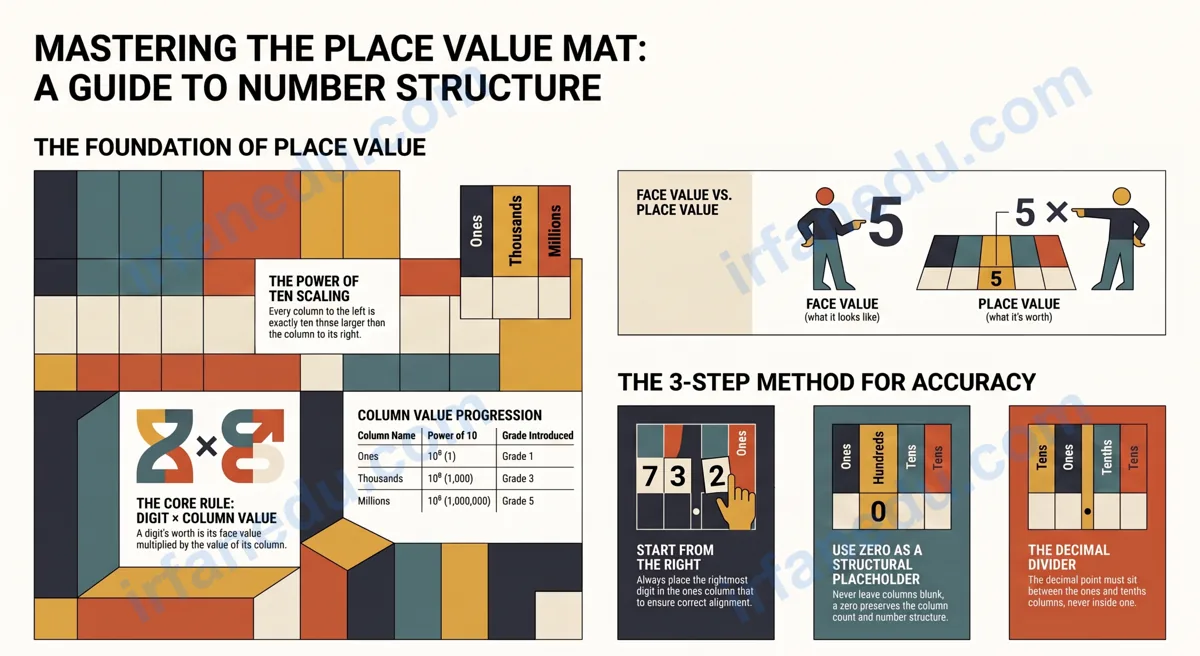
Every digit in a number has a face value (what it looks like) and a place value (what it is actually worth). The column a digit sits in determines that worth. A place value mat makes this relationship visible and concrete.
Example: In 3,472 — the digit 4 sits in the hundreds column, so its place value is 4 × 100 = 400.
- What Is a Place Value Mat?
- What Columns Does a Place Value Mat Have?
- How Do You Use a Place Value Mat? (Step-by-Step)
- Worked Examples: Ones to Millions
- How Does a Decimal Place Value Mat Work?
- Place Value vs. Face Value: What Is the Difference?
- What Are the Most Common Place Value Mat Mistakes?
- How Does a Place Value Mat Help with Addition and Subtraction?
- Unique Insight: The Zero Placeholder Problem
- Quick Quiz
- Practice Problems
- Frequently Asked Questions
- Sources and References
A place value mat is one of those tools that looks almost too simple to matter — a grid with labeled columns. But in my 15 years of teaching math, I have watched it transform students who “just can’t get numbers” into confident readers of six- and seven-digit values. The mat does not teach a trick; it makes the structure of our number system physically visible.
A place value mat is a flat grid divided into labeled columns — ones, tens, hundreds, thousands, and beyond — where students place digit cards or base-ten blocks to show what each digit in a number is worth. It makes abstract place value concrete and visual, helping students read, write, compare, and operate on multi-digit numbers accurately.
In this guide, I walk through exactly how the mat works, show you fully worked examples from two-digit numbers up to the millions, extend it to decimals, and fix the three mistakes I see students make most often. Every section builds on the core rule above: Place Value = Digit × Column Value.
- Understand what each column on a place value mat represents.
- Place any number correctly, including those with zeros in the middle.
- Read expanded form directly from the mat.
- Use the mat as a tool for addition, subtraction, and decimal work.
- Avoid the four most common errors that cost students marks.
- A place value mat is a column grid where each column has a specific value (ones, tens, hundreds, etc.).
- The core rule: Place Value = Digit × Column Value.
- Always start placing digits from the ones column on the right.
- Zeros are essential placeholders — never skip them.
- Decimal mats extend right of the decimal point: tenths, hundredths, thousandths.
- The mat makes regrouping (carrying/borrowing) visible as physical trades between columns.
| Fact | Detail |
|---|---|
| Tool type | Manipulative / graphic organiser |
| Grade range | Grades 1-5 (ages 6-11) |
| Basic columns | Ones, Tens, Hundreds |
| Extended columns | Up to Millions (and beyond) |
| Decimal columns | Tenths, Hundredths, Thousandths |
| Used with | Digit cards, base-ten blocks, dry-erase markers |
| Core concept | Place Value = Digit × Column Value |
What Is a Place Value Mat?
A place value mat is a printed or laminated grid where each column represents a specific power of ten, and students place digit cards or write numbers in the correct column to show a number’s structure. It is the physical embodiment of our base-ten number system.
The mat works because our number system is positional: the same digit means different things depending on where it sits. The digit 5 in 500 is worth five hundred; in 50 it is worth fifty; in 5 it is worth five. The mat makes that positional logic impossible to ignore.
In my experience teaching elementary and middle school math, students who use a place value mat for even two weeks develop a number sense that students who skip it often lack for years. The mat is not a crutch — it is a scaffold that builds genuine understanding.
A place value mat is a flat grid divided into labeled columns where each column’s value is ten times the column to its right. Digits placed in a column are multiplied by that column’s value to find their contribution to the whole number.
What Columns Does a Place Value Mat Have?
A standard place value mat has columns for every power of ten, labeled from right to left in increasing value. The ones column is always on the far right.
| Column Name | Power of 10 | Column Value | Grade Level Introduced |
|---|---|---|---|
| Ones | 10⁰ | 1 | Grade 1 |
| Tens | 10¹ | 10 | Grade 1 |
| Hundreds | 10² | 100 | Grade 2 |
| Thousands | 10³ | 1,000 | Grade 3 |
| Ten-Thousands | 10⁴ | 10,000 | Grade 4 |
| Hundred-Thousands | 10⁵ | 100,000 | Grade 4 |
| Millions | 10⁶ | 1,000,000 | Grade 5 |
| Tenths (decimal) | 10⁻¹ | 0.1 | Grade 4-5 |
| Hundredths (decimal) | 10⁻² | 0.01 | Grade 4-5 |
| Thousandths (decimal) | 10⁻³ | 0.001 | Grade 5 |
Notice the pattern: every column to the left is exactly ten times larger than the column to its right. This is the single most important structural fact about our number system, and the mat makes it visible at a glance.
How Do You Use a Place Value Mat? (Step-by-Step)
Using a place value mat correctly takes five steps, and the order matters. Always start from the right — from the ones column — and work left.
- Write the number you want to represent. Start with the complete number written somewhere visible, such as on a whiteboard or the top of the mat.
- Identify the rightmost digit. This digit always goes in the ones column, no exceptions.
- Move left, one digit at a time. Each digit moves one column to the left: tens, then hundreds, then thousands, and so on.
- Use a zero as a placeholder for any empty column. If a column has no digit, write 0. Never leave a column blank — a blank looks like a missing column, not a zero value.
- Read the number aloud from left to right. Say each digit’s full value: “three thousand, four hundred, seventy-two” — not just the digits.
Step 4 is the one most worksheets skip. I have seen students write 305 as “3 _ 5” on a mat, leaving the tens column blank. When they later do column addition, they shift every digit one place and get a completely wrong answer. The zero placeholder is not optional — it is structural. I always tell students: “A blank is not a zero. A blank is a mistake.”
Worked Examples: Ones to Millions
The best way to understand a place value mat is to watch it work on real numbers. Here are four fully worked examples, each building on the core rule: Place Value = Digit × Column Value.
Step 1: Rightmost digit is 7 → ones column → 7 × 1 = 7
Step 2: Next digit is 4 → tens column → 4 × 10 = 40
Expanded form: 40 + 7 = 47
Ones: 2 × 1 = 2
Tens: 8 × 10 = 80
Hundreds: 3 × 100 = 300
Expanded form: 300 + 80 + 2 = 382
This is where students most often make errors. The tens column has no digit — so we write 0.
Ones: 2 × 1 = 2
Tens: 7 × 10 = 70
Hundreds: 0 × 100 = 0 (placeholder — must be written!)
Thousands: 3 × 1,000 = 3,000
Expanded form: 3,000 + 0 + 70 + 2 = 3,072
Ones: 6 × 1 = 6
Tens: 1 × 10 = 10
Hundreds: 8 × 100 = 800
Thousands: 5 × 1,000 = 5,000
Ten-Thousands: 0 × 10,000 = 0 (placeholder)
Hundred-Thousands: 4 × 100,000 = 400,000
Millions: 2 × 1,000,000 = 2,000,000
Expanded form: 2,000,000 + 400,000 + 0 + 5,000 + 800 + 10 + 6 = 2,405,816
+----------+----------+----------+----------+
| THOUSANDS| HUNDREDS |   TENS   |   ONES   |
+----------+----------+----------+----------+
|    3     |    4     |    7     |    2     |
+----------+----------+----------+----------+
| 3×1,000  |  4×100   |   7×10   |   2×1   |
|  =3,000  |  = 400   |  = 70    |  =  2   |
+----------+----------+----------+----------+
  3,000  +   400   +    70   +    2   =  3,472
How Does a Decimal Place Value Mat Work?
A decimal place value mat extends the standard grid to the right of the decimal point, adding columns for tenths, hundredths, and thousandths. The decimal point itself is a fixed divider — it sits between the ones column and the tenths column.
+----------+----------+---+----------+----------+
| HUNDREDS |   TENS   | . | TENTHS   |HUNDREDTHS|
+----------+----------+---+----------+----------+
|    0     |    4     | . |    3     |    6     |
+----------+----------+---+----------+----------+
|  0×100   |  4×10    |   |  3×0.1   |  6×0.01  |
|  = 0     |  = 40    |   |  = 0.3   |  = 0.06  |
+----------+----------+---+----------+----------+
  40 + 7 + 0.3 + 0.06 = 47.36
Notice that the ones column is not shown above — it holds the digit 7 in 47.36. I left it out of the visual to keep the diagram compact, but in a real mat, every column from ones outward must be present.
Place Value vs. Face Value: What Is the Difference?
Face value is the digit itself, regardless of position. Place value is what that digit is actually worth in the number it belongs to. These two concepts are often confused, and the confusion causes errors in expanded form and in reading large numbers.
| Concept | Definition | Example (in 4,725) |
|---|---|---|
| Face Value | The digit as written, regardless of position | The face value of 7 is always 7 |
| Place Value | The digit multiplied by its column’s value | 7 is in the hundreds column → 7 × 100 = 700 |
| Total Value | The digit’s actual contribution to the number | 700 (seven hundred) |
The place value mat makes this distinction automatic. When a student places the digit 7 in the hundreds column, they can physically see that 7 is sitting on top of a “100” label. The face value is 7; the place value is 700.
What Are the Most Common Place Value Mat Mistakes?
Four errors account for the vast majority of place value mistakes I see in student work. Each one has a clear fix.
| Mistake | What It Looks Like | Correct Approach |
|---|---|---|
| Skipping the zero placeholder | Writing 305 as “3 _ 5” on the mat | Always write 0 in every empty column |
| Starting from the left | Placing the first digit in the ones column | Always start from the rightmost digit in the ones column |
| Confusing face value with place value | Saying the 4 in 4,725 is “worth 4” | Say “the 4 is in the thousands column, so it is worth 4,000” |
| Misplacing the decimal point | Putting the decimal inside a column | The decimal point is always between ones and tenths columns |
The “starting from the left” mistake is more common than most teachers expect, especially with students who read left-to-right naturally. I fix it by teaching a physical habit: always put your finger on the last digit of the number first, then drag it to the ones column. That one physical gesture eliminates the error almost immediately.
How Does a Place Value Mat Help with Addition and Subtraction?
A place value mat makes column addition and subtraction visual by ensuring digits of the same value are always aligned before any calculation begins. This alignment is the entire reason we write addition problems in vertical form.
Place both numbers on the mat, one row per number:
Row 1: Hundreds=3, Tens=4, Ones=7
Row 2: Hundreds=2, Tens=8, Ones=5
Ones column: 7 + 5 = 12 → write 2, carry 1 ten to the tens column
Tens column: 4 + 8 + 1 (carried) = 13 → write 3, carry 1 hundred
Hundreds column: 3 + 2 + 1 (carried) = 6
Result: 632
The “carry” in standard addition is actually a regrouping: 10 ones become 1 ten, 10 tens become 1 hundred. On a physical mat with base-ten blocks, students trade 10 unit cubes for 1 rod, making regrouping tangible rather than abstract.
The zero placeholder is not about writing neatly — it is about preserving column count.
Most place value guides treat the zero placeholder as a courtesy. In my experience, it is structural. Here is why: when students skip zeros, they do not just write a number incorrectly — they collapse the column structure of the mat. The number 3,072 has four columns. If a student writes “3 7 2” without the zero, they now have a three-column number. Every subsequent operation — addition, subtraction, comparison — will be performed on the wrong number (372, not 3,072).
The non-obvious fix: teach students to count the columns first, before placing any digits. For a four-digit number, draw four columns. Then fill them right to left. If you run out of digits before you run out of columns, every remaining column gets a zero. This “count columns first” habit eliminates the placeholder error at the source, not after the fact.
How Do You Make or Print a Place Value Mat?
A place value mat is easy to create at home or in a classroom. You need only a ruler, a pen, and paper — or a laminator for a reusable version.
- Draw a horizontal rectangle across the page.
- Divide it into equal columns — start with 4 (ones, tens, hundreds, thousands) for grades 1-3.
- Label each column from right to left: Ones, Tens, Hundreds, Thousands.
- Add a second row below the labels for digit cards or written digits.
- Laminate the mat and use dry-erase markers for a reusable version.
- For decimals, add a bold vertical line after the ones column and label the next columns: Tenths, Hundredths, Thousandths.
Quick Quiz — Test Your Place Value Knowledge
Question 1: In the number 6,304, what is the place value of the digit 3?
Show Answer
Question 2: A student places the number 5,028 on a mat and writes only three digits: 5, 2, 8. What did they forget?
Show Answer
Question 3: On a decimal place value mat, where does the decimal point sit?
Show Answer
Practice Problems
Try each problem on your own, then click to reveal the worked solution.
Problem 1: Write the expanded form of 70,405.
Solution:
Place each digit on the mat from right to left:
- Ones: 5 × 1 = 5
- Tens: 0 × 10 = 0 (placeholder)
- Hundreds: 4 × 100 = 400
- Thousands: 0 × 1,000 = 0 (placeholder)
- Ten-Thousands: 7 × 10,000 = 70,000
Expanded form: 70,000 + 0 + 400 + 0 + 5 = 70,405
Problem 2: What is the place value of 9 in 3,912,047?
Solution:
Place 3,912,047 on the mat:
- Ones: 7, Tens: 4, Hundreds: 0, Thousands: 2, Ten-Thousands: 1, Hundred-Thousands: 9, Millions: 3
The digit 9 sits in the hundred-thousands column.
Place value = 9 × 100,000 = 900,000
Problem 3: Place 8.47 on a decimal mat and write its expanded form.
Solution:
- Ones: 8 × 1 = 8
- Tenths: 4 × 0.1 = 0.4
- Hundredths: 7 × 0.01 = 0.07 Sources & References
Written and fact-checked by Dr Irfan Mansuri. External links open in a new tab and are provided for further reading and verification.