
Place Value Worksheets for 4th Graders 📊 Free Printable PDF + Answer Key
Your child just brought home a place value assignment — and the numbers go all the way to the millions. 😅 In the next two minutes, I’ll give you one fast trick that unlocks the whole concept, then walk you through the complete mastery path with a free printable worksheet.
Place value is the system that gives every digit in a number a specific worth based on its position. In 4th grade, students extend this idea from thousands all the way to millions and into decimals. Mastering place value is the single most important foundation for multiplication, long division, and fractions — which is exactly why it appears at the start of every Grade 4 math curriculum worldwide.
- 📌 Understand what place value means and why each column is worth 10× the one to its right
- 📌 Read and write numbers up to the millions in standard, word, and expanded form
- 📌 Compare and order multi-digit numbers using place value logic
- 📌 Apply place value to decimals (tenths and hundredths)
- 📌 Complete 10 graded practice problems and check your work with the answer key
📥 Free Printable PDF: 10 graded place value problems for Grade 4, with a separate answer key — ready to print and use today.
⚡ TL;DR – Quick Summary
- 📊 4th graders work with place values from millions down to hundredths
- 🔢 Each column is exactly 10 times the value of the column to its right
- 📝 Expanded form breaks a number into the sum of each digit’s value
- ⚠️ The most common error: confusing place value with face value
- 📥 This page includes a free printable worksheet with 10 problems + answer key
- ✅ Aligned to Common Core 4.NBT.A.1 and 4.NBT.A.2
📋 Quick Facts
| Feature | Detail |
|---|---|
| Grade Level | Grade 4 (Ages 9-10) |
| Standards | Common Core 4.NBT.A.1, 4.NBT.A.2, 4.NF.C.6 |
| Place Values Covered | Millions → Hundredths (9 positions) |
| Number of Problems | 10 (Easy → Hard) |
| Skills Tested | Expanded form, digit identification, comparison, ordering, rounding, decimals |
| Format | On-page + Free printable PDF with answer key |
| Prerequisite | 3rd-grade place value (ones through thousands) |
🚀 What Is Place Value? (Your 2-Minute Quick Win)
Place value is the rule that a digit’s worth depends on where it sits in a number, not just what digit it is. This single idea is your quick win — once you see it, everything else clicks.
Look at the digit 4 in these two numbers:
The Same Digit, Very Different Values
4,000 → The 4 is worth four thousand (4 × 1,000)
440 → The 4 in the middle is worth forty (4 × 10)
444 → The 4 on the right is worth four (4 × 1)
Same digit. Three completely different values. That is place value in action.
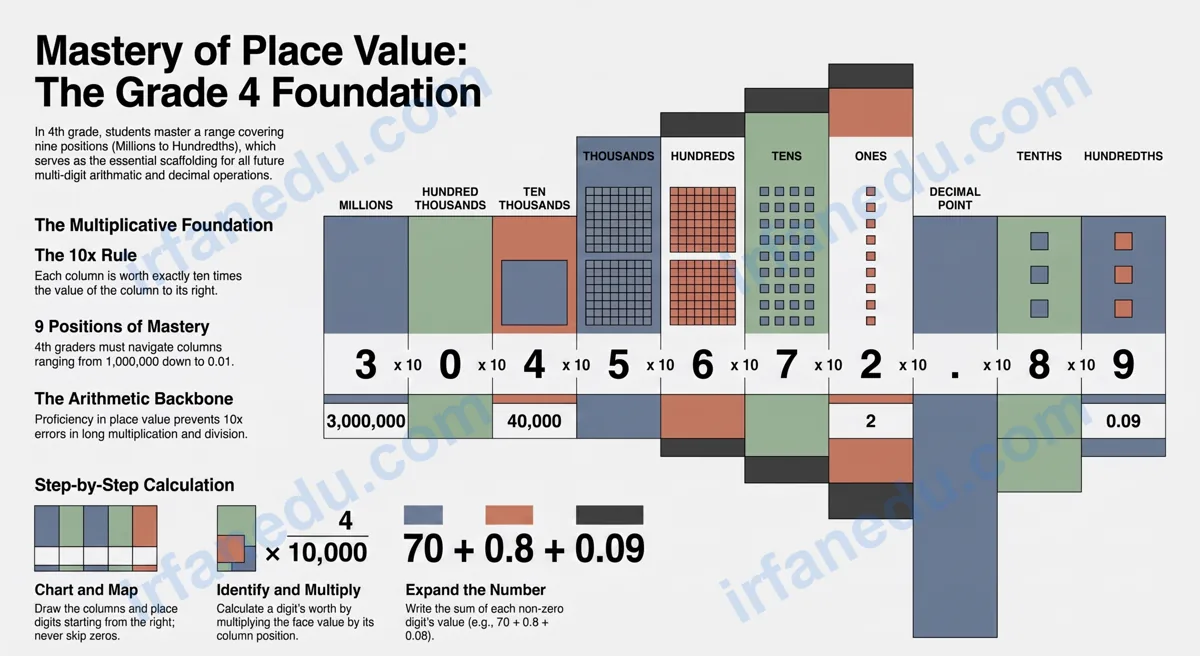
The key rule: each column is worth exactly 10 times the column immediately to its right. Thousands = 10 × hundreds. Hundreds = 10 × tens. This pattern never breaks — it extends left into millions and right into decimals.
📊 The 4th-Grade Place Value Chart
┌──────────┬──────────┬──────────┬──────────┬──────────┬──────────┬──────────┬──────────┬──────────┐
│ Millions │ Hund-Th  │ Ten-Th   │Thousands │ Hundreds │  Tens    │  Ones    │ Tenths   │Hundredths│
│  (M)     │ (100,000)│ (10,000) │ (1,000)  │  (100)   │  (10)    │   (1)    │ (0.1)    │ (0.01)   │
├──────────┼──────────┼──────────┼──────────┼──────────┼──────────┼──────────┼──────────┼──────────┤
│    3     │    0     │    4     │    5     │    6     │    7     │    2     │    8     │    9     │
└──────────┴──────────┴──────────┴──────────┴──────────┴──────────┴──────────┴──────────┴──────────┘

Number: 3,045,672.89

Reading: Three million, forty-five thousand, six hundred seventy-two and eighty-nine hundredths
That chart is your anchor. Every problem on this page — and in your child’s textbook — is just a variation of reading that chart correctly.
Why Does Place Value Matter So Much in 4th Grade?
Place value is the invisible scaffolding behind every multi-digit operation. Without it, long multiplication and long division become guesswork.
► MY POV: In my experience teaching Grade 4 math, the students who struggle with long multiplication in November almost always have a shaky place value foundation from September. I have seen a single 20-minute place value review session unlock weeks of stuck progress. It is the highest-leverage topic in the entire Grade 4 curriculum — and it is chronically under-drilled because it looks “too easy” on the surface.
Here is a concrete example of why it matters. When a student multiplies 34 × 6, they need to know that the “3” in 34 represents thirty, not three. If they treat it as three, they get 3 × 6 = 18 instead of 30 × 6 = 180. That is a 10× error — and it comes entirely from a place value gap.
| Skill That Needs Place Value | How Place Value Is Used | Grade Level |
|---|---|---|
| Multi-digit multiplication | Knowing each partial product’s column position | Grade 4-5 |
| Long division | Estimating how many times the divisor fits each group | Grade 4-5 |
| Decimal addition/subtraction | Aligning tenths with tenths, hundredths with hundredths | Grade 4-5 |
| Rounding | Identifying which digit is in the target place | Grade 3-4 |
| Fractions ↔ Decimals | Understanding tenths and hundredths as place value columns | Grade 4 |
🔢 Step-by-Step: How to Find the Place Value of Any Digit
Follow these four steps every time. They work for any number — from a 2-digit number to a 7-digit number with decimals.
-
Draw (or picture) the place value chart.
Write the column headers from left to right: Millions, Hundred-Thousands, Ten-Thousands, Thousands, Hundreds, Tens, Ones. Add a decimal point, then Tenths and Hundredths if needed. -
Place each digit in its column.
Start from the rightmost digit (ones) and work left. Write one digit per column. If a column has no digit, write a zero — never leave it blank. -
Read the value of the target digit.
The place value = digit × column worth. The digit 6 in the ten-thousands column = 6 × 10,000 = 60,000. -
Write expanded form (if asked).
List each non-zero digit’s value separated by plus signs: 56,814 = 50,000 + 6,000 + 800 + 10 + 4.
✏️ 3 Fully Worked Examples
Example 1 — Basic: What is the place value of 6 in 56,814?
Step 1: Place the digits in the chart.
Ten-Thousands: 5 | Thousands: 6 | Hundreds: 8 | Tens: 1 | Ones: 4
Step 2: The digit 6 is in the thousands column.
Step 3: Place value = 6 × 1,000 = 6,000
Answer: 6,000
Example 2 — Intermediate: Write 203,051 in expanded form.
Step 1: Chart the digits: 2 (hundred-thousands), 0 (ten-thousands), 3 (thousands), 0 (hundreds), 5 (tens), 1 (ones).
Step 2: Multiply each non-zero digit by its column value.
2 × 100,000 = 200,000 | 3 × 1,000 = 3,000 | 5 × 10 = 50 | 1 × 1 = 1
Step 3: Add them: 200,000 + 3,000 + 50 + 1
Note: The zeros (ten-thousands, hundreds) are NOT included in expanded form — they contribute nothing to the sum.
Example 3 — Advanced: Write 7.46 in expanded form using decimals.
Step 1: Chart: 7 (ones), 4 (tenths), 6 (hundredths).
Step 2: 7 × 1 = 7 | 4 × 0.1 = 0.4 | 6 × 0.01 = 0.06
Answer: 7 + 0.4 + 0.06
This is the bridge between whole-number place value and decimal place value — a key 4th-grade concept.
⚠️ Common Mistakes — Wrong vs. Right
These are the four errors I see most often when grading Grade 4 place value work. Knowing them in advance prevents them.
Wrong: “The value of 3 in 4,372 is 3.”
✅ Right: “The value of 3 in 4,372 is 300.” (3 is in the hundreds column, so 3 × 100 = 300.)
Wrong: 203,051 = 2,000 + 3,000 + 5 + 1 (the student misread 2 as thousands).
✅ Right: 200,000 + 3,000 + 50 + 1 — always chart the digits first to get the columns right.
Wrong: “3,045,200 > 3,054,200 because 3,045,200 has a bigger first digit.”
✅ Right: Both start with 3,0 — compare the next differing column. Ten-thousands: 4 vs. 5. Since 4 < 5, we get 3,045,200 < 3,054,200.
Wrong: 7.46 = 7 + 4 + 6 (treating tenths and hundredths as whole numbers).
✅ Right: 7 + 0.4 + 0.06 — tenths are 0.1 each, hundredths are 0.01 each.
► MY POV: Mistake #2 — the dropped-zero error — is the one that most surprises parents, because the student clearly knows place value in simple cases. The fix is not more drilling. It is teaching the habit of always drawing the chart first before writing expanded form. That one habit eliminates the error almost immediately. I have used this with hundreds of students and it works every time.
💡 Unique Insight — What Most Place Value Guides Get Wrong
Most worksheets and guides treat place value as a reading skill — “identify the digit in the thousands place.” But the deeper cognitive skill is multiplicative: understanding that moving one column left multiplies the value by 10, and moving one column right divides it by 10. This is the exact same structure as scientific notation and decimal multiplication. Students who learn place value as a multiplicative pattern (not just a labeling exercise) transfer the concept to decimals, fractions, and algebra far more readily. In my experience, spending five minutes on the question “what happens to the value if I shift this digit one column to the left?” produces more durable learning than 20 extra labeling problems.
📝 On-Page Practice Worksheet — 10 Problems
Work through these problems on paper before checking the answer key. They follow the same method as the worked examples above, ordered from easy to challenging.
Instructions: Write each number in expanded form, identify the value of the underlined digit, or complete the task as directed. Show your work where possible.
- Write 4,372 in expanded form.
- What is the value of the digit 6 in 56,814?
- Write 203,051 in expanded form.
- What digit is in the ten-thousands place in 748,293?
- Write the number: 500,000 + 40,000 + 700 + 8
- Compare using > or <: 3,045,200 ___ 3,054,200
- Round 2,867,413 to the nearest hundred thousand.
- Write 7.46 in expanded form using decimals.
- What is the value of the digit 3 in 1,230,985?
- Order from least to greatest: 4,502,100 | 4,052,100 | 4,520,100
✅ Show Answer Key
- 4,000 + 300 + 70 + 2
- 6,000
- 200,000 + 3,000 + 50 + 1
- 4
- 540,708
- 3,045,200 < 3,054,200
- 2,900,000
- 7 + 0.4 + 0.06
- 30,000
- 4,052,100 ; 4,502,100 ; 4,520,100
📥 Want a print-ready version? Download the free PDF — it includes the worksheet and a separate answer key on page 2.
🔍 Reveal-on-Click Practice Problems
Practice A: What is the place value of 9 in 4,923,100?
Answer: The 9 is in the hundred-thousands column. 9 × 100,000 = 900,000.
Practice B: Write 5,000,000 + 200,000 + 60 + 3 as a standard number.
Answer: Fill in zeros for missing columns: 5,200,063. (Ten-thousands, thousands, hundreds are all zero.)
Practice C: Is 4.09 the same as 4.9? Explain using place value.
Answer: No. In 4.09, the 9 is in the hundredths column (value = 0.09). In 4.9, the 9 is in the tenths column (value = 0.9). Since 0.9 > 0.09, we get 4.9 > 4.09.
🧠 Quick Quiz — Test Yourself (3 Questions)
1. What is the value of the digit 7 in 3,748,200?
2. Which expanded form matches 540,708?
3. In 7.46, what is the place value of the digit 4?
❓ Frequently Asked Questions
What place values do 4th graders need to know?
Fourth graders typically work with place values from the millions place down to the hundredths place. That covers ones, tens, hundreds, thousands, ten-thousands, hundred-thousands, millions, tenths, and hundredths — nine distinct positions in all. The Common Core standard 4.NBT.A.1 specifically requires students to recognise that a digit in one place represents ten times what it represents in the place to its right.
How do you teach place value to a 4th grader at home?
Start with a labeled place value chart drawn on paper. Place one digit in each column, name the column, and state its value. Then build expanded form by multiplying each digit by its column value. Use physical base-ten blocks or a drawn grid before moving to abstract notation. Ten minutes of daily practice with this worksheet is more effective than one long session per week.
What is expanded form in 4th grade math?
Expanded form breaks a number into the sum of each digit’s value. For example, 3,472 in expanded form is 3,000 + 400 + 70 + 2. Fourth graders extend this to numbers in the millions and to decimals — for example, 7.46 = 7 + 0.4 + 0.06. It is a direct application of the place value chart and the most common way teachers assess whether a student truly understands place value.
Are these worksheets aligned to Common Core Standards?
Yes. The problems on this page align with Common Core State Standards 4.NBT.A.1 (a digit in one place represents ten times the place to its right), 4.NBT.A.2 (read, write,
Sources & References
Written and fact-checked by Dr Irfan Mansuri. External links open in a new tab and are provided for further reading and verification.