
Algebra 2 Honors: the complete student guide (every topic, worked examples, real tips)
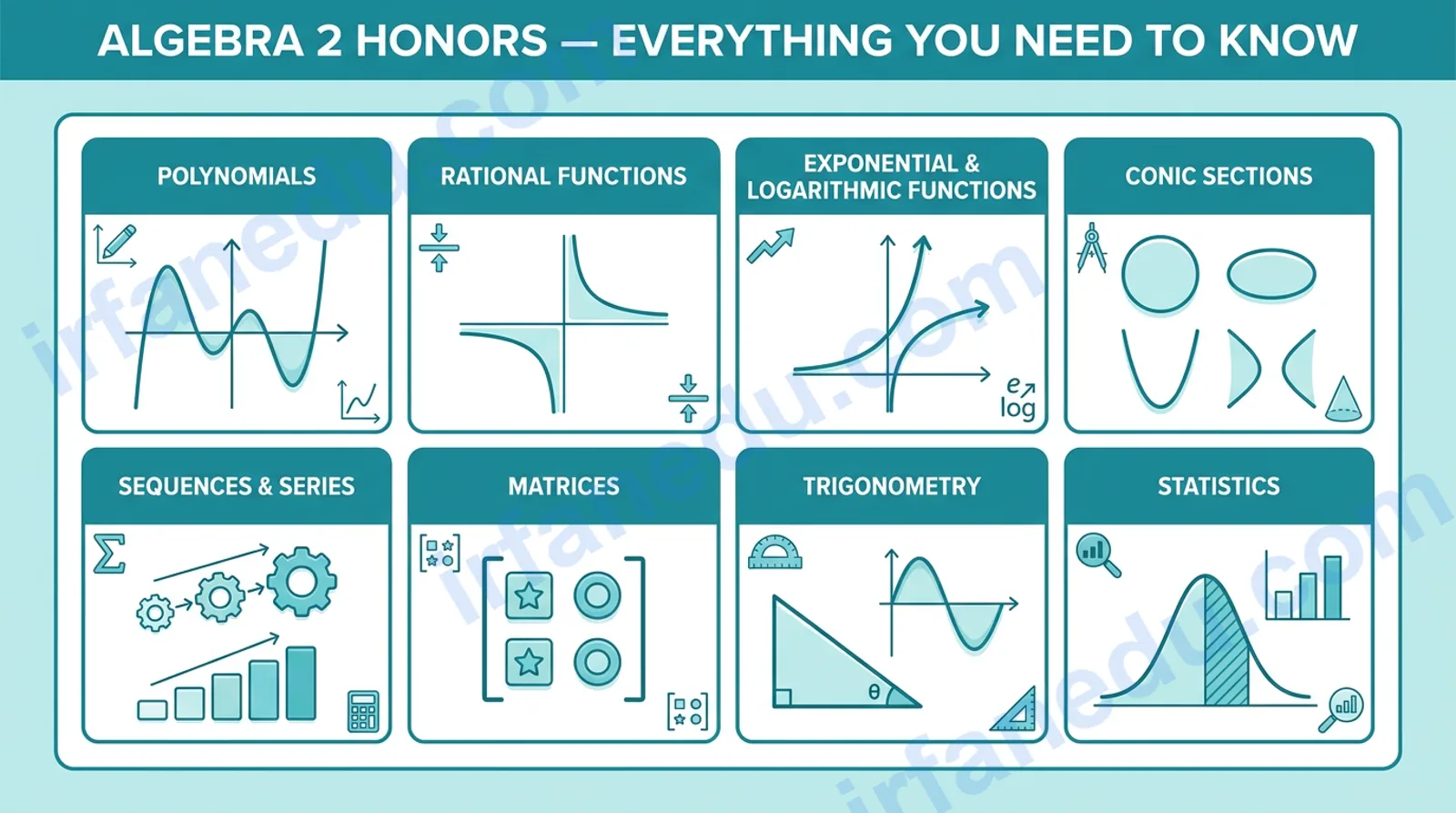
Algebra 2 Honors — course cheat sheet
Each line below is a full section in this guide. Jump to any topic or read straight through.
- What it is: an accelerated function-analysis course bridging Algebra 1 to Pre-Calculus
- Core topics: polynomials, rational functions, exponentials, logarithms, conic sections, sequences & series, matrices, intro trig
- Honors vs. regular: faster pace, deeper proofs, harder problem sets, weighted GPA
- Hardest unit: logarithmic equations — most students underestimate the rule-fluency required
- Biggest mistake: memorising formulas without understanding the underlying function behaviour
- Top study move: build a personal error log — fix your 3 recurring mistakes before learning new material
- What comes next: Pre-Calculus Honors or AP Calculus AB
- College value: weighted GPA boost + signals STEM readiness to admissions offices
Algebra 2 Honors is a rigorous high school mathematics course that builds on Algebra 1 and Geometry to cover advanced function families, polynomial operations, logarithms, conic sections, sequences, matrices, and introductory trigonometry. It is designed for students who want to reach AP Calculus or college-level STEM, and it earns a weighted GPA point at most schools.
If you are a student wondering whether to take Algebra 2 Honors, or a parent trying to understand what your child is walking into, this guide gives you the full picture. I have taught this material for over 15 years, and I know exactly where students succeed, where they stall, and what separates the students who genuinely master the course from those who just survive it.
By the end of this article you will know every major topic, how they connect, what the most common errors are, and how to study smarter rather than longer.
- Understand what Algebra 2 Honors covers and how it differs from the standard course
- See worked examples for the highest-weight topics
- Learn the non-obvious study strategies that actually move the grade needle
- Know exactly what comes next and how this course feeds into AP Calculus
Key takeaway: Algebra 2 Honors is not just “harder Algebra 2.” It is a conceptual shift toward function analysis that requires you to think about WHY a function behaves the way it does, not just how to solve for x.
Quick answer: Algebra 2 Honors is an accelerated high school math course covering polynomial, rational, exponential, and logarithmic functions, conic sections, sequences and series, matrices, and introductory trigonometry. It moves faster and goes deeper than standard Algebra 2, earns a weighted GPA point at most schools, and directly prepares students for Pre-Calculus Honors or AP Calculus AB.
⚡ TL;DR
- Algebra 2 Honors covers 8 major topic areas, from polynomials to intro trigonometry.
- It is faster and deeper than standard Algebra 2, with harder problem sets and proofs.
- Logarithms and conic sections are the two units students find hardest.
- The biggest study mistake is passive re-reading instead of active problem-solving.
- Strong performance here is the clearest path to AP Calculus AB or BC.
- Build an error log — fixing recurring mistakes beats studying new material every time.
What is Algebra 2 Honors?
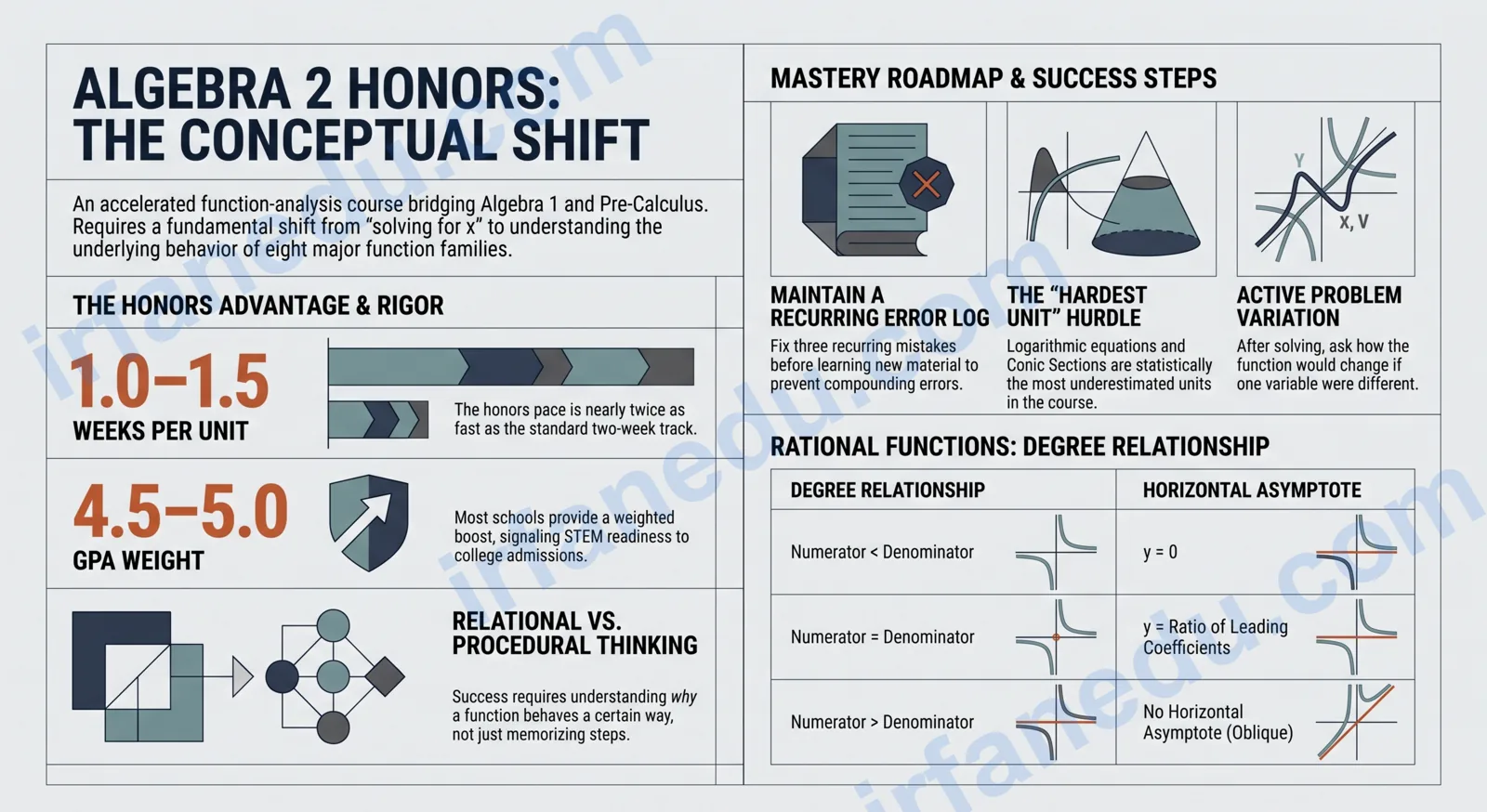
Algebra 2 Honors is a high school mathematics course that extends the function-analysis framework introduced in Algebra 1 into more complex and abstract territory. It is the third course in the standard US math sequence (Algebra 1 → Geometry → Algebra 2) and the honors designation means the course runs at an accelerated pace with additional depth, harder assessments, and a weighted GPA value.
The course is fundamentally about functions. Every major unit introduces a new family of functions, asks you to analyse its behaviour (domain, range, intercepts, asymptotes, transformations), and then teaches you to solve equations and model real-world situations with it. That unifying thread — functions — is what makes the course coherent rather than a random collection of algebra tricks.
According to Dr. Irfan Mansuri, the single most important mindset shift for Algebra 2 Honors students is moving from “what is the answer?” to “what does this function do?” Students who make that shift early outperform those who treat each unit as an isolated skill set.
How does Algebra 2 Honors differ from regular Algebra 2?
Honors and standard Algebra 2 share the same core topic list, but the honors version differs in four concrete ways: pace, depth, problem complexity, and GPA weight.
| Feature | Regular Algebra 2 | Algebra 2 Honors |
|---|---|---|
| Pace | ~2 weeks per unit | ~1–1.5 weeks per unit |
| Problem difficulty | Procedural, single-step | Multi-step, proof-adjacent |
| Logarithm coverage | Solve basic log equations | Derive and prove log properties |
| Polynomial coverage | Factor and solve | Long division, synthetic division, partial fractions |
| Conic sections | Parabola only (some schools) | All four conics + standard-form derivations |
| GPA weight | 4.0 scale | 4.5–5.0 scale (school-dependent) |
| Typical next course | Pre-Calculus (standard) | Pre-Calculus Honors or AP Calculus AB |
In my experience, the pace difference is what catches students off-guard more than the content difficulty. A student who would comfortably earn a B in standard Algebra 2 can struggle in honors simply because there is no time to consolidate one concept before the next arrives. My advice: treat each weekend as a mini-review session, not just a homework catch-up. Fifteen minutes of deliberate review on Saturday morning is worth more than two hours of cramming before a test.
What are the core topics in Algebra 2 Honors?
Algebra 2 Honors covers eight major topic areas. Every school sequences them slightly differently, but these eight units appear in virtually every honors curriculum.
- Polynomial functions — operations, factoring, long division, synthetic division, the Remainder and Factor Theorems, and the Fundamental Theorem of Algebra
- Rational functions — simplifying, solving rational equations, identifying vertical and horizontal asymptotes, and graphing
- Exponential functions — growth and decay models, transformations, and the number e
- Logarithmic functions — definition, properties (product, quotient, power rules), change-of-base, and solving logarithmic equations
- Conic sections — parabolas, circles, ellipses, and hyperbolas in standard form
- Sequences and series — arithmetic and geometric sequences, sigma notation, and the Binomial Theorem
- Matrices — operations, determinants, inverse matrices, and solving systems with matrices
- Introductory trigonometry — unit circle, radian measure, basic trig functions and their graphs (depth varies by school)
Print this list and check off each topic as your class covers it. Knowing where you are in the course helps you plan ahead — especially for the two hardest units (logarithms and conic sections), which typically land in the second semester.
Polynomials and rational functions
Polynomial functions are the backbone of Algebra 2 Honors. You need to factor, divide, and analyse them before you can tackle any other unit effectively.
Polynomial long division — worked example
Divide $$2x^3 – 3x^2 + x – 5$$ by $$(x – 2)$$.
- Set up: $$2x^3 \div x = 2x^2$$. Multiply: $$2x^2(x-2) = 2x^3 – 4x^2$$. Subtract: remainder $$x^2 + x – 5$$.
- Repeat: $$x^2 \div x = x$$. Multiply: $$x(x-2) = x^2 – 2x$$. Subtract: remainder $$3x – 5$$.
- Repeat: $$3x \div x = 3$$. Multiply: $$3(x-2) = 3x – 6$$. Subtract: remainder $$1$$.
- Result: $$2x^2 + x + 3 + \dfrac{1}{x-2}$$
Check with the Remainder Theorem: substitute $$x = 2$$ into the original polynomial. $$2(8) – 3(4) + 2 – 5 = 16 – 12 + 2 – 5 = 1$$. The remainder matches.
Rational functions and asymptotes
A rational function has the form $$f(x) = \dfrac{p(x)}{q(x)}$$ where both $$p$$ and $$q$$ are polynomials. Vertical asymptotes occur where $$q(x) = 0$$ (after cancelling common factors). The horizontal asymptote depends on the degrees of $$p$$ and $$q$$.
| Degree of numerator vs. denominator | Horizontal asymptote | Example |
|---|---|---|
| Numerator degree < denominator degree | $$y = 0$$ | $$\dfrac{3x}{x^2+1}$$ |
| Numerator degree = denominator degree | $$y = \dfrac{\text{leading coeff of numerator}}{\text{leading coeff of denominator}}$$ | $$\dfrac{4x^2}{2x^2-1} \Rightarrow y=2$$ |
| Numerator degree > denominator degree | No horizontal asymptote (oblique instead) | $$\dfrac{x^3}{x^2+1}$$ |
Exponential and logarithmic functions
Exponential and logarithmic functions are inverses of each other, and understanding that relationship is the key to solving equations in both families. This is the unit where most Algebra 2 Honors students lose points — not because the ideas are hard, but because the log rules require fluency, not just familiarity.
The three logarithm rules you must know cold
- Product rule: $$\log_b(MN) = \log_b M + \log_b N$$
- Quotient rule: $$\log_b\!\left(\dfrac{M}{N}\right) = \log_b M – \log_b N$$
- Power rule: $$\log_b(M^p) = p \cdot \log_b M$$
Solve: $$\log_2(x+3) + \log_2(x-1) = 5$$
- Apply the product rule: $$\log_2[(x+3)(x-1)] = 5$$
- Rewrite in exponential form: $$(x+3)(x-1) = 2^5 = 32$$
- Expand: $$x^2 + 2x – 3 = 32 \Rightarrow x^2 + 2x – 35 = 0$$
- Factor: $$(x+7)(x-5) = 0 \Rightarrow x = -7 \text{ or } x = 5$$
- Check domain: $$x = -7$$ makes $$\log_2(-4)$$ undefined. Reject it. Answer: $$x = 5$$.
Students often forget to check the domain after solving a logarithmic equation. A negative argument inside a logarithm is undefined in the real numbers. Always substitute your answer back and reject any solution that produces a non-positive argument.
Conic sections
Conic sections describe the four curves formed by slicing a cone at different angles: the circle, ellipse, parabola, and hyperbola. In Algebra 2 Honors you work with their standard-form equations and learn to identify, graph, and derive each one.
  CIRCLE        (x-h)² + (y-k)² = r²
                Center (h,k), radius r

  ELLIPSE       (x-h)²   (y-k)²
                ——————— + ——————— = 1
                  a²        b²
                a > b: wider horizontally

  PARABOLA      y = a(x-h)² + k   (vertical)
                x = a(y-k)² + h   (horizontal)

  HYPERBOLA     (x-h)²   (y-k)²
                ——————— - ——————— = 1   (opens left/right)
                  a²        b²
                Asymptotes: y-k = ±(b/a)(x-h)
The fastest way to identify which conic you are dealing with from the general form $$Ax^2 + Bxy + Cy^2 + Dx + Ey + F = 0$$ is to look at the coefficients of $$x^2$$ and $$y^2$$:
- Same sign, same value → circle
- Same sign, different values → ellipse
- One coefficient is zero → parabola
- Opposite signs → hyperbola
In my experience, conic sections feel overwhelming at first because students try to memorise four separate sets of formulas. The insight that changed everything for my students: all four conics come from the same distance definition. A circle is all points equidistant from one center. An ellipse is all points where the sum of distances from two foci is constant. A hyperbola is all points where the difference of distances from two foci is constant. Once you see that, the formulas stop feeling arbitrary and start feeling inevitable.
Sequences, series, and matrices
Sequences and series introduce the idea of summing infinitely many terms — a concept that becomes central in AP Calculus. Matrices extend the idea of solving systems of equations into a powerful, generalizable framework.
Arithmetic vs. geometric sequences at a glance
- Arithmetic sequence: each term differs by a constant $$d$$. General term: $$a_n = a_1 + (n-1)d$$
- Geometric sequence: each term is multiplied by a constant ratio $$r$$. General term: $$a_n = a_1 \cdot r^{n-1}$$
- Infinite geometric series sum (when $$|r| < 1$$): $$S = \dfrac{a_1}{1-r}$$
Find the sum of $$8 + 4 + 2 + 1 + \cdots$$
Here $$a_1 = 8$$ and $$r = \dfrac{1}{2}$$. Since $$|r| < 1$$:
$$S = \dfrac{8}{1 – \frac{1}{2}} = \dfrac{8}{\frac{1}{2}} = 16$$
For matrices, the key operations are addition, scalar multiplication, matrix multiplication, finding the determinant, and computing the inverse. The inverse of a $$2 \times 2$$ matrix $$A = \begin{pmatrix}a & b \\ c & d\end{pmatrix}$$ is:
$$A^{-1} = \dfrac{1}{ad – bc}\begin{pmatrix}d & -b \\ -c & a\end{pmatrix}$$
where $$ad – bc$$ is the determinant. If the determinant equals zero, the matrix has no inverse.
Common mistakes and how to fix them
After reviewing hundreds of Algebra 2 Honors tests, I see the same errors appearing again and again. Here are the five most costly ones and the exact fix for each.
After solving a logarithmic equation, always substitute each solution back into the original equation and verify that every argument of every logarithm is strictly positive. Reject any solution that fails this check.
Students mix up when a horizontal asymptote is $$y = 0$$, when it equals the ratio of leading coefficients, and when there is no horizontal asymptote. Memorise the three cases in the comparison table above and practice identifying them before graphing.
When converting a conic from general form to standard form, students frequently drop a negative sign when completing the square. Write each step on its own line and check by expanding back to the general form.
$$\log(x + y) \neq \log x + \log y$$. The product rule applies to a product inside the log, not a sum. This is one of the most common algebra errors in the entire course.
Matrix multiplication is not commutative: $$AB \neq BA$$ in general. Always check that the inner dimensions match before multiplying, and keep track of the order throughout multi-step problems.
The real reason students stall in Algebra 2 Honors is not the content — it is the transition from procedural to relational thinking.
Every guide tells you to “practice more problems.” That advice is correct but incomplete. In my 15+ years of teaching this course, the students who plateau at a C despite working hard are almost always stuck in procedural mode: they can execute a memorised algorithm but cannot adapt when the problem is slightly different from the textbook example.
The fix is deliberate variation practice. After solving a problem, ask yourself three questions:
- What would change if one number in the problem were different?
- What would change if the function type were different (e.g., exponential instead of polynomial)?
- Can I work backwards — start from the answer and reconstruct the problem?
This three-question habit forces your brain to build a flexible mental model of the concept rather than a rigid script. It is the difference between a student who earns 90% on a test they have seen before and one who earns 90% on a test they have never seen.
No other Algebra 2 Honors guide I have reviewed teaches this explicitly. It is the single highest-leverage study habit for this specific course.
How to succeed in Algebra 2 Honors: step-by-step
Success in Algebra 2 Honors is predictable. Students who follow these five steps consistently outperform those who study more but less strategically.
-
Review prerequisites before the course starts.
Algebra 2 Honors assumes fluency with linear equations, quadratic factoring, function notation, and basic transformations. Spend two to three hours reviewing these before day one. Gaps here compound quickly. -
Build a running formula sheet.
Write down every new formula the day you learn it. Organise it by topic. Review the sheet every Sunday for 10 minutes. By mid-semester you will have a personalised reference that is faster to use than any textbook. -
Solve problems actively, not passively.
Reading a worked example is not the same as solving a problem. For every example your teacher shows, close your notes and re-solve it from scratch. Then solve a variation. Passive reading builds false confidence. -
Keep an error log.
After every quiz or test, write down each problem you got wrong, the mistake you made, and the correct method. Review the log before the next assessment. Most students repeat the same three or four errors all semester. Fixing those is faster than studying new material. -
Connect each unit to the function-analysis framework.
Ask yourself: what is the domain? What is the range? Where are the intercepts? Where are the asymptotes or discontinuities? How does the graph transform? Applying this same checklist to every new function family builds the relational understanding that earns top marks.
Algebra 2 Honors feeds directly into Pre-Calculus and AP Calculus. Every hour you invest understanding logarithm properties and conic sections now saves three hours in your next course. Think of this course as a long-term investment, not a short-term grade target.
Quick knowledge check
1. What is the horizontal asymptote of $$f(x) = \dfrac{5x^2 – 1}{2x^2 + 3}$$?
2. Simplify: $$\log_3 27 + \log_3 \dfrac{1}{3}$$
Sources & References
Written and fact-checked by Dr Irfan Mansuri. External links open in a new tab and are provided for further reading and verification.