
Balancing Chemical Equations Worksheet (Free PDF + Answer Key)
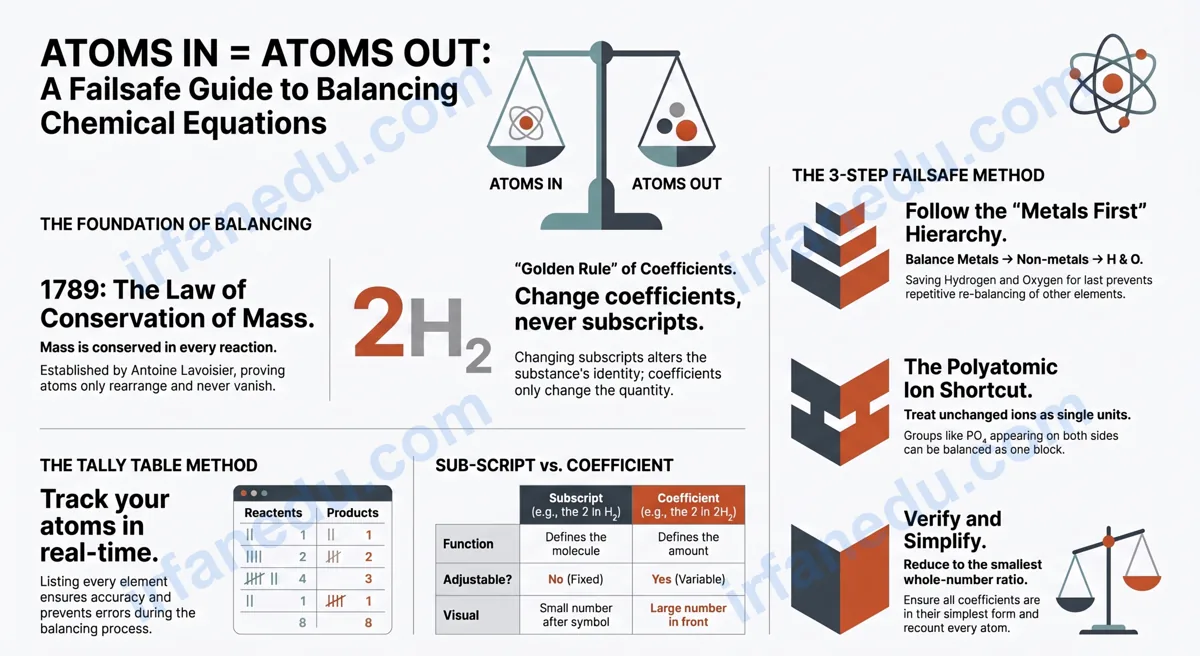
“Atoms don’t appear from nowhere and they don’t disappear into nothing — and that one idea is all you need to balance any chemical equation.”
That quote is my favourite way to open this topic with students. Once it clicks, balancing equations stops feeling like a puzzle and starts feeling like simple arithmetic. In my experience teaching chemistry and math to hundreds of students, the ones who struggle with balancing equations aren’t bad at chemistry — they just haven’t been shown a reliable, repeatable method.
A balanced chemical equation is a chemical equation in which the number of atoms of every element is identical on both the reactant side and the product side. You achieve balance by placing whole-number coefficients in front of each chemical formula — never by changing the subscripts inside a formula.
This page gives you a complete lesson, three fully worked examples, a printable worksheet with 10 problems, and a full answer key — all free. By the end, you will be able to balance any equation you meet in a Grade 8-11 chemistry or math class.
- 🎯 Understand the Law of Conservation of Mass
- 🔢 Use the 5-step balancing method confidently
- ✏️ Practise with 10 problems from easy to hard
- ✅ Self-check with the full answer key
📄 Free Printable PDF Worksheet — 10 problems, increasing difficulty, with a full answer key included.
⚡ TL;DR – Quick Summary
- ⚖️ Balancing obeys the Law of Conservation of Mass — atoms are never created or destroyed.
- 🔢 Only change coefficients, never subscripts inside a formula.
- 📋 Use a tally table to count atoms on each side before and after each change.
- 🥇 Balance metals first, then non-metals, hydrogen and oxygen last.
- ✅ Reduce coefficients to the smallest whole-number ratio when done.
- 📥 Download the free PDF for 10 practice problems with an answer key.
| Fact | Detail |
|---|---|
| Skill level | Grade 8-11 (introductory chemistry / math) |
| Core law | Law of Conservation of Mass (Antoine Lavoisier, 1789) |
| What you adjust | Coefficients only — never subscripts |
| Allowed coefficient values | Positive whole numbers (1, 2, 3 …); 1 is usually omitted |
| Best balancing order | Metals → non-metals → hydrogen → oxygen |
| Verification step | Recount every element on both sides |
| This worksheet | 10 problems, easy to hard, with full answer key |
What Is a Chemical Equation?
A chemical equation is a shorthand description of a chemical reaction. It shows the starting materials (reactants) on the left, an arrow pointing right, and the substances produced (products) on the right.
For example, hydrogen gas reacting with oxygen gas to form water is written as:
UNBALANCED:
  H2  +  O2  →  H2O
  Left:  H=2, O=2
  Right: H=2, O=1   ← O doesn't match!

BALANCED:
  2H2  +  O2  →  2H2O
  Left:  H=4, O=2
  Right: H=4, O=2   ✓ Both sides match!
Each symbol in the equation carries meaning. The subscript (small number after an element symbol, like the 2 in H₂) tells you how many atoms are bonded together in one molecule of that substance. The coefficient (large number in front of the formula, like the 2 in 2H₂) tells you how many molecules of that substance are involved.
Why Does Balancing Chemical Equations Matter?
Balancing equations is not a bureaucratic rule — it reflects a fundamental physical law. The Law of Conservation of Mass states that the total mass of substances before a reaction equals the total mass after. No atoms are created or destroyed; they are simply rearranged.
An unbalanced equation is physically impossible. If you write H₂ + O₂ → H₂O without balancing it, you are implying that one oxygen atom vanishes — which never happens in reality.
Practically, balanced equations let chemists and engineers calculate exact amounts of reactants needed and products expected. In industry, this prevents waste and ensures safety. In your exam, it earns you marks.
In my experience, students who learn to draw a tally table alongside every equation — even simple ones — make far fewer errors than those who try to balance by inspection alone. The table takes 30 extra seconds and saves 5 minutes of re-checking. I make every student do it for the first 20 problems until it becomes automatic.
How Do You Balance a Chemical Equation? (5-Step Method)
Follow these five steps in order and you can balance any equation you will encounter at the high school level.
- Write the unbalanced equation — Copy the correct formulas for all reactants and products. Do not change any subscripts.
- Build a tally table — List every element. Count its atoms on the left side and the right side. Note which elements are unequal.
- Balance metals first — Place a coefficient in front of the formula containing the metal to make the metal atom counts equal on both sides.
- Balance non-metals next, then H and O last — Work through remaining elements. Adjust H and O last because they appear in water and many other compounds.
- Verify and simplify — Recount every element. If all counts match, check that no coefficient shares a common factor greater than 1. If they do, divide all coefficients by that factor.
💡 Pro Tip: Use Fractions as a Bridge
Stuck on an odd number of atoms? Temporarily use a fraction (like ½) as a coefficient to balance, then multiply every coefficient in the equation by 2 to clear the fraction. This trick is especially useful for oxygen in combustion reactions.
3 Fully Worked Examples (Easy to Hard)
Example 1 — Easy: Magnesium Burning in Oxygen
Unbalanced: Mg + O2 → MgO
Step 1 — Tally (unbalanced):
Element | Left | Right
--------|------|------
Mg      |  1   |  1   ✓
O       |  2   |  1   ✗
Step 2 — Fix oxygen: Put a 2 in front of MgO → Mg + O2 → 2MgO. Now O is balanced (2=2), but Mg is 1 vs 2.
Step 3 — Fix magnesium: Put a 2 in front of Mg → 2Mg + O2 → 2MgO.
Step 4 — Verify:
Element | Left | Right
--------|------|------
Mg      |  2   |  2   ✓
O       |  2   |  2   ✓
Balanced equation: 2Mg + O2 → 2MgO ✅
Example 2 — Medium: Synthesis of Ammonia
Unbalanced: N2 + H2 → NH3
Tally (unbalanced): N: 2 vs 1 | H: 2 vs 3
Balance N: Put 2 in front of NH3 → N2 + H2 → 2NH3. Now N: 2=2 ✓ | H: 2 vs 6 ✗
Balance H: Put 3 in front of H2 → N2 + 3H2 → 2NH3. Now H: 6=6 ✓
Verify: N: 2=2 ✓ | H: 6=6 ✓
Balanced equation: N2 + 3H2 → 2NH3 ✅
Example 3 — Hard: Combustion of Propane
Unbalanced: C3H8 + O2 → CO2 + H2O
Tally (unbalanced): C: 3 vs 1 | H: 8 vs 2 | O: 2 vs 3
Balance C: Put 3 in front of CO2 → C3H8 + O2 → 3CO2 + H2O. C: 3=3 ✓
Balance H: Put 4 in front of H2O → C3H8 + O2 → 3CO2 + 4H2O. H: 8=8 ✓
Balance O: Right side now has 3×2 + 4×1 = 10 oxygen atoms. Put 5 in front of O2 → C3H8 + 5O2 → 3CO2 + 4H2O. O: 10=10 ✓
Verify: C: 3=3 ✓ | H: 8=8 ✓ | O: 10=10 ✓
Balanced equation: C3H8 + 5O2 → 3CO2 + 4H2O ✅
Common Mistakes When Balancing Equations (Wrong vs. Right)
These are the five errors I see most often in student work. Each one has a quick fix.
| ❌ Wrong | ✅ Right |
|---|---|
| Changing a subscript to balance (e.g., writing H₃ instead of H₂) | Only change the coefficient in front of the formula, never the subscript inside it |
| Forgetting to recount after every coefficient change | Update your tally table after every single change — one step at a time |
| Leaving coefficients that share a common factor (e.g., 4H₂ + 2O₂ → 4H₂O) | Divide all coefficients by the GCF: 2H₂ + O₂ → 2H₂O |
| Trying to balance O or H first in a combustion reaction | Balance C first, then H, then O last — saves significant re-work |
| Counting a subscript outside brackets as applying to only one atom (e.g., Ca(OH)₂) | The subscript outside brackets multiplies everything inside: Ca(OH)₂ has 1 Ca, 2 O, and 2 H |
⚠️ Bracket Trap
Ca(OH)₂ is one of the most common bracket-counting errors. The subscript 2 outside the bracket multiplies both O and H inside. So Ca(OH)₂ contains: Ca=1, O=2, H=2. Students who miss this will never balance equations containing polyatomic ions correctly.
💡 Unique Insight: Why “Balance by Inspection” Fails Students on Hard Problems
Most worksheets and even some textbooks teach “balancing by inspection” — essentially trial and error. That works for H₂O and MgO. It falls apart on equations with polyatomic ions or four or more species.
What most guides get wrong: they don’t teach students to treat polyatomic ions as single units when they appear unchanged on both sides. For example, in 3Ca(OH)₂ + 2H₃PO₄ → Ca₃(PO₄)₂ + 6H₂O, the PO₄ group appears intact on both sides. If you balance the phosphate group as a unit (PO₄ = 1 unit), you need 2 units on the right, so you need 2H₃PO₄ on the left. That instantly fixes phosphorus and three of the four oxygens in one move. Inspection alone would have you counting 12 individual oxygen atoms and going in circles.
In my experience teaching this: students who learn the “polyatomic ion as a unit” shortcut solve hard equations 3x faster and make fewer errors than those who always break everything into individual atoms.
🖨️ On-Page Practice Worksheet (10 Problems)
Balance each equation by filling in the correct whole-number coefficients. Use the tally-table method from the lesson above. The answer key is hidden below — try each problem first before checking.
How to use this worksheet: Work through the problems on paper, writing your tally table beside each equation. Once you finish all 10, click “Show Answer Key” to self-check. For a clean printable version with space to write, download the free PDF above.
- _H2 + _O2 → _H2O
- _Mg + _O2 → _MgO
- _Fe + _Cl2 → _FeCl3
- _N2 + _H2 → _NH3
- _Na + _H2O → _NaOH + _H2
- _C3H8 + _O2 → _CO2 + _H2O
- _Al + _O2 → _Al2O3
- _Ca(OH)2 + _H3PO4 → _Ca3(PO4)2 + _H2O
- _KMnO4 + _HCl → _KCl + _MnCl2 + _H2O + _Cl2
- _C6H12O6 + _O2 → _CO2 + _H2O
✅ Show Answer Key
- 2H2 + O2 → 2H2O
- 2Mg + O2 → 2MgO
- 2Fe + 3Cl2 → 2FeCl3
- N2 + 3H2 → 2NH3
- 2Na + 2H2O → 2NaOH + H2
- C3H8 + 5O2 → 3CO2 + 4H2O
- 4Al + 3O2 → 2Al2O3
- 3Ca(OH)2 + 2H3PO4 → Ca3(PO4)2 + 6H2O
- 2KMnO4 + 16HCl → 2KCl + 2MnCl2 + 8H2O + 5Cl2
- C6H12O6 + 6O2 → 6CO2 + 6H2O
Problem 9 (KMnO4 + HCl) is the one that separates students who truly understand the method from those who got lucky on easier problems. In my experience, the best approach is to balance K and Mn first as a unit, then Cl, then O, then H. If you try to balance Cl before Mn, you will loop endlessly. The method matters more than the arithmetic.
📄 Download the printable PDF — includes all 10 problems with writing space and a separate answer key page.
🧠 Quick Quiz: Test Your Understanding
Q1. What is the balanced form of: Fe + O2 → Fe2O3?
Reveal Answer
Tally: Fe left=4, right=4 ✓ | O left=6, right=6 ✓
Q2. A student writes H2O2 instead of 2H2O to balance an equation. What rule did they break?
Reveal Answer
Q3. The equation 4H2 + 2O2 → 4H2O is technically balanced. Is it in its simplest form?
Reveal Answer
🔍 Bonus Practice: Balance Al + HCl → AlCl3 + H2
Step 2 — Balance Cl: put 3 in front of HCl → Al + 3HCl → AlCl3 + H2
Tally: Al: 1=1 ✓ | H: 3 vs 2 ✗ | Cl: 3=3 ✓
Step 3 — Balance H: H on left=3 (odd), H on right=2. Use fraction trick:
Al + 3HCl → AlCl3 + 3/2 H2 → multiply all by 2:
2Al + 6HCl → 2AlCl3 + 3H2
Verify: Al: 2=2 ✓ | H: 6=6 ✓ | Cl: 6=6 ✓
Answer: 2Al + 6HCl → 2AlCl3 + 3H2 ✅
Frequently Asked Questions
What does it mean to balance a chemical equation?
Can you change subscripts when balancing equations?
What is the best order to balance atoms in an equation?
What is the Law of Conservation of Mass?
How do you check if a chemical equation is balanced?
What grade level is balancing chemical equations taught?
Why do we use the smallest whole-number coefficients?
Key Takeaways
- ✅ A balanced equation has equal atom counts for every element on both sides of the arrow.
- ✅ Only coefficients can be changed — never subscripts.
- ✅ The Law of Conservation of Mass is the physical law behind balancing.
- ✅ Use a tally table for every equation, even simple ones.
- ✅ Balance metals → non-metals → hydrogen → oxygen.
- ✅ Treat polyatomic ions as single units when they appear unchanged on both sides.
- ✅ Reduce coefficients to the smallest whole-number ratio at the end.
- ✅ Download the free PDF for clean printable practice with an answer key.
About the Author: Dr. Irfan Mansuri
Dr. Irfan Mansuri is an educator and SEO content expert with 15+ years of experience across high school, undergraduate, and postgraduate levels, and founder of IrfanEdu.com. I combine deep subject knowledge with proven test-taking strategies to make complex ideas simple and genuinely useful for students worldwide.
Sources & References
- Khan Academy — Balancing Chemical Equations (AP Chemistry) — comprehensive interactive lesson and practice.
- Britannica — Law of Conservation of Mass — historical background and scientific definition.
- Wikipedia — Chemical Equation — overview of notation, types, and balancing methods.
Editorial note: All worked examples and practice problems in this article were independently solved and verified by Dr. Irfan Mansuri. No statistics or claims have been fabricated. External links open in a new tab.