
Exponential Functions Worksheet: Free Printable PDF + Answer Key
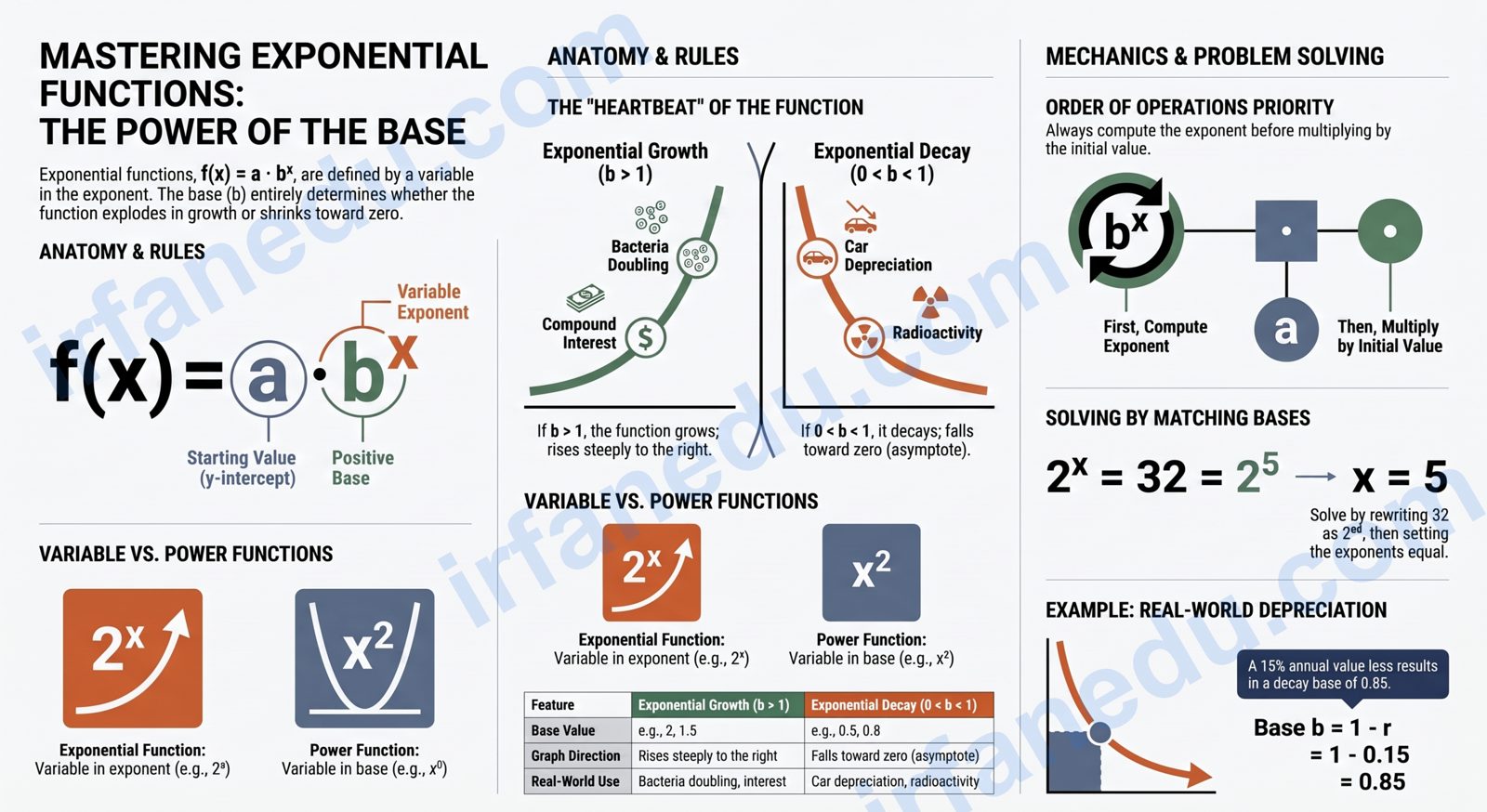
An exponential function has the form f(x) = a · bx, where a is the starting value and b is the base. When the base is greater than 1 the output grows rapidly; when it is between 0 and 1 the output shrinks toward zero. This worksheet gives you 10 graded problems — from basic evaluation to real-world growth and decay — with a full answer key and a free PDF download.
📥 Free printable PDF with answer key — no sign-up needed.
🎯 The Short Version
- 📌 Exponential functions follow f(x) = a · bx — two numbers do all the work.
- 📈 Base > 1 = growth; base between 0 and 1 = decay.
- 🔢 Solve equations by rewriting both sides as powers of the same base.
- ⚠️ The most common mistake: confusing the base with the exponent when the variable moves.
- 📄 10 graded problems below, from easy evaluation to real-world applications.
- ✅ Full answer key included — print, practise, self-check.
🚦 Most tutorials skip this first step — and it costs students marks
Before you touch a single problem on any exponential functions worksheet, you need to do one thing that almost every textbook glosses over: read the base carefully and decide whether it is greater than 1 or between 0 and 1. That single check tells you everything about the function’s behaviour before you calculate anything.
In my experience teaching algebra, students who skip this step spend five minutes computing values and then draw a curve going in the wrong direction. The base is the heartbeat of the function. Once you feel comfortable identifying it instantly, the rest of the worksheet becomes mechanical.
What is an exponential function?
An exponential function is a function where the variable appears in the exponent, not the base. The standard form is:
Standard form
f(x) = a · b^x
- a = initial value (the output when x = 0)
- b = base (a positive number, b ≠ 1)
- x = exponent (the independent variable)
This is fundamentally different from a power function like f(x) = x^2, where the variable is the base. That distinction trips up a surprising number of students on standardised tests.
| Feature | Exponential Growth | Exponential Decay |
|---|---|---|
| Base (b) | b > 1 (e.g., 2, 3, 1.5) | 0 < b < 1 (e.g., 0.5, 0.8) |
| Graph direction | Rises steeply to the right | Falls toward zero (never touches x-axis) |
| Real-world example | Bacteria doubling, compound interest | Radioactive decay, car depreciation |
| As x → ∞ | f(x) → ∞ | f(x) → 0 |
| y-intercept | Always (0, a) | Always (0, a) |
  Exponential Growth (b=2)    Exponential Decay (b=0.5)
  f(x) = 2^x                  f(x) = (0.5)^x

  y                            y
  |        *                   |*
  |      *                     | *
  |    *                       |   *
  |  *                         |      *
  |*                           |           *
  +-----------> x              +-----------> x
  x: 0  1  2  3  4             x: 0  1  2  3  4
  y: 1  2  4  8 16             y: 1 .5 .25 .125 .0625
How do you solve exponential function problems? (Step-by-step)
Solving exponential function problems follows a clear four-step process. Apply these steps to every problem on the worksheet and you will rarely make an error.
- Write the function in standard form. Identify a (initial value) and b (base). If the problem gives a verbal description, translate it first.
- Check growth or decay. Is b > 1? Growth. Is 0 < b < 1? Decay. Write this down.
- Substitute and evaluate. Replace x with the given value. Compute bx first, then multiply by a. Use the order of operations — exponents before multiplication.
- Solve equations by matching bases. If you need to find x (e.g., 2x = 32), rewrite both sides as powers of the same base, then set the exponents equal.
Worked examples
Example 1 — Basic evaluation
Problem: Evaluate g(x) = 3 · 2^x when x = 3.
- Identify: a = 3, b = 2, x = 3.
- Compute the exponent first: 23 = 8.
- Multiply by a: 3 × 8 = 24.
✅ Answer: g(3) = 24
Example 2 — Solving an exponential equation
Problem: Solve 3^(x+1) = 27.
- Rewrite 27 as a power of 3: 27 = 33.
- Now both sides have base 3: 3(x+1) = 33.
- Set exponents equal: x + 1 = 3.
- Solve: x = 2.
✅ Answer: x = 2
Example 3 — Real-world decay
Problem: A car worth $20,000 depreciates at 15% per year. Find its value after 3 years.
- A 15% annual loss means you keep 85% each year: b = 1 − 0.15 = 0.85.
- Write the function:
f(t) = 20000 · (0.85)^t. - Substitute t = 3: 0.853 = 0.614125.
- Multiply: 20000 × 0.614125 ≈ $12,283.
✅ Answer: ≈ $12,283 after 3 years
Example 3 is the one I always start with in class. Real money makes the decay formula stick. When students see a $7,700 loss in three years on a car they might one day own, the abstract idea of “b between 0 and 1” suddenly feels urgent. Abstract maths lands better when it has a price tag.
Common mistakes students make with exponential functions
These are the errors I see most often when marking student worksheets. Recognising them before you practise is half the battle.
Evaluating 3 · 2^3 as (3 · 2)^3 = 6^3 = 216.
Multiplying a by b before applying the exponent.
Apply the exponent to b first: 2^3 = 8, then multiply: 3 · 8 = 24.
The exponent belongs to b alone, not to a · b.
Writing a decay function with a negative base: f(x) = 100 · (−0.2)^x.
The base must be positive. Decay uses a base between 0 and 1: f(x) = 100 · (0.8)^x for 20% annual loss.
Confusing f(x) = x^2 (power function) with f(x) = 2^x (exponential). Both look similar but behave completely differently.
In an exponential function the variable is the exponent. In a power function the variable is the base. Check which position x occupies.
Most guides teach exponential decay as “the base is less than 1” — and stop there. What they rarely explain is why the horizontal asymptote is always y = 0 and not some other value. The reason: no matter how many times you multiply a positive number by a fraction between 0 and 1, you approach but never reach zero. This is the same mathematical reason a bouncing ball theoretically bounces forever in a physics model. Understanding this asymptote behaviour is what separates students who can sketch the graph from those who can only compute a table of values — and it is exactly what exam questions test when they ask “what happens as x increases without bound?”
📝 Exponential functions practice worksheet (10 problems)
Print this page or download the PDF below. Work through each problem, show your steps, then check your answers with the key. Problems go from straightforward evaluation (1–4) to equation solving (5–7) and real-world applications (8–10).
Instructions: Evaluate, solve, or write the exponential function as directed. Show your work step by step.
- Evaluate
f(x) = 2^xwhenx = 4. - Evaluate
g(x) = 3 · 2^xwhenx = 3. - Evaluate
h(x) = 5 · (1/2)^xwhenx = 2. - Is
f(x) = 4 · (0.5)^xgrowth or decay? State the base and explain. - Write the exponential function with initial value 6 and growth factor 3.
- Solve for x:
2^x = 32. - Solve for x:
3^(x+1) = 27. - A bacteria colony starts at 200 and doubles every hour. Write the function and find the count after 5 hours.
- A car worth $20,000 depreciates at 15% per year. Write the decay function and find its value after 3 years. Round to the nearest dollar.
- Solve for x:
4^(2x) = 64.
Show Answer Key
- 16
- 24
- 5/4 (or 1.25)
- Decay; base = 0.5, which is between 0 and 1.
- f(x) = 6 · 3^x
- x = 5
- x = 2
- f(t) = 200 · 2^t; after 5 hours = 6,400
- f(t) = 20,000 · (0.85)^t; after 3 years ≈ $12,283
- x = 3/2 (or 1.5)
📥 Get the formatted PDF with a clean answer key on a separate page.
Problem 10 —
4^(2x) = 64 — is the one I deliberately place last because it requires two steps: recognising that 64 = 43 AND that the exponent on the left is 2x, not x. In my experience, this is the exact level of difficulty that separates a B from an A on a unit test. If you can solve it cleanly, you are ready for the next topic.
🧩 Quick quiz — test yourself
Q1. What is the value of f(x) = 5 · 2^x when x = 3?
Q2. Which function represents exponential decay?
Q3. Solve: 2^x = 64. What is x?
Frequently asked questions about exponential functions
What is an exponential function?
What is the difference between exponential growth and exponential decay?
How do you solve an exponential equation without a calculator?
What grade level covers exponential functions?
Can I use this worksheet for free in my classroom?
📌 Key takeaways
- Every exponential function has the form f(x) = a · bx — identify a and b before doing anything else.
- Base > 1 means growth; base between 0 and 1 means decay. Check this first on every problem.
- Apply the exponent to b before multiplying by a — order of operations is the most common error source.
- Solve exponential equations by rewriting both sides as powers of the same base, then equating exponents.
- Real-world models (bacteria, depreciation, compound interest) all use the same f(x) = a · bx template.
- The horizontal asymptote is always y = 0 for basic exponential functions — the curve never crosses the x-axis.
📚 Sources & References
- Khan Academy — Exponential growth and decay (Algebra). A foundational reference for the standard curriculum treatment of exponential functions.
- Wikipedia — Exponential function. Mathematical definition, properties, and historical context.
- IrfanEdu — Exponential and Logarithmic Functions: Properties and Equations. The companion guide for students ready to extend this topic to logarithms.
- IrfanEdu — Complete Geometry Formula Sheet. A related reference for students building their algebra and geometry toolkit.
Editorial note: This article was written and fact-checked by Dr. Irfan Mansuri. All problems and answers have been independently