
Complementary & Supplementary Angles Worksheet 📐 Free PDF + Answer Key
✍ Written & fact-checked by Dr. Irfan Mansuri | Last Updated: July 2026
Imagine you’re helping a friend hang a picture frame on the wall. You tilt it slightly and notice the angle between the frame and the wall — and the angle between the frame and the ceiling. Those two angles together form a perfect straight line: 180°. That’s a supplementary pair, right there in your living room. 🏠
Complementary and supplementary angles are one of the most tested angle-relationship concepts in middle school geometry. Complementary angles add up to 90°, supplementary angles add up to 180°, and finding a missing angle in either pair takes exactly one subtraction step. This worksheet gives you a full lesson plus 10 graded practice problems to master both.
In this guide, you get a real lesson first — not just a list of definitions — followed by a printable PDF worksheet with a full answer key. By the end, you’ll be able to solve any complementary or supplementary angle problem, including the algebraic ones that trip up most students.
- 🎯 Understand the difference between complementary and supplementary angles
- 🔢 Find missing angles using subtraction and simple algebra
- 🖨️ Download and print a 10-problem worksheet with a full answer key
- ❌ Avoid the three most common mistakes students make on tests
Download Free PDF Worksheet (with Answer Key)
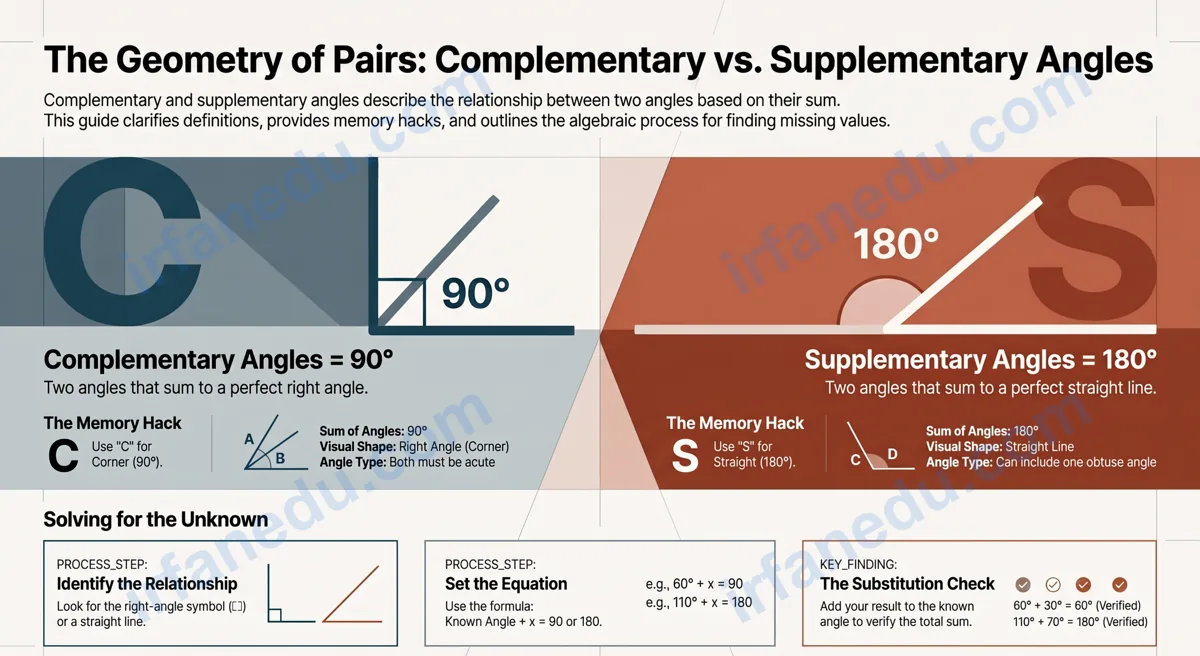
- ✅ Complementary angles: two angles that sum to 90°
- ✅ Supplementary angles: two angles that sum to 180°
- ✅ Missing angle = 90° − known (complementary) or 180° − known (supplementary)
- ✅ Algebraic problems: set up an equation, combine like terms, solve for x
- ✅ Memory trick: Corner (right angle) = 90°; Straight line = 180°
- ✅ This worksheet has 10 problems: easy subtraction → algebra → word problems
| Feature | Complementary Angles | Supplementary Angles |
|---|---|---|
| Sum of angles | 90° | 180° |
| Visual shape | Right angle (corner) | Straight line |
| Memory letter | C → Corner | S → Straight |
| Example pair | 35° + 55° | 110° + 70° |
| Can include obtuse? | No (both must be acute) | Yes (one can be obtuse) |
| US curriculum grade | Grade 6–7 (CCSS 7.G.B.5) | Grade 6–7 (CCSS 7.G.B.5) |
🌍 Where You See These Angles in Real Life
Complementary and supplementary angles appear everywhere once you start looking. Architects use them to design staircases — a staircase tread and riser form a complementary pair that must sum to exactly 90° for the step to be level. 🏗️
A door hinge opens to form a supplementary pair with the wall: when the door is fully open against the wall, the door and the wall together make a 180° straight line. Carpenters check this constantly. A clock face is another great example: at 3:00, the minute and hour hands form a 90° complementary angle. At 6:00, they form a 180° supplementary (straight) angle.
In sports, a basketball backboard meets the floor at 90°. The angle of a soccer ball’s trajectory off a wall and the angle of incidence are supplementary. Even in graphic design, rotating an element by its supplementary angle flips it to the mirror position on a straight line.
📐 Visual Diagram: Complementary vs Supplementary
The diagram below shows both angle types side by side. Study it before reading the definitions — your brain will absorb the rule faster with a visual anchor. 👇
  COMPLEMENTARY ANGLES                SUPPLEMENTARY ANGLES
  ─────────────────────               ──────────────────────────────

         │  ↖ 55°                     ←─────────────────────────────→
         │ /                           straight line (180°)
    35°  │/                           ──────────────┬───────────────
  ───────┘                                  110°    │   70°
   right angle = 90°                               (point on line)

  35° + 55° = 90° ✅                  110° + 70° = 180° ✅

  Both angles MUST be acute.          One angle CAN be obtuse.
  (each < 90°)                        (as long as sum = 180°)

  Memory: C = Corner = 90°            Memory: S = Straight = 180°
📖 What Are Complementary and Supplementary Angles?
A complementary angle pair is any two angles whose measures add up to exactly 90°. The angles do not need to be adjacent (touching) — they just need to sum to 90°. For example, 20° and 70° are complementary even if they are drawn on opposite sides of a page.
A supplementary angle pair is any two angles whose measures add up to exactly 180°. When supplementary angles are adjacent and share a common vertex, they form a straight line — this is called a linear pair. But again, they don’t have to be adjacent to be supplementary.
One definition that trips up students: complementary and supplementary describe a relationship between two angles, not a property of one angle alone. You cannot say “this angle is complementary” without naming what it is complementary to.
Complementary: ∠A + ∠B = 90° | Supplementary: ∠A + ∠B = 180°
Note: A right angle (90°) is its own supplementary partner when paired with another 90° angle. No angle is its own complement (that would require the angle to equal 45° and its partner to also equal 45° — they are complementary to each other, not to themselves).
🔢 How to Find a Missing Angle: Step-by-Step
Finding a missing angle in a complementary or supplementary pair takes exactly four steps. Follow this process every time and you will never mix them up. ✅
- Identify the relationship. Read the problem carefully. Does it say “complementary” (sum = 90°) or “supplementary” (sum = 180°)? If neither word appears, look for a right-angle symbol (□) for complementary, or a straight line for supplementary.
- Write the equation. Let the missing angle = x. Write: known angle + x = 90° (complementary) or known angle + x = 180° (supplementary).
- Solve for x. Subtract the known angle from 90° or 180°. If the problem uses expressions like (2x + 10)°, combine like terms first, then solve.
- Check your answer. Add both angles together. The sum must equal exactly 90° or 180°. If it doesn’t, recheck your arithmetic.
🔍 Worked Example 1 — Basic Subtraction
Step 1: Supplementary → sum = 180°
Step 2: 130° + B = 180°
Step 3: B = 180° − 130° = 50°
Step 4 (check): 130° + 50° = 180° ✅
🔍 Worked Example 2 — Algebraic Expression
Step 1: Complementary → sum = 90°
Step 2: (2x + 10) + 3x = 90
Step 3: 5x + 10 = 90 → 5x = 80 → x = 16
Angle M = 2(16) + 10 = 42°
Angle N = 3(16) = 48°
Step 4 (check): 42° + 48° = 90° ✅
🔍 Worked Example 3 — Word Problem
Let the smaller angle = x. Its complement = 90° − x.
Set up: x = (90° − x) + 18
Solve: x = 108 − x → 2x = 108 → x = 54°
Complement = 90° − 54° = 36°
Check: 54° − 36° = 18° ✅ and 54° + 36° = 90° ✅
❌ Common Mistakes Students Make (and How to Fix Them)
These three errors appear constantly in student work. Recognising them now saves you marks on every geometry test. 🚨
| ❌ Wrong Approach | ✅ Correct Approach |
|---|---|
| Confusing the sums: subtracting from 180° when the problem says complementary | Always re-read: complementary = 90°, supplementary = 180°. Write the sum before solving. |
| Saying one angle “is complementary” without naming its partner | Complementary/supplementary describe a pair. Always name both angles in your answer. |
| Forgetting to check: solving for x but not substituting back to verify the sum | Always add both angles after solving. If the sum ≠ 90° or 180°, you made an arithmetic error. |
| Algebraic errors: writing (2x + 10) + 3x = 90 but then solving 5x = 90 (forgetting to subtract 10) | Combine like terms carefully: 5x + 10 = 90 → 5x = 80 → x = 16. Show every step. |
Almost every worksheet site and even some textbooks imply that complementary or supplementary angles must be adjacent (sharing a side and vertex). This is incorrect. The CCSS definition (7.G.B.5) and standard geometry define complementary and supplementary purely by their angle sum — adjacency is irrelevant. Two angles on opposite sides of a diagram can be complementary.
Why does this matter on tests? Problems sometimes show two non-adjacent angles and ask if they are supplementary. Students who believe adjacency is required will answer “no” and lose the mark. The correct answer depends only on whether the sum equals 180° — not on whether the angles share a side. Always check the sum, not the position.
🖊️ On-Page Practice Worksheet — 10 Problems
Work through all 10 problems below. They start with simple subtraction and build up to algebraic and word-problem types — the same progression used in classroom assessments. Use the Answer Key to self-check when you’re done. 📝
Instructions: Find the missing angle in each problem. State whether the angle pair is complementary (sum = 90°) or supplementary (sum = 180°), then solve. Show your working.
- Angles A and B are complementary. Angle A = 30°. Find angle B.
- Angles P and Q are supplementary. Angle P = 120°. Find angle Q.
- Two complementary angles are equal. Find each angle.
- Angles X and Y are supplementary. Angle X = 3 × angle Y. Find both angles.
- Find the complement of 67°.
- Find the supplement of 43°.
- Angles M and N are complementary. Angle M = (2x + 10)° and angle N = (3x)°. Find x and both angles.
- Angles C and D are supplementary. Angle C = (5x − 20)° and angle D = (3x + 8)°. Find x and both angles.
- An angle is 18° more than its complement. Find both angles.
- An angle is 40° less than three times its supplement. Find the angle.
✅ Show Answer Key
- 60° (90 − 30 = 60)
- 60° (180 − 120 = 60)
- 45° each (x + x = 90 → x = 45)
- Angle X = 135°, Angle Y = 45° (3Y + Y = 180 → Y = 45, X = 135)
- 23° (90 − 67 = 23)
- 137° (180 − 43 = 137)
- x = 16; Angle M = 42°, Angle N = 48° (5x + 10 = 90 → x = 16)
- x = 24; Angle C = 100°, Angle D = 80° (8x − 12 = 180 → x = 24)
- 54° and 36° (x = 90 − x + 18 → x = 54)
- 130° (Let angle = a; supplement = 180 − a; a = 3(180 − a) − 40 → a = 540 − 3a − 40 → 4a = 500 → a = 125°… re-check: a = 3(180−a)−40 → a = 540−3a−40 → 4a = 500 → a = 125°. Verify: supplement of 125° = 55°; 3×55° − 40° = 165° − 40° = 125° ✅ Answer: 125°)
Download Free PDF Worksheet (with Answer Key)
How to use this worksheet: Print the PDF (or use the on-page version above). Cover the Answer Key section and attempt all 10 problems. Then reveal the key and check each answer. For any problem you got wrong, re-read the relevant worked example above and try a similar problem before moving on.
🎯 Quick Quiz — Test Yourself!
Q1. Angles A and B are complementary. Angle A = 48°. What is angle B?
Reveal Answer
✅ B) 42° — Complementary sum = 90°. 90° − 48° = 42°.
Q2. Which of the following pairs is supplementary?
Reveal Answer
✅ B) 90° and 90° — 90 + 90 = 180°. (A = 90°, not supplementary; C = 170°; D = 170°.)
Q3. Angles C and D are supplementary. C = (4x + 6)° and D = (2x)°. What is x?
Reveal Answer
✅ A) x = 29 — (4x+6) + 2x = 180 → 6x + 6 = 180 → 6x = 174 → x = 29. Check: 122° + 58° = 180° ✅
❓ Frequently Asked Questions
What is the difference between complementary and supplementary angles?
How do you find a missing complementary angle?
How do you find a missing supplementary angle?
Can two obtuse angles be supplementary?
Do complementary or supplementary angles have to be adjacent?
Sources & References
Written and fact-checked by Dr Irfan Mansuri. External links open in a new tab and are provided for further reading and verification.