
How to Study for a Math Test: From Easiest to Hardest (Step-by-Step)
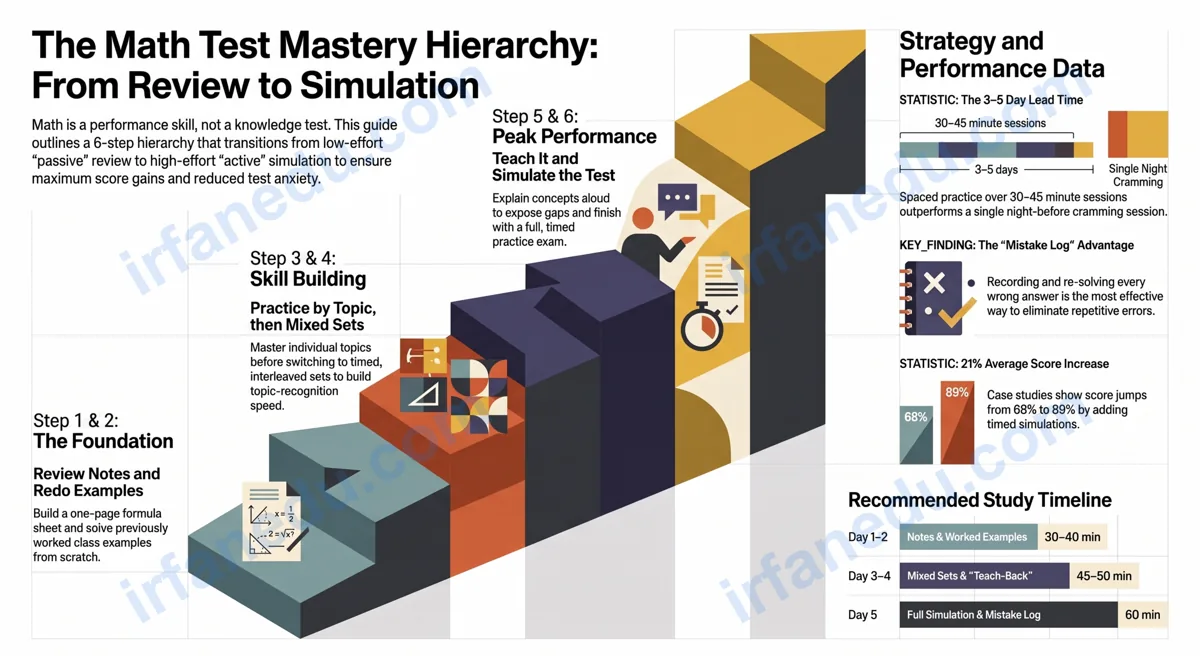
Most students study for a math test the wrong way. They re-read their notes, feel like they understand everything, and then blank out on the actual test. The problem is not effort — it is method.
To study for a math test effectively, you need to move from passive review to active problem-solving, and you need to do it in the right order — starting with the easiest techniques to build confidence, then progressing to the hardest ones that actually build test-ready skill.
In my 15 years of teaching math, I have watched hundreds of students transform their scores not by studying longer, but by studying smarter. This guide gives you a concrete, ranked system — six techniques ordered from easiest to hardest — so you always know exactly what to do next.
- You will know the six study techniques ranked by difficulty and when to use each one.
- You will get a worked example showing how to apply the method to a real algebra problem.
- You will see a 5-day study schedule you can copy immediately.
- You will understand the single biggest mistake most guides miss (and how to fix it).
To study for a math test, start by reviewing your notes and formula sheet, then redo worked examples from class, then practice new problems in order of difficulty. Space your sessions over at least three days, identify your weakest topic, and finish with a timed full-length practice test under real exam conditions. Active problem-solving — not passive re-reading — is what builds the score.
⚡ TL;DR – Quick Summary
- Start with notes review — the easiest entry point that orients your brain.
- Redo class examples from scratch before trying new problems.
- Practice by topic first, then mix problem types in timed sets.
- Teach concepts aloud to expose hidden gaps in understanding.
- End with a full timed test simulation — the hardest but highest-value step.
- Keep a mistake log: it is the single most underused study tool in math.
| Factor | Recommendation |
|---|---|
| When to start | 3-5 days before a unit test; 7-10 days before a final |
| Session length | 30-45 minutes per session (avoid marathon sessions) |
| Sessions per day | 1-2 focused sessions with breaks |
| Best first step | Review notes + build formula sheet |
| Most effective technique | Timed mixed practice + full test simulation |
| Least effective technique | Re-reading notes without solving problems |
| Night-before strategy | Light review only; prioritize sleep |
| Tools needed | Pencil, paper, formula sheet, past tests or textbook |
The 6 Study Techniques Ranked: Easiest to Hardest
Every technique below works. The ranking tells you where to start and how to progress as the test gets closer.
-
Easiest
Step 1: Review notes and formula sheet -
Easy
Step 2: Redo worked examples from class -
Medium
Step 3: Practice problems by topic -
Medium-Hard
Step 4: Timed mixed problem sets -
Hard
Step 5: Teach the concept out loud -
Hardest
Step 6: Full test simulation
The difficulty here refers to cognitive effort and discomfort, not complexity. Steps 1 and 2 feel easy because they are familiar and low-stakes. Steps 5 and 6 feel hard because they expose exactly what you do not know — which is precisely why they produce the biggest score gains.
Step 1 (Easiest): Review Your Notes and Build a Formula Sheet
Reviewing your class notes is the right starting point because it orients your brain to the topic before you attempt any problems. Do not just read passively — interact with the material.
Here is how I tell my students to do this review:
- Read through all notes from the unit once at normal speed.
- Highlight or circle any concept you cannot explain in your own words.
- Write a formula sheet on a single index card — formulas only, no worked examples yet.
- For each highlighted concept, write a one-sentence plain-English definition.
Say your test covers solving linear equations. Your formula sheet might include: ax + b = c → x = (c – b) / a, the distributive property, and the rule for combining like terms. Writing these out by hand — not typing — forces your brain to process them actively.
The formula sheet you build here becomes your anchor for every step that follows. Keep it visible during all study sessions.
Write your formula sheet in the same format your teacher uses on the board. Your brain encodes visual memory, so matching the format speeds recall during the actual test.
Step 2: Redo Worked Examples from Class
Redoing worked examples is the bridge between understanding and doing — and it is the step most students skip entirely. This is where passive knowledge becomes active skill.
The method is simple but strict:
- Open your notes to a worked example.
- Read it once to understand the logic.
- Close your notes (or cover the solution with a sheet of paper).
- Redo the problem from scratch on a blank sheet.
- Compare your work step-by-step — not just the final answer.
- If you got stuck, note exactly which step caused the problem.
In my experience, students who redo three worked examples from scratch outperform students who read ten examples passively. The act of retrieving the method — even imperfectly — builds the neural pathway that fires during the real test. I have seen this pattern repeat across hundreds of students at every level.
Your notes show: Solve x² + 5x + 6 = 0 by factoring → (x + 2)(x + 3) = 0 → x = -2 or x = -3.
Cover it. Now redo: Solve x² + 7x + 12 = 0. Find two numbers that multiply to 12 and add to 7: that is 3 and 4. So (x + 3)(x + 4) = 0 → x = -3 or x = -4. Check by substituting back. This is active retrieval, not passive reading.
Step 3: Practice Problems by Topic
Once you can redo class examples, move to fresh problems from your textbook or homework sets — still organized by topic at this stage. Topic-blocked practice builds depth in each skill before you mix them.
Target 5-10 problems per topic. Prioritize topics where you lost points on previous quizzes or homework. Do not skip the problems you find boring — those are usually the foundational ones the test will assume you know cold.
Do not check the answer after every single problem. Instead, complete a block of 5 problems, then check all five at once. This forces you to commit to your method rather than course-correcting after each step — which is exactly what the real test demands.
Visual: Topic-Blocked Practice Structure
TOPIC-BLOCKED PRACTICE SESSION (45 min)
=========================================
[0:00 - 0:10]  Topic A — 5 problems (e.g., solving equations)
[0:10 - 0:15]  Check + correct Topic A errors
[0:15 - 0:25]  Topic B — 5 problems (e.g., graphing lines)
[0:25 - 0:30]  Check + correct Topic B errors
[0:30 - 0:40]  Topic C — 5 problems (e.g., systems of equations)
[0:40 - 0:45]  Check + correct Topic C errors
=========================================
Log every wrong answer in your Mistake Log (see Unique Insight below)
Step 4: Timed Mixed Problem Sets
Timed mixed sets are where real test preparation begins. You take problems from all topics, shuffle them, set a timer, and work through them as if it were the actual test.
Why does mixing matter? A real test does not label problems by topic. Your brain has to recognize which technique to apply — a skill called “discriminative retrieval” — and that skill only develops through mixed practice. Topic-blocked practice alone does not build it.
| Practice Type | What It Builds | Limitation |
|---|---|---|
| Topic-blocked (Step 3) | Depth in each individual skill | Does not train topic-switching |
| Mixed/interleaved (Step 4) | Topic recognition + switching speed | Harder; feels slower at first |
| Timed mixed (Step 4+) | Test-pace fluency + time management | Requires prior topic-blocked foundation |
Set your timer for the same time per problem you will have on the real test. If your test is 50 minutes for 25 problems, that is 2 minutes per problem. Practice at that pace, not slower.
The biggest jump in student scores I have ever seen — consistently — comes from switching to timed mixed practice in the final two days before a test. Students who only do topic-blocked practice often know the material but run out of time on the real test. Timing yourself is not optional; it is the skill.
Step 5: Teach the Concept Out Loud
Teaching a concept out loud — to a friend, a parent, a pet, or an empty chair — is one of the most cognitively demanding study techniques, and one of the most effective. It is harder than it sounds.
When you explain a concept, you cannot hide behind vague familiarity. Every gap in your understanding surfaces immediately. If you cannot explain why you flip the inequality sign when dividing by a negative number, you do not actually know it — you have only memorized the rule.
- Pick one major concept from the test (e.g., the Pythagorean theorem).
- Explain it out loud as if teaching a student who has never seen it.
- Work through a full example while narrating every step.
- Note any moment you hesitate or say “I think it’s…” — that is a gap to fix.
- Return to your notes for that specific gap, then re-teach it.
Record yourself on your phone while teaching. Play it back at 1.5x speed. You will immediately hear every “um,” pause, or vague explanation — those are your study targets for the next session.
Step 6 (Hardest): Simulate the Full Test
Full test simulation is the hardest step because it is the most honest. You take a complete practice test — or a full set of past test problems — under real conditions: timed, no notes, no phone, no interruptions.
This step does two things no other technique can do. First, it reveals exactly which topics still need work. Second, it makes the real test feel familiar, which directly reduces test anxiety.
- Gather a full set of practice problems covering every topic on the test.
- Set a timer for the exact length of the real test.
- Work through every problem without stopping to check answers.
- When time is up, grade your work using your answer key or formula sheet.
- For every wrong answer, write out the correct solution in full — do not just read it.
- Identify your three weakest areas and do a focused 15-minute review of each.
A student I worked with scored 68% on a geometry unit test despite understanding every concept individually. When I asked how she studied, she said she had done all her homework and reviewed her notes. She had never once timed herself. In her next unit, she added two timed simulations. Her score jumped to 89%. The content knowledge was already there — the simulation built the execution skill.
What Most Study Guides Get Wrong About Studying for a Math Test
Most guides tell you to “practice problems” and “review your notes.” That advice is not wrong — but it is dangerously incomplete. Here are the three things most guides miss entirely.
Mistake 1: Treating All Practice as Equal
Not all problem-solving practice is the same. Doing 30 problems of the same type in a row builds speed on that type but does not prepare your brain to switch between types — which is what every real test requires. You need both blocked and mixed practice, in that order.
Mistake 2: Checking Answers Too Soon
Checking the answer immediately after each problem short-circuits the retrieval process. The struggle of not knowing whether you are right is cognitively uncomfortable — but that discomfort is where learning happens. Batch your answer-checking.
Mistake 3: Ignoring Wrong Answers
Most students circle a wrong answer and move on. That is the single most wasteful thing you can do with study time. Every wrong answer is a diagnostic — it tells you exactly which concept or step needs more work. Write out the full correct solution by hand, then redo a similar problem from scratch 24 hours later.
They focus on input (reading, watching, reviewing) rather than output (solving, explaining, simulating). Math is a performance skill, not a knowledge test. You prepare for it the way an athlete prepares for a game — by performing under pressure, not by reading about the game.
Sample 5-Day Math Test Study Schedule
This schedule applies the six steps in the right order. Adjust the topics to match your actual test content.
| Day | Focus | Technique | Time |
|---|---|---|---|
| Day 1 | Notes review + formula sheet | Step 1 | 30 min |
| Day 2 | Redo all class examples | Step 2 | 40 min |
| Day 3 | Topic-blocked practice (weakest topics first) | Step 3 | 45 min |
| Day 4 | Timed mixed set + teach-back on 2 concepts | Steps 4 + 5 | 50 min |
| Day 5 (eve before) | Full test simulation + mistake log review | Step 6 | 60 min |
On test morning, spend 10 minutes only: read your formula sheet once, redo one easy problem per topic to warm up your brain, then stop. Your preparation is done. Cramming on test morning raises anxiety and rarely adds points.
Quick Quiz: How Well Do You Know Math Study Strategy?
1. Which study technique is MOST effective for building test-ready math skill?
Show Answer
C is correct. Timed mixed practice builds both topic-recognition speed and time management — the two skills that most directly determine your score on a real test. Passive techniques like re-reading and highlighting create familiarity without building performance skill.
2. What should you do IMMEDIATELY after getting a problem wrong during practice?
Show Answer
B is correct. Writing out the full correct solution by hand forces active processing of the right method. Logging it in a mistake log ensures you revisit it before the test. Simply moving on is the most common — and most costly — study mistake in math.
3. How far in advance should you start studying for a major math unit test?
Show Answer
C is correct. Starting 3-5 days before a unit test allows you to space your practice across multiple sessions, which cognitive science consistently shows produces stronger retention than a single long session. For finals or standardized tests, start 7-10 days out.
Practice Problems (Reveal-on-Click)
Try each problem on your own first. Click to reveal the full worked solution only after you have committed to an answer.
Problem 1: Solve for x — 3x + 7 = 22
Step 1: Subtract 7 from both sides → 3x = 15
Step 2: Divide both sides by 3 → x = 5
Check: 3(5) + 7 = 15 + 7 = 22 ✓
Problem 2: Find the area of a triangle with base 8 cm and height 5 cm
Formula: Area = (1/2) × base × height
Area = (1/2) × 8 × 5 = (1/2) × 40 = 20 cm²
Answer: 20 cm²
Problem 3: Simplify — 4(2x – 3) + 5x
Step 1: Distribute → 8x – 12 + 5x
Step 2: Combine like terms → 13x – 12
Answer: 13x – 12
Problem 4: What is 15% of 240?
Method: 15% = 0.15
0.15 × 240 = 36
Answer: 36
Quick check: 10% of 240 = 24; 5% of 240 = 12; 24 + 12 = 36 ✓
Frequently Asked Questions
How do you study for a math test the night before?
How many days before a math test should you start studying?
What is the most effective way to study math?
How do you study for a math test if you don’t understand the material?
Does re-reading notes help for a math test?
How do you deal with math anxiety before a test?
Sources & References
Reviewed by Dr. Irfan Mansuri. External links open in a new tab and are provided for further reading and verification.