
Junior High Math: The Complete Guide Students Actually Need 📐
📋 Table of Contents
- ⚡ Quick Win: One Skill You Can Master in 2 Minutes
- Quick Answer
- TL;DR – Quick Summary
- What Is Junior High Math?
- The 6 Core Strands (Grade-by-Grade)
- Strand 1: Integers & Rational Numbers
- Strand 2: Fractions, Decimals & Percents
- Strand 3: Pre-Algebra & Equations
- Strand 4: Geometry
- Strand 5: Statistics & Probability
- 5 Common Mistakes (and How to Fix Them)
- 💡 Unique Insight
- Quick Quiz
- Practice Problems
- FAQ
- Key Takeaways
- Related Articles
- About the Author
- Sources & References
Junior high math has a reputation for being the point where students either fall in love with numbers — or decide math “isn’t for them.” In my 15+ years of teaching, I’ve watched that fork in the road happen at the same predictable spots every single time. This guide shows you exactly where those spots are and how to navigate them.
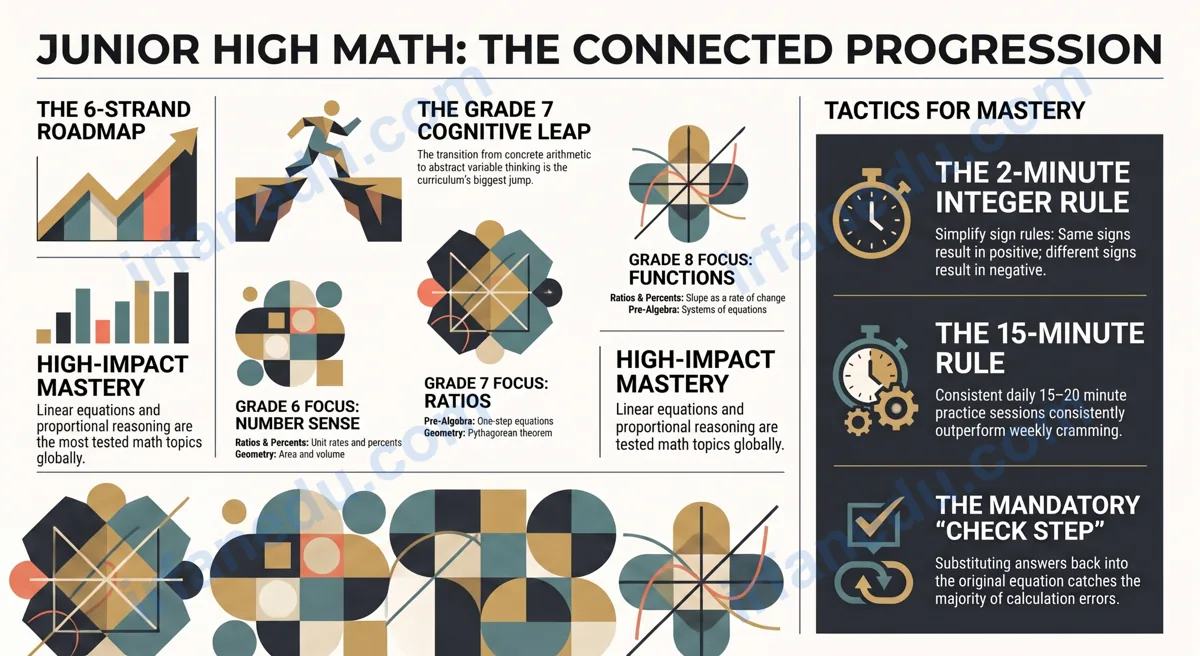
Junior high math covers grades 6 through 8 and builds the six core strands — integers, fractions, ratios, pre-algebra, geometry, and statistics — that every high school math course depends on. Students who understand why each operation works, not just how to execute it, consistently outperform peers who rely on memorized steps alone.
- 🎯 Understand what each grade level covers and why it matters
- 🔢 Work through real, step-by-step examples for every major topic
- 🚫 Spot and fix the five most common errors before they become habits
- 📊 Use a comparison table to see how topics connect across grades
- ✅ Test yourself with a 3-question quiz and reveal-on-click practice problems
⚡ Quick Win: One Skill You Can Master in 2 Minutes
Before the full mastery path, here is something you can do right now that will immediately make junior high math easier: learn the integer sign rules as a single pattern, not four separate rules.
🏆 The 2-Minute Integer Sign Pattern
Same signs → positive result. Different signs → negative result.
That’s it. It applies to both multiplication and division:
- (+6) × (+3) = +18 — same signs, positive ✅
- (−6) × (−3) = +18 — same signs, positive ✅
- (+6) × (−3) = −18 — different signs, negative ✅
- (−6) × (+3) = −18 — different signs, negative ✅
Most textbooks list these as four rules. They are one rule with four examples. Seeing it as one pattern reduces cognitive load and makes it stick permanently.
Bookmark that pattern. Now let’s build the full picture.
⚡ TL;DR – Quick Summary
- 📌 Junior high math spans grades 6–8 and covers six major strands.
- 📌 Grade 6 = number sense; Grade 7 = ratios + pre-algebra; Grade 8 = equations + geometry.
- 📌 The biggest skill jump is from arithmetic to abstract variable thinking in grade 7.
- 📌 Most errors come from sign mistakes, fraction shortcuts, and skipping the check step.
- 📌 Daily 15-minute practice beats weekly cramming — research consistently confirms this.
- 📌 Every topic in this guide connects directly to a high school math course.
| Quick Facts | Detail |
|---|---|
| Grade range | 6, 7, 8 (ages ~11–14) |
| Number of core strands | 6 |
| Biggest cognitive leap | Arithmetic → abstract algebra (grade 7) |
| Most tested topic globally | Linear equations & proportional reasoning |
| Feeds into | Algebra I, Geometry, Pre-Calculus |
| Recommended daily practice | 15–20 minutes |
What Is Junior High Math?
Junior high math is the mathematics curriculum taught in grades 6, 7, and 8 — the bridge between elementary arithmetic and high school algebra. It is the stage where students stop just computing answers and start reasoning about quantities, relationships, and unknowns.
The term “junior high math” is used most commonly in the United States, but the content maps closely to what other countries call “lower secondary mathematics” or “middle school math.” The six strands below are standard across most national curricula.
What makes this stage unique is the shift in abstraction level. In elementary school, every problem has concrete numbers. In junior high, letters start appearing — and that transition is where many students lose confidence. The good news: the abstraction is not as scary as it looks once you see the logic behind it.
In my experience, the students who struggle most in junior high math are not struggling because they lack ability. They are struggling because they were never shown the connections between topics. Fractions and division are the same operation. Ratios and fractions are the same concept in different clothing. Linear equations and proportional reasoning are the same relationship expressed differently. Once you see those connections, the whole curriculum clicks into place.
The 6 Core Strands: What Each Grade Covers
Junior high math is not random. Each strand builds on the previous one in a deliberate sequence. Here is how the six strands distribute across grades 6–8:
| Strand | Grade 6 Focus | Grade 7 Focus | Grade 8 Focus | High School Connection |
|---|---|---|---|---|
| 1. Integers & Rationals | Intro to negatives, absolute value | All four operations with integers | Real number system | Algebra I number line reasoning |
| 2. Fractions & Decimals | Divide fractions, decimal ops | Add/subtract rational numbers | Rational vs irrational numbers | Algebraic fractions |
| 3. Ratios & Percents | Ratios, unit rates, percent | Proportional relationships | Slope as a rate of change | Linear functions |
| 4. Pre-Algebra | Expressions, one-step equations | Two-step equations, inequalities | Systems of equations, functions | Algebra I & II |
| 5. Geometry | Area, surface area, volume | Scale drawings, angle relationships | Pythagorean theorem, transformations | Geometry, Trigonometry |
| 6. Statistics & Probability | Data displays, mean/median/mode | Sampling, probability basics | Scatter plots, linear models | Statistics, Data Science |
Notice how each grade deepens the same strand rather than introducing entirely new topics. This is intentional — and it means that fixing a gap in grade 6 automatically makes grade 7 easier.
Strand 1: How Do Integers and Rational Numbers Work?
Integers are whole numbers and their negatives: …, −3, −2, −1, 0, 1, 2, 3, … Rational numbers extend this to include fractions and decimals that either terminate or repeat.
Adding and Subtracting Integers
The number line is the most reliable mental model. Moving right = adding a positive. Moving left = adding a negative.
NUMBER LINE — Adding Integers

  −5   −4   −3   −2   −1    0   +1   +2   +3   +4   +5
   |----|----|----|----|----|----|----|----|----|----|

  Example: (−3) + (+5)
  Start at −3, move 5 steps RIGHT → land on +2  ✓

  Example: (+4) + (−6)
  Start at +4, move 6 steps LEFT  → land on −2  ✓

  RULE: Subtracting a negative = adding a positive
  (+5) − (−3)  =  (+5) + (+3)  =  +8  ✓
📝 Worked Example — Absolute Value
The absolute value of a number is its distance from zero. Distance is always positive.
|−7| = 7 |+7| = 7 |0| = 0
Use case: “The temperature dropped from 3°C to −4°C. What was the total change?”
Change = |3 − (−4)| = |3 + 4| = |7| = 7 degrees
Strand 2: How Do Fractions, Decimals, and Percents Connect?
Fractions, decimals, and percents are three ways to write the same number. Converting fluently between them is one of the highest-value skills in junior high math.
| Fraction | Decimal | Percent | Quick Conversion Trick |
|---|---|---|---|
| 1/2 | 0.5 | 50% | Divide numerator by denominator |
| 1/4 | 0.25 | 25% | Memorize the “quarter” family |
| 1/3 | 0.333… | 33.3% | Repeating decimal — round as needed |
| 3/5 | 0.6 | 60% | 3 ÷ 5 = 0.6, then × 100 |
| 7/8 | 0.875 | 87.5% | 7 ÷ 8 = 0.875 |
Dividing Fractions: The Step Most Students Get Wrong
📝 Worked Example — Fraction Division
Problem: 3/4 ÷ 2/5 = ?
- Keep the first fraction: 3/4
- Change ÷ to ×
- Flip the second fraction: 2/5 becomes 5/2
- Multiply: (3 × 5) / (4 × 2) = 15/8
- Simplify: 15/8 = 1 and 7/8
The “Keep-Change-Flip” (KCF) method works every time for fraction division.
Strand 3: How Do You Solve Equations in Pre-Algebra?
A pre-algebra equation is a mathematical sentence with an unknown variable. Solving it means finding the value of that variable that makes the sentence true.
How to Solve a Two-Step Equation (Step-by-Step)
- Identify the variable — the letter you are solving for (e.g., x).
- Undo addition or subtraction first — apply the inverse operation to both sides.
- Undo multiplication or division second — isolate the variable completely.
- Check your answer — substitute back into the original equation and verify both sides are equal.
📝 Worked Example — Two-Step Equation
Problem: 3x + 7 = 22
Step 1: Subtract 7 from both sides: 3x + 7 − 7 = 22 − 7 → 3x = 15
Step 2: Divide both sides by 3: 3x ÷ 3 = 15 ÷ 3 → x = 5
Check: 3(5) + 7 = 15 + 7 = 22 ✓
In my experience teaching this topic, the check step is the single most skipped step — and the one that catches the most errors. I tell my students: “The check step is not optional. It is the step that proves you’re right.” Students who check every answer consistently score higher on tests because they catch their own mistakes before the teacher does.
Strand 4: What Geometry Do You Learn in Junior High?
Junior high geometry moves from measuring shapes (grade 6) to understanding spatial relationships and proofs (grade 8). The Pythagorean theorem is the crown jewel of grade 8 geometry.
Key Geometry Formulas at a Glance
| Shape / Concept | Formula | Grade Level |
|---|---|---|
| Rectangle Area | A = l × w | Grade 6 |
| Triangle Area | A = ½ × b × h | Grade 6 |
| Circle Area | A = π r² | Grade 7 |
| Cylinder Volume | V = π r² h | Grade 7 |
| Pythagorean Theorem | a² + b² = c² | Grade 8 |
| Slope of a Line | m = (y₂ − y₁) / (x₂ − x₁) | Grade 8 |
📝 Worked Example — Pythagorean Theorem
Problem: A right triangle has legs of 6 cm and 8 cm. Find the hypotenuse.
Step 1: Write the formula: a² + b² = c²
Step 2: Substitute: 6² + 8² = c² → 36 + 64 = c² → 100 = c²
Step 3: Take the square root: c = √100 = 10 cm
This is the famous 3-4-5 triple scaled by 2. Memorizing common Pythagorean triples (3-4-5, 5-12-13, 8-15-17) saves significant time on tests.
PYTHAGOREAN THEOREM — Visual

        c (hypotenuse)
       /|
      / |
   c /  | b = 8
    /   |
   /    |
  /_____|
     a = 6

  a² + b² = c²
  6² + 8² = c²
  36 + 64 = 100
  c = √100 = 10 cm  ✓
Strand 5: What Statistics and Probability Are Taught in Junior High?
Statistics in junior high focuses on describing and comparing data sets. Probability introduces the language of chance and prediction.
Measures of Center — What’s the Difference?
| Measure | Definition | Best Used When | Example (Data: 2, 4, 4, 7, 13) |
|---|---|---|---|
| Mean | Sum ÷ count | Data has no extreme outliers | (2+4+4+7+13)/5 = 6 |
| Median | Middle value when sorted | Data has outliers | 4 (middle of sorted list) |
| Mode | Most frequent value | Categorical or repeated data | 4 (appears twice) |
| Range | Max − Min | Measuring spread | 13 − 2 = 11 |
5 Common Junior High Math Mistakes (Wrong vs. Right)
These five errors account for the majority of lost points on junior high math tests. Recognizing them is the first step to eliminating them.
| # | ❌ Wrong | ✅ Right | Why It Matters |
|---|---|---|---|
| 1 | −3² = 9 | −3² = −9 (but (−3)² = 9) | The negative is NOT inside the exponent unless brackets are shown |
| 2 | 1/2 + 1/3 = 2/5 | 1/2 + 1/3 = 3/6 + 2/6 = 5/6 | You must find a common denominator before adding fractions |
| 3 | Solving 2x + 4 = 10 → x = 7 | 2x = 6, so x = 3 | Subtract the constant BEFORE dividing by the coefficient |
| 4 | Area of circle = 2πr | Area = πr² (circumference = 2πr) | Mixing up area and circumference formulas is extremely common |
| 5 | Mean of 2, 4, 4, 7, 13 = 4 | Mean = 30/5 = 6 | Always sum ALL values and divide by the total count, not just the middle |
Most guides teach junior high math as six separate topics. That framing is the problem.
Here is what I have observed after years of working with struggling students: the students who improve fastest are not the ones who study harder topic by topic. They are the ones who discover the cross-strand connections early.
For example: slope (grade 8 geometry/algebra) is just a ratio (grade 6 number sense) expressed on a coordinate plane. Once a student sees that slope = rise/run = a fraction = a rate of change, three “separate” topics collapse into one concept. The cognitive load drops dramatically.
Similarly, probability fractions (grade 7 statistics) are the same arithmetic as regular fractions (grade 6) — just with a real-world context attached. Students who struggle with probability often have no fraction gap; they have a context-recognition gap. Showing them the fraction structure underneath the probability language fixes the problem in minutes.
Practical takeaway: When you study any new junior high math topic, ask “What earlier concept is this built on?” That single question accelerates learning more than any extra practice set.
🧠 Quick Quiz: Test Your Junior High Math Knowledge
Select your answer, then click “Show Answer” to check.
Q1. What is (−4) × (−5)?
Show Answer
Q2. Solve for x: 5x − 3 = 17
Show Answer
Q3. A right triangle has legs 5 and 12. What is the hypotenuse?
Show Answer
🔓 Reveal-on-Click Practice Problems
Try each problem on paper first, then click to reveal the full solution.
Problem 1: Simplify −2 + (−8) − (−3)
Rewrite subtracting a negative as adding a positive:
−2 + (−8) − (−3) = −2 + (−8) + (+3)
= (−2 − 8) + 3 = −10 + 3 = −7
Problem 2: What is 2/3 ÷ 4/9?
Keep-Change-Flip: 2/3 × 9/4 = 18/12 = 3/2 = 1.5
Problem 3: Find the area of a circle with radius 7 cm. (Use π ≈ 3.14)
A = π r² = 3.14 × 7² = 3.14 × 49 = 153.86 cm²
Problem 4: The data set is 5, 8, 8, 10, 14. Find the mean, median, and mode.
Mean: (5 + 8 + 8 + 10 + 14) / 5 = 45 / 5 = 9
Median: Middle value of sorted set = 8
Mode: Most frequent = 8 (appears twice)
❓ Frequently Asked Questions About Junior High Math
What math topics are covered in junior high?
What is the hardest topic in junior high math?
How can I get better at junior high math fast?
Is junior high math the same as pre-algebra?
What grade level is junior high math?
Sources & References
Reviewed by Dr. Irfan Mansuri. External links open in a new tab and are provided for further reading and verification.