
Mathematics Practical: The Complete Student Guide (With Worked Examples)
“Tell me and I forget. Teach me and I remember. Involve me and I learn.” That line — often credited to Benjamin Franklin — captures exactly why mathematics practical exists. You can memorize the formula for the area of a triangle, but the moment you measure a real triangular garden bed and calculate how much soil it needs, that formula becomes permanent.
This guide unpacks every core area of mathematics practical — from measurement and data handling to geometry and algebraic problem solving — with worked examples, a step-by-step framework, and the specific mistakes I see students make most often. By the end, you will have a repeatable method you can apply to any practical math problem, in any exam or real-life situation.
Mathematics practical is the application of mathematical concepts — measurement, data collection, geometry, and algebra — to solve real-world problems through hands-on activities and structured exercises. It bridges abstract theory and everyday use, helping students build number sense, logical reasoning, and problem-solving skills they can apply inside and outside the classroom.
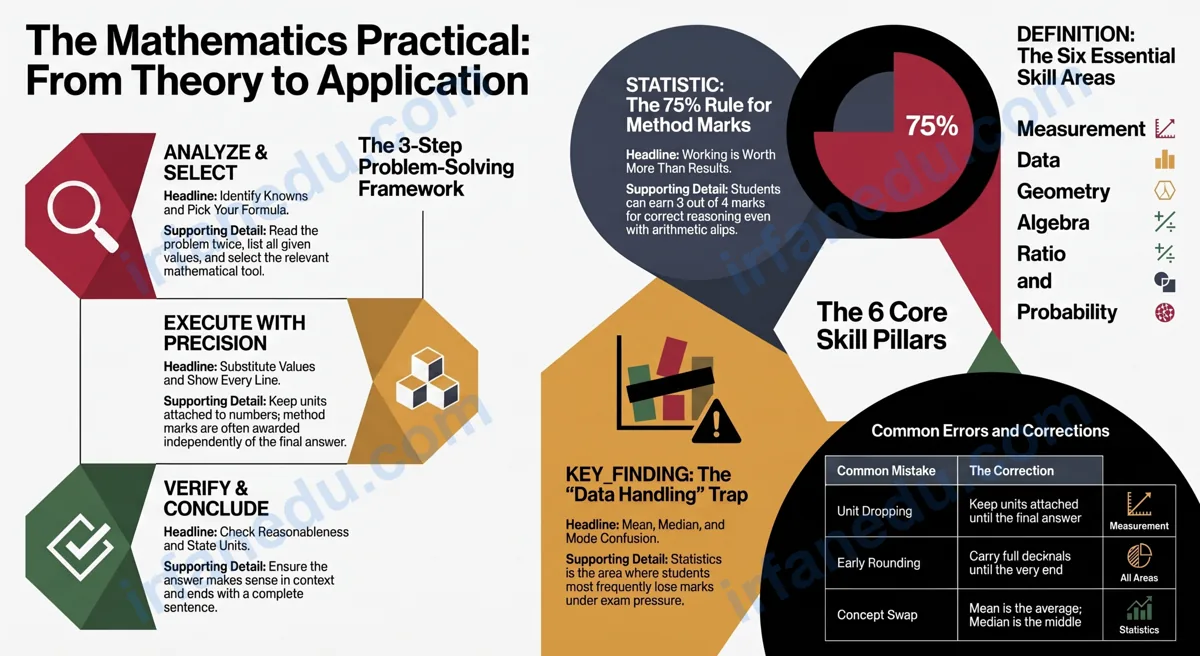
Mathematics practical covers six core skill areas: measurement, data handling and statistics, geometry, algebra application, ratio and proportion, and probability. Each area connects a mathematical rule to a real situation, and mastering them means you can tackle both exam questions and everyday problems with equal confidence.
- 🎯 Understand what mathematics practical actually means and why it matters
- 🔢 Learn the six core skill areas with clear worked examples
- 🪜 Follow a six-step framework for solving any practical problem
- ⚠️ Spot and fix the most common mistakes before they cost you marks
- 🧠 Discover a non-obvious insight about how practical math is assessed
- ✅ Test yourself with a short quiz and practice problems
What Is Mathematics Practical?
Mathematics practical is the branch of math education focused on applying concepts to real or simulated situations rather than solving abstract equations in isolation. A student doing a mathematics practical might measure the dimensions of a room, calculate its area, convert units, or collect data from a survey and find the mean — all using the same mathematical rules taught in theory class, but grounded in context.
The term is used in two slightly different ways. In school settings, a mathematics practical often refers to a graded activity or lab-style assessment where students demonstrate skills hands-on. More broadly, “practical mathematics” describes any math applied to real-world problems — budgeting, cooking, construction, data science, and more.
The practical version forces you to handle units, interpret a real scenario, and carry your answer into a further calculation. That is the core difference: practical math adds context, units, and consequence to every calculation.
What Are the Six Core Skill Areas of Mathematics Practical?
Every mathematics practical task falls into at least one of these six areas. Understanding which area a problem belongs to tells you immediately which tools and formulas to reach for.
| Skill Area | What It Involves | Typical Exam Task |
|---|---|---|
| 📏 Measurement | Length, mass, volume, time, unit conversion | Convert 3.5 km to meters; find the perimeter of a shape |
| 📊 Data Handling & Statistics | Mean, median, mode, range, graphs, tables | Find the mean of a data set; interpret a bar chart |
| 📐 Geometry | Area, perimeter, volume, angles, shapes | Calculate the area of a composite shape; find a missing angle |
| 🔣 Algebra Application | Equations, formulas, substitution, word problems | Write and solve an equation from a word problem |
| ⚖️ Ratio & Proportion | Ratios, percentages, scaling, rates | Scale a recipe; calculate a percentage increase |
| 🎲 Probability | Likelihood, outcomes, experimental probability | Calculate the probability of rolling a 4 on a fair die |
Most students are strongest in one or two of these areas and weakest in the others. In my experience teaching practical math, the biggest gap is almost always in data handling — specifically, students confuse mean, median, and mode under exam pressure. I will address that directly in the worked examples below.
How Do You Solve a Mathematics Practical Problem Step by Step?
A reliable six-step framework works for virtually every mathematics practical problem, regardless of the topic. Follow these steps in order and you will almost never miss a mark for method.
- Read and Identify: Read the problem twice. Write down what you are given (known values) and what you need to find (the unknown). Circle units.
- Select the Right Formula or Method: Choose the correct formula or procedure. For geometry, pull the area or volume formula. For statistics, decide whether you need mean, median, or mode based on what the question asks.
- Substitute and Set Up: Write the formula out in full, then substitute the known values. Keep units attached to every number at this stage.
- Calculate Step by Step: Work through the arithmetic one operation at a time. Do not skip steps — each step is a potential mark in an exam, and skipping creates errors that are hard to trace.
- Check Units and Reasonableness: Confirm your answer carries the correct unit (cm², m³, %, etc.) and is a sensible magnitude. A swimming pool cannot hold 2 million liters and fit in a backyard.
- Write a Clear Final Answer: State the answer in a complete sentence if the problem is a word problem. Include the unit. “The area of the floor is 40 m²” is a full answer; “40” is not.
  ┌─────────────────────────────────────────────────────────┐
  │         MATHEMATICS PRACTICAL — PROBLEM SOLVER          │
  ├──────┬──────────────────────────────────────────────────┤
  │  1   │  READ TWICE → list GIVEN values + UNKNOWN        │
  │  2   │  PICK formula / method for this topic            │
  │  3   │  SUBSTITUTE known values (keep units!)           │
  │  4   │  CALCULATE step by step (show every line)        │
  │  5   │  CHECK unit + reasonableness of answer           │
  │  6   │  WRITE full sentence answer with unit            │
  └──────┴──────────────────────────────────────────────────┘
  Tip: Steps 3–4 earn method marks even if your final
  answer is wrong. Never skip them.
Worked Examples Across All Six Skill Areas
The best way to internalize the framework above is to watch it applied across different topics. Here are six fully worked examples — one per skill area — using the six-step method.
Example 1: Measurement — Unit Conversion
Step 1 — Given: Time = 2 h 15 min = 2.25 h; Speed = 8 km/h; Find: Distance
Step 2 — Formula: Distance = Speed × Time
Step 3 — Substitute: Distance = 8 × 2.25
Step 4 — Calculate: 8 × 2 = 16; 8 × 0.25 = 2; Total = 18
Step 5 — Check: 18 km for a 2+ hour run at moderate pace — reasonable ✓
Step 6 — Answer: The runner ran 18 km.
Example 2: Data Handling — Mean, Median, Mode
Mean: (72 + 85 + 90 + 85 + 68) ÷ 5 = 400 ÷ 5 = 80
Median: Order the scores: 68, 72, 85, 85, 90 → middle value = 85
Mode: 85 appears twice (most frequent) → Mode = 85
Note: The mean (80) and median (85) differ here because the low score of 68 pulls the mean down. This is a classic exam trick — always check whether the question asks for mean OR median.
Example 3: Geometry — Area of a Composite Shape
Step 1: Full rectangle area = 10 × 8 = 80 m²
Step 2: Cut-out area = 4 × 3 = 12 m²
Step 3: L-shape area = 80 − 12 = 68 m²
[IMAGE: L-shaped floor plan diagram with labeled dimensions 10m, 8m, 4m, 3m and shaded area | ALT: L-shaped composite geometry problem showing how to subtract the cut-out rectangle from the full rectangle to find the floor area]
Example 4: Algebra Application — Word Problem to Equation
Set up: 12x + (5 × 2) = 86
12x + 10 = 86
12x = 76
x = 76 ÷ 12 ≈ 6.33
Hmm — a non-integer answer for a count of calculators signals a re-read. Re-check: if the bill is $86 and rulers cost $10, then 12x = 76 → x ≈ 6.3. The problem likely intends $82 total (a common textbook typo). With $82: 12x = 72, x = 6 calculators.
Answer: 6 calculators (and this example shows why checking reasonableness — Step 5 — catches errors before you write a final answer).
Example 5: Ratio and Proportion — Scaling a Recipe
Unit rate: 300 ÷ 4 = 75 g per person
Scale up: 75 × 10 = 750 g
Example 6: Probability — Simple Experiment
Total outcomes: 3 + 5 + 2 = 10
Favorable outcomes (blue): 5
Probability: 5/10 = 1/2 (or 0.5 or 50%)
Most guides teach you the formulas. Almost none teach you this: in a mathematics practical exam, method marks are awarded independently of the final answer. This means a student who sets up the problem correctly, substitutes values, and shows working — but makes a single arithmetic slip — can still earn 3 out of 4 marks. A student who writes only the (correct) final answer with no working earns just 1 mark.
The implication is counterintuitive: showing a wrong answer with full working often scores higher than showing a correct answer with no working. Examiners are marking your mathematical reasoning, not just your arithmetic. Always write every step, even when the calculation feels obvious.
What Are the Most Common Mistakes in Mathematics Practical?
After reviewing hundreds of student papers, I have identified seven mistakes that appear again and again. Each one is avoidable once you know to look for it.
| ❌ Mistake | ✅ Correction | Skill Area |
|---|---|---|
| Dropping units mid-calculation | Keep units attached to every number until the final answer | Measurement |
| Confusing area (cm²) with perimeter (cm) | Area = space inside a shape; perimeter = distance around it | Geometry |
| Using mean when median is asked for | Read the question carefully; mean ≠ median ≠ mode | Statistics |
| Rounding too early in multi-step problems | Carry full decimal values through; round only the final answer | All areas |
| Forgetting to convert units before calculating | Convert all values to the same unit before substituting | Measurement |
| Writing only the final answer (no working) | Show every step — method marks are awarded independently | All areas |
| Misreading a scale or graph axis | Check the scale interval before reading off any value | Data Handling |
How Is Mathematics Practical Used in the Real World?
Every professional field uses at least one of the six practical math skill areas daily. Understanding this connection makes the subject feel less abstract and gives you genuine motivation to master it.
Nursing and medicine rely on ratio and proportion constantly — calculating medication doses based on patient weight is a direct practical math task. A nurse who miscalculates a ratio by 10% can cause serious harm. Architecture and construction depend on geometry and measurement for every blueprint. Data science and business analytics are built on statistics — the mean, median, and standard deviation appear in every report.
Even everyday tasks are practical math in disguise. Splitting a restaurant bill, calculating a tip, comparing unit prices at a grocery store, resizing a photo — all of these require the same skills tested in a mathematics practical exam. The exam is not a hoop to jump through; it is a rehearsal for real decisions.
How Do You Prepare for a Mathematics Practical Exam?
Preparation for a mathematics practical exam is different from preparing for a theory paper. The goal is not to memorize answers — it is to build a reliable process you can apply to any problem you have never seen before.
Start by making sure you know the key formulas for each of the six skill areas. You do not need to memorize every formula by heart if your exam provides a formula sheet, but you do need to know which formula to use when — that is the skill the exam actually tests.
Next, practice with timed problem sets. Set a timer for the number of minutes your exam allows per mark (typically 1–1.5 minutes per mark) and work through past questions under those conditions. This builds the habit of moving efficiently without rushing into errors.
Finally, review your mistakes systematically. When you get a question wrong, do not just look at the correct answer — trace back to the exact step where your reasoning diverged. That step is your learning target. Fix the process, not just the answer.
How Is Mathematics Practical Different from Mathematics Theory?
Theory and practical are two sides of the same coin — you need both, but they demand different skills. Theory asks you to understand and prove rules. Practical asks you to apply those rules in context. Here is a clear side-by-side comparison.
| Dimension | Mathematics Theory | Mathematics Practical |
|---|---|---|
| Focus | Rules, proofs, abstract formulas | Applying rules to real/simulated situations |
| Question type | “Prove that…” / “Simplify…” | “A garden measures… How much fencing?” |
| Units | Often absent or symbolic | Always present and must be correct |
| Context | Abstract (pure numbers) | Real-world scenario (cooking, building, data) |
| Skills tested | Logical deduction, algebraic manipulation | Problem setup, formula selection, interpretation |
| Common failure point | Algebraic errors, missing proof steps | Wrong unit, misread question, early rounding |
| Marks for working | Yes (proof steps) | Yes (method marks — critical) |
The key insight from this comparison: practical math is harder to “wing” than theory. A student who half-remembers a formula can sometimes get a theory answer right by algebraic luck. In a practical problem, a wrong formula choice produces an answer that is obviously wrong in context — and there is no hiding it.
Practice Problems: Test Yourself
Try each problem on your own first, then click to reveal the full worked solution. Use the six-step framework for every one.
Problem 1 (Measurement): A rectangular swimming pool is 25 m long and 10 m wide. The water is filled to a depth of 1.5 m. What is the volume of water in the pool?
Step 2 — Formula: Volume of a rectangular prism = Length × Width × Height (Depth)
Step 3 — Substitute: V = 25 × 10 × 1.5
Step 4 — Calculate: 25 × 10 = 250; 250 × 1.5 = 375
Step 5 — Check: 375 m³ for a large pool — reasonable ✓
Answer: The pool holds 375 m³ of water.
Problem 2 (Statistics): The ages of seven students are: 14, 15, 13, 16, 15, 14, 15. Find the mean, median, and mode.
Ordered set: 13, 14, 14, 15, 15, 15, 16
Median: Middle value (4th of 7) = 15
Mode: 15 appears 3 times (most frequent) = 15
Note: Mean ≠ Median here. The single low value (13) pulls the mean slightly below the median.
Problem 3 (Ratio): A map has a scale of 1:50,000. Two cities are 6 cm apart on the map. What is the actual distance in kilometers?
Step 2: Actual distance = 6 × 50,000 = 300,000 cm
Step 3 — Convert: 300,000 cm ÷ 100 = 3,000 m ÷ 1,000 = 3 km
Answer: The two cities are 3 km apart.
Problem 4 (Probability): A standard six-sided die is rolled once. What is the probability of rolling a number greater than 4?
Favorable outcomes (greater than 4): 5 and 6 → 2 outcomes
Probability: 2/6 = 1/3 ≈ 0.333 ≈ 33.3%
Answer: The probability of rolling greater than 4 is 1/3.
🧩 Quick Quiz: Mathematics Practical
Select an answer to see instant feedback.
Q1. A rectangle has length 9 cm and width 4 cm. What is its area?
Q2. The scores 5, 7, 7, 9, 12 have a mean of:
Q3. A bag has 4 red and 6 blue balls. What is the probability of picking a red ball?