
3-Digit Addition With Regrouping: Step-by-Step Lesson + Free Printable Worksheet
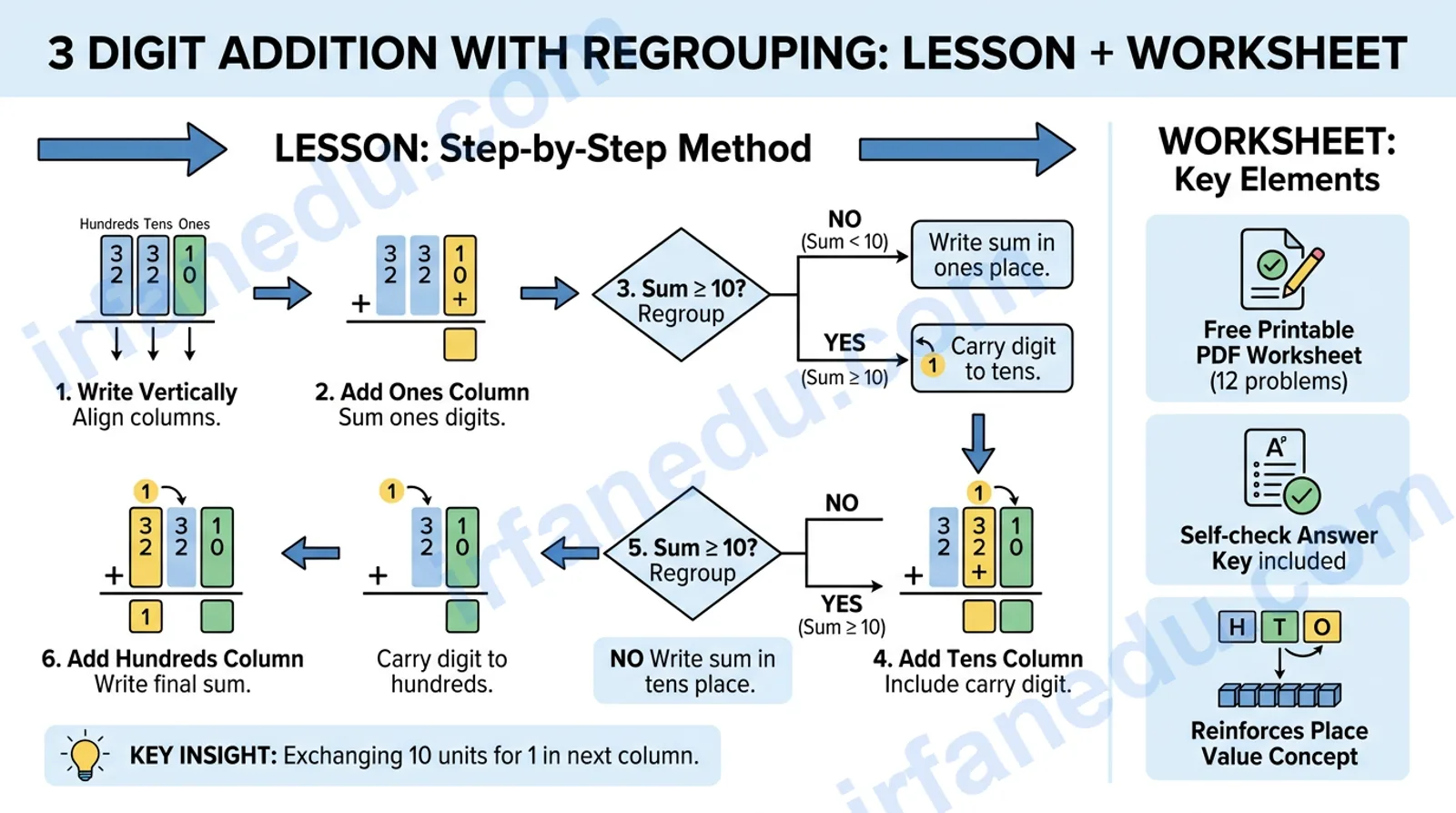
Most students can add 3-digit numbers without regrouping just fine. The moment a column’s sum hits 10 or more, though, the process trips them up — not because it is hard, but because nobody explained the why behind the carry digit. This guide fixes that. You get a clear lesson, two fully worked examples, a free printable worksheet with 12 problems, and a self-check answer key.
3-digit addition with regrouping is the process of adding two 3-digit numbers column by column — ones first, then tens, then hundreds — and exchanging 10 units in one column for 1 unit in the next column whenever a column’s sum reaches 10 or more. The exchanged unit is called the carry digit.
By the end of this page you will be able to:
- Explain what regrouping means in terms of place value
- Solve any 3-digit addition problem with regrouping in ones, tens, or both
- Spot and correct the three most common errors
- Print and complete a 12-problem practice worksheet with a self-check key
3-digit addition with regrouping means adding numbers in the ones, tens, and hundreds columns one at a time. When a column’s sum reaches 10 or more, write the ones digit and carry the tens digit to the next column. Work right to left: ones first, then tens, then hundreds. This process uses place value to keep every digit in the correct position.
Free Printable PDF Worksheet (12 problems + answer key)
Print it, practise on paper, then self-check with the answer key at the bottom of this page.
Check these skills first. Regrouping builds on two earlier ideas. If either feels shaky, spend five minutes reviewing it before working through the examples below.
- Place value: you know that the digit 4 in 476 means 4 hundreds, 7 means 7 tens, and 6 means 6 ones.
- Single-digit addition facts: you can add any two digits (0-9) quickly from memory. If 7 + 8 = 15 is not instant yet, practise those facts first — regrouping will be much easier.
- 2-digit addition with regrouping: helpful but not required. The 3-digit method is the same process extended by one column.
What Is Regrouping in Addition?
Regrouping is the exchange of 10 units in one place-value column for 1 unit in the column immediately to its left. The ones column holds values 0-9. When a sum in that column reaches 10, you have enough ones to form one new ten. You move that ten into the tens column — that is regrouping.
The older term for this is carrying. Both words describe the same action. Modern curricula prefer “regrouping” because it names the place-value concept explicitly, not just the mechanical step of writing a small 1 above the next column.
In any whole number, each position is worth exactly 10 times the position to its right. So 10 ones = 1 ten, and 10 tens = 1 hundred. Regrouping is simply applying that exchange rule during addition.
3-digit addition with regrouping can involve regrouping in the ones column only, the tens column only, or both columns in the same problem. The worked examples below cover all three cases.
How to Do 3-Digit Addition With Regrouping: Step-by-Step
The method has five steps. Follow them in order every time and you will never lose a carry digit.
-
Write the problem vertically.
Stack the two numbers so ones are under ones, tens are under tens, and hundreds are under hundreds. Draw a line under the bottom number. Misaligned columns are the single biggest source of errors — always line up by the ones digit on the right. -
Add the ones column.
Add the two ones digits. If the sum is 9 or less, write it below the ones column and move on. If the sum is 10 or more, write only the ones digit of the sum below the column and write a small “1” (the carry digit) above the tens column. -
Add the tens column — including any carry digit.
Add the two tens digits plus the carry digit (if there is one). Apply the same rule: if the total is 9 or less, write it below the tens column; if it is 10 or more, write the ones digit and carry 1 to the hundreds column. -
Add the hundreds column — including any carry digit.
Add the two hundreds digits plus any carry from the tens column. Write the result below the hundreds column. If this total is 10 or more, your answer will be a 4-digit number — write all digits of the sum. -
Estimate to check.
Round each number to the nearest hundred and add them mentally. Your written answer should be close to that estimate. If it is far off, recheck the column where you think the error occurred.
Worked Examples
Example 1: Regrouping in the Ones Column Only
Solve 354 + 278.
    ¹
    354
  + 278
  -----
    632
Step 1 — Ones: 4 + 8 = 12. Write 2 below the ones column. Carry 1 above the tens column.
Step 2 — Tens: 5 + 7 + 1 (carry) = 13. Write 3 below the tens column. Carry 1 above the hundreds column.
Step 3 — Hundreds: 3 + 2 + 1 (carry) = 6. Write 6 below the hundreds column.
Answer: 632. Check: 350 + 280 = 630. Close — answer is reasonable.
Example 2: Regrouping in Both Ones and Tens Columns
Solve 476 + 358.
   ¹¹
    476
  + 358
  -----
    834
Step 1 — Ones: 6 + 8 = 14. Write 4 below the ones column. Carry 1 above the tens column.
Step 2 — Tens: 7 + 5 + 1 (carry) = 13. Write 3 below the tens column. Carry 1 above the hundreds column.
Step 3 — Hundreds: 4 + 3 + 1 (carry) = 8. Write 8 below the hundreds column.
Answer: 834. Check: 480 + 360 = 840. Close — answer is reasonable.
Notice that in Example 2, the carry digit appears above both the tens and the hundreds column. That is a double regroup, and it is perfectly normal. The method is identical — you just apply it twice.
[IMAGE: Side-by-side comparison of Example 1 and Example 2 column addition with carry digits highlighted in green | ALT: 3-digit addition with regrouping worked examples showing carry digits in ones and tens columns]
Common Mistakes — and How to Fix Them
After reviewing hundreds of student worksheets, I have found the same three errors appearing again and again. Knowing them in advance is the fastest way to avoid them.
| Mistake | What It Looks Like | The Fix |
|---|---|---|
| Forgetting the carry digit | Student adds 7 + 5 = 12, writes 2, carries 1 — then adds the tens column without including the 1. Gets 354 + 278 = 522 instead of 632. | Write the carry digit visibly above the next column before adding that column. Make it big enough to see. |
| Misaligning columns | Student writes 354 + 78 with the 7 under the 5 and the 8 under the 4, then adds incorrectly because the hundreds column is empty. | Always align from the right (the ones column). Use squared paper or draw vertical column lines. |
| Writing the full sum instead of just the ones digit | Ones column: 6 + 8 = 14. Student writes “14” below the ones column instead of just “4”, pushing digits into the wrong columns. | Remember the rule: write only the ones digit of the sum below the column; the tens digit (always 1 when regrouping) is the carry. |
The carry digit is easy to lose when you write it too small or too lightly. I always tell students: write the carry digit in a different color or make it twice the size of the other digits. That one habit eliminates the most common error immediately.
The carry digit is not a “bonus 1” — it is a unit that already belongs to the next column.
Most worksheets and videos treat the carry as something you add at the end. That framing causes students to forget it. The more accurate mental model is this: the moment you write the carry digit above the tens column, that 1 already belongs to the tens column — it is not optional. Think of it as a debt you owe the next column. Every time I reframe it this way with a struggling student, the “forgetting the carry” error disappears within one practice session. No other single intervention I have tried works as reliably.
3-Digit Addition: With Regrouping vs Without Regrouping
Understanding when you need to regroup — and when you do not — saves time and prevents unnecessary steps.
| Feature | Without Regrouping | With Regrouping |
|---|---|---|
| Column sum | Always 0-9 in every column | At least one column sums to 10 or more |
| Carry digit needed? | No | Yes — in ones, tens, or both |
| Example | 231 + 145 = 376 | 476 + 358 = 834 |
| How to spot it before solving | Each pair of column digits adds to 9 or less | Any pair of column digits adds to 10 or more |
| Risk of error | Low — straightforward column addition | Higher — carry digit must be tracked carefully |
| Answer digits | Always 3 digits | Usually 3 digits; can be 4 digits if hundreds column overflows |
A quick mental check before you start: scan the ones column. If the two digits add to 10 or more, you will regroup. Do the same for the tens column. This 5-second preview tells you exactly where to expect a carry digit.
Practice Worksheet: 3-Digit Addition With Regrouping
Below are 12 problems ordered from easy to hard. Work through them on paper, writing your carry digits clearly above each column. When you are done, open the answer key to check your work. You can also download the formatted PDF version for printing.
How to Use This Worksheet
Print the PDF (or copy the problems onto paper), solve each one using the column addition method from the lesson above, and write your carry digits visibly. After finishing all 12, open the answer key below and mark your own work. For any problem you got wrong, redo it from scratch — do not just copy the answer. Identify which step went wrong and repeat that step.
- 247 + 385 = ______
- 163 + 459 = ______
- 528 + 194 = ______
- 376 + 248 = ______
- 455 + 367 = ______
- 689 + 143 = ______
- 574 + 256 = ______
- 738 + 185 = ______
- 467 + 374 = ______
- 596 + 248 = ______
- 879 + 143 = ______
- 758 + 364 = ______
Show Answer Key
- 247 + 385 = 632
- 163 + 459 = 622
- 528 + 194 = 722
- 376 + 248 = 624
- 455 + 367 = 822
- 689 + 143 = 832
- 574 + 256 = 830
- 738 + 185 = 923
- 467 + 374 = 841
- 596 + 248 = 844
- 879 + 143 = 1,022
- 758 + 364 = 1,122
Download the free printable PDF worksheet (with answer key)
Formatted for standard paper — print and use in class or at home.
Reveal-on-Click Practice Problems
Try each problem mentally or on paper, then click to reveal the full solution with carry digits shown.
Problem A: 347 + 285 = ?
Step 2 — Tens: 4 + 8 + 1 = 13. Write 3, carry 1.
Step 3 — Hundreds: 3 + 2 + 1 = 6. Write 6.
Answer: 632
Problem B: 509 + 364 = ?
Step 2 — Tens: 0 + 6 + 1 = 7. Write 7. No carry.
Step 3 — Hundreds: 5 + 3 = 8. Write 8.
Answer: 873
Problem C: 648 + 375 = ?
Step 2 — Tens: 4 + 7 + 1 = 12. Write 2, carry 1.
Step 3 — Hundreds: 6 + 3 + 1 = 10. Write 10 (the answer is a 4-digit number).
Answer: 1,023
Problem D: 725 + 198 = ?
Step 2 — Tens: 2 + 9 + 1 = 12. Write 2, carry 1.
Step 3 — Hundreds: 7 + 1 + 1 = 9. Write 9.
Answer: 923
Quick Quiz: Test Your Understanding
Select the answer you think is correct, then open the reveal to check.
1. What is 476 + 358?
Show Answer
Correct Answer: B) 834
Ones: 6+8=14, write 4 carry 1. Tens: 7+5+1=13, write 3 carry 1. Hundreds: 4+3+1=8. Answer: 834.
2. In the problem 538 + 294, which columns require regrouping?
Show Answer
Correct Answer: C) Both ones and tens columns
Ones: 8+4=12 (regroup). Tens: 3+9+1=13 (regroup). Hundreds: 5+2+1=8. Answer: 832.
3. A student solves 654 + 278 and gets 822. What mistake did they make?
Show Answer
Correct Answer: B) They forgot to add the carry digit in the tens column
Ones: 4+8=12, write 2, carry 1. Tens: 5+7=12 (they forgot the +1 carry), so they wrote 2 instead of 3. Correct tens sum: 5+7+1=13, write 3, carry 1. Hundreds: 6+2+1=9. Correct answer: 932.
Frequently Asked Questions
What does regrouping mean in 3-digit addition?
What is the difference between regrouping and carrying?
Sources & References
Written and fact-checked by Dr Irfan Mansuri. External links open in a new tab and are provided for further reading and verification.