
Operations with Polynomials: The Complete Guide (+ Free Worksheet)
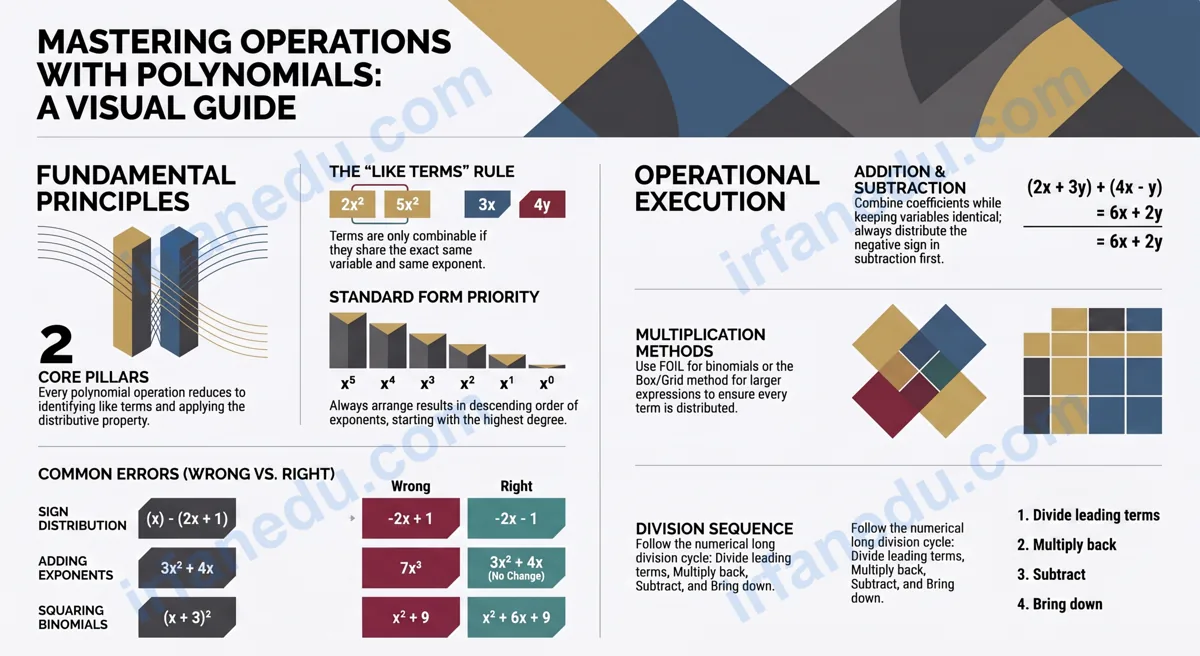
If polynomial operations have ever left you staring at a page full of x’s and exponents wondering where to even start — you are absolutely not alone. 😊 I have taught algebra to hundreds of students, and this topic trips up nearly everyone the first time, not because it is genuinely hard, but because most explanations skip the one mental model that makes everything click.
Operations with polynomials are the four core algebraic skills — adding, subtracting, multiplying, and dividing polynomial expressions — that form the backbone of algebra, calculus, and beyond. Every operation follows a small number of rules, and once you see the pattern, the whole topic becomes predictable and manageable.
By the end of this guide, you will:
- Understand what polynomials are and why like terms are the key concept
- Add and subtract polynomials confidently, including multi-term expressions
- Multiply polynomials using the distributive property and FOIL
- Divide polynomials using long division
- Avoid the five most common mistakes students make on tests
- Practice with a free printable worksheet and answer key
Operations with polynomials cover four skills: adding (combine like terms), subtracting (distribute the negative sign first, then combine like terms), multiplying (use the distributive property or FOIL for two binomials), and dividing (use polynomial long division or synthetic division). Every operation depends on correctly identifying like terms — terms that share the same variable and the same exponent.
⬇ Download Free PDF Worksheet
⚡ TL;DR – Quick Summary
- 🔵 Adding: Identify like terms, add their coefficients, keep the variable and exponent.
- 🟣 Subtracting: Distribute the minus sign to ALL terms in the second polynomial first.
- 🟡 Multiplying: Use the distributive property; use FOIL only for two binomials.
- 🔴 Dividing: Polynomial long division mirrors numerical long division — divide, multiply, subtract, repeat.
- ✅ Like terms rule: Same variable + same exponent = combinable. No exceptions.
- 📝 Worksheet: 12 graded practice problems with a full answer key below.
What Are Polynomials — and Why Do Operations Matter?
A polynomial is an algebraic expression made up of one or more terms, where each term is a number (coefficient) multiplied by a variable raised to a non-negative whole-number exponent. The word comes from Greek: poly (many) + nomos (terms).
| Term | Definition | Example |
|---|---|---|
| Monomial | One term | 5x² |
| Binomial | Two terms | 3x + 7 |
| Trinomial | Three terms | x² + 4x − 3 |
| Polynomial | Any number of terms | 2x³ − x² + 6x − 1 |
| Degree | Highest exponent in the polynomial | Degree of 2x³ − x² is 3 |
| Like terms | Same variable, same exponent | 4x² and −9x² are like terms |
Polynomial operations appear in physics (projectile motion equations), engineering (signal processing), computer graphics (curve rendering), and economics (cost modeling). Mastering them in algebra class is not just test prep — it is foundational literacy for any STEM field.
How Do You Add Polynomials?
To add polynomials, identify all like terms across both expressions and add their coefficients. The variable part stays exactly the same — you never change the exponent when adding.
- Remove the parentheses. Addition does not change any signs, so the parentheses simply drop away.
- Group like terms together. Rearrange so that terms with the same variable-exponent pair are next to each other.
- Add the coefficients. Treat the variable part as a label — only the number in front changes.
- Write the result in standard form. Descending order of exponents (highest first) is the convention.
✏️ Worked Example 1 — Adding Two Trinomials
Add: (4x² + 3x − 2) + (x² − 5x + 7)
Step 1: Drop the parentheses (addition, no sign change)
        4x² + 3x − 2 + x² − 5x + 7

Step 2: Group like terms
        (4x² + x²) + (3x − 5x) + (−2 + 7)

Step 3: Combine
        5x²  +  (−2x)  +  5

Answer: 5x² − 2x + 5
How Do You Subtract Polynomials?
To subtract polynomials, distribute the negative sign (multiply by −1) to every single term inside the second polynomial’s parentheses, then combine like terms exactly as you would for addition.
- Keep the first polynomial as-is. Do not touch any signs in the first set of parentheses.
- Distribute the minus sign. Flip the sign of every term in the second polynomial. This is the step most students rush and get wrong.
- Combine like terms. Follow the same steps as addition from here.
✏️ Worked Example 2 — Subtracting Polynomials
Subtract: (5x² − 3x + 1) − (2x² + x − 4)
Step 1: Distribute the minus sign to the second polynomial
        5x² − 3x + 1  −2x² − x + 4
        (Note: +x becomes −x, and −4 becomes +4)

Step 2: Group like terms
        (5x² − 2x²) + (−3x − x) + (1 + 4)

Step 3: Combine
        3x²  +  (−4x)  +  5

Answer: 3x² − 4x + 5
In my experience teaching algebra, subtraction of polynomials causes more lost test points than any other single operation — and almost always for the same reason: students flip the sign of the first term in the second polynomial but forget the rest. I now tell every student to physically rewrite the second polynomial with all signs flipped before combining anything. That one extra line of work eliminates the mistake almost entirely.
How Do You Multiply Polynomials?
To multiply polynomials, apply the distributive property: every term in the first polynomial multiplies every term in the second polynomial. For two binomials specifically, the FOIL method organizes this process.
| Situation | Best Method | Example |
|---|---|---|
| Monomial × Polynomial | Distribute the monomial | 3x(2x + 5) = 6x² + 15x |
| Binomial × Binomial | FOIL | (x+3)(x+4) = x²+7x+12 |
| Binomial × Trinomial | Distribute each term | (x+2)(x²−2x+4) |
| Any × Any | Box/Grid method | Organize in a table |
✏️ Worked Example 3 — FOIL (Binomial × Binomial)
Multiply: (2x − 1)(3x + 5)
FOIL breakdown:
  First:  2x × 3x  = 6x²
  Outer:  2x × 5   = 10x
  Inner: −1 × 3x   = −3x
  Last:  −1 × 5    = −5

Combine like terms (10x − 3x = 7x):

Answer: 6x² + 7x − 5
✏️ Worked Example 4 — Binomial × Trinomial
Multiply: (x + 2)(x² − 2x + 4)
Distribute x:   x·x² − x·2x + x·4  =  x³ − 2x² + 4x
Distribute +2:  2·x² − 2·2x + 2·4  =  2x² − 4x + 8

Combine like terms:
  x³ + (−2x² + 2x²) + (4x − 4x) + 8
  x³ +      0       +      0     + 8

Answer: x³ + 8   (This is the sum of cubes pattern!)
🟣 Visual: The Box/Grid Method for (2x + 3)(x + 4)
         |    x    |    4    |
---------+---------+---------+
   2x    |  2x²   |   8x   |
---------+---------+---------+
    3    |   3x   |   12   |
---------+---------+---------+

Sum all cells: 2x² + 8x + 3x + 12 = 2x² + 11x + 12
The box method is especially helpful when multiplying larger polynomials because it keeps every partial product in its own cell — nothing gets dropped or double-counted.
How Do You Divide Polynomials?
To divide polynomials, use polynomial long division when the divisor has two or more terms. The process mirrors numerical long division: divide the leading term, multiply back, subtract, bring down, and repeat.
- Write both polynomials in standard form (descending exponent order). Insert 0 as a placeholder coefficient for any missing degree.
- Divide the leading term of the dividend by the leading term of the divisor. Write the result above the division bar.
- Multiply that result by the entire divisor and write it below the dividend.
- Subtract (be careful with signs — this is the same trap as polynomial subtraction).
- Bring down the next term and repeat until the degree of the remainder is less than the degree of the divisor.
✏️ Worked Example 5 — Polynomial Long Division
Divide: (x² + 5x + 6) ÷ (x + 2)
         x  +  3
       ___________
x + 2 | x² + 5x + 6

Step 1: x² ÷ x = x  →  write x above
Step 2: x × (x + 2) = x² + 2x  →  write below
Step 3: Subtract: (x² + 5x) − (x² + 2x) = 3x  →  bring down +6
Step 4: 3x ÷ x = 3  →  write +3 above
Step 5: 3 × (x + 2) = 3x + 6  →  write below
Step 6: Subtract: (3x + 6) − (3x + 6) = 0  →  no remainder

Answer: x + 3
Check: (x + 3)(x + 2) = x² + 5x + 6 ✓
I always teach polynomial long division by having students check their answer through multiplication. If (dividend) ÷ (divisor) = quotient, then quotient × divisor must equal the dividend. That self-check habit catches sign errors instantly and builds genuine number sense — far more valuable than just getting the answer right once.
Common Mistakes Students Make (Wrong vs. Right)
These five errors account for the majority of lost marks on polynomial operation problems. Recognizing them in advance is the fastest way to improve your score.
| ❌ Wrong | ✅ Right |
|---|---|
| (5x² − 3x) − (2x² + x) = 3x² − 2x Only flipped the first sign |
(5x² − 3x) − (2x² + x) = 3x² − 4x Flip ALL signs: −2x² and −x |
| 3x² + 4x = 7x³ Added exponents when adding |
3x² + 4x cannot simplify Unlike terms — different exponents |
| (x + 3)² = x² + 9 Forgot the middle term |
(x + 3)² = x² + 6x + 9 FOIL: x² + 3x + 3x + 9 |
| 2x · 3x = 6x Forgot to add exponents when multiplying |
2x · 3x = 6x² Coefficients multiply; exponents add |
| Dividing x³ − 8 without placeholder zeros | Rewrite as x³ + 0x² + 0x − 8 before dividing |
💡 Unique Insight: Why FOIL Is a Trap (and What to Teach Instead)
Most algebra textbooks introduce FOIL as the method for multiplying polynomials. In my experience, this causes a specific and predictable failure: when students encounter a binomial times a trinomial, they try to apply FOIL and get stuck because FOIL only works for two binomials. The underlying method — distribute every term in the first polynomial across every term in the second — works universally. FOIL is just a memory shortcut for one special case. Teaching the general distributive property first, and introducing FOIL as a shortcut afterward, produces students who can handle any multiplication problem. If you learned FOIL first and nothing else, that is what most guides get wrong — and it is worth going back and internalizing the general rule now.
📝 Practice Worksheet — Operations with Polynomials
These 12 problems progress from straightforward to challenging, covering all four operations. Print the PDF for a clean worksheet experience, or work through the problems on-screen below.
How to use this worksheet: Work through each problem on paper, showing all steps. When you finish, use the collapsible Answer Key below to self-check. For any problem you got wrong, go back to the relevant worked example above and identify exactly which step you missed.
- (3x + 5) + (2x + 4)
- (4x² + 3x) + (x² − 2x + 7)
- (6x + 9) − (2x + 3)
- (5x² − 3x + 1) − (2x² + x − 4)
- 3x(2x + 5)
- (x + 4)(x + 3)
- (2x − 1)(3x + 5)
- (x + 2)(x² − 2x + 4)
- (6x² + 9x) ÷ 3x
- (x² + 5x + 6) ÷ (x + 2)
- (2x³ − 3x² + x − 5) ÷ (x − 1)
- (x² − 9) ÷ (x − 3)
📋 Show Answer Key
- 5x + 9
- 5x² + x + 7
- 4x + 6
- 3x² − 4x + 5
- 6x² + 15x
- x² + 7x + 12
- 6x² + 7x − 5
- x³ + 8
- 2x + 3
- x + 3
- 2x² − x + remainder −5/(x−1) (quotient: 2x² − x, remainder: −5)
- x + 3
⬇ Download Free PDF Worksheet
🧠 Quick Quiz — Test Your Understanding
Q1. What is (3x² + 2x) + (x² − 5x)?
Q2. What is the result of (x + 5)(x − 3) using FOIL?
Q3. Which terms are like terms?
❓ Frequently Asked Questions
What are the four operations with polynomials?
What are like terms in polynomials?
Sources & References
Written and fact-checked by Dr Irfan Mansuri. External links open in a new tab and are provided for further reading and verification.