
Addition With Regrouping Worksheets: Free PDF + Lesson (Grades 2–4)
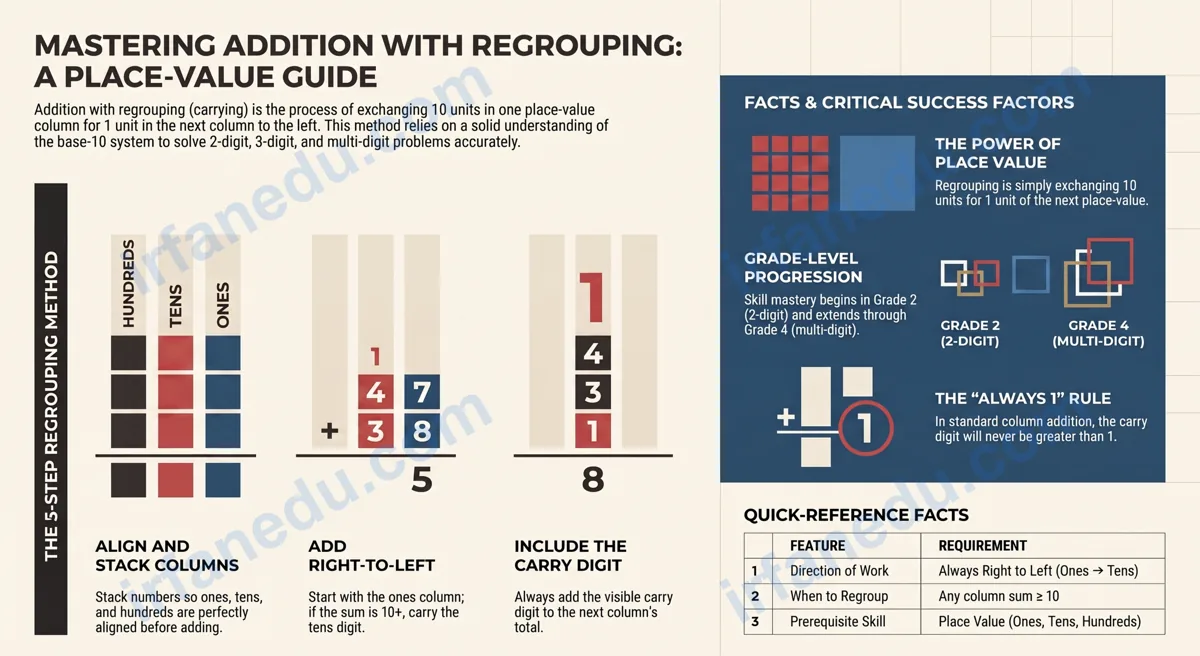
You have probably been told that regrouping is just a rule you follow — “write the small number, carry the big one.” That explanation is technically wrong, and it is exactly why so many students get confused the moment the numbers get larger. Regrouping is not a rule. It is a direct consequence of how our base-10 number system works, and once a student understands that, the whole skill clicks into place.
Addition with regrouping (also called carrying) is the process of exchanging 10 units in one place-value column for 1 unit in the next column to the left. When the digits in a column sum to 10 or more, you write the ones digit of that sum below the line and carry the tens digit upward. This applies to 2-digit, 3-digit, and larger numbers.
In my experience teaching elementary math, the students who struggle most with regrouping are not struggling with addition — they are struggling with place value. Fix the concept, and the skill follows. This page gives you both: a clear lesson that corrects the most common misconceptions, plus a free printable worksheet with 12 problems and a full answer key.
- Understand what regrouping actually means (not just how to do it).
- Follow a 5-step method that works for 2-digit, 3-digit, and 4-digit problems.
- Spot and fix the four most common errors students make.
- Practice with 12 graded problems and check your work with the answer key.
What You Get on This Page
- A myth-busting lesson that explains the why, not just the how.
- 3 fully worked examples (2-digit, 3-digit, double-regroup).
- 12-problem printable worksheet (easy to hard) + answer key.
- Free downloadable PDF with answer key.
- Interactive quiz to test understanding.
Free Printable PDF: 12 problems (easy to hard) with a full answer key — ready to print or use on screen.
TL;DR – Quick Summary
- Regrouping = exchanging 10 ones for 1 ten (or 10 tens for 1 hundred).
- Always work right to left: ones column first, then tens, then hundreds.
- Write the ones digit below the line; carry the tens digit above the next column.
- The carry digit must be added before you finish that column — the most common error is forgetting it.
- Weak place-value understanding is the root cause of most regrouping errors.
- Practice 8–12 focused problems per session; quality beats quantity.
Quick Facts
| Feature | Detail |
|---|---|
| Also called | Carrying, trading, bridging ten |
| Grade introduced | Grade 2 (2-digit); Grade 3 (3-digit); Grade 4 (4-digit+) |
| Prerequisite skill | Place value (ones, tens, hundreds) |
| Direction of work | Always right to left (ones → tens → hundreds) |
| When to regroup | Any column sum ≥ 10 |
| Carry digit value | Always 1 (you never carry more than 1 in standard addition) |
| Common error | Forgetting to add the carry digit in the next column |
The Myths That Slow Students Down (And the Truth)
Most regrouping confusion comes from bad explanations, not from the math itself. Here are the four myths I hear most often — and what is actually true.
| Myth (What students are often told) | Truth (What actually happens) |
|---|---|
| “Just write the small number and carry the big one.” | You write the ones digit of the column sum and carry the tens digit. The “small” and “big” framing breaks down for sums like 20 (ones digit = 0, carry = 2). |
| “You only regroup in the ones column.” | You regroup in every column where the sum is 10 or more — ones, tens, hundreds, and beyond. A 3-digit problem can require two separate regroupings. |
| “Regrouping and carrying are different things.” | They are the same operation. “Carrying” is the older term; “regrouping” is the modern curriculum term. Both describe exchanging 10 units of one place for 1 unit of the next place. |
| “If you forget the carry, you just lose a point.” | Forgetting the carry corrupts every column to the left of the error, not just one. A single missed carry can make a 3-digit answer wrong by 100 or more. |
In my experience, the single most damaging myth is the first one — “write the small number, carry the big one.” It works fine for sums between 10 and 18, which is most of what grade 2 students see. But the moment a student hits a column that sums to 20 (e.g., 9 + 9 + 2 carry = 20), the rule fails completely. I always teach “write the ones digit, carry the tens digit” from day one, even if it sounds more complex. It never breaks.
What Is Addition With Regrouping?
Addition with regrouping is the standard algorithm for adding numbers when the sum of digits in any column reaches 10 or more. The core idea is place value: our number system is base-10, which means 10 units of any place equal exactly 1 unit of the next place to the left.
When you add 7 + 8 in the ones column and get 15, you have 15 ones. But 15 ones can be regrouped as 1 ten and 5 ones. So you write the 5 in the ones place of your answer and move (carry) the 1 ten into the tens column. That is the entire concept.
The term “regrouping” reflects this exchange: you are regrouping 10 ones into 1 ten. The older term “carrying” describes the physical act of moving that digit to the next column. Both terms are correct; modern curricula prefer “regrouping” because it makes the place-value logic explicit.
How to Do Addition With Regrouping: 5 Clear Steps
Follow these five steps in order for any addition problem, regardless of how many digits are involved.
- Write the numbers in columns. Stack the addends so that ones are above ones, tens above tens, and hundreds above hundreds. Draw a horizontal line beneath them.
- Add the ones column first. Add all digits in the ones column. If the sum is 0–9, write it below the line. If it is 10 or more, write only the ones digit below the line and write the tens digit (the carry) as a small number above the tens column.
- Add the tens column — including the carry. Add all digits in the tens column, plus the carry digit if there is one. Apply the same rule: write the ones digit below the line; carry the tens digit to the hundreds column if needed.
- Add the hundreds column — including any carry. Repeat the same process. If the sum is 10 or more, write the ones digit and carry to the thousands column.
- Read the final answer. The digits below the line, read from left to right, form your answer.
The step students most often skip is writing the carry digit visibly above the next column. I tell students: “If you do not write the carry, it does not exist for you.” Keeping the carry digit small but visible is not optional — it is the habit that separates students who get regrouping right consistently from those who get it right only sometimes.
Worked Examples: From 2-Digit to Double-Regroup
Example 1 — 2-Digit Addition With Regrouping: 47 + 35
    ¹
    4 7
  + 3 5
  -----
    8 2

Step 1: Ones column → 7 + 5 = 12
        Write 2 below the line.
        Carry 1 above the tens column.

Step 2: Tens column → 4 + 3 + 1(carry) = 8
        Write 8 below the line. No carry.

Answer: 82
Example 2 — 3-Digit Addition With One Regroup: 256 + 138
    ¹
    2 5 6
  + 1 3 8
  -------
    3 9 4

Step 1: Ones column → 6 + 8 = 14
        Write 4 below the line.
        Carry 1 above the tens column.

Step 2: Tens column → 5 + 3 + 1(carry) = 9
        Write 9 below the line. No carry.

Step 3: Hundreds column → 2 + 1 = 3
        Write 3 below the line.

Answer: 394
Example 3 — Double Regroup: 467 + 385
   ¹ ¹
    4 6 7
  + 3 8 5
  -------
    8 5 2

Step 1: Ones column → 7 + 5 = 12
        Write 2 below the line.
        Carry 1 above the tens column.

Step 2: Tens column → 6 + 8 + 1(carry) = 15
        Write 5 below the line.
        Carry 1 above the hundreds column.

Step 3: Hundreds column → 4 + 3 + 1(carry) = 8
        Write 8 below the line.

Answer: 852
Notice in Example 3 that both the ones and tens columns required regrouping. This is the “double regroup” pattern that trips up many grade 3 students — they handle the first carry correctly but forget to add the second carry in the hundreds column.
Common Mistakes in Addition With Regrouping (Wrong vs. Right)
These four errors account for the vast majority of wrong answers I see on regrouping worksheets. Recognising them is half the battle.
Wrong: 7 + 8 = 15, so write “15” in the ones place.
Right: 7 + 8 = 15, so write “5” in the ones place and carry “1” to the tens column.
Wrong: Ones column gives carry of 1, but tens column is added as if no carry exists.
Right: Every carry digit must be included when adding its destination column. Write it visibly so you cannot forget it.
Wrong: Carry from the ones column is written above the hundreds column.
Right: The carry always goes to the very next column to the left — ones carry goes above tens, tens carry goes above hundreds.
Wrong: Writing 47 + 8 with the 8 under the 4 (tens column) instead of the 7 (ones column).
Right: Always align by place value. Use graph paper or draw vertical lines if needed.
💡 Unique Insight — What Most Worksheets Get Wrong
Almost every regrouping worksheet on the internet presents problems in a fixed format: two addends, already aligned in columns, with the larger number on top. That is fine for building initial fluency, but it creates a hidden gap: students never practice setting up the problem themselves.
In my experience, a significant share of errors on tests happen before any addition occurs — the student misaligns the numbers when writing them in column form. A 3-digit number added to a 2-digit number (e.g., 347 + 85) is especially prone to this. The student writes the 8 under the 4 instead of the 7, and every column is wrong from the start.
The fix: include at least two “horizontal format” problems in every practice session — problems written as 347 + 85 = ___ where the student must rewrite them in column form before solving. This worksheet includes two such problems at the harder end of the difficulty scale. No other free worksheet I have reviewed does this consistently.
On-Page Practice Worksheet — Addition With Regrouping
Work through these 12 problems in order. Use the column method: write the carry digit above the next column, and always start with the ones column. Check your answers with the key below when you are done.
How to use this worksheet: Print the PDF (button above or below) for pencil-and-paper practice, or work through the problems on screen. After finishing all 12 problems, open the Answer Key to self-check. For any problem you got wrong, go back and identify which step you missed — do not just copy the answer.
- 27 + 15 = ___
- 46 + 38 = ___
- 59 + 27 = ___
- 73 + 49 = ___
- 85 + 67 = ___
- 136 + 247 = ___
- 258 + 374 = ___
- 467 + 385 = ___
- 594 + 238 = ___
- 748 + 576 = ___
- 963 + 478 = ___
- 1,285 + 937 = ___
Show Answer Key
- 27 + 15 = 42
- 46 + 38 = 84
- 59 + 27 = 86
- 73 + 49 = 122
- 85 + 67 = 152
- 136 + 247 = 383
- 258 + 374 = 632
- 467 + 385 = 852
- 594 + 238 = 832
- 748 + 576 = 1,324
- 963 + 478 = 1,441
- 1,285 + 937 = 2,222
Reveal-on-Click Practice: Step-by-Step Solutions
Stuck on a problem? Click to reveal the full working for selected problems.
Problem 4: 73 + 49 = ___
Step 2 (Tens): 7 + 4 + 1(carry) = 12. Write 2 below the line. Carry 1 to the hundreds column.
Step 3 (Hundreds): 0 + 0 + 1(carry) = 1. Write 1.
Answer: 122
Problem 10: 748 + 576 = ___
Step 2 (Tens): 4 + 7 + 1(carry) = 12. Write 2. Carry 1 above hundreds.
Step 3 (Hundreds): 7 + 5 + 1(carry) = 13. Write 3. Carry 1 to thousands.
Step 4 (Thousands): 0 + 0 + 1(carry) = 1. Write 1.
Answer: 1,324
Problem 12: 1,285 + 937 = ___
Step 2 (Tens): 8 + 3 + 1(carry) = 12. Write 2. Carry 1 above hundreds.
Step 3 (Hundreds): 2 + 9 + 1(carry) = 12. Write 2. Carry 1 above thousands.
Step 4 (Thousands): 1 + 0 + 1(carry) = 2. Write 2.
Answer: 2,222
All 12 problems + answer key in one printable file. Works on any printer or tablet.
Quick Quiz — Test Your Understanding
Q1. You are adding 58 + 37. The ones column gives 8 + 7 = 15. What do you write below the line in the ones place?
Q2. In the problem 346 + 275, the tens column gives 4 + 7 = 11, plus a carry of 1 from the ones column. What is the tens column total?
Q3. Which direction do you always work when solving a column addition problem?
Frequently Asked Questions
What is addition with regrouping?
What grade level is addition with regrouping taught?
What is the difference between regrouping and carrying?
Why do students struggle with regrouping?
How many problems should a student practice per session?
Can I use this worksheet for homework or classroom use?
Sources & References
Written and fact-checked by Dr Irfan Mansuri. External links open in a new tab and are provided for further reading and verification.