
2-digit addition without regrouping: lesson, examples & free worksheet 📘
Think about counting your loose change. You have 34 cents in one pocket and 25 cents in another. You don’t need to borrow from anywhere — you just count 4 + 5 = 9 cents, then 3 + 2 = 5 tens, and you have 59 cents. That everyday mental move is 2-digit addition without regrouping.
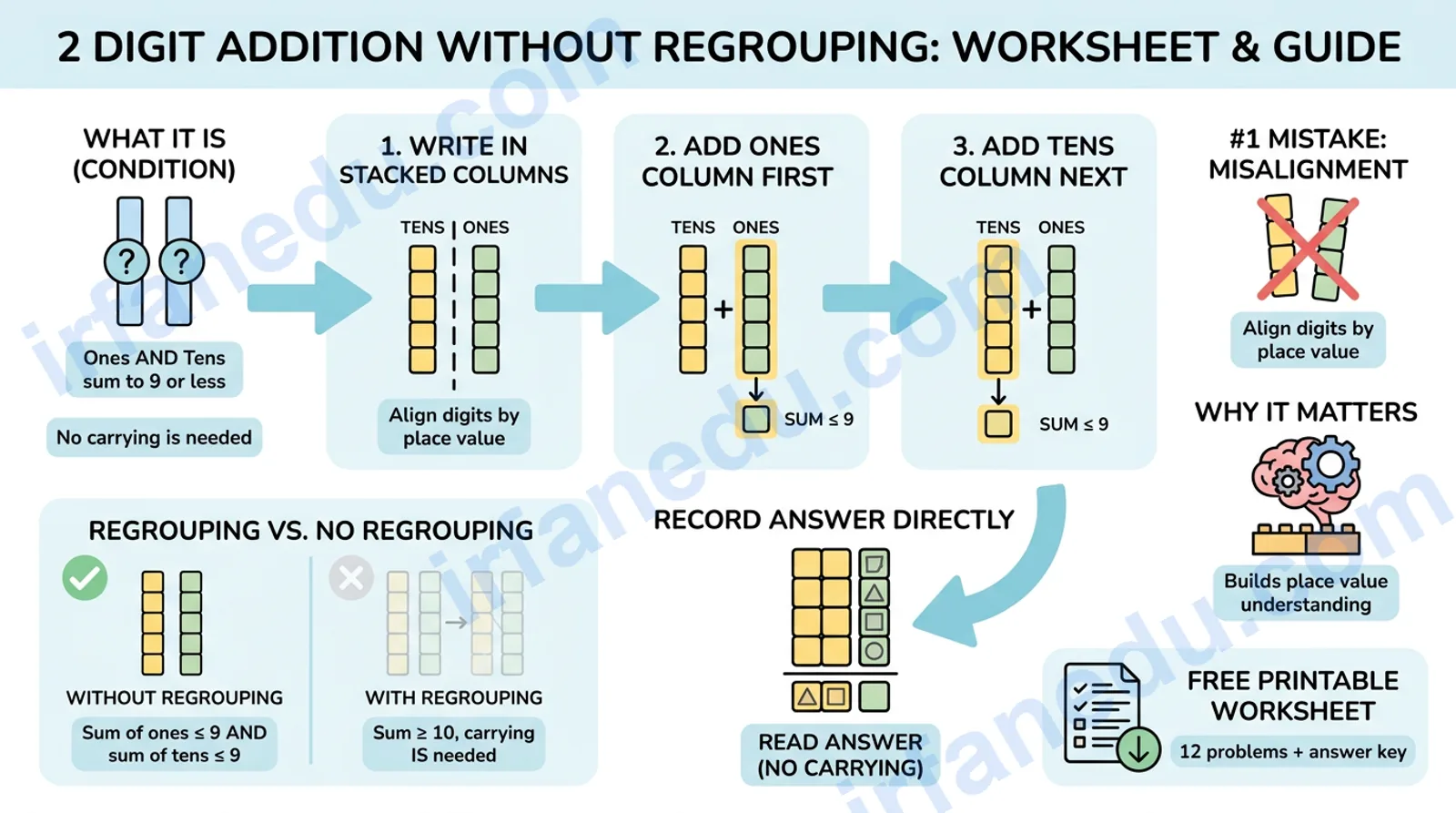
2-digit addition without regrouping is the skill of adding two 2-digit numbers where neither the ones column nor the tens column produces a sum of 10 or more. Because no carrying is required, students can solve each column independently and write the answer directly — making it the ideal bridge between single-digit addition and the more complex regrouping algorithm.
In this guide I walk you through the concept, show you three fully worked examples, flag the four mistakes I see most often in my teaching practice, and give you a free printable 12-problem worksheet with a full answer key. By the end, you and your child will have everything needed to master this skill confidently.
- 📌 Understand what “no regrouping” actually means (and why it matters)
- 📌 Follow a clear 4-step method with visual column diagrams
- 📌 Spot and fix the most common errors before they become habits
- 📌 Download and print a ready-to-use practice worksheet with answer key
Print it, solve it, self-check with the key — great for classroom or home practice.
- ✅ No regrouping = ones column AND tens column each sum to 9 or less.
- ✅ Always add the ones column first, then the tens column.
- ✅ Align digits by place value — misalignment is the #1 error.
- ✅ If any column sums to 10+, regrouping IS needed (different skill).
- ✅ This skill is typically mastered in Grade 1 before regrouping in Grade 2.
What is 2-digit addition without regrouping? 🔢
2-digit addition without regrouping is adding two numbers that each have a tens digit and a ones digit, where the sum of the ones digits is 9 or less and the sum of the tens digits is also 9 or less. The term “without regrouping” means you never need to carry a value from one column to the next.
The table below captures the key facts at a glance:
| Fact | Detail |
|---|---|
| Skill name | 2-digit addition without regrouping (also called “without carrying”) |
| Grade level | Grade 1 (introduced); Grade 2 (reviewed) |
| Prerequisite | Single-digit addition facts 0–9; understanding of tens and ones place value |
| Key condition | Ones digits sum ≤ 9 AND tens digits sum ≤ 9 |
| Number of steps | 4 (write, add ones, add tens, read answer) |
| Common error | Misaligning digits (mixing up tens and ones columns) |
| Next skill | 2-digit addition WITH regrouping |
Why does this skill matter before regrouping? 🎯
Mastering addition without regrouping first gives students a solid mental model of place value that makes regrouping far less confusing later. When a child can reliably add columns independently, the concept of “carrying” becomes a natural extension rather than a mysterious rule.
In my experience teaching early elementary math, students who rush past the no-regrouping stage and jump straight to carrying often develop a fragile, procedural understanding. They can follow the steps but cannot explain why they carry — which causes errors to multiply as numbers get larger. Spending a week on no-regrouping problems is never wasted time.
Place value is the foundation of all multi-digit arithmetic. According to the Khan Academy Grade 1 Math curriculum, place value understanding — knowing that the “3” in 34 means 3 tens, not 3 ones — is the single most important concept for early addition fluency.
How do you solve 2-digit addition without regrouping? (4 steps) 🪜
Follow these four steps every time and you will never mix up a column or lose a digit.
- Write the numbers in stacked columns. Put the larger number on top (optional, but tidy). Line up the ones digits in the right column and the tens digits in the left column. Draw a line underneath.
- Add the ones column. Look only at the right column. Add the two ones digits. Write the sum directly below the line in the ones column.
- Add the tens column. Look only at the left column. Add the two tens digits. Write the sum directly below the line in the tens column.
- Read the answer. The two digits you wrote below the line form your answer. Tens digit on the left, ones digit on the right.
  Tens | Ones
  -----+-----
    3  |  4      ← first number
  + 2  |  5      ← second number
  -----+-----
    5  |  9      ← answer: 59

  Step 2: ones → 4 + 5 = 9  ✔
  Step 3: tens → 3 + 2 = 5  ✔
  Answer: 59
Worked examples: three problems solved step by step ✏️
Seeing the method applied to real numbers is the fastest way to build confidence. Here are three examples, progressing from simple to slightly more challenging.
Step 1 — Write in columns:
  Tens | Ones
    2  |  3
  + 1  |  4
  -----+-----
Step 2 — Ones column: 3 + 4 = 7. Write 7 below the ones column.
Step 3 — Tens column: 2 + 1 = 3. Write 3 below the tens column.
Answer: 37 ✅
Check: 7 is less than 10, so no regrouping was needed. Confirmed.
Step 1 — Write in columns:
  Tens | Ones
    5  |  0
  + 1  |  9
  -----+-----
Step 2 — Ones column: 0 + 9 = 9. Write 9.
Step 3 — Tens column: 5 + 1 = 6. Write 6.
Answer: 69 ✅
Note: Adding 0 is a great confidence builder — the ones digit stays the same.
Step 1 — Write in columns:
  Tens | Ones
    4  |  4
  + 3  |  3
  -----+-----
Step 2 — Ones column: 4 + 3 = 7. Write 7.
Step 3 — Tens column: 4 + 3 = 7. Write 7.
Answer: 77 ✅
Both columns summed to 7 — well below 10, so no carrying at all.
I always ask students to whisper the column name as they work: “ones column… 4 plus 3 equals 7. Tens column… 4 plus 3 equals 7.” This tiny verbal habit forces them to think about place value rather than just running digits together. In my experience, students who narrate their columns make far fewer alignment errors and transition to regrouping with much less confusion.
What are the most common mistakes in 2-digit addition without regrouping? ⚠️
These four errors appear repeatedly in early-grade work. Recognising them early prevents them from becoming ingrained habits.
| Mistake | ❌ Wrong | ✅ Right |
|---|---|---|
| Misaligning digits | Writing 34 + 5 as: tens=3, ones=4+5 → 39 (treating 5 as a ones digit of a 1-digit number, but not aligning it) | Always right-align: ones under ones, tens under tens. 34 + 05 = 39 ✔ |
| Adding left to right | Adding the tens column first, then the ones — works here but builds a bad habit for regrouping | Always add ones first. This habit is essential when regrouping is introduced. |
| Concatenating instead of adding | 23 + 14 = 214 (writing “2, 1” and “3, 4” side by side) | Add each column: 3+4=7, 2+1=3 → 37. Each column produces one digit. |
| Forgetting the tens digit | 23 + 14 = 7 (only adding the ones column and ignoring tens) | Complete both columns. The tens column gives the leading digit of the answer. |
2-digit addition without regrouping vs. with regrouping: what’s the difference? 🔄
Understanding the boundary between these two types of addition is crucial. The table below makes the distinction clear and concrete.
| Feature | Without regrouping | With regrouping |
|---|---|---|
| Ones column sum | 0–9 | 10 or more |
| Carrying needed? | No | Yes — carry the 1 to tens column |
| Example | 34 + 25 = 59 | 37 + 25 = 62 |
| Grade introduced | Grade 1 | Grade 2 |
| Complexity | Lower — two independent column sums | Higher — columns interact |
| Common error | Misalignment | Forgetting to add the carried 1 |
| Prerequisite | Single-digit addition, place value | No-regrouping addition, place value |
A quick rule of thumb: look at the ones digits of the two numbers. If they add to 10 or more, you need regrouping. If they add to 9 or less, you do not. For example, 37 + 25: ones are 7 + 5 = 12 — regrouping required. But 34 + 25: ones are 4 + 5 = 9 — no regrouping needed.
Two ways to check your answer
After solving, always verify. Here are two reliable methods:
| Method | How it works | Example (34 + 25 = 59) |
|---|---|---|
| Reverse subtraction | Subtract one addend from the answer. If you get the other addend, the answer is correct. | 59 − 25 = 34 ✔ |
| Switch the order | Addition is commutative: a + b = b + a. Swap the numbers and re-add. | 25 + 34: ones 5+4=9, tens 2+3=5 → 59 ✔ |
The “no regrouping” constraint is a hidden gift, not just a simplification. Most guides treat no-regrouping problems as merely “easier” versions of regrouping problems. But in my teaching practice I’ve found they serve a completely different cognitive purpose: they let students isolate the place-value concept from the carrying algorithm. When a child solves 44 + 33 = 77, they are not doing “easy addition” — they are building a mental model where tens and ones are separate, independent containers. That mental model is exactly what makes regrouping feel logical rather than arbitrary later on.
What most guides get wrong: they rush students to regrouping problems as soon as basic facts are memorized, skipping the no-regrouping stage. The result is students who can carry mechanically but cannot explain what the carried “1” represents. Spend at least a full week on no-regrouping 2-digit problems before introducing carrying — the payoff in conceptual clarity is significant.
Practice worksheet: 12 problems (no regrouping) 📝
Work through these problems using the 4-step method above. All problems are designed so no carrying is needed — if you feel the urge to carry, double-check your column alignment first.
How to use this worksheet: Print the PDF (button below) or solve directly on screen. Work each problem independently, then use the collapsible answer key to self-check. For best results, time yourself — aim to complete all 12 in under 5 minutes once you’re comfortable with the method.
- 23 + 14 = ___
- 31 + 25 = ___
- 42 + 36 = ___
- 50 + 19 = ___
- 61 + 27 = ___
- 44 + 33 = ___
- 72 + 15 = ___
- 80 + 18 = ___
- 53 + 24 = ___
- 11 + 46 = ___
- 30 + 29 = ___
- 64 + 25 = ___
Show Answer Key 🔑
- 23 + 14 = 37
- 31 + 25 = 56
- 42 + 36 = 78
- 50 + 19 = 69
- 61 + 27 = 88
- 44 + 33 = 77
- 72 + 15 = 87
- 80 + 18 = 98
- 53 + 24 = 77
- 11 + 46 = 57
- 30 + 29 = 59
- 64 + 25 = 89
Includes all 12 problems neatly formatted for printing, plus a separate answer key section.