
Cinder Block Calculator: Blocks, Mortar & Cost Estimator 🧱
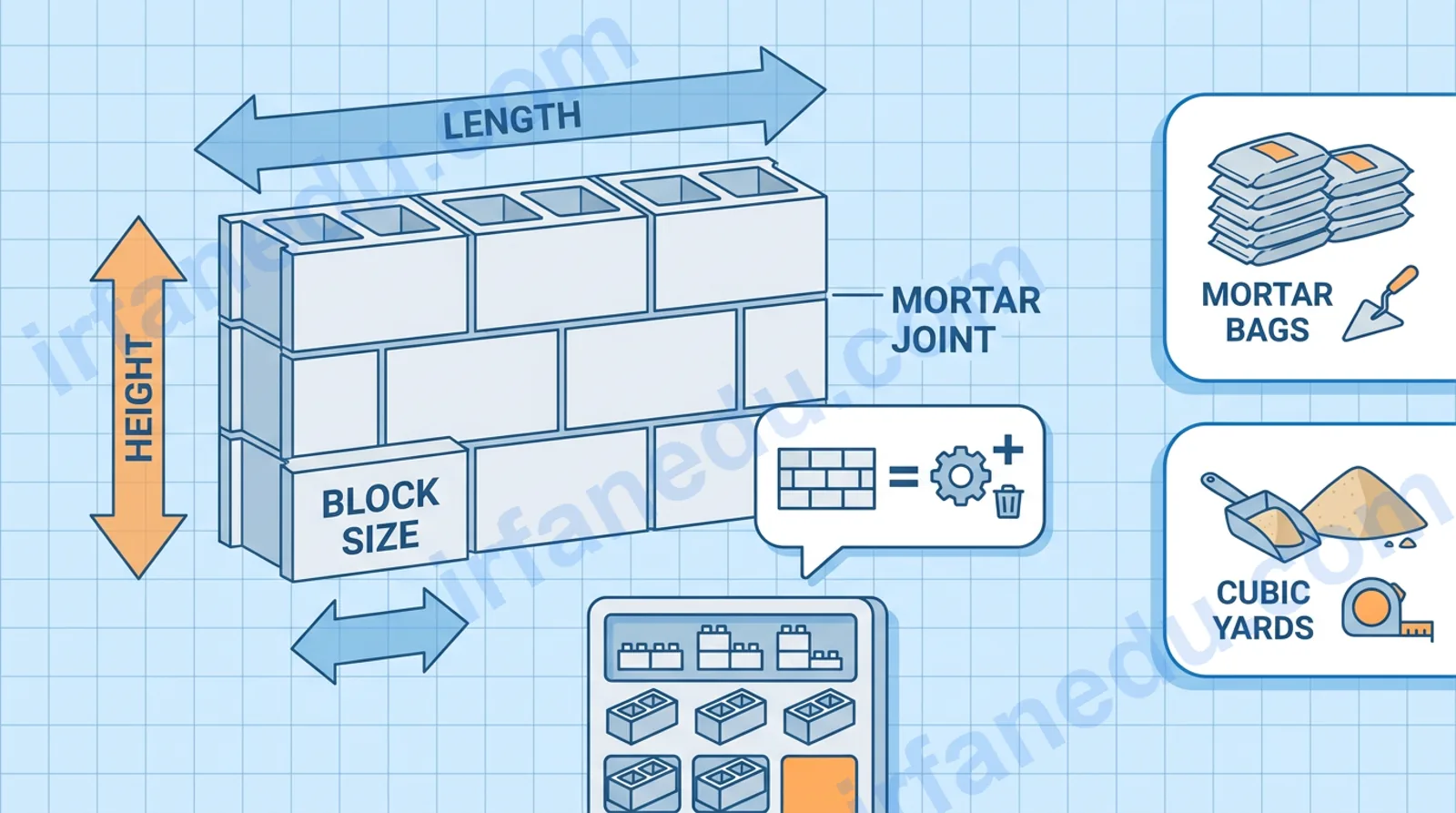
Think of ordering cinder blocks like buying tiles for a floor: you measure the area, divide by the size of one piece, and add a little extra for cuts. The math is almost identical — except you also need to account for mortar joints, hollow cores you might fill with grout, and the bags of mortar that hold everything together. Get the numbers wrong and you either make two expensive trips to the hardware store or end up with a pallet of leftover blocks taking up space in your yard.
This cinder block calculator computes the exact number of standard 8×8×16 CMU blocks (or any custom size), mortar bags, cubic yards of fill, and estimated project cost for any wall. Enter your wall dimensions, hit Calculate, and get a numbered step-by-step breakdown you can take straight to the store.
⚡ In Short
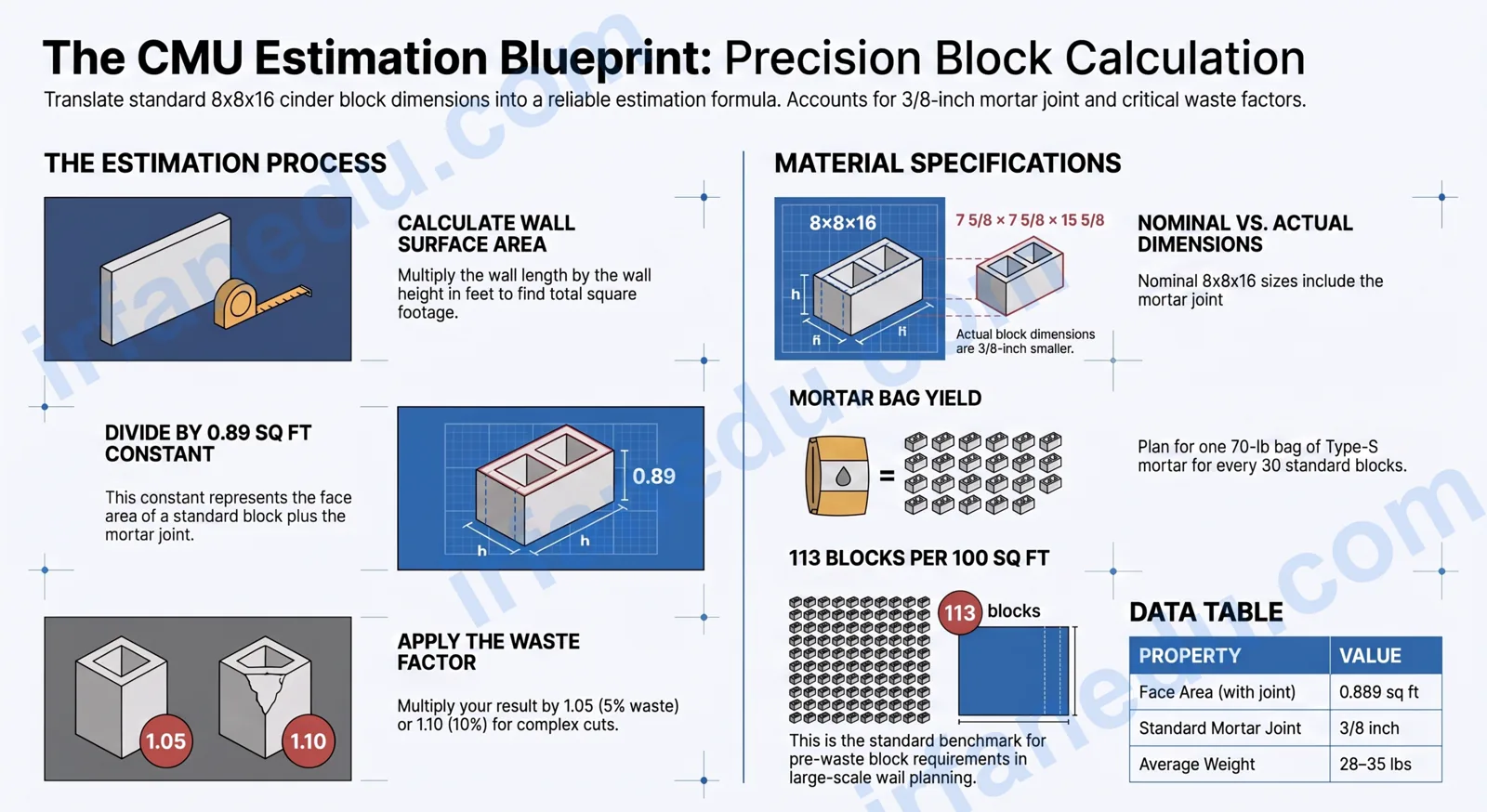
- 🧱 Standard CMU block face area = 0.89 sq ft (accounts for 3/8-in mortar joint).
- 📐 Formula: Blocks = (Wall Length × Wall Height ÷ 0.89) × 1.05 waste factor.
- 🪣 Mortar: roughly 1 bag per 30 blocks for standard 70-lb bags.
- 🏗️ Fill (grout): depends on how many cores you fill; calculator estimates cubic yards.
- 💰 Cost estimate = blocks needed × price per block (add mortar + fill separately).
- 🔑 Always add 5–10% waste; never order the exact count the math gives you.
| Property | Standard 8×8×16 CMU |
|---|---|
| Nominal dimensions | 8 in (H) × 8 in (W) × 16 in (L) |
| Actual dimensions | 7.625 in × 7.625 in × 15.625 in |
| Mortar joint (standard) | 3/8 inch (0.375 in) |
| Face area (with joint) | ≈ 0.889 sq ft (128 sq in) |
| Blocks per 100 sq ft | ≈ 113 (before waste) |
| Weight per block | ~28–35 lb (standard weight) |
| Mortar bags per 100 blocks | ~3.3 bags (70-lb type-S) |
| Typical cost per block (US) | $1.50 – $3.50 (2026) |
Cinder Block Calculator
Blocks · Mortar · Fill · Cost — instant results
Step-by-step solution
How to use this cinder block calculator
The calculator has two modes. Wall / Project mode takes length and height; Area → Blocks mode takes a pre-calculated square footage. Both modes give you blocks, mortar, fill, and optional cost.
- Choose your mode: Wall / Project (enter length + height) or Area → Blocks (enter sq ft directly).
- Enter your wall length and height in feet (or total area in sq ft).
- Confirm block size — default is 16 in × 8 in (standard CMU). Change it for 4-in, 6-in, or 12-in blocks.
- Set your waste factor. Use 5% for simple straight walls; 10% for walls with many corners or openings.
- Optionally enter your price per block for a cost estimate.
- Click Calculate and read the numbered step-by-step breakdown.
What is a cinder block (CMU)?
A cinder block — formally called a concrete masonry unit (CMU) — is a hollow rectangular block made from Portland cement, aggregate, and water, used to build walls, foundations, retaining walls, and garden beds. The term “cinder block” comes from an older manufacturing method that used coal cinders as aggregate; virtually all modern blocks use sand, gravel, or lightweight pumice instead.
The most common size is nominally 8 in × 8 in × 16 in. “Nominal” means the dimension includes the 3/8-inch mortar joint — the actual block is 7.625 in × 7.625 in × 15.625 in. This distinction is critical for accurate calculations.
A CMU (concrete masonry unit) is a standardized hollow concrete block used in masonry construction. Its nominal dimensions include the mortar joint; actual dimensions are 3/8 inch smaller in each direction.
The cinder block formula explained
The core formula is straightforward: divide the total wall area by the face area of one block (including its mortar joint), then apply a waste multiplier.
Blocks Needed = ⌈ (Wall Area ÷ Block Face Area) × (1 + Waste%) ⌉
Where:
Wall Area (sq ft) = Wall Length (ft) × Wall Height (ft)
Block Face Area = (Nominal Length ÷ 12) × (Nominal Height ÷ 12)
For standard 8×16: = (16/12) × (8/12) = 1.333 × 0.667 = 0.889 sq ft
⌈ ⌉ = ceiling function (round up to nearest whole block)
Variables & symbols table
| Symbol | Meaning | Unit |
|---|---|---|
| Lw | Wall length | feet (ft) |
| Hw | Wall height | feet (ft) |
| Aw | Wall area = Lw × Hw | square feet (sq ft) |
| Lb | Block nominal length (incl. mortar joint) | inches (in) |
| Hb | Block nominal height (incl. mortar joint) | inches (in) |
| Ab | Block face area = (Lb/12) × (Hb/12) | sq ft |
| W | Waste factor | % (decimal: 0.05 = 5%) |
| N | Blocks needed (rounded up) | whole blocks |
SI note: If you work in metres, convert: 1 ft = 0.3048 m; 1 in = 0.0254 m. The formula logic is identical — just keep units consistent throughout.
Worked examples (matching the calculator’s steps)
Example 1 — Garden retaining wall: 15 ft × 4 ft, standard 8×16 blocks, 5% waste
- Wall area = 15 × 4 = 60 sq ft
- Block face area = (16/12) × (8/12) = 1.333 × 0.667 = 0.889 sq ft
- Blocks (no waste) = 60 ÷ 0.889 = 67.5 blocks
- Apply 5% waste: 67.5 × 1.05 = 70.9 → 71 blocks
- Mortar bags = ⌈71 ÷ 30⌉ = 3 bags
- Fill estimate = (
Sources & References
Written and fact-checked by Dr Irfan Mansuri. External links open in a new tab and are provided for further reading and verification.