
Sonotube Sizes Calculator: Find the Right Tube and Concrete Volume Fast
Construction Calculator
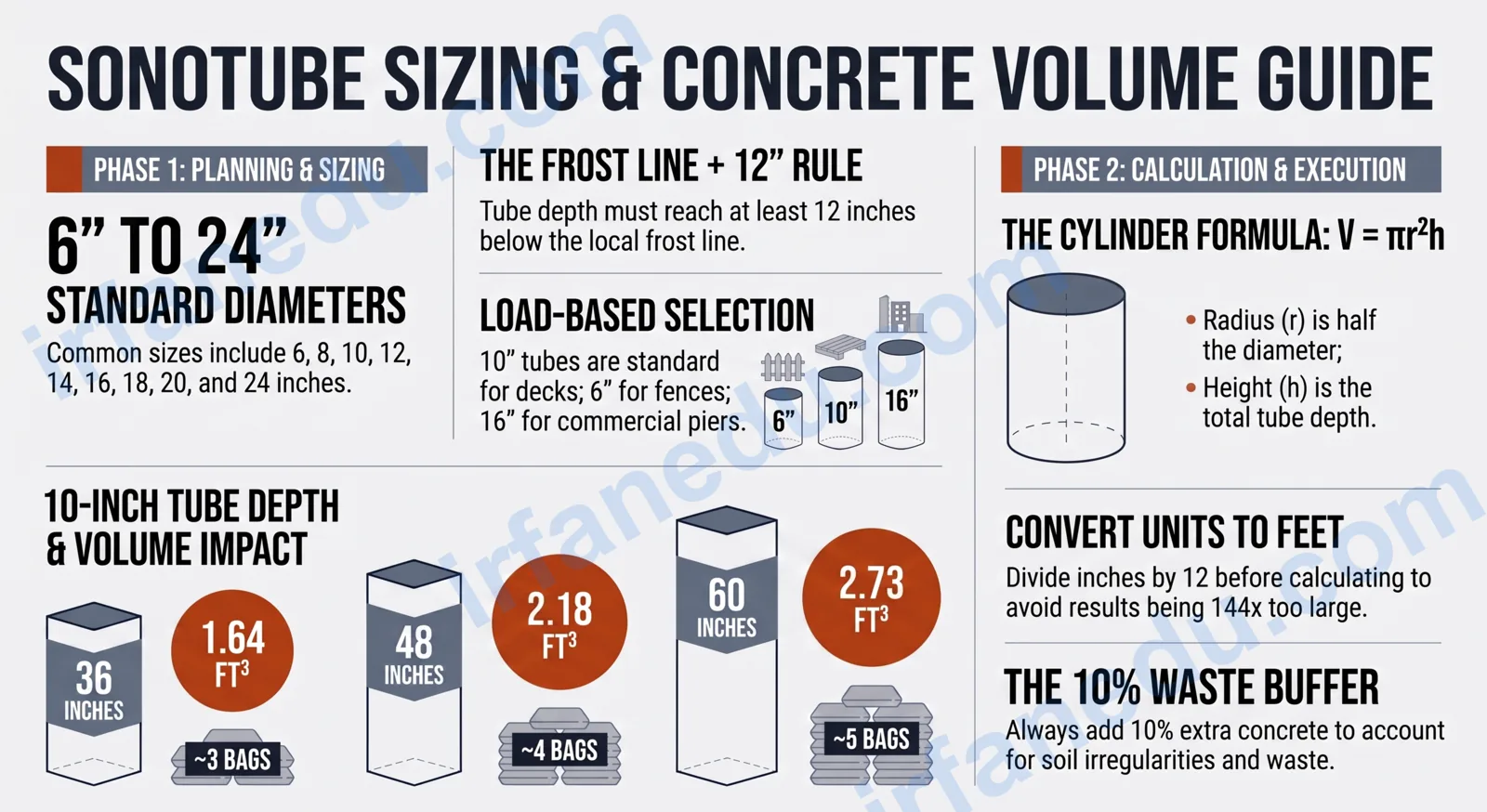
A sonotube comes in standard diameters from 6 to 24 inches. To find how much concrete you need, use the cylinder volume formula: V = π × r² × h, where r is half the diameter and h is the depth. A 10-inch tube filled 48 inches deep needs roughly 2.18 cubic feet (0.081 cubic yards) of concrete. Always add 10% for waste.
You’ve probably been told to just “eyeball” the sonotube size for a deck footing. That advice costs real money. Order too little concrete and you make a second trip to the hardware store; order too much and you pour cash down the drain. This calculator gives you the exact volume in seconds, using the same cylinder formula structural engineers use.
Enter your tube’s diameter and depth below. The calculator shows the result in cubic feet, cubic yards, and liters, plus a numbered step-by-step solution so you can verify every number before you mix a single bag.
- Standard sonotube diameters: 6, 8, 10, 12, 14, 16, 18, 20, and 24 inches.
- Volume formula: V = π × r² × h (r = radius, h = depth).
- Depth must reach at least 12 inches below the local frost line.
- Always buy 10% extra concrete to account for waste and uneven soil walls.
- One 80-lb bag of concrete yields about 0.60 cubic feet when mixed.
Sonotube Sizes Calculator
Enter diameter and depth to find concrete volume instantly
in
Common sizes: 6, 8, 10, 12, 16 in
in
Typical range: 36–72 in (below frost line)
How to use this calculator
- Choose your unit system: Imperial (inches) for US projects, or Metric (cm) for international work.
- Enter the tube diameter in the first field. Use the nominal size printed on the tube (e.g., 10 for a 10-inch sonotube).
- Enter the tube depth — the total length of tube you will fill with concrete, from the bottom of the hole to grade.
- Click Calculate. The result card shows volume in cubic feet, cubic yards, liters, and the number of 80-lb bags needed.
- Add the 10% waste buffer shown in the result before ordering concrete.
The myth most DIYers believe about sonotube sizing
You've probably been told that the diameter of a sonotube is the only number that matters. That's wrong. Depth controls the majority of the concrete volume, and it's the number most people guess at.
Consider this: a 10-inch tube at 36 inches deep needs 1.64 cubic feet of concrete. The same tube at 60 inches deep needs 2.73 cubic feet — that's 66% more concrete from one decision. If you're placing six footings, that difference is nearly 7 cubic feet, or about 12 extra 80-lb bags.
The second myth is that you can use the same tube diameter for any post load. In reality, the required diameter depends on the tributary area your deck carries and the soil's bearing capacity. A 6-inch tube might be fine for a light pergola; a 12-inch tube is the minimum for a heavy multi-level deck in soft soil. The calculator above handles the volume math; the diameter selection depends on your load and local code.
Quick facts: standard sonotube sizes
| Diameter (in) | Diameter (cm) | Cross-section area (ft²) | Typical use |
|---|---|---|---|
| 6 | 15.2 | 0.196 | Light fence posts, small pergolas |
| 8 | 20.3 | 0.349 | Standard fence posts, light deck footings |
| 10 | 25.4 | 0.545 | Residential deck footings (most common) |
| 12 | 30.5 | 0.785 | Heavy deck footings, structural columns |
| 14 | 35.6 | 1.069 | Large structural columns |
| 16 | 40.6 | 1.396 | Commercial footings, bridge piers |
| 18 | 45.7 | 1.767 | Heavy commercial / industrial |
| 24 | 61.0 | 3.142 | Large-diameter piers, bridge work |
The formula explained
A sonotube is a cylinder. The volume of a cylinder is the area of its circular base multiplied by its height (depth). That gives you one formula to remember:
V = π × r² × h
Where V is volume, r is the radius (half the diameter), and h is the depth (height) of the tube.
| Symbol | Meaning | SI unit | US unit |
|---|---|---|---|
| V | Volume of concrete | m³ | ft³ or yd³ |
| π | Pi (constant) | 3.14159… | 3.14159… |
| r | Radius = diameter ÷ 2 | m | ft (convert from in ÷ 12) |
| h | Depth (height) of tube | m | ft (convert from in ÷ 12) |
Unit conversion note: If you measure in inches, divide both r and h by 12 before plugging into the formula to get cubic feet. Divide cubic feet by 27 to get cubic yards (the unit concrete suppliers use). Multiply cubic meters by 1,000 to get liters.
         |<--- d = 2r --->|
         ___________________
        /                   \
       |    SONOTUBE FORM    |
       |                     |
  h    |   V = π x r² x h   |
(depth)|                     |
       |                     |
        \___________________/
              FOOTING

  r = d / 2    (radius)
  h = tube depth (in feet)
  V = 3.14159 x r² x h  (cubic feet)
  yd³ = V / 27
Worked examples
10-inch diameter tube, 48 inches deep (standard residential deck footing)
- Radius r = 10 ÷ 2 = 5 in = 5/12 = 0.4167 ft
- Depth h = 48 in = 48/12 = 4.0000 ft
- V = 3.14159 × (0.4167)² × 4.0000 = 3.14159 × 0.17361 × 4.0000
- V = 2.182 ft³ = 0.0808 yd³ = 61.8 L
- With 10% waste: order 0.089 yd³ ≈ 4 × 80-lb bags
12-inch diameter tube, 60 inches deep (heavy deck, cold-climate frost line)
- Radius r = 12 ÷ 2 = 6 in = 0.5000 ft
- Depth h = 60 in = 5.0000 ft
- V = 3.14159 × (0.5000)² × 5.0000 = 3.14159 × 0.2500 × 5.0000
- V = 3.927 ft³ = 0.1454 yd³ = 111.2 L
- With 10% waste: order 0.160 yd³ ≈ 7 × 80-lb bags
8-inch diameter tube, 36 inches deep (light pergola post)
- Radius r = 8 ÷ 2 = 4 in = 0.3333 ft
- Depth h = 36 in = 3.0000 ft
- V = 3.14159 × (0.3333)² × 3.0000 = 3.14159 × 0.1111 × 3.0000
- V = 1.047 ft³ = 0.0388 yd³ = 29.6 L
- With 10% waste: order 0.043 yd³ ≈ 2 × 80-lb bags
Wrong vs. right: common sonotube mistakes
| What most people do (wrong) | What you should do (right) |
|---|---|
| Use diameter in inches directly in the formula without converting to feet | Divide inches by 12 first. Using raw inches gives a result 144x too large. |
| Order concrete in cubic feet from a ready-mix supplier | Ready-mix is sold in cubic yards. Divide your cubic-foot result by 27. |
| Set tube depth equal to frost line depth | Set depth to frost line PLUS 12 inches minimum, so the base sits below the frost zone. |
| Skip the 10% waste buffer | Soil walls are never perfectly smooth. Always add 10% to avoid running short mid-pour. |
| Choose tube diameter based on post size alone | Choose diameter based on load, tributary area, and soil bearing capacity — not just post width. |
Real-world applications
Sonotubes are the go-to form for residential deck footings, pergola bases, mailbox posts, flag pole bases, and light commercial column footings. They work because the cardboard tube holds the wet concrete in a perfect cylinder while it cures, then you peel it away (or leave it
Sources & References
Written and fact-checked by Dr Irfan Mansuri. External links open in a new tab and are provided for further reading and verification.