
Aggregate Calculator: Gravel, Sand & Crushed Stone
Before I built the tool below, I priced out a 40 ft x 12 ft gravel driveway and ordered two tons too few — a costly second delivery. The math is simple once you see it done once, so let me walk through a real example first, then you can run your own numbers in the calculator.
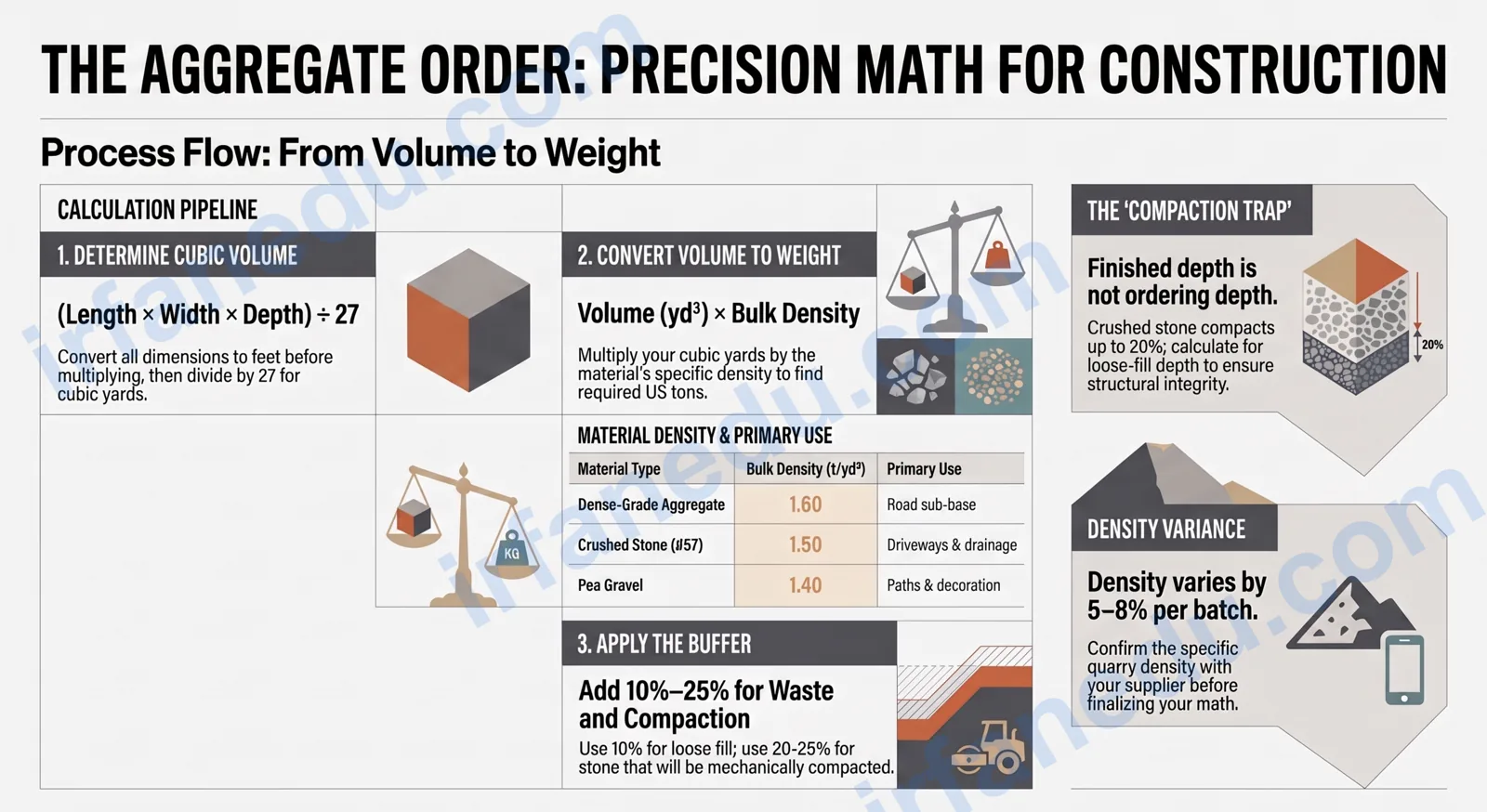
An aggregate calculator finds how much gravel, sand, or crushed stone a project needs. Multiply area (length x width) by depth, convert to cubic yards, then multiply by the material’s bulk density to get weight in tons. Add a 10–15% waste buffer before placing your order.
⚡ TL;DR
- Volume (yd³) = Length × Width × Depth (all in feet) ÷ 27
- Weight (tons) = Volume (yd³) × bulk density of material
- Standard densities: gravel 1.4 t/yd³, crushed stone 1.5 t/yd³, sand 1.35 t/yd³
- Always order 10–15% extra to cover compaction and waste
- A 4-inch driveway depth is the standard for residential vehicles
Aggregate Calculator
Gravel • Sand • Crushed Stone • Any aggregate
Your results
yd³
(with waste buffer)
Step-by-step solution
How to use this aggregate calculator
- Choose your area shape: Rectangular (most projects) or Circular (round patios, tree rings).
- Enter your dimensions in feet and the desired depth in inches.
- Select the material type — the density pre-fills automatically.
- Set a waste buffer (10% is the standard recommendation; use 15% for irregular shapes).
- Optionally enter a price per ton for a cost estimate.
- Click Calculate. The result card shows cubic yards, US tons, and a numbered solution you can screenshot and take to the supply yard.
Worked examples that match the calculator’s steps
I always start with a concrete example before explaining the theory — it makes the formula stick. Here are three real-world scenarios.
Example 1 — Rectangular gravel driveway (40 ft × 12 ft × 4 in deep)
- Area = 40 ft × 12 ft = 480 ft²
- Depth = 4 in ÷ 12 = 0.3333 ft
- Volume = 480 × 0.3333 = 160 ft³
- Convert: 160 ÷ 27 = 5.926 yd³
- Weight = 5.926 × 1.50 t/yd³ (crushed stone) = 8.889 US tons
- Add 10% waste: 8.889 × 1.10 = 9.78 US tons to order (round up to 10 tons)
Enter these values in the calculator above and you will see the identical steps.
Example 2 — Circular patio (15 ft diameter × 3 in deep, pea gravel)
- Radius = 15 ÷ 2 = 7.5 ft
- Area = π × 7.5² = 176.71 ft²
- Depth = 3 ÷ 12 = 0.25 ft
- Volume = 176.71 × 0.25 = 44.18 ft³
- Convert: 44.18 ÷ 27 = 1.636 yd³
- Weight = 1.636 × 1.40 t/yd³ (pea gravel) = 2.29 US tons
- Add 10% waste: 2.29 × 1.10 = 2.52 US tons to order
Example 3 — Sandbox fill (8 ft × 6 ft × 6 in deep, sand)
- Area = 8 × 6 = 48 ft²
- Depth = 6 ÷ 12 = 0.5 ft
- Volume = 48 × 0.5 = 24 ft³
- Convert: 24 ÷ 27 = 0.889 yd³
- Weight = 0.889 × 1.35 t/yd³ (sand) = 1.20 US tons
- Add 10% waste: 1.20 × 1.10 = 1.32 US tons to order
What is aggregate and why does density matter?
Aggregate is any granular material — gravel, crushed stone, sand, or recycled concrete — used as a base, fill, or surface layer in construction and landscaping. The key variable in every calculation is bulk density: how much a cubic yard of the loose material actually weighs.
Suppliers sell aggregate by the ton, not by volume. So you must convert your volume (cubic yards) to weight (tons) using the material’s density. Get the density wrong and you either over-order (wasted money) or under-order (second delivery fee).
The core formula:
Variables and symbols table
| Symbol | Meaning | SI / US unit |
|---|---|---|
| L | Length of project area | feet (ft) |
| W | Width of project area | feet (ft) |
| D | Depth of aggregate layer | inches (in) → convert to ft ÷ 12 |
| V | Volume of aggregate | cubic feet (ft³) or cubic yards (yd³) |
| ρ | Bulk density of material | US tons per cubic yard (t/yd³) |
| m | Mass / weight to order | US tons (short tons, 2,000 lb) |
| w | Waste buffer factor | % (typically 10–15%) |
Bulk density reference by material
| Material | Bulk density (t/yd³) | Typical use |
|---|---|---|
| Crushed stone (#57) | 1.50 | Driveways, drainage, base layers |
| Pea gravel | 1.40 | Paths, decorative fill, drainage |
| River rock | 1.45 | Landscaping, dry creek beds |
| Concrete sand | 1.35 | Mortar, paver base, sandboxes |
| Decomposed granite | 1.25 | Paths, xeriscaping |
| Dense-grade aggregate (DGA) | 1.60 | Road sub-base, compacted fill |
RECTANGULAR AREA — CROSS SECTION VIEW
┌─────────────────────────────────────────┐
│  Length (L) = 40 ft                     │
│  ◄──────────────────────────────────►   │
│  ┌──────────────────────────────────┐   │ ▲
│  │  ░░░░ AGGREGATE LAYER ░░░░░░░░░  │   │ D = 4 in
│  └──────────────────────────────────┘   │ ▼
│         Width (W) = 12 ft               │
└─────────────────────────────────────────┘

Volume (ft³) = L × W × (D ÷ 12)
             = 40 × 12 × 0.333 = 160 ft³

Volume (yd³) = 160 ÷ 27 = 5.93 yd³

Weight (tons) = 5.93 × 1.50 = 8.89 tons
  + 10% waste = 9.78 tons  →  ORDER 10 TONS
💡 Unique Insight — the compaction trap most guides ignore
Every aggregate calculator online (including the popular reference tools) tells you to add a 10% waste buffer. What they rarely explain is why that number is often too low for crushed stone driveways. Crushed stone compacts 15–20% by volume when mechanically tamped. If you calculate a 6-inch finished depth and order for exactly 6 inches of loose material, you may end up with only 5 inches after compaction — below the structural minimum for vehicle traffic. In my experience reviewing project estimates, the correct approach is: calculate for your loose-fill depth (finished depth ÷ 0.85 for crushed stone), then add your waste buffer on top of that. For a 4-inch finished driveway, order for 4.7 inches of loose material, not 4 inches. The calculator above lets you set a custom waste buffer — use 20–25% for any project that will be mechanically compacted.
Common mistakes when ordering aggregate
Right: Always convert yd³ to tons using the material’s density before calling the supplier.
Right: Use 20–25% for mechanically compacted crushed stone to account for volume loss during tamping.
Right: Pea gravel (1.40 t/yd³) and dense-grade aggregate (1.60 t/yd³) differ by 14% — that gap matters on large projects.
Rectangular vs. circular area: which formula applies?
| Shape | Area formula | Example | Result |
|---|---|---|---|
| Rectangle / square | L × W | 20 ft × 10 ft | 200 ft² |
| Circle | π × r² | Diameter 10 ft → r = 5 ft | 78.54 ft² |
| Triangle | ½ × base × height | Base 12 ft, height 8 ft | 48 ft² |
| Irregular | Break into rectangles | Sum sub-areas | Add each sub-area |
In my experience helping students and homeowners work through construction math, the single biggest ordering mistake is thinking in cubic yards when the supplier thinks in tons. I always recommend calling the supply yard first, confirming their quoted density for that specific material batch, and then plugging that number into the calculator. Supplier densities for the same material can vary by 5–8% depending on moisture content and source quarry. That variance on a 20-ton order is a full extra ton — roughly $50–$80 you either waste or have to pay for on a second delivery.