
Timpani drum: the complete student guide to the orchestra’s pitched powerhouse
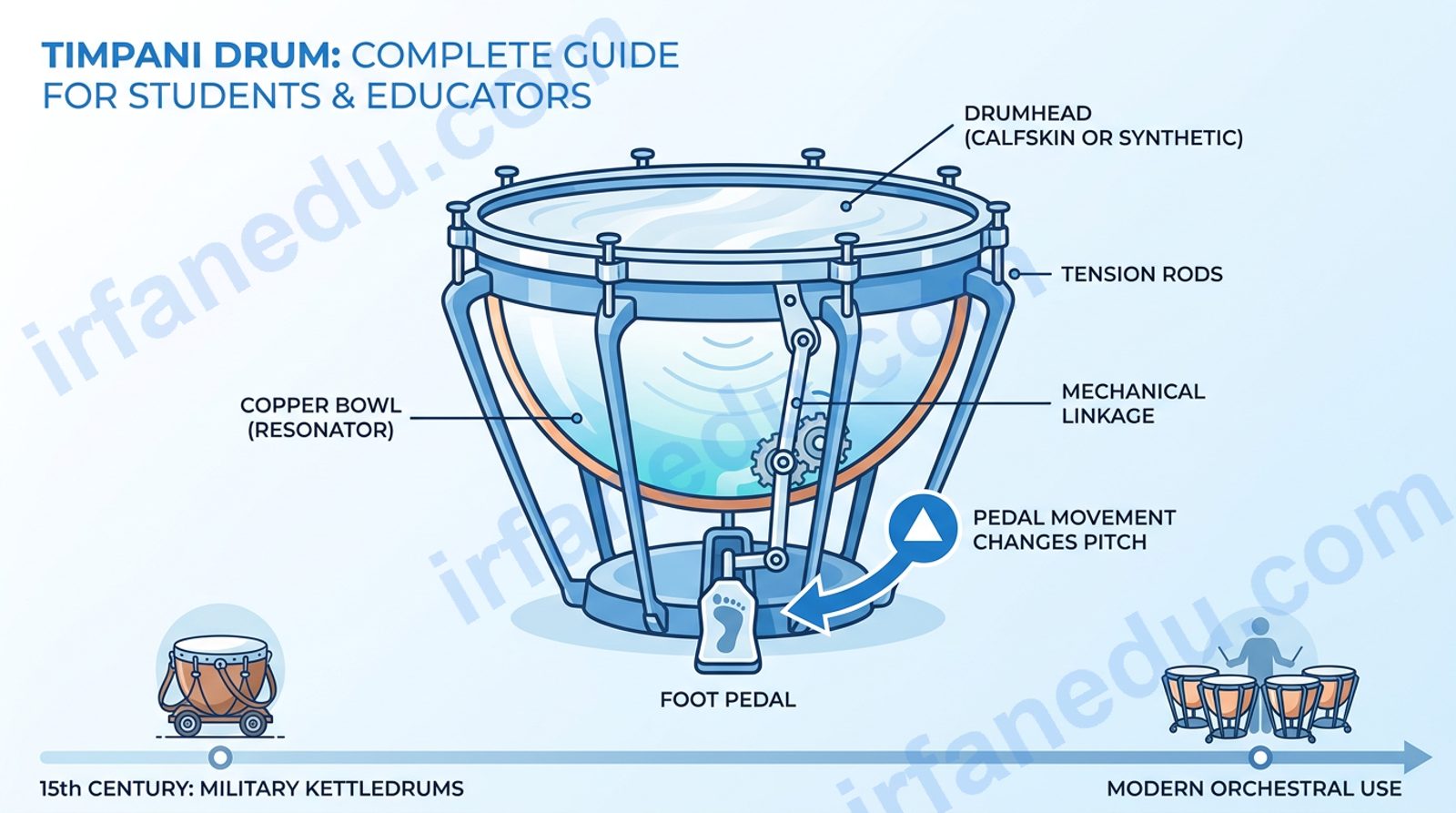
The timpani drum is the only standard orchestral drum that plays specific musical notes. Every other drum in the percussion section produces an indefinite pitch — a sound you can hear but cannot name on a musical scale. The timpani breaks that rule entirely, and that single fact changes everything about how it is written for, played, and heard.
In my experience teaching music fundamentals to students who are new to orchestral instruments, the timpani is consistently the most surprising instrument in the percussion family. Students expect drums to be purely rhythmic. When they realize a timpanist reads a pitched staff, changes notes mid-performance with a foot pedal, and can play a bass line alongside the cellos, their understanding of what percussion can do shifts permanently.
This guide covers everything you need: what a timpani is, how it physically produces pitch, its anatomy, how to tune it, its history, its role in the orchestra, and the one insight about mallet choice that almost every beginner guide skips entirely.
- Understand what makes timpani unique among percussion instruments.
- Learn how the pedal mechanism controls pitch.
- Follow a clear step-by-step tuning process.
- See how timpani compare to other drums in a side-by-side table.
- Discover the non-obvious truth about mallet selection and tone.
Quick answer: A timpani drum (also called a kettledrum) is a large, bowl-shaped percussion instrument made of a copper or fiberglass shell with a stretched drumhead on top. Unlike most drums, it produces a definite musical pitch. The player changes pitch by pressing a foot pedal that tightens or loosens the drumhead. Timpani are a core part of the symphony orchestra and appear in concert bands and film scores worldwide.
📌 Quick summary
- Timpani are bowl-shaped drums that produce a definite, changeable musical pitch.
- A foot pedal tightens or loosens the drumhead to raise or lower the note.
- A standard orchestra uses four timpani covering roughly two octaves (D2 to A3).
- The instrument originated as military kettledrums in the 15th century.
- Mallet hardness controls tone color, not just volume — a fact most guides miss.
- Timpani parts are written on a pitched staff, like a melodic instrument.
| Feature | Detail |
|---|---|
| Also known as | Kettledrum, timpano (singular) |
| Instrument family | Membranophone (percussion) |
| Pitch type | Definite pitch (specific musical notes) |
| Shell material | Copper (professional), fiberglass (student/marching) |
| Head material | Calfskin (traditional) or synthetic plastic film |
| Tuning method | Foot pedal (pedal timpani) or hand-tightened screws (hand-screw timpani) |
| Standard set size | 4 drums: 32″, 29″, 26″, 23″ diameter |
| Pitch range (full set) | Approximately D2 to A3 (about two octaves) |
| Range per drum | Approximately a perfect fifth |
| Orchestral section | Percussion |
| Written notation | Bass clef, pitched staff |
| Historical origin | Middle Eastern / Central Asian military drums, 14th-15th century |
What is a timpani drum?
A timpani drum is a large, bowl-shaped percussion instrument that produces a specific, tunable musical pitch. The bowl — called the kettle — is made of copper or fiberglass and acts as a resonating chamber. A drumhead made of calfskin or synthetic film is stretched across the open top of the bowl and struck with a padded mallet to produce sound.
The defining characteristic of a timpani is its ability to play exact musical notes. A bass drum produces a low thud with no identifiable pitch. A timpani produces a D, an F, a B-flat — whatever note the composer has written. This is why timpani parts are notated on a standard pitched staff in bass clef, exactly like a cello or trombone part.
The word “timpani” is Italian and is the plural of “timpano.” In English, the instrument is also called a kettledrum, a name that describes its shape directly. Both terms refer to the same instrument. In professional and academic contexts, “timpani” is now the standard term worldwide.
Definition: A timpani drum is a membranophone — an instrument that produces sound by vibrating a stretched membrane (the drumhead). What separates it from other membranophones is that the vibration frequency, and therefore the pitch, is precisely controllable.
How a timpani produces pitched sound
A timpani produces a specific pitch because the tension of its drumhead determines the frequency at which it vibrates, and frequency determines pitch. Higher tension means faster vibration, which means a higher pitch. Lower tension means slower vibration and a lower pitch.
This is the same physics as a guitar string. Tighten the string (increase tension) and the pitch rises. Loosen it and the pitch falls. The timpani applies this principle to a circular membrane instead of a string.
The copper bowl beneath the head is not decorative. It acts as an acoustic resonator. When the head vibrates, the air column inside the bowl resonates at the same frequency, amplifying and sustaining the sound. The bowl’s shape and volume are calculated to reinforce the fundamental pitch and suppress unwanted overtones, giving the timpani its characteristic warm, round tone.
In my experience, the physics of the timpani is one of the clearest real-world demonstrations of the relationship between tension, frequency, and pitch that you can show a student. It is more intuitive than a string instrument because the pedal movement is visible and the pitch change is immediate. If you ever get access to a timpani in a school music room, demonstrating this live is worth ten minutes of any physics or music lesson.
The anatomy of a timpani drum
Every component of a timpani has a specific acoustic or mechanical function. Understanding the parts helps you understand why the instrument sounds and behaves the way it does.
  ┌─────────────────────────────────────────────────────┐
  │              TIMPANI DRUM — ANATOMY                 │
  │                                                     │
  │   ┌──────────────────────────────────────────┐      │
  │   │  DRUMHEAD (calfskin or synthetic film)   │      │
  │   └──────────────────────────────────────────┘      │
  │        │  Tension rods (8-10 around the rim)        │
  │        ▼                                            │
  │   ╔══════════════════════════════════════════╗      │
  │   ║   COPPER BOWL (kettle / resonator)       ║      │
  │   ║   Amplifies and sustains the pitch       ║      │
  │   ╚══════════════════════════════════════════╝      │
  │              │                                      │
  │         PEDAL ROD (connects pedal to rim)           │
  │              │                                      │
  │   ┌──────────▼───────────────────────────────┐      │
  │   │  FOOT PEDAL — press forward = higher     │      │
  │   │  pitch; release backward = lower pitch   │      │
  │   └──────────────────────────────────────────┘      │
  │                                                     │
  │   FRAME / LEGS — support the bowl at playing height │
  │   TUNING GAUGE — shows approximate pitch (dial)     │
  └─────────────────────────────────────────────────────┘
The tension rods (also called tuning bolts or lugs) run from the rim of the drumhead down to the bowl. They must be evenly tensioned around the entire circumference so the head vibrates uniformly. An unevenly tensioned head produces multiple conflicting pitches at once — a common problem for beginners.
The tuning gauge is a dial or indicator on the pedal mechanism that shows the approximate pitch. It is a guide, not a guarantee. Experienced timpanists always confirm pitch by ear, because temperature and humidity change head tension throughout a performance.
How to tune a timpani: step-by-step
Tuning a timpani correctly requires both mechanical adjustment and careful listening. Here is the process used by professional timpanists and taught in music programs worldwide.
- Set the pedal to its lowest position. Press the pedal fully back to release maximum tension. This is your starting baseline.
- Check head evenness. Strike the head lightly near each tension rod in turn. All spots should produce the same pitch. If they differ, adjust individual rods until they match.
- Strike near the edge, not the center. The clearest pitch comes from striking about 4 inches (10 cm) from the rim. The center of the head produces a thuddy, unclear tone.
- Compare to a reference pitch. Use a piano, electronic tuner, or pitch pipe to identify your target note.
- Adjust the pedal. Press forward slowly to raise pitch toward your target. Release slowly to lower it.
- Strike and re-check. After each pedal adjustment, strike and listen. Repeat until the pitch matches the reference exactly.
- Confirm at performance temperature. Heads go sharp when warm and flat when cold. Always re-check tuning after the hall has reached its performance temperature.
Pro tip: Before a concert, timpanists often “pre-set” each drum to the first pitch they need in the piece. They mark the pedal position with tape or memorize the gauge reading so they can return to it quickly after a mid-piece retune.
A brief history of the timpani
The timpani’s ancestors were military kettledrums carried on horseback across Central Asia and the Middle East as early as the 13th century. These instruments — called naqqara in Arabic — were used to signal troop movements and intimidate enemies on the battlefield.
European armies adopted kettledrums in the 15th century, and by the 16th century they had entered the courts of European monarchs as prestige instruments. Ownership of a pair of kettledrums was a symbol of royal status. They were played by mounted cavalry drummers and were strictly regulated — in some German states, only nobility could own them.
The transition from battlefield to concert hall happened gradually through the 17th century. Baroque composers including Johann Sebastian Bach and George Frideric Handel wrote prominent parts for timpani, typically paired with trumpets. At this stage, the drums were still hand-screw instruments: changing pitch required the player to physically tighten or loosen screws around the rim, which took 20-30 seconds per drum.
The invention of the pedal mechanism in the late 19th century transformed the instrument. The Munich firm of Rottenbacher is credited with one of the earliest practical pedal systems around 1855. By the early 20th century, pedal timpani had become standard in professional orchestras, allowing composers to write rapid pitch changes that were physically impossible on hand-screw drums.
Composers like Beethoven, Berlioz, Brahms, and later Bartók and Shostakovich exploited the new capabilities aggressively. Beethoven’s Fifth Symphony uses timpani to drive the famous four-note motif. Bartók’s Sonata for Two Pianos and Percussion treats the timpani as a full melodic partner, not just a rhythmic accent.
The timpani’s role in the orchestra
The timpani serves three distinct functions in the orchestra, and understanding all three is essential to understanding why composers treat it as more than a “big drum.”
1. Rhythmic foundation. The most visible role. Timpani reinforce the pulse of the music, add weight to climactic moments, and punctuate cadences. A single fortissimo timpani stroke at the end of a phrase can feel like a physical impact in a concert hall.
2. Harmonic support. Because the timpani plays specific pitches, it contributes to the harmonic texture of the music. Composers often write timpani parts that double the bass note of the current chord, reinforcing the harmonic foundation the way a bass guitar does in a rock band.
3. Melodic and motivic contribution. In 20th-century and contemporary music especially, the timpani takes on melodic roles. Bartók, Britten, and many film composers write melodic lines for timpani that are as important as any wind or string line.
Most music textbooks describe the timpani purely as a rhythmic instrument. That framing is outdated and misleading. When I teach orchestration, I ask students to listen to the opening of Bartók’s Music for Strings, Percussion and Celesta — the timpani there is carrying harmonic and melodic weight that a snare drum simply cannot. Treating timpani as “just rhythm” causes students to misread scores and miss what the composer actually wrote.
Timpani vs. other drums: key differences
The table below shows how the timpani compares to the other main drums found in an orchestra or concert band. The differences are fundamental, not cosmetic.
| Feature | Timpani | Snare drum | Bass drum | Tenor drum |
|---|---|---|---|---|
| Pitch type | Definite (specific notes) | Indefinite | Indefinite | Indefinite |
| Shell shape | Hemispherical bowl | Cylinder | Cylinder | Cylinder |
| Shell material | Copper / fiberglass | Metal / wood | Wood | Wood |
| Tuning method | Foot pedal or hand screws | Fixed (not tuned to notes) | Fixed (not tuned to notes) | Fixed (not tuned to notes) |
| Notation | Pitched staff (bass clef) | Unpitched staff / single line | Unpitched staff / single line | Unpitched staff / single line |
| Primary role | Rhythm + harmony + melody | Rhythm / texture | Rhythm / weight | Rhythm / color |
| Typical size | 23″–32″ diameter | 13″–14″ diameter | 28″–40″ diameter | 12″–16″ diameter |
⭐ My key takeaway: the timpani is the only drum that changes pitch in real time during a performance
Here is the point almost every introductory guide misses: the pedal timpani does not just allow pitch changes between pieces or movements. A skilled timpanist changes pitch while the drum is still ringing — a technique called a “glissando” or “pedal glissando.” By pressing the pedal smoothly while the head is vibrating, the player produces a rising or falling pitch slide, like a trombone slide but on a drum. Bartók, Britten, and many film composers use this effect deliberately. No other standard orchestral drum can do this. It means the timpani occupies a unique category: a percussion instrument with the real-time pitch flexibility of a brass or string instrument.
Mallets and tone: what most guides get wrong
Most introductory guides describe timpani mallets as simply “soft” or “hard” and leave it there. That framing misses the most important point: mallet choice controls tone color, not just loudness.
A soft felt mallet produces a warm, round, sustained tone with strong fundamental pitch and few overtones. This is the standard orchestral sound most people associate with the timpani. A harder mallet — cork, wood, or hard felt — produces a brighter, more percussive attack with stronger overtones. The note is the same pitch, but it sounds sharper and more cutting.
Composers sometimes specify mallet type in the score. Bartók frequently calls for wooden mallets to create a dry, aggressive tone that contrasts with the warm orchestral texture. Ravel’s Bolero uses soft mallets throughout to keep the timpani blended and warm. When no mallet is specified, the timpanist chooses based on the musical context — a skill that takes years to develop.
The practical implication for students: if you are learning to play or analyze timpani parts, pay attention to mallet markings in the score. They are not optional instructions — they are part of the composer’s intended sound.
[IMAGE: Close-up of three timpani mallets side by side showing soft felt, medium felt, and hard cork heads | ALT: Three timpani mallets showing different head materials — soft felt, medium felt, and hard cork — used to control tone color]
Frequently asked questions about the timpani drum
What is a timpani drum?
How does a timpani produce different pitches?
What is the typical pitch range of a timpani?
Why is the timpani considered a melodic percussion instrument?
What are timpani mallets made of?
How many timpani drums are in a standard orchestra?
What is the difference between timpani and kettledrums?
Key takeaways
- The timpani is the only standard orchestral drum that produces a definite, tunable musical pitch.
- Pitch is controlled by a foot pedal that changes the tension of the drumhead.
- A standard orchestral set of four timpani covers approximately two octaves (D2 to A3).
- The copper bowl acts as an acoustic resonator, amplifying and sustaining the pitch.
- Timpani parts are written on a pitched bass-clef staff, like a melodic instrument.
- Mallet hardness controls tone color (warm vs. bright), not just loudness.
- The pedal glissando — changing pitch while the drum is ringing — is a unique capability no other standard drum possesses.
- The instrument evolved from 15th-century military kettledrums to its modern orchestral form through the invention of the pedal mechanism in the mid-19th century.
Dr. Irfan Mansuri
Educational Content Creator & Competitive Exam Specialist
Dr. Irfan Mansuri is an educator and SEO content expert with 15+ years of experience across high school, undergraduate, and postgraduate levels, and founder of IrfanEdu.com. I combine deep subject knowledge with proven teaching strategies to make complex ideas simple and accessible for students worldwide.
Sources & references
- Encyclopaedia Britannica — Kettledrum (Timpani). Authoritative overview of the instrument’s history, construction, and orchestral use.
- Wikipedia — Timpani. Comprehensive reference covering acoustic principles, historical development, and notable orchestral works.
- Irfan Edu — Physics 2 Equation Sheet. Related resource on wave and sound physics relevant to understanding how pitch and frequency relate.
- Irfan Edu — Tension Calculator: Two Strings Different Angles. Supports understanding of tension as a physical concept underlying timpani tuning.
✍ Editorial note: This article was written and fact-checked by Dr. Irfan Mansuri. All claims are based on established musicological sources. No statistics, quotes, or studies have been fabricated. Last reviewed August 2026.