
LVL span calculator: find your safe beam length fast 📐
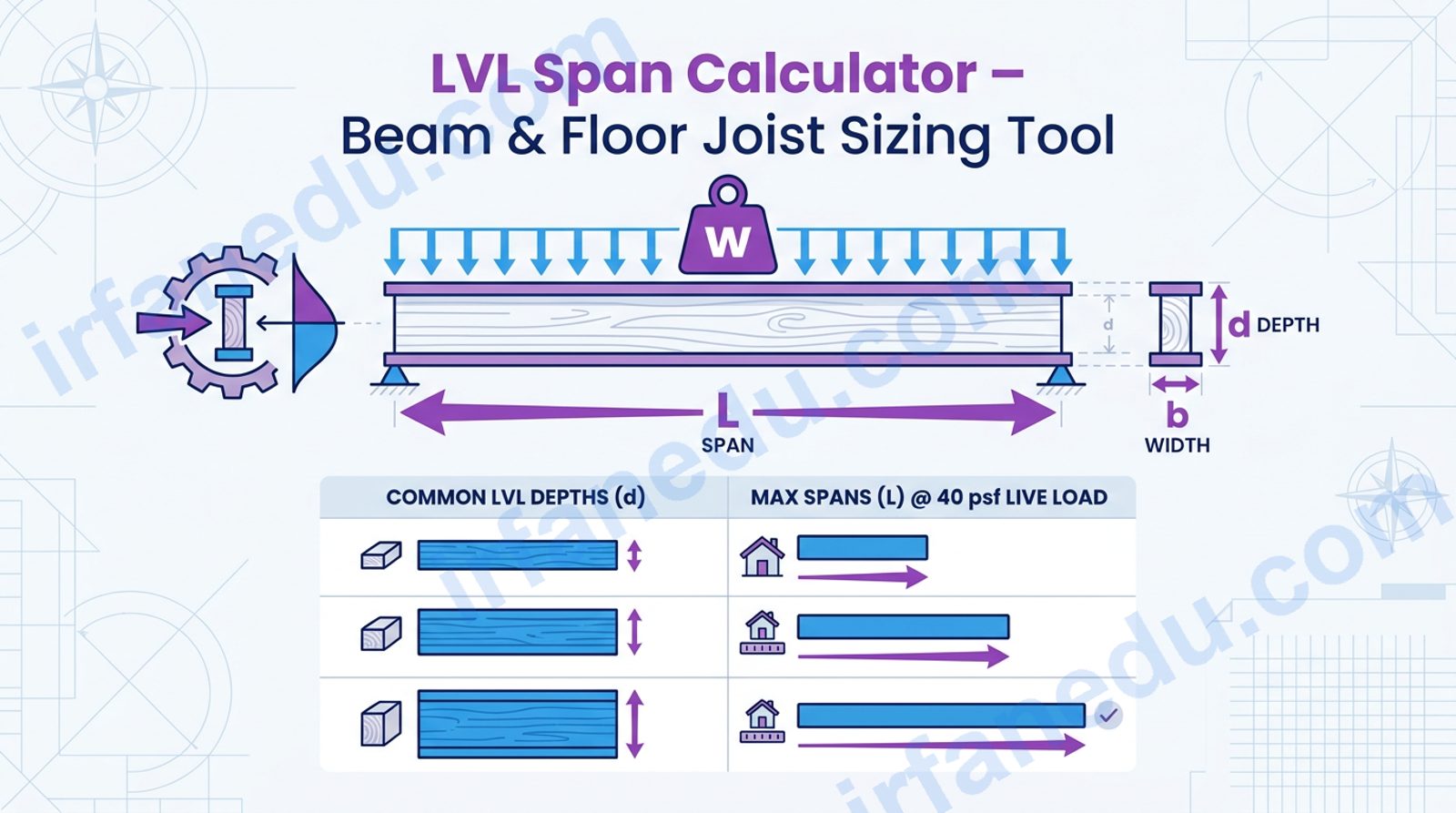
If sizing an LVL beam has ever left you staring at a span table wondering whether you picked the right depth, you are not alone. 🏗️ Most online tools either give you a raw number with zero explanation, or they bury the formula so deep you never learn why it works. This calculator does both: it gives you the answer and shows every step, so you understand what drives the result.
An LVL span calculator estimates the maximum safe span for a Laminated Veneer Lumber beam by applying the bending-stress formula and checking it against the beam’s allowable bending capacity. Enter your load, beam width, and depth to get an instant result with a full step-by-step breakdown.
- 🔢 Calculate max span, required depth, or max load in one click
- 📋 See a numbered step-by-step solution using your exact values
- 📏 Understand the formula behind every LVL span table
- ⚠️ Know when to call a structural engineer (hint: always for final sign-off)
An LVL span calculator finds the maximum safe span using the bending-stress formula L = √(8 × Fb × S / w), where Fb is the allowable bending stress (typically 2,600 psi for residential LVL), S is the section modulus (bd²/6), and w is the uniform load per linear foot. For a 3.5 in × 9.5 in LVL at 55 psf total load on 16-in joist spacing, the maximum span is roughly 10–11 feet.
Interactive LVL span calculator 🧮
LVL Span Calculator
Bending-stress method | Residential & light commercial
psf
in
in
in
psi
How to use this calculator
- Choose a mode. Select Max Span to find how far your beam can reach, Required Depth to find the minimum beam depth for a target span, or Max Load to find the heaviest load a given beam can carry.
- Enter the total load. Add your live load (typically 40 psf for residential floors) and dead load (typically 10–15 psf for framing + flooring). Use the combined total.
- Enter joist or beam spacing in inches (common values: 12, 16, 19.2, or 24 in on-center).
- Enter beam width and depth in inches. Standard LVL sizes: 1.75 in, 3.5 in, or 5.25 in wide; 7.25 in to 18 in deep.
- Enter Fb. Use 2,600 psi for standard residential LVL (e.g. Weyerhaeuser Microllam, LP SolidStart). Check your product spec sheet for the exact value.
- Click Calculate. Read the result and review the numbered steps to understand how it was computed.
- Verify with a professional. This tool estimates bending capacity only. A licensed structural engineer must confirm deflection, shear, bearing, and code compliance.
What is an LVL beam?
An LVL (Laminated Veneer Lumber) beam is an engineered wood product made by bonding thin wood veneers (typically 1/10 in thick) with waterproof adhesive under heat and pressure. The grain of each veneer runs parallel to the beam’s length, which concentrates strength exactly where a beam needs it most: along its axis.
LVL is stronger, straighter, and more dimensionally stable than solid sawn lumber. A typical residential LVL has an allowable bending stress (Fb) of 2,600 psi — roughly twice that of #2 Douglas Fir at 1,200–1,500 psi. That strength advantage is why LVL is the go-to choice for long-span headers, ridge beams, and floor joists where solid lumber would require an impractically large cross-section.
In my experience reviewing residential framing plans, the single most common error I see is builders choosing an LVL depth based on what “looks right” or what the lumber yard had in stock, rather than running the numbers. A beam that is one size too shallow will deflect visibly over time — you will see it as a bouncy floor or a cracked ceiling finish. Spending two minutes with a calculator like this one before ordering saves real money and real headaches.
The LVL span formula explained
The calculator uses the bending-stress method from structural mechanics. A simply supported beam carrying a uniform load develops its maximum bending moment at mid-span. The beam is safe as long as that moment does not exceed the beam’s allowable bending capacity.
Core formula: max span
Sources & References
Written and fact-checked by Dr Irfan Mansuri. External links open in a new tab and are provided for further reading and verification.