
PTCB Practice Test: Complete Prep Guide to Pass the PTCE in 2026
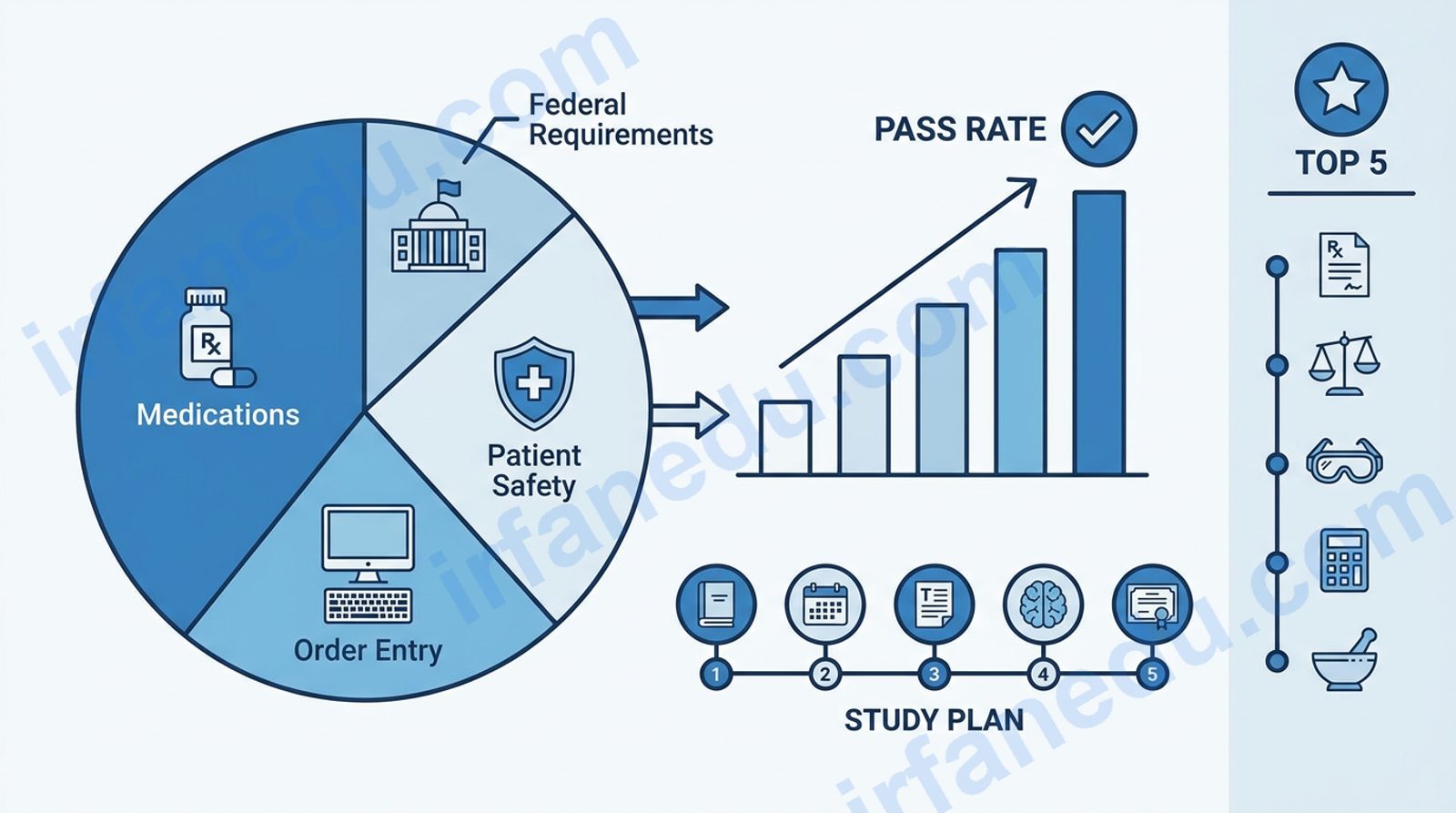
Here is a number that should get your attention: the PTCB reports that roughly one in four first-time PTCE candidates does not pass. The exam is not impossibly hard, but it is precise — a single knowledge gap in drug interactions or federal law can cost you a passing score. The candidates who pass on the first attempt almost always share one habit: they used structured, timed practice tests from the very start of their preparation.
A PTCB practice test is a simulated version of the Pharmacy Technician Certification Exam (PTCE). It mirrors the real exam’s 90-question format, four knowledge domains, and 110-minute time limit. Using practice tests strategically — not just passively reading through them — is the single most effective way to build the speed and accuracy the real PTCE demands.
In this guide, I walk you through the exam blueprint, show you how to interpret your practice-test scores, share a 6-week study schedule, and give you a mini quiz to try right now. Everything here is built around the current official PTCB exam blueprint — not a recycled list of generic tips.
After reading this guide, you will be able to:
- Understand exactly what the PTCE tests and how it is scored.
- Use practice tests as a diagnostic tool, not just a confidence check.
- Identify the highest-yield topics to prioritize in your study time.
- Follow a realistic, week-by-week study schedule.
What Is the PTCB Practice Test?
A PTCB practice test is a full-length or section-specific simulation of the PTCE, the exam administered by the Pharmacy Technician Certification Board (PTCB). It presents multiple-choice questions drawn from the same four knowledge domains the real exam covers, under the same time pressure.
The purpose of a practice test is not just to check what you know — it is to train your brain to retrieve information under timed conditions. Research in cognitive psychology consistently shows that retrieval practice (testing yourself) produces stronger long-term retention than re-reading notes. In my experience working with certification candidates, the students who score highest on the real exam are those who spent at least 40% of their total study time on active practice testing rather than passive review.
The PTCB offers its own official practice exam through the PTCB website. Third-party providers — including Quizlet, Pocket Prep, and Pharmacy Tech Lessons — also offer question banks. Quality varies significantly; always verify that any resource aligns with the current four-domain blueprint before using it.
PTCE vs. Practice Test: Key Differences
Understanding the structural differences between a practice test and the real exam helps you calibrate your expectations and avoid surprises on test day.
| Feature | Real PTCE | Good Practice Test |
|---|---|---|
| Total questions | 90 (80 scored + 10 unscored pilot) | 80-90 questions |
| Time limit | 1 hour 50 minutes (110 min) | 110 minutes (timed mode) |
| Question format | Multiple choice, 4 options | Multiple choice, 4 options |
| Scoring | Scaled score 1000-1600; pass = 1400 | Percentage (aim for 75%+) |
| Unscored questions | Yes — 10 pilot questions (unknown) | No (all questions scored) |
| Immediate feedback | No (results in ~3 weeks) | Yes — instant explanations |
| Calculator allowed | Yes (on-screen) | Depends on platform |
| Retake policy | Wait period if failed | Unlimited retakes |
The single biggest mistake I see PTCE candidates make is treating practice tests as a final check rather than a diagnostic tool. If you only take practice tests in the last week before your exam, you are wasting their most powerful benefit: the ability to show you exactly where your knowledge gaps are while you still have time to fix them. Take your first full-length practice test on day one of your study plan, even if you score poorly. That score is your roadmap.
Quick Facts About the PTCE
| Fact | Detail |
|---|---|
| Administering body | Pharmacy Technician Certification Board (PTCB) |
| Exam name | Pharmacy Technician Certification Exam (PTCE) |
| Eligibility | High school diploma/GED + PTCB-recognized education or work experience |
| Exam fee (2026) | $129 USD |
| Passing scaled score | 1400 out of 1000-1600 |
| Retake wait | 60 days after first/second failure; 6 months after third |
| Certification validity | 2 years (20 CE hours required for renewal) |
| Test delivery | Pearson VUE testing centers worldwide |
The Four PTCE Knowledge Domains Explained
The PTCE tests four knowledge domains. Every question on the exam — and on any quality practice test — maps to one of these domains. Knowing the weight of each domain lets you allocate study time where it counts most.
Domain 1: Medications                          ████████████████░░░░  40.0%
Domain 2: Federal Requirements                 █████░░░░░░░░░░░░░░░  12.5%
Domain 3: Patient Safety & Quality Assurance   ██████████░░░░░░░░░░  26.25%
Domain 4: Order Entry & Processing             ████████░░░░░░░░░░░░  21.25%

Total scored questions: 80   |   Total time: 110 minutes
Pass mark: scaled score 1400 (approx. 75% raw correct)
Domain 1: Medications (40%)
This is the largest domain and the one most candidates underestimate. It covers generic and brand drug names, drug classes, mechanisms of action, common side effects, and drug interactions. You need to know the top 200 drugs cold — both names and their therapeutic categories.
Domain 2: Federal Requirements (12.5%)
This domain covers DEA schedules, HIPAA, the Poison Prevention Packaging Act, and FDA recall classifications. It is the smallest domain by weight, but the questions are highly specific. A single wrong answer on a Schedule II rule can be the difference between passing and failing.
Domain 3: Patient Safety and Quality Assurance (26.25%)
This domain tests error prevention, high-alert medications, look-alike/sound-alike (LASA) drugs, and quality assurance processes. In my experience, this is where candidates with real pharmacy work experience have a natural advantage — the scenarios mirror real dispensing situations.
Domain 4: Order Entry and Processing (21.25%)
This domain covers prescription interpretation, sig code translation, days-supply calculations, and compounding. The math questions here are straightforward but require accuracy. Practice all calculation types until you can do them without a calculator, even though one is provided.
How to Use Practice Tests to Pass the PTCE
Taking a practice test and reviewing your score is not enough. The candidates who improve fastest use a specific process. Here is the exact six-step method I recommend.
- Take a diagnostic test on day one. Sit a full 90-question timed practice test before you study anything. Your score reveals your baseline and shows which domains need the most work.
- Map your gaps to the exam blueprint. Break down your diagnostic score by domain. If you scored 55% on Medications but 80% on Federal Requirements, your study time should reflect that imbalance.
- Study domain by domain using active recall. Use flashcards for drug names, write out federal law rules from memory, and practice sig code translation daily. Passive re-reading is the least efficient method.
- Take a timed full-length practice test every week. Simulate real exam conditions: 90 questions, 110 minutes, no phone, no notes. Track your score and domain breakdown each week to measure progress.
- Review every wrong answer in writing. For each incorrect answer, write one sentence explaining why the correct answer is right. This forces active processing and prevents you from making the same mistake twice.
- Schedule the real exam when you hit 75%+ on three consecutive tests. Three consistent scores above 75% indicate that your knowledge is stable, not just lucky. That is your green light to book the real PTCE.
Sample Practice Questions With Explanations
These worked examples mirror the style and difficulty of real PTCE questions. Read the explanation for each — understanding the reasoning matters more than memorizing the answer.
Sample Question 1: Medications Domain
A patient presents a prescription for atorvastatin 40 mg. Which of the following drug classes does atorvastatin belong to?
- A. ACE inhibitor
- B. HMG-CoA reductase inhibitor (statin)
- C. Beta-blocker
- D. Calcium channel blocker
Correct Answer: B. Atorvastatin (brand name Lipitor) is an HMG-CoA reductase inhibitor — a statin used to lower LDL cholesterol. This is one of the top 200 drugs you must know by both generic and brand name. ACE inhibitors (e.g., lisinopril), beta-blockers (e.g., metoprolol), and calcium channel blockers (e.g., amlodipine) are separate cardiovascular drug classes with different mechanisms.
Sample Question 2: Order Entry and Processing Domain
A prescription reads: “Amoxicillin 500 mg capsules — Sig: 1 cap PO TID x 10 days.” How many capsules should be dispensed?
- A. 20 capsules
- B. 28 capsules
- C. 30 capsules
- D. 14 capsules
Correct Answer: C. TID = three times daily. 3 capsules/day x 10 days = 30 capsules. This is a straightforward days-supply calculation. On the real exam, read the sig code carefully — “BID x 14 days” would give 28, which is option B and a common distractor.
Sample Question 3: Federal Requirements Domain
Under DEA scheduling, which schedule includes drugs with accepted medical use but the highest potential for abuse and severe psychological or physical dependence?
- A. Schedule I
- B. Schedule II
- C. Schedule III
- D. Schedule IV
Correct Answer: B. Schedule II drugs (e.g., oxycodone, fentanyl, Adderall) have accepted medical uses but carry the highest abuse potential among drugs with accepted use. Schedule I drugs (e.g., heroin) have no accepted medical use in the US. This distinction is a frequent PTCE question type.
Most practice test guides tell you to aim for 75% — but they do not tell you that your domain-level score matters more than your total score.
Here is why: the PTCE uses a scaled scoring model, and the four domains are not equally weighted. A candidate who scores 90% on Medications (40% of the exam) but only 50% on Patient Safety (26.25%) will likely fail, even if their overall raw percentage looks acceptable. I have seen candidates score 74% overall and pass, while others score 76% overall and fail — because the latter had a catastrophic domain gap that the scaled model penalized heavily.
The practical fix: when you review your practice test results, always break down your score by domain, not just overall. If any single domain is below 65%, treat it as a critical failure regardless of your total score. Fix the domain gap first.
A Realistic 6-Week Study Schedule
This schedule assumes roughly 1-2 hours of study per day and is designed for candidates with some pharmacy work experience. Adjust the timeline if you are starting from zero.
| Week | Focus | Practice Test Activity |
|---|---|---|
| Week 1 | Diagnostic + Domain 1 (Medications, top 100 drugs) | Full diagnostic test on Day 1; review all wrong answers |
| Week 2 | Domain 1 continued (top 200 drugs, drug interactions) | 50-question Medications-only practice set |
| Week 3 | Domain 3 (Patient Safety, LASA drugs, high-alert meds) | Full-length timed practice test; track domain scores |
| Week 4 | Domain 4 (Order Entry, calculations, sig codes) | 30-question calculation-focused practice set daily |
| Week 5 | Domain 2 (Federal Requirements, DEA, HIPAA) | Full-length timed practice test; compare to Week 3 scores |
| Week 6 | Full review of weakest domain; mixed practice | Two full-length timed tests; schedule real exam if 75%+ achieved |
Six weeks is enough for most candidates — but only if you are honest with yourself about your weak domains. I have worked with candidates who spent five weeks on Medications (their strongest area) and barely touched Federal Requirements, then failed because of DEA scheduling questions. The schedule above is deliberately front-loaded on Medications because it is the largest domain, but do not skip the smaller domains. A 12.5% domain can still be the one that costs you a passing score.
- Top 200 brand/generic drug names and their drug classes
- DEA drug schedules (I through V) with examples
- Days-supply and dosage calculations
- LASA (look-alike/sound-alike) drug pairs
- Sig code translations (QD, BID, TID, QID, PRN, AC, PC)
- FDA recall classifications (Class I, II, III)
- HIPAA minimum necessary standard
- High-alert medications (anticoagulants, insulin, opioids)
Mini Quiz: Test Your PTCE Knowledge
Select an answer to reveal whether it is correct. No page reload needed.
1. Which DEA schedule has NO currently accepted medical use in the United States?
Incorrect. Schedule II drugs (e.g., oxycodone) have accepted medical uses but high abuse potential.
Correct! Schedule I drugs (e.g., heroin, LSD) have no accepted medical use and the highest abuse potential.
Incorrect. Schedule III drugs (e.g., buprenorphine) have accepted medical uses with moderate abuse potential.
Incorrect. Schedule V drugs (e.g., cough preparations with codeine) have accepted medical uses and the lowest abuse potential.
2. A prescription reads: “Metformin 500 mg — Sig: 1 tab PO BID x 30 days.” How many tablets should be dispensed?
Incorrect. BID = twice daily. 2 x 30 = 60 tablets, not 30.
Correct! BID = twice daily. 2 tablets/day x 30 days = 60 tablets.
Incorrect. 90 tablets would be TID (three times daily) x 30 days.
Incorrect. 14 tablets would be 1 tablet/day x 14 days (QD x 14 days).
3. Which of the following is a high-alert medication that requires extra caution during dispensing?
Incorrect. Amoxicillin is a common antibiotic and is not classified as a high-alert medication.
Incorrect. Ibuprofen is an OTC NSAID and is not on the standard high-alert medication list.
Correct! Warfarin is a high-alert anticoagulant. Errors in dosing can cause serious bleeding or clotting events. It is on the ISMP high-alert medications list.
Incorrect. Cetirizine is an OTC antihistamine and is not classified as high-alert.
Frequently Asked Questions
How many questions are on the PTCB practice test?
What score do you need to pass the PTCE?
How long should I study for the PTCE?
Are free PTCB practice tests accurate?
Sources & References
-
Pharmacy Technician Certification Board (PTCB) – Official PTCE Exam Information
— the primary authoritative source for exam structure, blueprint, scoring, and eligibility requirements. -
Institute for Safe Medication Practices (ISMP) – High-Alert Medications List
— referenced for the Patient Safety domain content on high-alert medications. -
U.S. Drug Enforcement Administration (DEA) – Drug Scheduling
— official source for DEA Schedule I-V definitions and examples.
Editorial note: This article was written and fact-checked by Dr. Irfan Mansuri. All exam statistics and blueprint information reflect the current official PTCB exam framework as of August 2026. No data was fabricated. Verify current exam fees and policies directly at ptcb.org before registering.