
APUSH Study Guide: Complete Exam Prep Strategy
- You are enrolled in or have completed an AP United States History course.
- You know the AP exam is scored 1-5 and that most colleges accept a 3, 4, or 5 for credit.
- You have access to the College Board’s official APUSH Course and Exam Description (CED) — it is free at apcentral.collegeboard.org.
- You understand basic essay structure: thesis, evidence, analysis, conclusion.
If any of these feel shaky, spend 30 minutes reviewing them before diving into this guide. Everything below builds on that foundation.
Table of Contents
- Quick Answer
- What Is the APUSH Exam?
- The 9 APUSH Periods at a Glance
- Which Periods Carry the Most Weight?
- The Three Essay Types: DBQ, LEQ, SAQ
- How to Write a High-Scoring APUSH DBQ
- Common APUSH Mistakes (and How to Fix Them)
- 8-Week APUSH Study Schedule
- Unique Insight: The Skill Most Students Ignore
- Quick Quiz
- Practice Problems
- FAQ
- Key Takeaways
- Related Articles
- Sources & References
The APUSH exam tests your ability to analyze US history from 1491 to the present using historical thinking skills — not just memorized facts. It consists of multiple-choice questions, short-answer questions, a document-based essay, and a long essay. Students who score 4s and 5s consistently focus on understanding causation and argument structure, not on memorizing every date.
I have worked with hundreds of AP students over 15 years, and the ones who struggle with APUSH almost always share one problem: they treat it like a history trivia test. It is not. The College Board rewards historical reasoning above all else. This guide gives you a clear, honest path from where you are now to a score you are proud of.
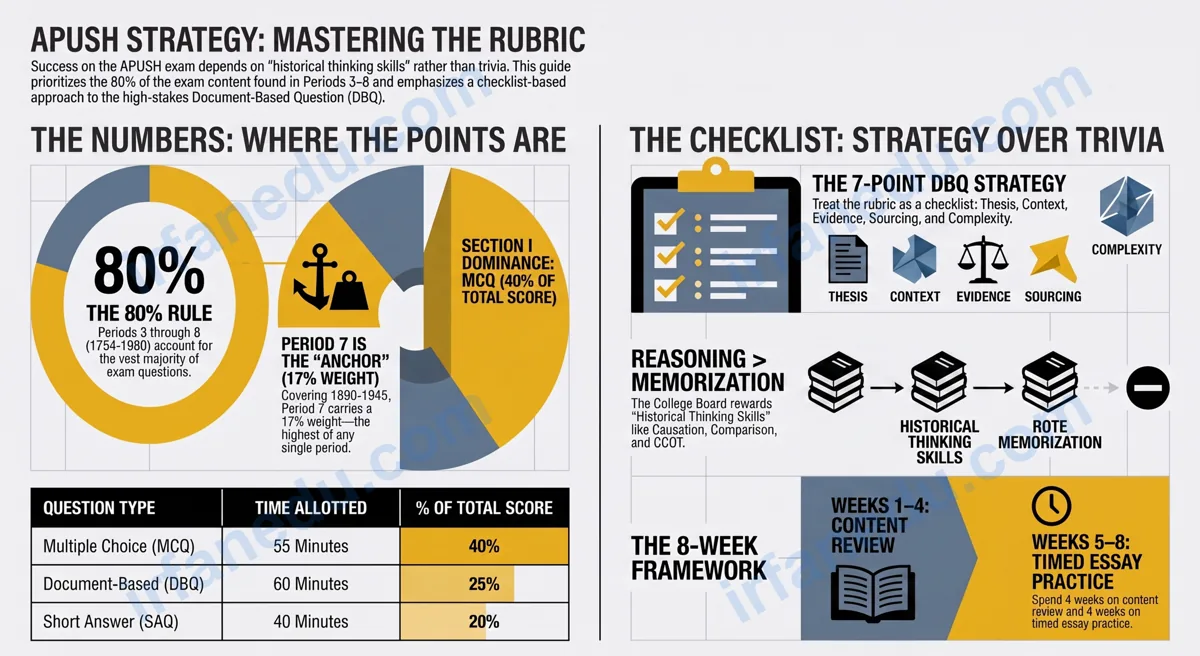
The APUSH (AP United States History) exam covers US history from 1491 to the present across 9 chronological periods. It includes 55 multiple-choice questions, 3 short-answer questions, 1 document-based question (DBQ), and 1 long-essay question (LEQ). Scoring is 1-5; a 3 or above earns college credit at most universities. Success depends on historical thinking skills, not just memorized facts.
TL;DR – Quick Summary
- APUSH covers 9 periods from 1491 to present; Periods 3-8 carry the heaviest exam weight.
- The exam has four question types: MCQ, SAQ, DBQ, and LEQ.
- DBQ is worth the most points; thesis + sourcing + outside evidence are the three keys.
- Historical thinking skills (causation, CCOT, comparison) matter more than memorized dates.
- An 8-week study plan beats last-minute cramming every time.
- The complexity point on essays is the most commonly missed point — and the easiest to plan for.
What Is the APUSH Exam?
The AP United States History exam is a College Board assessment that, if passed, can earn you college credit before you graduate high school. It tests your ability to read primary sources, construct historical arguments, and apply analytical thinking to US history from pre-Columbian societies through the modern era.
The exam runs approximately 3 hours and 15 minutes and is divided into two sections.
| Section | Question Type | Number | Time | % of Score |
|---|---|---|---|---|
| Section I, Part A | Multiple Choice (MCQ) | 55 questions | 55 min | 40% |
| Section I, Part B | Short Answer (SAQ) | 3 questions | 40 min | 20% |
| Section II, Part A | Document-Based (DBQ) | 1 essay | 60 min | 25% |
| Section II, Part B | Long Essay (LEQ) | 1 essay (choice of 3) | 40 min | 15% |
MCQs are always paired with a primary or secondary source stimulus — a document, image, map, or graph. You are never answering in a vacuum. That means reading comprehension and source analysis are just as important as content knowledge.
The 9 APUSH Periods at a Glance
The College Board organizes all of US history into 9 chronological periods, each with a defined set of themes and key concepts. Knowing the boundaries and dominant themes of each period is the foundation of every content-review session.
APUSH Period Timeline (ASCII)
Period 1  |1491-1607 | Indigenous societies; European contact
Period 2  |1607-1754 | Colonial development; Atlantic world
Period 3  |1754-1800 | Revolution; new nation; Constitution
Period 4  |1800-1848 | Market revolution; Jacksonian democracy
Period 5  |1844-1877 | Manifest Destiny; Civil War; Reconstruction
Period 6  |1865-1898 | Industrialization; Gilded Age; immigration
Period 7  |1890-1945 | Progressivism; WWI; Depression; WWII
Period 8  |1945-1980 | Cold War; Civil Rights; social movements
Period 9  |1980-Pres | Conservative resurgence; globalization
Each period has a set of Key Concepts in the CED. Those Key Concepts are the College Board’s own outline of what they will test. If you have not read them, stop and read them tonight — they are the closest thing to a cheat sheet the College Board will ever give you.
In my experience teaching APUSH, students spend too much time on Period 1 because it feels unfamiliar and exotic. Period 1 carries only about 5% of the exam weight. Spend proportional time — roughly one study session on Period 1, versus four or five sessions on Periods 7 and 8, which together carry close to 30% of the exam.
Which Periods Carry the Most Weight?
The College Board publishes approximate exam weight percentages for each period, and smart students use these to prioritize their review time. The heaviest periods are 3 through 8, which together account for roughly 80% of the exam.
| Period | Years | Approx. Exam Weight | Priority |
|---|---|---|---|
| 1 | 1491-1607 | ~5% | Low |
| 2 | 1607-1754 | ~5% | Low |
| 3 | 1754-1800 | ~12% | High |
| 4 | 1800-1848 | ~10% | High |
| 5 | 1844-1877 | ~13% | High |
| 6 | 1865-1898 | ~13% | High |
| 7 | 1890-1945 | ~17% | Very High |
| 8 | 1945-1980 | ~17% | Very High |
| 9 | 1980-Present | ~8% | Medium |
Period 7 (1890-1945) is the single most tested period. It covers Progressivism, World War I, the Great Depression, the New Deal, and World War II — all of which appear constantly in both MCQ stimuli and essay prompts. If you have limited time, make Period 7 your anchor.
Suppose you have 4 weeks left before the exam. You have 20 study sessions available. A smart allocation based on weight: Period 7 gets 4 sessions, Period 8 gets 4 sessions, Periods 3-6 get 2 sessions each (8 total), and the remaining 4 sessions go to timed essay practice. Periods 1, 2, and 9 get covered in your general review reading, not dedicated sessions.
The Three Essay Types: DBQ, LEQ, and SAQ
The three essay formats each test a different set of skills, and each has its own rubric. Treating them as interchangeable is one of the most common mistakes I see.
| Essay Type | Time | Max Points | Core Skill | Key Requirement |
|---|---|---|---|---|
| DBQ | 60 min | 7 pts | Source analysis + argumentation | Use 6 of 7 docs; source at least 3 |
| LEQ | 40 min | 6 pts | Argumentation from memory | Thesis + 2 categories of evidence |
| SAQ | ~13 min each | 3 pts each | Concise factual response | No thesis needed; answer A, B, C directly |
The SAQ is the most forgiving. You do not need a thesis — just a direct, specific answer to each part. The LEQ rewards students who can build an argument from memory alone. The DBQ is the most complex and carries the most points, so it deserves the most practice time.
How to Write a High-Scoring APUSH DBQ
A high-scoring DBQ follows a clear, repeatable process. The 7-point rubric rewards thesis, contextualization, evidence (document use), sourcing, and complexity — in that order of reliability.
- Read the prompt first (2 min). Identify the time period, topic, and historical thinking skill. Do not touch the documents yet.
- Skim all 7 documents (5 min). Note the source, date, and main argument for each. Mark 3 documents you will source.
- Write your thesis (3 min). Make a historically defensible claim that goes beyond restating the prompt. Establish a line of reasoning — tell the reader why your argument is structured the way it is.
- Group documents into 3 thematic categories (2 min). Your body paragraphs follow these groups. Each group needs at least 2 documents.
- Write body paragraphs (30 min). Each paragraph: topic sentence, document evidence, sourcing for at least one document in the group, outside evidence where possible.
- Write contextualization (5 min). This goes in your introduction. Describe a broader historical context that is relevant before, during, or after the prompt’s time period — and explain how it connects to your argument.
- Add a complexity statement (3 min). In your conclusion, acknowledge a contradiction, a nuance, or a broader connection across time periods.
Prompt: “Evaluate the extent to which the New Deal changed the role of the federal government in American life between 1933 and 1939.”
Weak thesis (restates prompt): “The New Deal changed the role of the federal government in many ways.”
Strong thesis (defensible claim + line of reasoning): “While the New Deal significantly expanded federal responsibility for economic welfare through programs like Social Security and the FDIC, its impact was limited by persistent racial exclusion and conservative Congressional resistance, meaning the change was transformative in scope but uneven in application.”
The strong thesis earns the point because it makes a specific, defensible claim and sets up two categories of evidence (expansion AND limitations).
In my experience, the complexity point is the most misunderstood point on the entire APUSH rubric. Students think it means “write a complicated sentence.” It does not. It means: show that history is not simple. The easiest way to earn it is to plan one of four moves before you start writing — corroboration (two documents that seem to contradict each other), continuity (this issue did not fully resolve after the period), causation (a cause that had unintended consequences), or connection across time. Pick one, plan it, and write it in your conclusion. That is the whole strategy.
Common APUSH Mistakes — and How to Fix Them
Most lost points on APUSH come from a small set of repeatable errors. Here are the ones I see most often, with direct fixes.
| Mistake | Why It Costs Points | The Fix |
|---|---|---|
| Vague thesis (“changed a lot”) | Fails the defensible claim requirement | Make a specific claim + give a reason |
| Summarizing documents instead of using them | Earns content point but not analysis point | Always explain HOW the doc supports your argument |
| Skipping sourcing on documents | Misses up to 3 sourcing points | For 3 docs, explain purpose/audience/situation/POV |
| Writing contextualization in one sentence | One sentence rarely earns the point | Write 3-4 sentences; describe AND connect to argument |
| Ignoring the historical thinking skill in the prompt | Misses the complexity and analysis points | Underline the skill word (evaluate, compare, explain) before writing |
| Running out of time on Section II | Incomplete essays score 0 on missing rubric rows | Practice timed writes; DBQ 60 min, LEQ 40 min — hard stops |
8-Week APUSH Study Schedule
An 8-week plan gives you enough time to cover all 9 periods, practice all essay types, and do full-length timed sections. Here is the framework I recommend to students.
| Week | Focus | Daily Task |
|---|---|---|
| 1 | Periods 1-3 content review | Read CED Key Concepts + make flashcards |
| 2 | Periods 4-5 content review | Read + 15 MCQ practice questions daily |
| 3 | Periods 6-7 content review | Read + 15 MCQ + 1 SAQ practice |
| 4 | Periods 8-9 content review | Read + 15 MCQ + 1 SAQ practice |
| 5 | DBQ strategy + 2 timed DBQs | One full DBQ per session; score with rubric |
| 6 | LEQ strategy + 2 timed LEQs | One full LEQ per session; score with rubric |
| 7 | Full-length practice exam | One full timed exam; review every wrong answer |
| 8 | Targeted review + rest | Review weakest periods; no new material after Day 5 |
The key discipline in Week 8 is stopping new content review by Day 5. Cramming new facts two days before the exam increases anxiety without meaningfully improving your score. Use those final two days to review your own notes, re-read your best practice essays, and sleep well.
Almost every APUSH study guide tells you to “know your periods” and “practice DBQs.” That is correct but incomplete. The insight most guides skip is this: the APUSH rubric is a checklist, not a holistic judgment.
AP readers score your essay by checking boxes — thesis: yes or no; contextualization: yes or no; sourcing: yes or no. They are not reading for beautiful prose or impressive vocabulary. This means a student with average writing but a clear checklist strategy will consistently outscore a strong writer who does not know the rubric.
In my experience, the fastest score gains come not from reading more history but from printing the DBQ rubric, taping it to your desk, and writing your next practice essay with the rubric open in front of you. Check each box as you earn it. Do this five times and the rubric becomes instinct.
The second overlooked insight: contextualization is not the same as background information. Most students write a paragraph of general historical context and assume they earned the point. The rubric requires you to connect that context to your argument. “The Progressive Era created public demand for federal intervention, which directly shaped the political environment Roosevelt exploited in 1933” earns the point. “The 1920s was a time of economic growth” does not.
Quick Quiz: Test Your APUSH Knowledge
APUSH Quick Quiz (3 Questions)
1. Which section of the APUSH exam carries the highest percentage of your total score?
2. What does “sourcing” mean in the APUSH DBQ rubric?
3. Which APUSH period carries the highest approximate exam weight?
Select an answer to reveal the explanation.
Practice Problems
Practice 1: Identify the historical thinking skill — “Evaluate the extent to which Reconstruction changed the political and social status of African Americans between 1865 and 1877.”
Practice 2: Write a one-sentence contextualization for a DBQ on the causes of the Civil War.
Why it works: It describes a broader historical trend (territorial expansion of slavery), names specific events, and connects that context to the prompt’s subject (the causes of the Civil War). It does not just say “there was tension between North and South.”
Practice 3: What outside evidence could you add to a DBQ on the Progressive Era?
Frequently Asked Questions
What is the APUSH exam format?
How many periods does APUSH cover?
What is a DBQ in APUSH?
What score do you need to pass APUSH?
How long should I study for APUSH?
What are the historical thinking skills tested on APUSH?
Is APUSH harder than other AP exams?
Can I use outside evidence in a DBQ?
Key Takeaways
- The APUSH exam tests historical thinking skills, not just memorized facts — know the six skills.
Reviewed by Dr. Irfan Mansuri. External links open in a new tab and are provided for further reading and verification.