
Limit Calculator: Solve Any Limit Step by Step
The first time I taught limits to a classroom of 16-year-olds, I drew a car driving toward a wall but never quite touching it. Half the class laughed. The other half suddenly understood calculus for the first time. That image — approaching without arriving — is the whole idea behind a limit, and it is the gateway to every derivative and integral you will ever compute.
A limit tells you the value a function is heading toward as its input gets closer and closer to a specific number. You write it as lim(x→a) f(x) = L. The function does not need to be defined at that exact point; what matters is the value it approaches from both sides.
This page gives you a working limit calculator that shows numbered steps, two comparison tables, fully worked examples, and a plain-English breakdown of every method. Whether you are meeting limits for the first time or reviewing for an exam, you will leave with a clear, usable process.
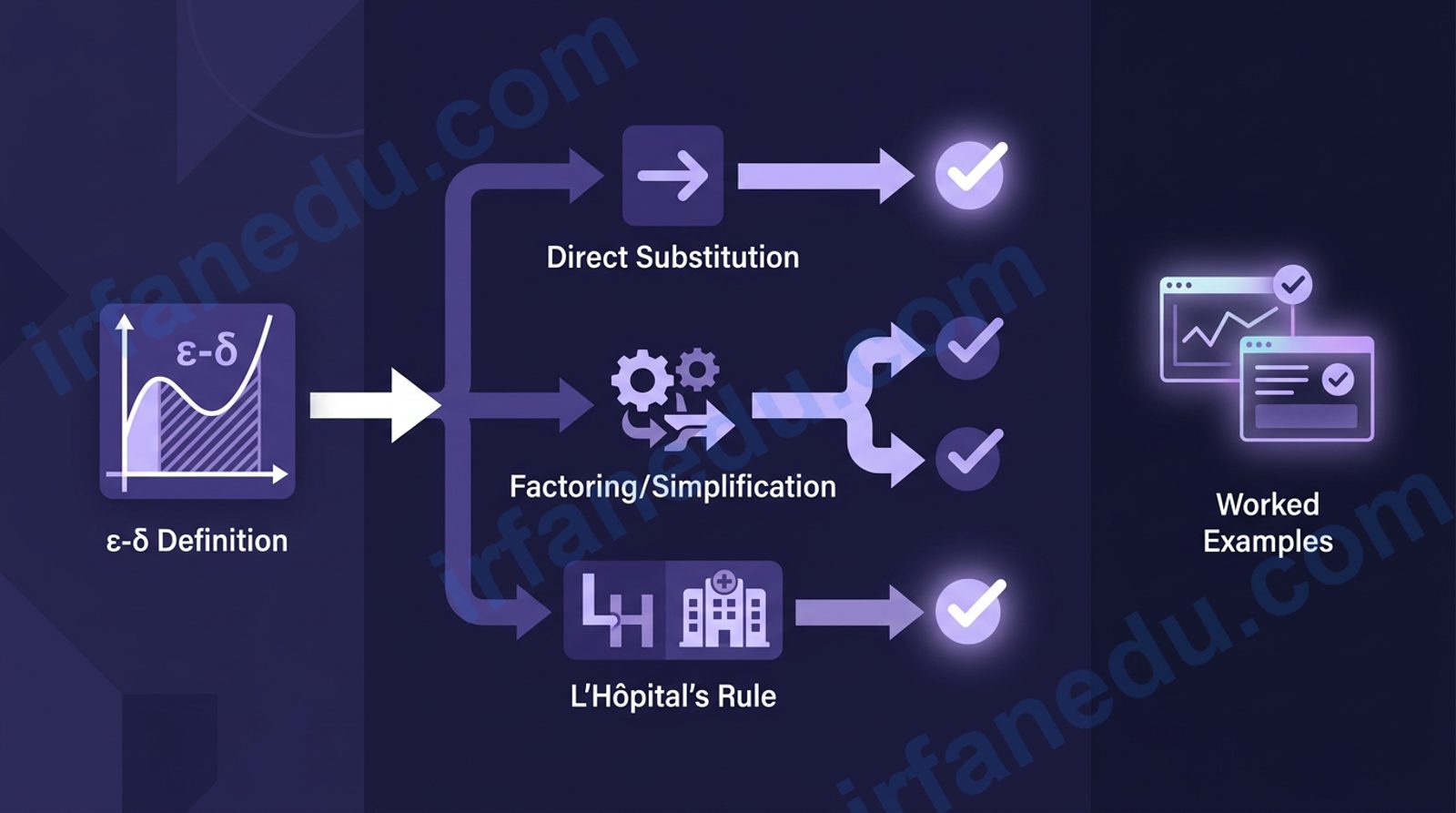
A limit is the value a function approaches as its input gets arbitrarily close to a point. To find it: (1) try direct substitution first; (2) if you get 0/0 or ∞/∞, factor and cancel or rationalize; (3) if still indeterminate, apply L’Hôpital’s rule — differentiate numerator and denominator separately, then substitute. For example, lim(x→2) (x²−4)/(x−2) = 4.
🧮 Interactive limit calculator
Enter your polynomial or rational function below. The calculator supports three methods and shows every step so you can follow the working.
Limit Calculator
Polynomial & rational functions — step-by-step
Enter coefficients for f(x) = (ax² + bx + c) / (dx² + ex + f). For a simple polynomial (no denominator), set d=0, e=0, f=1.
Enter the value x is approaching (can be any real number).
How to use this calculator
- Choose a method — Direct Substitution, Factor & Cancel, or L’Hôpital’s Rule.
- Enter numerator coefficients a, b, c for the polynomial ax² + bx + c.
- Enter denominator coefficients (for a rational function). For a plain polynomial, set a=0, b=0, c=1.
- Enter the approach value — the number x is approaching.
- Click Calculate and read the result plus the numbered steps. Press Enter inside any field to calculate instantly.
Worked examples
Example 1: Direct substitution (no issue)
Find lim(x→3) (x² + 2x − 1).
Substitute x = 3: (9 + 6 − 1) = 14. No denominator, no problem. The limit is 14.
Calculator inputs: na=1, nb=2, nc=−1, da=0, db=0, dc=1, x→3. Method: Direct Substitution.
Example 2: Factor and cancel (0/0 form)
Find lim(x→2) (x² − 4) / (x − 2).
Direct substitution gives (4 − 4)/(2 − 2) = 0/0. Factor the numerator: (x − 2)(x + 2). Cancel (x − 2). The simplified expression is (x + 2). Substitute x = 2: 4.
Calculator inputs: na=1, nb=0, nc=−4, da=0, db=1, dc=−2, x→2. Method: Factor & Cancel.
  lim(x→2)  (x² − 4)
            ─────────
             (x − 2)

  Step 1:  Factor numerator → (x−2)(x+2)
           ─────────────────────────────
                  (x − 2)

  Step 2:  Cancel (x−2) [valid for x ≠ 2]
           → lim(x→2) (x + 2)

  Step 3:  Substitute → 2 + 2 = 4  ✓
Example 3: L’Hôpital’s rule
Find lim(x→0) (2x² + 3x) / (4x² + x).
Substituting x = 0 gives 0/0. Differentiate numerator: 4x + 3. Differentiate denominator: 8x + 1. Substitute x = 0: 3/1 = 3.
Calculator inputs: na=2, nb=3, nc=0, da=4, db=1, dc=0, x→0. Method: L’Hôpital’s Rule.
What is a limit in calculus?
A limit is the value a function f(x) approaches as x gets arbitrarily close to a number a, written lim(x→a) f(x) = L. The function does not need to equal L at x = a — it only needs to approach L from both sides.
Limits are the foundation of calculus. Every derivative is defined as a limit of a difference quotient, and every definite integral is defined as a limit of a Riemann sum. Without limits, neither concept exists.
In my experience teaching calculus, students who struggle with limits almost always have the same misconception: they think the function must be defined at the point. It does not have to be. The limit is about the journey, not the destination. Once that clicks, everything else — derivatives, continuity, integrals — falls into place naturally.
The formulas and rules explained
Core limit notation
lim(x→a) f(x) = LRead: “the limit of f(x) as x approaches a equals L.”
L’Hôpital’s rule
If lim f(x)/g(x) = 0/0 or ∞/∞, then:

lim(x→a) f(x)/g(x) = lim(x→a) f'(x)/g'(x)
Variables & symbols table
| Symbol | Meaning | Notes |
|---|---|---|
| lim | Limit operator | Reads “limit of” |
| x → a | x approaches a | x gets close to a, never equals a |
| f(x) | The function | Any expression in x |
| L | The limit value | A finite real number (or ±∞) |
| f'(x) | Derivative of f(x) | Used in L’Hôpital’s rule |
| 0/0, ∞/∞ | Indeterminate forms | Trigger for factoring or L’Hôpital |
Comparing the three main limit-solving methods
| Method | When to use | Steps | Works for |
|---|---|---|---|
| Direct Substitution | Denominator ≠ 0 at x = a | Plug in x = a | Polynomials, most rational functions |
| Factor & Cancel | 0/0 form; common factor exists | Factor, cancel, substitute | Rational functions with removable discontinuity |
| L’Hôpital’s Rule | 0/0 or ∞/∞ after substitution | Differentiate top and bottom separately, substitute | Differentiable functions in indeterminate form |
| Limit type | Notation | Meaning | Limit exists? |
|---|---|---|---|
| Two-sided | lim(x→a) f(x) | Approach from both sides | Yes, if left = right |
| Left-sided | lim(x→a⁻) f(x) | Approach from x < a only | May differ from right |
| Right-sided | lim(x→a⁺) f(x) | Approach from x > a only | May differ from left |
| Infinite | lim(x→a) f(x) = ∞ | Function grows without bound | No finite limit |
Sources & References
Written and fact-checked by Dr Irfan Mansuri. External links open in a new tab and are provided for further reading and verification.