
Florida Paycheck Calculator: Estimate Your Take-Home Pay
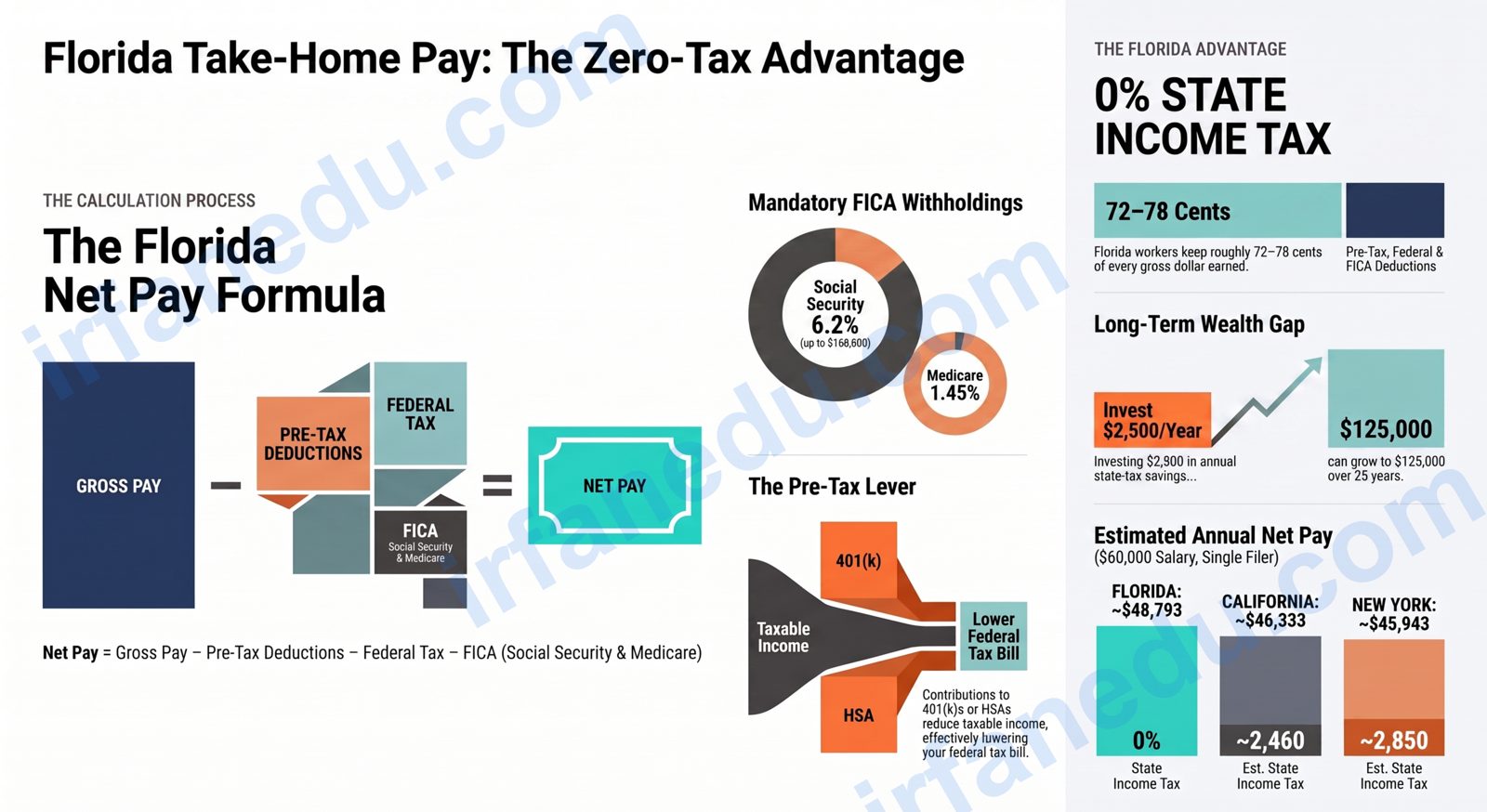
A Florida paycheck calculator estimates your net take-home pay by subtracting federal income tax (10%–37% depending on bracket), Social Security (6.2% up to the wage base), and Medicare (1.45%) from your gross pay. Florida charges zero state income tax, so those three federal deductions are the only mandatory withholdings most employees face. Pre-tax deductions like 401(k) contributions lower your taxable income further.
⚡ In Short
- Florida has no state income tax — a significant advantage over most U.S. states.
- Your paycheck deductions are: federal income tax + Social Security (6.2%) + Medicare (1.45%).
- Pre-tax deductions (401k, health insurance) reduce your federal taxable income.
- Use the calculator below to get an instant, step-by-step net pay estimate.
- Most Florida earners keep roughly 72–78 cents of every gross dollar earned.
Table of Contents
Most paycheck guides bury the most important fact: Florida workers pay no state income tax. That single detail changes your net pay calculation entirely compared to living in a high-tax state. In this guide, I walk you through exactly what gets deducted from a Florida paycheck, give you a working calculator, and show you two real numeric examples so you can verify the math yourself.
Florida vs. Other States: The No-Tax Advantage
The fastest way to understand Florida’s paycheck benefit is to compare mandatory deductions side by side. The table below uses a $60,000 annual salary, single filer, standard W-4 as the baseline.
| Deduction | Florida | California (example) | New York (example) |
|---|---|---|---|
| Federal Income Tax (est.) | ~$6,617 | ~$6,617 | ~$6,617 |
| Social Security (6.2%) | $3,720 | $3,720 | $3,720 |
| Medicare (1.45%) | $870 | $870 | $870 |
| State Income Tax | $0 | ~$2,460 | ~$2,850 |
| Estimated Net Pay | ~$48,793 | ~$46,333 | ~$45,943 |
State tax estimates are approximate and use 2024 rates for illustration. Actual amounts vary by filing status and deductions.
In my experience helping students and early-career professionals understand their first paychecks, the state income tax line is the one that causes the most confusion. People move to Florida from states like Illinois or Georgia and are genuinely surprised to see that line missing. It is not an error — it is the law, and it adds up to thousands of dollars a year in your pocket.
Interactive Florida Paycheck Calculator
Enter your gross pay details below. The calculator applies 2024 federal tax brackets, standard FICA rates, and your pre-tax deductions to give you an instant net pay estimate with a full step-by-step breakdown.
Florida Paycheck Calculator
Estimate your net take-home pay — no state income tax applied
Amount before any deductions
How often you are paid
From your W-4
401(k), health insurance, HSA, etc.
How to Use This Calculator
Using the Florida paycheck calculator takes under a minute. Follow these steps:
- Enter your gross pay per period — this is your pay before any deductions. For hourly workers, multiply your hourly rate by hours worked in the period.
- Select your pay frequency — weekly, bi-weekly, semi-monthly, or monthly.
- Choose your federal filing status — this matches the status on your W-4 form (Single, Married Filing Jointly, or Head of Household).
- Enter pre-tax deductions — include 401(k) contributions, health insurance premiums, HSA contributions, or any other pre-tax benefit. Leave blank or enter 0 if none.
- Click Calculate — your net take-home pay appears instantly with a full step-by-step breakdown and annual summary chips.
The Florida Paycheck Formula Explained
Your net pay is your gross pay minus every mandatory and voluntary deduction. In Florida, the formula is simpler than in most states because there is no state income tax line.
┌─────────────────────────────────────────────────────────┐
│           FLORIDA NET PAY FORMULA                       │
├─────────────────────────────────────────────────────────┤
│  Gross Pay (per period)                                 │
│  ─ Pre-Tax Deductions  (401k, health ins., HSA)         │
│  ─ Federal Income Tax  (based on taxable income)        │
│  ─ Social Security Tax (6.2% up to $168,600/yr)         │
│  ─ Medicare Tax        (1.45% of all wages)             │
│  ─ State Income Tax    ($0 — Florida has none)          │
│  ─ Post-Tax Deductions (Roth 401k, garnishments, etc.)  │
│  ═══════════════════════════════════════════════════    │
│  = NET TAKE-HOME PAY                                    │
└─────────────────────────────────────────────────────────┘
Variables and Symbols Table
| Symbol / Term | Meaning | 2024 Rate / Limit |
|---|---|---|
| Gross Pay | Total earnings before deductions | Varies |
| Pre-Tax Ded. | Deductions that reduce federal taxable income | Varies (IRS limits apply) |
| Federal Tax | Tax on taxable income per IRS brackets | 10% – 37% |
| SS Tax | Social Security (OASDI) employee share | 6.2% up to $168,600/yr |
| Medicare | Hospital Insurance employee share | 1.45% (all wages) |
| FL State Tax | Florida individual income tax | 0% |
| Net Pay | Amount deposited to your bank account | Gross minus all deductions |
Worked Examples: Two Florida Earners
Example 1: Hourly Worker, $18/hr, Bi-Weekly
Maria works 80 hours per bi-weekly period at $18/hour. She is single, has no pre-tax deductions, and is paid bi-weekly (26 times per year).
- Gross pay per period: 80 × $18 = $1,440.00
- Annual gross: $1,440 × 26 = $37,440
- Annual taxable income: $37,440 – $0 (pre-tax) – $14,600 (std. deduction) = $22,840
- Federal tax on $22,840: 10% × $11,600 = $1,160 + 12% × $11,240 = $1,348.80 → annual $2,508.80 → per period $96.49
- Social Security: $1,440 × 6.2% = $89.28
- Medicare: $1,440 × 1.45% = $20.88
- Florida state tax: $0.00
- Net take-home pay: $1,440 – $96.49 – $89.28 – $20.88 = $1,233.35
Example 2: Salaried Worker, $75,000/yr, Monthly, with 401(k)
James earns $75,000 per year, paid monthly ($6,250/month). He files as single and contributes $400/month to his 401(k) pre-tax.
- Gross pay per period: $6,250.00
- Pre-tax deduction: $400 (401k)
- Annual gross: $75,000; annual pre-tax: $4,800
- Annual taxable income: $75,000 – $4,800 – $14,600 = $55,600
- Federal tax on $55,600: 10% × $11,600 = $1,160 + 12% × $35,550 = $4,266 + 22% × $8,450 = $1,859 → annual $7,285 → per period $607.08
- Social Security: $6,250 × 6.2% = $387.50
- Medicare: $6,250 × 1.45% = $90.63
- Florida state tax: $0.00
- Net take-home pay: $6,250 – $400 – $607.08 – $387.50 – $90.63 = $4,764.79
James’s example reveals something most paycheck guides skip: the 401(k) contribution does not just save for retirement — it cuts his federal tax bill by about $88 per month (22% bracket × $400). In my experience, this is the single most underused lever for Florida workers who want to increase take-home pay without getting a raise. Maxing pre-tax contributions is a legal pay raise.
Common Mistakes When Estimating a Florida Paycheck
Wrong: Applying a flat 25% tax rate to your gross pay.
Right: The U.S. uses a progressive bracket system. Only the income in each bracket is taxed at that bracket’s rate. Most Florida workers’ effective federal rate is 12–18%, not 22–25%.
Wrong: Forgetting that pre-tax deductions reduce federal tax but NOT Social Security and Medicare.
Right: FICA taxes (SS + Medicare) are calculated on gross wages before most pre-tax deductions. Your 401(k) lowers your federal income tax, but SS and Medicare are still owed on the full gross amount.
Wrong: Assuming the standard deduction is already factored into your paycheck automatically.
Right: Your employer uses your W-4 elections to estimate withholding. The standard deduction is factored into the IRS withholding tables, but if your W-4 is outdated or incorrect, your withholding may be off. Review your W-4 annually.
Most Florida paycheck guides focus only on what you save versus other states. What they miss is the compounding benefit of investing that state-tax savings. A Florida worker earning $60,000 saves roughly $2,500–$3,000 per year compared to a peer in a 5% state-income-tax state. If that $2,500 is invested annually in an index fund at a 7% average return, it grows to over $125,000 in 25 years — purely from the state-tax-free status. The paycheck advantage is not just monthly; it is a long-term wealth gap.
Practice Problems
Try these yourself, then reveal the answer to check your work.
Problem 1: Sarah earns $22/hr, works 40 hrs/week, is single with no pre-tax deductions. What is her approximate weekly net pay?
Solution:
- Gross: 40 × $22 = $880/week; Annual gross: $880 × 52 = $45,760
- Taxable income: $45,760 – $14,600 = $31,160
- Federal tax: 10% × $11,600 = $1,160 + 12% × $19,560 = $2,347.20 → annual $3,507.20 → weekly $67.45
- SS: $880 × 6.2% = $54.56; Medicare: $880 × 1.45% = $12.76
- Net weekly pay: $880 – $67.45 – $54.56 – $12.76 = $745.23
Problem 2: David earns $5,000/month (salaried), files Married Filing Jointly, and contributes $500/month to health insurance pre-tax. Estimate his monthly net pay.
Solution:
- Gross: $5,000; Pre-tax: $500; Annual gross: $60,000; Annual pre-tax: $6,000
- Taxable income: $60,000 – $6,000 – $29,200 (MFJ std. ded.) = $24,800
- Federal tax on $24,800: 10% × $23,200 = $2,320 + 12% × $1,600 = $192 → annual $2,512 → monthly $209.33
- SS: $5,000 × 6.2% = $310; Medicare: $5,000 × 1.45% = $72.50
- Net monthly pay: $5,000 – $500 – $209.33 – $310 – $72.50 = $3,908.17
Frequently Asked Questions
Does Florida have a state income tax?
No. Florida is one of nine U.S. states with no individual state income tax. This means Florida workers keep more of each paycheck compared to employees in states like California or New York, where state income tax can reach 9–13%. The Florida Constitution prohibits a personal income tax, making this a permanent feature of the state’s tax structure.
What Percentage Is Taken Out of a Paycheck in Florida?
For most Florida workers, total mandatory withholding is roughly 18–28% of gross pay: federal income tax (10–22% for most earners in the 2024 brackets), Social Security (6.2%), and Medicare (1.45%). There is no state income tax deduction. Your exact percentage depends on your income level, filing status, and pre-tax deductions.
Sources & References
Written and fact-checked by Dr Irfan Mansuri. External links open in a new tab and are provided for further reading and verification.