
How to Calculate the Right Amount of Salt for Your Pool
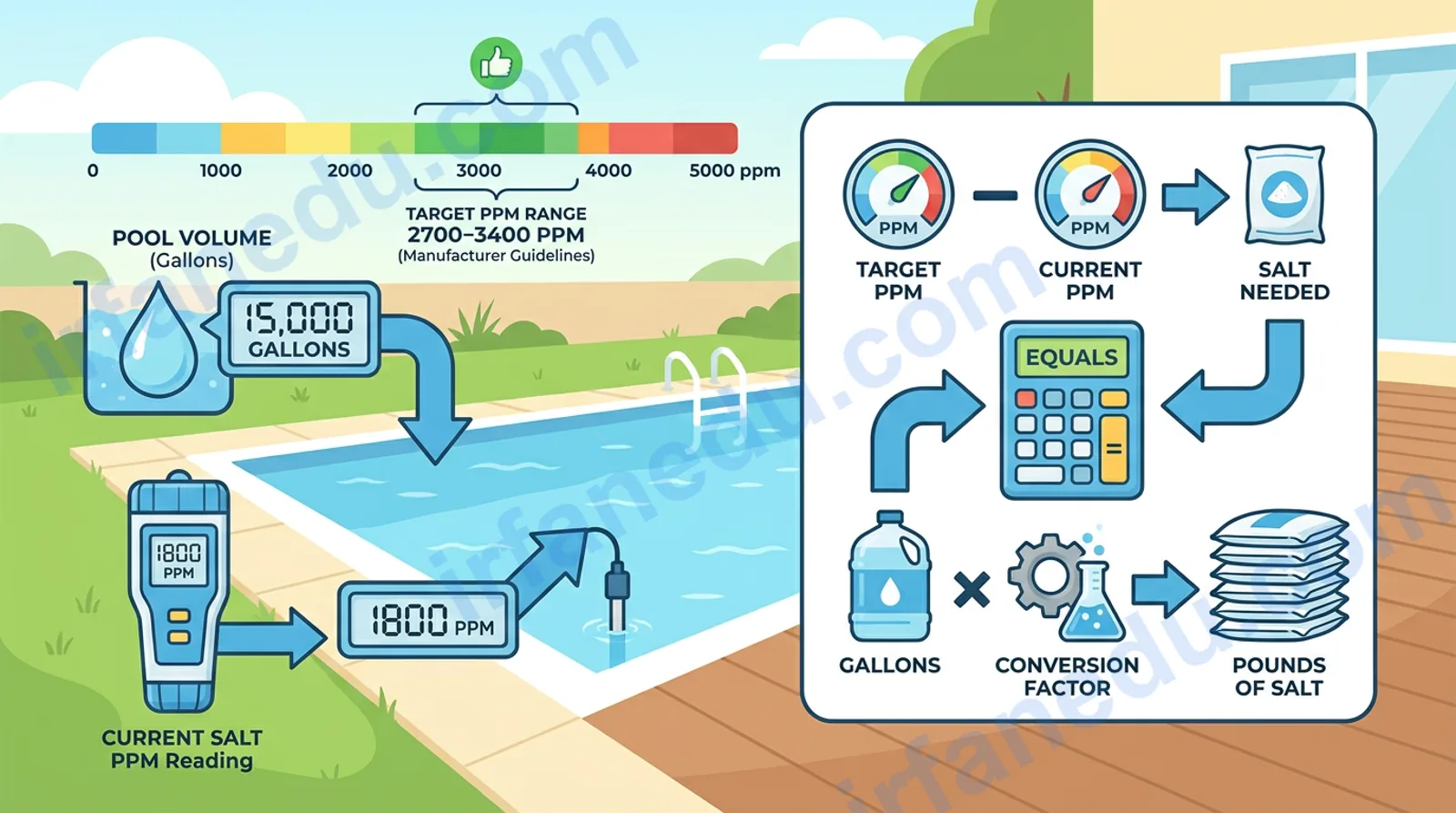
Here’s the part most people miss when converting to a saltwater pool: the amount of salt you need is not printed on the bag in a useful way. A 40 lb bag of pool salt says nothing about your pool’s size or current salt reading. Get it wrong and you either run your chlorinator at low efficiency — or you overshoot and corrode your equipment.
A pool salt calculator takes your pool’s volume in gallons, your current salt level in parts per million (ppm), and your target ppm, then returns the exact pounds of salt to add. The math is straightforward, but the inputs have to be right — especially your current salt reading.
In this guide you’ll get a fully working calculator, the formula behind it, two worked examples, and the one mistake I see pool owners make every single season.
What you’ll learn
- How to calculate pounds of salt for any US pool size
- The correct target ppm range for US salt chlorine generators
- Why your current salt reading matters more than anything else
- How to avoid over-salting (it’s harder to fix than under-salting)
| The Answer — How much salt does a pool need? |
|---|
| To calculate pool salt, subtract your current salt ppm from your target ppm (typically 3,200 ppm for most US chlorinators), multiply by your pool’s volume in gallons, divide by 1,000,000, then multiply by 8.34 (lbs per gallon of water). A 15,000-gallon pool starting at 0 ppm needs about 401 lbs of salt to reach 3,200 ppm. Always test first; add in batches; retest after 24 hours. |
Quick facts about saltwater pool salt levels
| Parameter | Value / Range |
|---|---|
| Ideal salt level (most US chlorinators) | 2,700 – 3,400 ppm |
| Sweet-spot target | 3,200 ppm |
| Minimum for chlorinator operation | ~2,500 ppm |
| Maximum safe level | 4,000 ppm |
| Salt type recommended | 99.8%+ pure NaCl (pool-grade) |
| Pounds of salt per 1,000 ppm per 10,000 gal | ~83.4 lbs |
| Saltwater pool salt taste threshold | ~3,500 ppm (barely perceptible) |
| Ocean water salt level (for comparison) | ~35,000 ppm |
Pool Salt Calculator
Enter your pool details below. Use US gallons and ppm.
e.g. 15000 — not sure? See volume formulas below
From a test strip or digital salt meter; enter 0 if brand new
Check your chlorinator manual; default is 3200 ppm
Step-by-step solution
How to use this calculator
- Find your pool volume in gallons. Use the formulas below if you don’t know it. Rectangular pools: Length (ft) × Width (ft) × Avg Depth (ft) × 7.48. Round pools: Diameter² × Avg Depth × 5.9.
- Test your current salt level. Use a digital salt meter or test strips. Do not skip this step — guessing your current level is the most common cause of over-salting.
- Enter your target ppm. Check your chlorinator’s manual. Most US brands (Hayward, Pentair, Jandy) recommend 3,200 ppm. The default is set to 3,200.
- Click Calculate. The result shows pounds needed, how many 40 lb or 50 lb bags to buy, and a numbered solution.
- Add salt in batches. Pour salt around the perimeter with the pump running. Brush undissolved granules off the floor. Retest after 24 hours before adding more.
What is salt ppm in a pool?
Salt ppm (parts per million) is the concentration of dissolved sodium chloride in your pool water. One ppm means one milligram of salt per liter of water — or, practically, one pound of salt dissolved in roughly 120,000 gallons. Your salt chlorine generator (chlorinator) uses electrolysis to split that dissolved salt into chlorine, which sanitizes the water, and then recombines it back into salt — so the salt level stays relatively stable over time.
The US EPA notes that sodium chloride is the same compound as table salt; at pool concentrations (around 3,200 ppm), the water tastes mildly salty — about one-tenth the salinity of the ocean. That’s why many swimmers find saltwater pools gentler on their eyes and skin than traditionally chlorinated pools.
The pool salt formula explained
The formula for calculating how many pounds of salt to add is derived from basic unit conversion:
  POOL SALT FORMULA
  ─────────────────────────────────────────────────────
  Pounds of Salt = (Target ppm − Current ppm)
                  × Pool Volume (gallons)
                  ÷ 1,000,000
                  × 8.34 (lbs per US gallon of water)
  ─────────────────────────────────────────────────────
  Why 8.34?  One US gallon of water weighs 8.34 lbs.
  Why ÷ 1,000,000?  ppm = mg per liter ≈ mg per ~264 gal
                    The factor converts ppm × gallons → lbs.
  ─────────────────────────────────────────────────────
| Symbol | Meaning | Unit |
|---|---|---|
| T | Target salt level | ppm |
| C | Current salt level | ppm |
| V | Pool volume | US gallons |
| 8.34 | Weight of one US gallon of water | lbs/gal |
| Lbs | Salt to add | pounds |
SI units note: If you prefer metric, replace 8.34 with 1.0 (kg per liter) and use liters instead of gallons. The ppm relationship holds: 1 ppm = 1 mg/L = 1 g per 1,000 L.
Worked examples
Example 1 — New pool, 20,000 gallons, starting from zero
Given: Pool volume = 20,000 gal, Current salt = 0 ppm, Target = 3,200 ppm
Step 1: Deficit = 3,200 − 0 = 3,200 ppm
Step 2: 3,200 × 20,000 ÷ 1,000,000 × 8.34 = 534.0 lbs
Step 3: 534 ÷ 40 = 13.35 → buy 14 bags (40 lb)
Example 2 — Existing pool after heavy rain, 12,000 gallons
Given: Pool volume = 12,000 gal, Current salt = 2,100 ppm (diluted by rain), Target = 3,200 ppm
Step 1: Deficit = 3,200 − 2,100 = 1,100 ppm
Step 2: 1,100 × 12,000 ÷ 1,000,000 × 8.34 = 110.1 lbs
Step 3: 110.1 ÷ 40 = 2.75 → buy 3 bags (40 lb)
Common mistakes when adding pool salt
| Mistake | What happens | Correct approach |
|---|---|---|
| Skipping the current salt test | You add too much or too little | Always test before calculating |
| Using rock salt or iodized salt | Cloudy water, cell damage | Use 99.8%+ pure pool-grade NaCl |
| Dumping all salt in one spot | Undissolved granules bleach the liner | Broadcast around perimeter; brush |
| Testing immediately after adding | Falsely low reading; you add more | Wait 24 hours with pump running |
| Ignoring the chlorinator manual | Wrong target ppm for your unit | Check the manual — targets vary by brand |
Saltwater vs. traditional chlorine: a quick comparison
| Factor | Saltwater pool | Traditional chlorine pool |
|---|---|---|
| Chlorine source | Generated on-site from salt via electrolysis | Added manually (tablets, liquid, granules) |
| Upfront cost | Higher (chlorinator unit: $500–$1,500+) | Lower (no generator needed) |
| Ongoing cost | Lower (salt is cheap; ~$10–$15 per 40 lb bag) | Higher (chlorine chemicals year-round) |
| Maintenance frequency | Monthly salt test; annual cell cleaning | Weekly chemical testing and dosing |
| Swimmer comfort | Gentler on eyes and skin at 3,200 ppm | Can cause irritation at high chlorine levels |
| Equipment corrosion risk | Higher if salt exceeds 4,000 ppm | Lower (no salt present) |
Most pool guides tell you to aim for 3,200 ppm and leave it there. What they don’t mention: your chlorinator’s efficiency curve matters more than hitting a single number. Hayward’s AquaRite, for example, runs at peak efficiency between 2,800 and 3,200 ppm — but Pentair’s IntelliChlor IC40 is rated for 3,000–3,500 ppm. Using the same target for both means one of them is always working harder than it needs to, shortening the cell’s lifespan. Before you run this calculator, pull up your chlorinator’s spec sheet and use its midpoint as your target — not the generic industry default. That one adjustment can add years to your cell.
In my experience helping families set up backyard pools, the biggest source of confusion is not the math — it’s trusting a test strip over a digital meter. Strips give you a ballpark; a digital salt meter (around $30–$50 at any pool supply store) gives you a reading accurate to within 200 ppm. For a calculation that directly affects your equipment’s lifespan, that precision is worth the investment. I always recommend testing twice with a digital meter before running the numbers.
Explore More Calculators on IrfanEdu
Quick quiz — test your knowledge
1. A 10,000-gallon pool has 0 ppm salt. You want to reach 3,200 ppm. Approximately how many pounds of salt do you need?
2. What is the maximum safe salt level for most US residential pools before equipment damage becomes a risk?
3. Why do you multiply by 8.34 in the pool salt formula?
Practice problems
Problem 1: A 25,000-gallon pool reads 1,500 ppm. Target is 3,200 ppm. How many pounds of salt are needed?
Deficit = 3,200 − 1,500 = 1,700 ppm
Lbs = 1,700 × 25,000 ÷ 1,000,000 × 8.34 = 354.5 lbs
Bags (40 lb): 354.5 ÷ 40 = 8.86 → buy 9 bags
Problem 2: An 8,000-gallon pool reads 2,900 ppm. The chlorinator manual says target is 3,400 ppm. How many pounds?
Deficit = 3,400 − 2,900 = 500 ppm
Lbs = 500 × 8,000 ÷ 1,000,000 × 8.34 = 33.4 lbs
That’s less than one 40 lb bag — add about 34 lbs from a bag and store the rest.
Frequently asked questions
How many pounds of salt do I need for a 15,000-gallon pool?
What is the ideal salt level for a saltwater pool?
Can I add too much salt to my pool?
What type of salt should I use in a saltwater pool?
How often do I need to add salt to my pool?
How do I calculate my pool’s volume in gallons?
Does rain affect my pool’s salt level?
Key takeaways
- The pool salt formula is: (Target ppm − Current ppm) × Gallons ÷ 1,000,000 × 8.34 = pounds of salt.
- Most US chlorinators target 2,700–3,400 ppm; 3,200 ppm is the standard default.
- Always test your current salt level with a digital meter before calculating — guessing causes over-salting.
- Over 4,000 ppm damages equipment; the only fix is draining and diluting.
- Use 99.8%+ pure pool-grade NaCl; avoid rock salt or iodized salt.
- Add salt with the pump running, brush to dissolve, and retest after 24 hours.
- Salt does not evaporate — you only need to top up after rain, draining, or a low test reading.
For more pool-related electrical calculations, see my kVA Calculator: Apparent Power Guide — useful if you’re sizing the electrical supply for a pool pump or heater.