
Indiana Permit Practice Test: Pass Your BMV Exam First Try
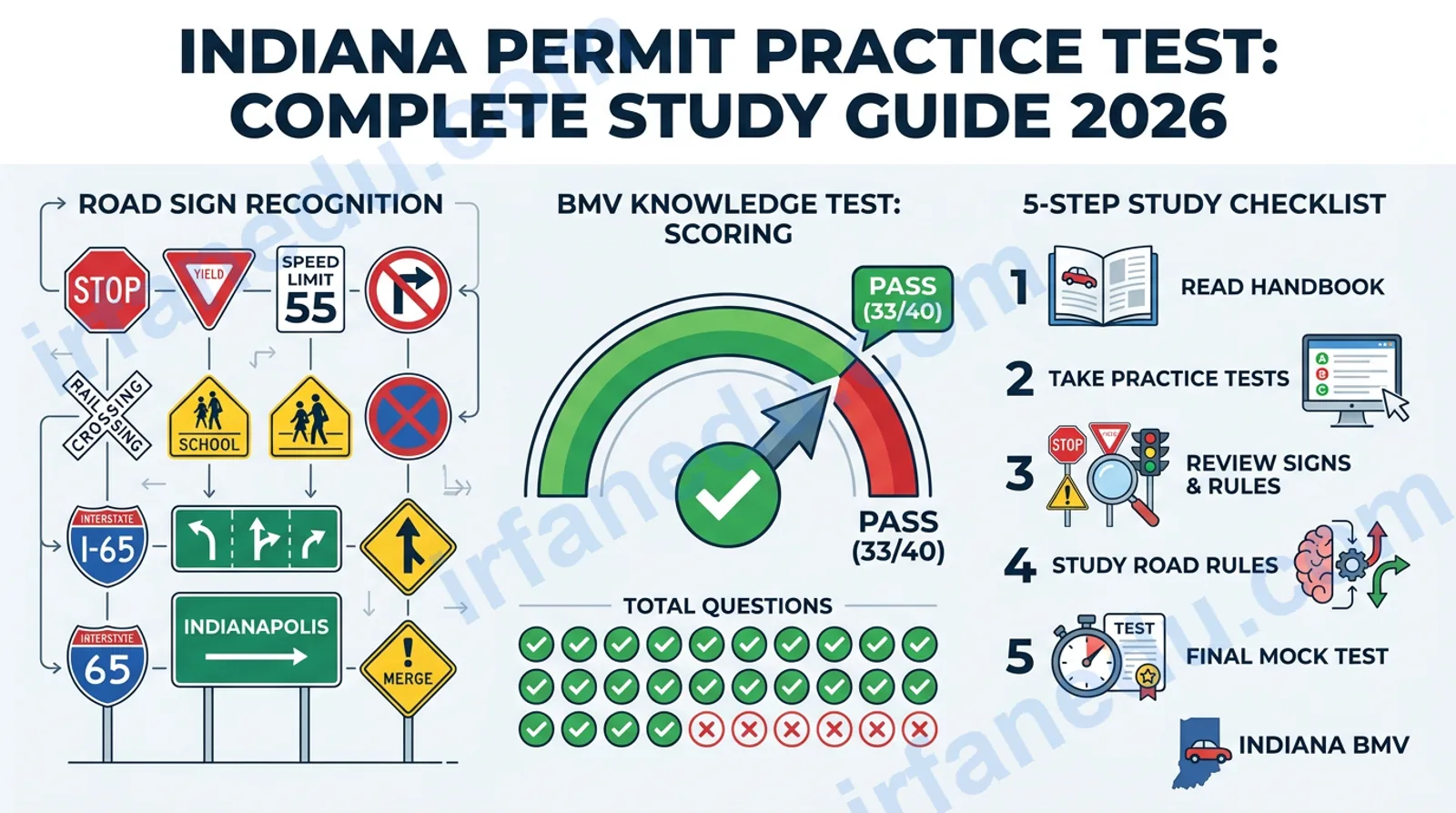
Failing the Indiana permit test is more common than most people expect — not because the material is hard, but because most first-timers study the wrong things. In my experience helping students prepare for licensing exams, the gap between passing and failing almost always comes down to one thing: whether you practiced with realistic, exam-style questions before you walked into the BMV.
The Indiana BMV knowledge test is a 40-question multiple-choice exam drawn directly from the Indiana Driver’s Manual. You need 33 correct answers (83%) to pass. Topics include traffic laws, road signs, right-of-way rules, and safe-driving practices. Most applicants who fail do so on road-sign questions — not traffic law — because they assume signs are obvious without studying them.
By the end of this guide, you will know exactly what the test covers, how to build a focused study plan, which road signs trip up the most test-takers, and how to use practice tests the right way. You will also get a short knowledge check to test yourself right now.
⚡ TL;DR
- The Indiana BMV knowledge test has 40 questions; pass mark is 33 (83%).
- Minimum age to apply for a learner’s permit is 15 years old.
- All questions come directly from the Indiana Driver’s Manual.
- Road signs account for roughly 30% of the exam — the most-failed category.
- Practice tests that match the real format are the most effective prep tool.
- You must take the test in person at an Indiana BMV branch — no online option.
Fact vs. Fiction: Common Permit Test Myths
Before diving into study strategies, clear out the misinformation. These myths cause real test failures every year.
| What People Believe (Fiction) | What Is Actually True (Fact) |
|---|---|
| You can take the Indiana permit test online from home. | As of 2026, the test must be taken in person at an Indiana BMV branch. No official remote option exists. |
| The test is mostly about traffic laws — signs are easy. | Road signs make up roughly 30% of the exam. Many applicants fail because they underestimate the sign section. |
| You need a perfect score to pass. | You need 33 out of 40 correct (83%). You can miss up to 7 questions and still pass. |
| Failing means you wait a month to retry. | You wait just one day after a first or second failure. A 30-day wait only applies after three failures in 12 months. |
| Any online practice test is good enough to prepare. | Only practice tests based on the current Indiana Driver’s Manual are reliable. Generic national tests include rules that differ from Indiana law. |
| You only need to study the night before. | Spaced practice over 5-7 days produces significantly better retention than a single cramming session. |
What Is the Indiana Permit Practice Test?
The Indiana permit practice test is an unofficial study tool that replicates the format and content of the real Indiana BMV knowledge exam. It is not administered by the BMV — it is a preparation resource.
The real exam is called the Indiana BMV Knowledge Test. It is a computer-based, 40-question multiple-choice test administered at any Indiana BMV branch. Every question is drawn from the Indiana Driver’s Manual, which the BMV publishes and updates periodically.
A good practice test mirrors the real exam in three ways: it uses the same question format, pulls from the same source material, and applies the same 83% pass threshold. When you score 90% or above on a quality practice test, you are genuinely ready for the real thing.
Who Needs to Take This Test?
Any Indiana resident who wants a learner’s permit must pass the knowledge test first. This applies to first-time drivers aged 15 and older, as well as adults who are new to Indiana and need to convert a foreign or out-of-state license under certain conditions. Check the Indiana BMV website for your specific situation.
What Does the Indiana BMV Knowledge Test Cover?
The Indiana BMV knowledge test draws all questions from the Indiana Driver’s Manual. The content falls into three broad areas, each with a different weight on the exam.
Based on the manual’s chapter structure and widely reported test experiences, here is how the content typically breaks down:
| Topic Area | Approx. % of Exam | Key Subtopics |
|---|---|---|
| Road Signs & Signals | ~30% | Sign shapes, colors, regulatory vs. warning vs. informational signs, traffic signals |
| Traffic Laws & Right-of-Way | ~40% | Speed limits, passing rules, right-of-way at intersections, school zones, railroad crossings |
| Safe Driving Practices | ~30% | Following distance, impaired driving, distracted driving, seat belts, sharing the road |
Traffic laws carry the most weight, but road signs are where most applicants lose points. The reason is simple: people assume they already know signs from daily life. In reality, many signs have specific legal meanings that differ from what you might guess by looking at them.
How to Study for the Indiana Permit Test: Step-by-Step
This five-step plan takes most students from zero preparation to exam-ready in about one week. Each step builds on the last.
-
Download the Official Indiana Driver’s Manual. Get it directly from the Indiana BMV website (in.gov/bmv). This is the only source the test draws from. Read it cover to cover once — do not skip the appendix on road signs.
-
Study Road Signs by Shape and Color First. Before memorizing individual signs, learn the system: octagons always mean stop, triangles mean yield, yellow diamonds mean warning. Once you know the system, individual signs become much easier to remember.
-
Take a Diagnostic Practice Test. Without studying anything else, take one full 40-question practice test. Your score tells you which topics need the most work. Focus your reading time on those chapters.
-
Do Timed Practice Tests Daily for 5 Days. Take one full practice test each day under real conditions: 40 questions, no manual open, time yourself. After each test, read the explanation for every wrong answer — not just the correct one.
-
Book Your BMV Appointment When You Score 90%+ Consistently. Schedule online at the Indiana BMV portal. Bring all required documents. Arrive 15 minutes early so you are calm, not rushed.
 INDIANA PERMIT TEST — 7-DAY STUDY SCHEDULE
 ─────────────────────────────────────────────────────
 Day 1 │ Read Manual (Chapters 1-3) + Diagnostic test
 Day 2 │ Read Manual (Chapters 4-6: Road Signs focus)
 Day 3 │ Practice Test #1 → Review all wrong answers
 Day 4 │ Practice Test #2 → Focus on weakest topic
 Day 5 │ Practice Test #3 → Aim for 90%+
 Day 6 │ Quick sign flashcard review + Practice Test #4
 Day 7 │ Light review only — rest, sleep well, test day
 ─────────────────────────────────────────────────────
 Target: Score 90%+ on practice before booking real exam
How to Master Road Signs Fast
Road signs are the most-failed section of the Indiana permit test, and the fix is simpler than most guides suggest: learn the sign language system, not individual signs.
Every road sign in the United States follows a standardized shape-and-color code established by the Federal Highway Administration (FHWA). Once you know this code, you can make an educated guess about any sign you have never seen before.
Sign Shape Quick Reference
- Octagon (8 sides): Stop — always and only.
- Triangle (inverted): Yield — always and only.
- Diamond: Warning — something requires caution ahead.
- Rectangle (vertical): Regulatory — speed limits, turn restrictions.
- Rectangle (horizontal): Guide or informational — distances, directions.
- Pentagon (5 sides, pointing up): School zone or school crossing.
- Circle: Railroad advance warning.
Color adds a second layer of meaning. Red means prohibition (stop, do not enter, wrong way). Yellow means general warning. Orange means construction or work zone. Green means guide information. Blue means motorist services (gas, food, hospital).
When a practice test question shows an unfamiliar sign, apply shape first, then color. You will get the right answer category even if you have never seen that exact sign before.
Practice Test vs. Real BMV Exam: Key Differences
Not all practice tests are equal. Understanding how they differ from the real exam helps you choose the right resource and set realistic expectations.
| Feature | Quality Practice Test | Real Indiana BMV Exam |
|---|---|---|
| Number of Questions | 40 (mirrors real exam) | 40 |
| Pass Mark | 33/40 (83%) — same threshold | 33/40 (83%) |
| Source Material | Indiana Driver’s Manual (current edition) | Indiana Driver’s Manual (current edition) |
| Immediate Feedback | Yes — explanation shown after each answer | No — score shown at end only |
| Retake Limit | Unlimited — practice as many times as you want | Wait 1 day after failure (30 days after 3 failures) |
| Cost | Free (most reputable sites) | Included in permit application fee |
| Location | Any device, anywhere | In person at Indiana BMV branch only |
The biggest practical advantage of practice tests is the immediate, question-level feedback. The real exam tells you only your final score. Practice tests tell you exactly which questions you got wrong and why — which is the only feedback loop that actually improves your knowledge.
Most guides tell you to “read the manual.” Here is what they miss.
The Indiana Driver’s Manual is organized by topic, but the BMV test is not. Questions are drawn from across the entire manual and presented in random order. This means reading the manual linearly gives you knowledge in the wrong sequence for how your brain will be tested. A more effective method: after reading each chapter, immediately write down the three most testable facts from that chapter in your own words. This forces active recall — the same cognitive process the test demands — rather than passive recognition. In my experience, students who do this score 8-12 percentage points higher on their first practice test than those who read without pausing to self-test.
I have seen students spend hours reading the manual and still fail the practice test, while others who spent 90 minutes on targeted practice questions passed the real exam on the first try. The difference is not effort — it is method. Reading is passive. Testing yourself is active. My honest recommendation: spend no more than 40% of your study time reading, and at least 60% answering practice questions and reviewing your wrong answers. The test does not reward recognition; it rewards recall under pressure. Practice tests train exactly that skill.
Quick Knowledge Check
Select an answer, then reveal the explanation. No score is tracked — this is just for your own review.
1. How many questions are on the Indiana BMV knowledge test, and how many must you answer correctly to pass?
Reveal Answer
2. An octagonal (8-sided) red sign always means what?
Reveal Answer
3. What is the minimum age to apply for an Indiana learner’s permit?
Reveal Answer
Frequently Asked Questions
How many questions are on the Indiana permit test?
How old do you have to be to take the Indiana permit test?
Can I take the Indiana permit test online?
What happens if I fail the Indiana permit test?
What documents do I need for the Indiana learner’s permit?
Key Takeaways
- The Indiana BMV knowledge test is 40 questions; you need 33 correct (83%) to pass.
- Minimum age for a learner’s permit is 15 years old.
- All questions come from the Indiana Driver’s Manual — that is your primary study source.
- Road signs (~30% of the exam) are the most-failed section; learn sign shapes and colors as a system.
- Practice tests with question-level feedback are more effective than re-reading the manual.
- After a first or second failure, you wait just one day to retake; a 30-day wait only applies after three failures in 12 months.
- The test is in person only — no official online option exists as of 2026.
- Score 90%+ consistently on practice tests before booking your real BMV appointment.
Sources & References
- Indiana Bureau of Motor Vehicles (BMV) — Getting Your First License. Official Indiana state government resource covering knowledge test requirements, eligibility, and document checklist. (in.gov)
- Federal Highway Administration — Manual on Uniform Traffic Control Devices (MUTCD). The national standard that defines road sign shapes, colors, and meanings used in the Indiana Driver’s Manual. (fhwa.dot.gov)
- Wikipedia — Graduated Driver Licensing. Background on the GDL system that governs Indiana’s learner’s permit and probationary license stages.
Editorial note: This article was written and fact-checked by Dr. Irfan Mansuri in August 2026. BMV policies and fees can change — always verify current requirements at the official Indiana BMV website before your appointment.