
CrCl Calculator: Creatinine Clearance in Seconds 🧪
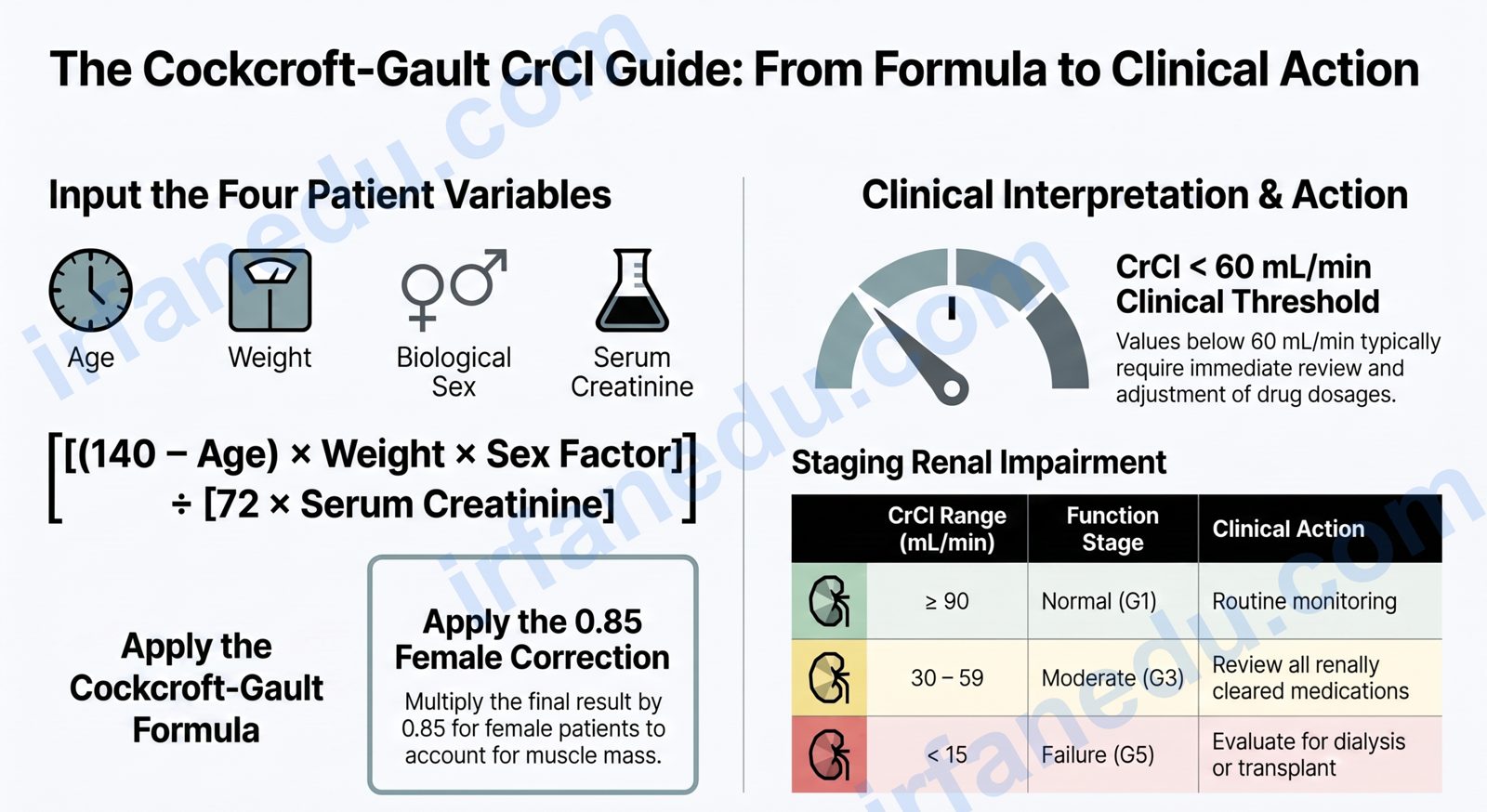
“Your kidneys don’t announce when they’re struggling — but a single number can tell you everything.” That number is creatinine clearance (CrCl), and this calculator gives it to you in seconds.
CrCl measures how efficiently your kidneys filter creatinine — a muscle-metabolism waste product — out of the blood. Clinicians use it daily to decide whether a drug dose is safe, whether a patient needs dialysis, and how far kidney disease has progressed. This page gives you a fully working calculator, the complete Cockcroft-Gault formula, two worked examples, and a plain-English explanation of every variable.
CrCl (creatinine clearance) is estimated using the Cockcroft-Gault equation: CrCl = [(140 − Age) × Weight × (0.85 if female)] ÷ (72 × Serum Creatinine). The result, in mL/min, reflects how well the kidneys filter waste. A normal CrCl is roughly 90–120 mL/min; values below 60 mL/min suggest chronic kidney disease and often require drug-dose adjustments.
- 🧮 CrCl uses age, weight, serum creatinine, and sex — nothing else.
- 📐 Formula: [(140 − Age) × Weight × sex factor] ÷ (72 × SCr).
- 🟢 Normal range: 90–120 mL/min for healthy adults.
- 💊 Below 60 mL/min: many drugs need dose reduction.
- ⚠️ Use adjusted body weight in obese patients to avoid overestimating CrCl.
- 🔬 CrCl ≠ eGFR — they serve different clinical purposes.
CrCl Calculator
Cockcroft-Gault Equation — instant creatinine clearance
Fill in all four fields, then click Calculate.
Biological sex
How to use this CrCl calculator
- Enter age — the patient’s age in whole years.
- Enter body weight — use actual body weight in kg for most patients; use adjusted body weight for obese patients (see the common-mistakes section below).
- Enter serum creatinine — the lab value in mg/dL from a recent blood test.
- Select biological sex — male or female (the formula applies a 0.85 correction factor for females).
- Click Calculate — the result appears instantly with a step-by-step breakdown and an interpretation of the CrCl range.
Quick facts about creatinine clearance
| Parameter | Detail |
|---|---|
| Full name | Creatinine Clearance (CrCl) |
| Standard equation | Cockcroft-Gault (1976) |
| Unit of measurement | mL/min |
| Normal adult range | 90–120 mL/min |
| CKD threshold | < 60 mL/min for ≥ 3 months |
| Primary clinical use | Drug dosing in renal impairment |
| Female sex factor | × 0.85 (lower muscle mass) |
| Key limitation | Less accurate in obesity, elderly, extremes of muscle mass |
What is creatinine clearance (CrCl)?
Creatinine clearance is the volume of blood the kidneys completely clear of creatinine per minute. It is a reliable proxy for the glomerular filtration rate (GFR) — the gold-standard measure of kidney function. Creatinine is a waste product of normal muscle metabolism; healthy kidneys filter it out continuously, so a falling CrCl is an early warning sign of declining kidney health.
The Cockcroft-Gault equation, published in 1976, remains the most widely used formula for estimating CrCl in clinical practice — especially for calculating drug doses — because it is simple, requires only routine lab values, and has been validated across large patient populations.
The Cockcroft-Gault formula explained
CrCl (mL/min) =
  [(140 − Age) × Weight × (0.85 if female)]
  ─────────────────────────────────────────
           72 × Serum Creatinine
| Symbol | Meaning | Unit |
|---|---|---|
| Age | Patient’s age | Years |
| Weight | Body weight (actual or adjusted) | kg |
| 0.85 | Sex correction factor for females | Dimensionless |
| SCr | Serum creatinine | mg/dL |
| CrCl | Creatinine clearance | mL/min |
| 72 | Empirical constant (unit correction) | Dimensionless |
The numerator captures how much creatinine the body produces: production falls with age (hence 140 − Age) and rises with muscle mass (hence weight). The denominator normalizes for the serum creatinine concentration. A higher serum creatinine means the kidneys are clearing it more slowly, so CrCl drops.
Worked examples: step-by-step CrCl calculations
Patient: 58-year-old male, 80 kg, serum creatinine 1.0 mg/dL.
- 140 − 58 = 82
- 82 × 80 kg = 6,560
- Sex factor: male → × 1.0 = 6,560
- Denominator: 72 × 1.0 = 72
- CrCl = 6,560 ÷ 72 = 91.1 mL/min ✅ Normal kidney function
Patient: 72-year-old female, 60 kg, serum creatinine 1.4 mg/dL.
- 140 − 72 = 68
- 68 × 60 kg = 4,080
- Sex factor: female → × 0.85 = 3,468
- Denominator: 72 × 1.4 = 100.8
- CrCl = 3,468 ÷ 100.8 = 34.4 mL/min 🟠 Moderately reduced — many drugs need dose adjustment
  CrCl (mL/min)   Kidney Function Stage
  ─────────────────────────────────────────────────
  ≥ 90            ██████████████  Normal (G1)
  60 – 89         ████████████    Mildly reduced (G2)
  30 – 59         ████████        Moderately reduced (G3)
  15 – 29         ████            Severely reduced (G4)
  < 15            ██              Kidney failure (G5)
  ─────────────────────────────────────────────────
  Drug dose adjustment typically starts at < 50 mL/min
CrCl vs eGFR: which one should you use?
This is one of the most common points of confusion in clinical practice. CrCl and eGFR both estimate kidney filtration, but they are calculated differently and used for different purposes.
| Feature | CrCl (Cockcroft-Gault) | eGFR (CKD-EPI) |
|---|---|---|
| Primary use | Drug dosing | CKD diagnosis & staging |
| Variables used | Age, weight, SCr, sex | Age, SCr, sex, race (older versions) |
| Output | mL/min (not normalized) | mL/min/1.73 m² (body-surface normalized) |
| Accuracy in obesity | Overestimates — use adjusted weight | More stable (normalized to BSA) |
| Accuracy in elderly | Can overestimate if SCr is low | Better validated in elderly |
| Regulatory standard for drug labels | Yes (FDA guidance) | Increasingly used (post-2022 FDA guidance) |
In my experience reviewing pharmacokinetics content, students often assume eGFR and CrCl are interchangeable. They are not. The FDA still recommends Cockcroft-Gault for most drug-dosing decisions, while nephrologists prefer CKD-EPI eGFR for staging kidney disease. Knowing which to use — and why — is a key clinical skill.
CrCl and CKD staging: a side-by-side reference
| CrCl (mL/min) | CKD Stage | Description | Typical action |
|---|---|---|---|
| ≥ 90 | G1 | Normal or high | Monitor if other CKD markers present |
| 60 – 89 | G2 | Mildly decreased | Monitor; lifestyle review |
| 45 – 59 | G3a | Mild–moderate decrease | Review all medications |
| 30 – 44 | G3b | Moderate–severe decrease | Dose-adjust most renally cleared drugs |
| 15 – 29 | G4 | Severely decreased | Prepare for renal replacement therapy |
| < 15 | G5 | Kidney failure | Dialysis or transplant evaluation |
A "normal" serum creatinine does not mean normal kidney function in elderly patients. Because creatinine production falls as muscle mass declines with age, an 80-year-old woman with a serum creatinine of 0.8 mg/dL might have a CrCl of only 35–40 mL/min
Sources & References
Written and fact-checked by Dr Irfan Mansuri. External links open in a new tab and are provided for further reading and verification.