
🏡 Vinyl Fence Installation Cost Calculator — 7 Things Nobody Tells You
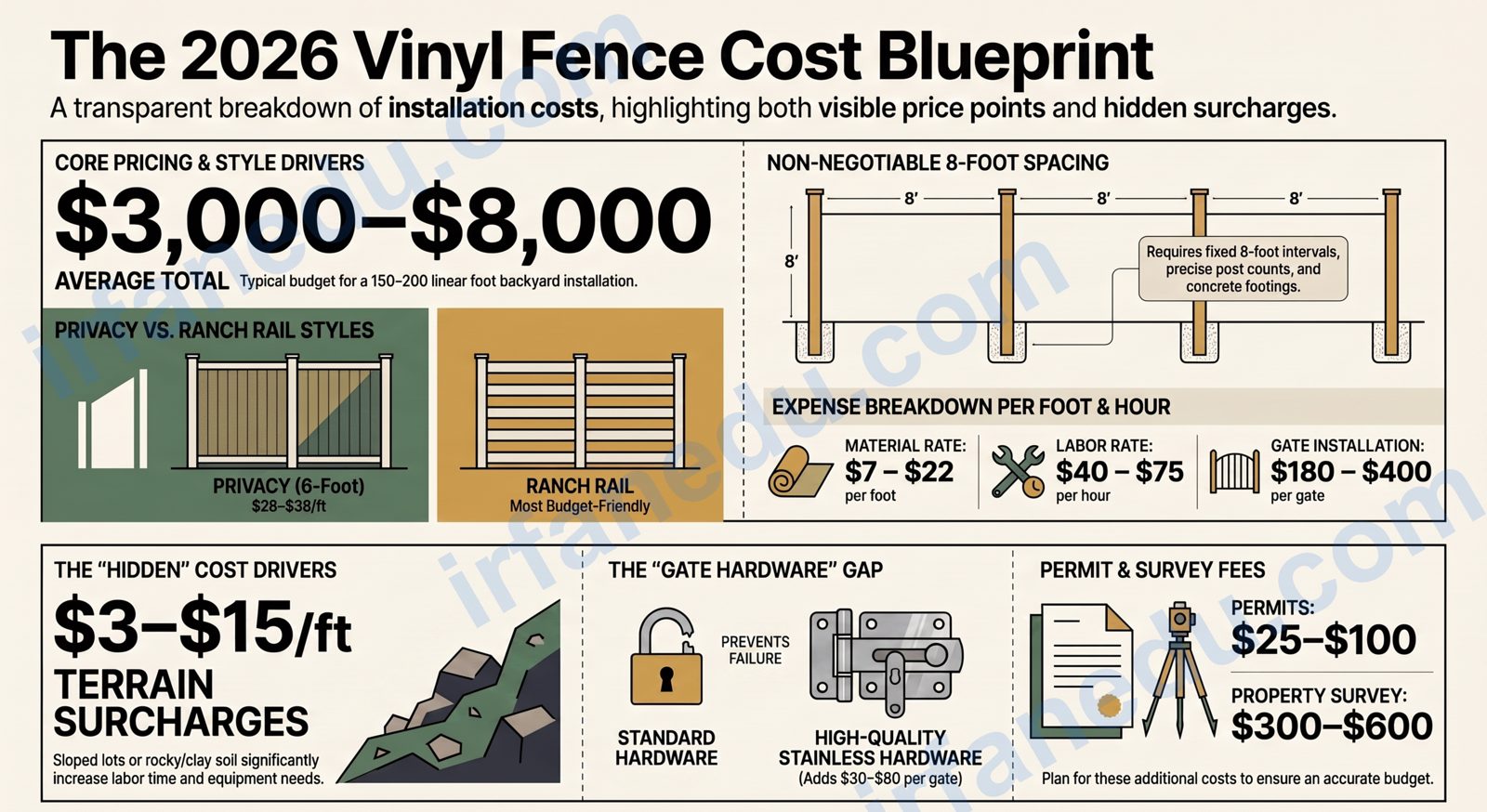
Most online vinyl fence cost guides give you a single number — “$20–$40 per foot” — and call it a day. That number is real, but it hides seven cost drivers that can swing your final bill by thousands of dollars. I’ve seen homeowners budget $4,000 and get a $7,200 invoice because nobody warned them about post spacing, gate hardware, or sloped-lot surcharges.
Use the calculator below to get a project-specific estimate in seconds. Then read the seven things nobody tells you — because knowing them before you call a contractor is worth real money.
Vinyl fence installation costs $20–$40 per linear foot installed, or roughly $3,000–$8,000 for a typical 150–200 ft backyard. A 6-foot privacy fence averages $28–$38/ft. Total cost depends on fence style, height, number of gates, ground conditions, and local labor rates. Use the calculator below for a project-specific estimate.
Vinyl Fence Installation Cost Calculator
Enter your project details — get an instant cost estimate with step-by-step breakdown
How to use this vinyl fence cost calculator
The calculator gives you a project-specific estimate in under 30 seconds. Here’s exactly what to do:
- Choose Basic or Detailed mode. Basic is fine for a quick ballpark. Detailed lets you add slope surcharges and old fence removal.
- Enter your total linear footage. Measure the perimeter of the area you want to fence, minus any openings for gates. Not sure? A standard 50×50 ft backyard = 200 linear feet minus gate openings.
- Select your fence style. Privacy fences are the most popular and most expensive. Ranch rail is the cheapest.
- Enter the number of gates. Each gate adds $180–$400 to the total.
- Enter your local labor rate (optional). Leave it at 0 to use the $55/hr national average. Check local contractor quotes to refine this.
- Click Calculate. You’ll see the total cost, a per-foot rate, an estimated post count, and a numbered step-by-step breakdown.
What is vinyl fence installation cost — and how is it calculated?
Vinyl fence installation cost is the total amount you pay to have a vinyl fence fully installed on your property, including materials, posts, gates, and labor. It is expressed as a cost per linear foot or as a total project cost.
The core formula the calculator uses is:
  ┌─────────────────────────────────────────────────────────────┐
  │  VINYL FENCE TOTAL COST FORMULA                             │
  │                                                             │
  │  Total Cost =                                               │
  │    (Length × Material Rate)                                 │
  │  + (Length × Labor Hrs/ft × Labor Rate)                     │
  │  + (Gates × Gate Cost)                                      │
  │  + (Length × Slope Surcharge)   ← if lot is not flat        │
  │  + Old Fence Removal Fee        ← if applicable             │
  │                                                             │
  │  Cost per foot = Material Rate + (Labor Hrs/ft × Labor Rate)│
  └─────────────────────────────────────────────────────────────┘
Variables and symbols table
| Variable | Meaning | Typical Range (US, 2026) |
|---|---|---|
| Length | Total linear feet of fence | 50–500 ft (most yards: 100–250 ft) |
| Material Rate | Cost of vinyl panels + posts + caps per linear foot | $7–$22/ft depending on style |
| Labor Hrs/ft | Installer time per linear foot | 0.13–0.22 hrs/ft |
| Labor Rate | Contractor hourly rate | $40–$75/hr (avg ~$55) |
| Gate Cost | Installed cost per gate (panel + hardware + labor) | $180–$400/gate |
| Slope Surcharge | Extra cost per foot for sloped ground | $3–$15/ft |
| Removal Fee | Flat fee to tear out old fence | $300–$800 typical |
Post spacing is set every 8 feet for vinyl (unlike wood which can go 6–10 ft). This means a 160-ft fence needs roughly 21 posts. Each post requires a concrete footing — that’s a meaningful chunk of your labor cost that many online calculators ignore.
Worked examples — matching the calculator’s steps
Scenario: 120 linear feet of 6-ft privacy fence, 1 gate, flat lot, $55/hr labor.
- Material cost: 120 ft × $18/ft (avg) = $2,160
- Labor cost: 120 ft × 0.22 hrs/ft × $55/hr = $1,452
- Gate cost: 1 × $320 = $320
- Slope surcharge: $0 (flat lot)
- Total: $3,932 (range ~$3,460–$4,522)
Scenario: 240 linear feet of semi-privacy fence, 2 gates, sloped lot (+$6/ft), $60/hr labor, old wood fence removal ($500).
- Material cost: 240 ft × $14.50/ft (avg) = $3,480
- Labor cost: 240 ft × 0.18 hrs/ft × $60/hr = $2,592
- Gate cost: 2 × $260 = $520
- Slope surcharge: 240 ft × $6/ft = $1,440
- Removal fee: $500
- Total: $8,532 (range ~$7,508–$9,812)
Scenario: 80 linear feet of picket fence, no gates, DIY install (labor rate $0 — materials only).
- Material cost: 80 ft × $11/ft (avg) = $880
- Labor cost: $0 (DIY)
- Gate cost: $0
- Total materials only: $880 — you save ~$960 in labor vs. hiring a pro.
In my experience researching home improvement costs, the single biggest budget shock I see homeowners face is the gate. Most people price one gate, then realize they need a double drive gate for the car — which costs 2–3× more. Price your gates first, then work backward to the fence panels. It changes the math significantly.
7 things nobody tells you about vinyl fence installation cost
These are the cost drivers that most guides bury in a footnote — or skip entirely. Knowing them before you get quotes puts you in control.
1. 🪨 Rocky or clay soil adds $5–$15 per linear foot
Post-setting is the hardest part of vinyl fence installation. In sandy or loamy soil, a crew drills post holes in minutes. In rocky ground or heavy clay, they may need a hydraulic auger or even hand-digging — and that time shows up on your invoice. Always ask your contractor: “What’s your surcharge for difficult soil?”
2. 📐 Post spacing is fixed at 8 feet — not negotiable
Vinyl panels are manufactured in 8-foot sections. Unlike wood, you cannot adjust spacing to reduce post count. A 160-ft fence needs exactly 21 posts. Each post needs a concrete footing that cures for 24–48 hours. This is why vinyl installation takes longer than it looks.
3. 🌡️ Temperature affects installation timing and cost
Vinyl expands and contracts more than wood. Installers must leave expansion gaps at posts, especially in climates with large temperature swings. If a contractor skips this step, your fence will buckle in summer. In cold climates, winter installation may carry a premium of $2–$5/ft.
4. 🏛️ Permit fees are rarely included in contractor quotes
Most US municipalities require a fence permit. The fee is usually $25–$100, but the contractor’s quote almost never includes it. You pay it separately. Some areas also require a survey to confirm property lines — that’s another $300–$600 if you don’t already have a recent survey on file.
5. 🔩 Gate hardware quality varies wildly
The gate is the part of your fence that moves every day. Cheap gate hardware (hinges, latches, drop rods) fails within 3–5 years. Quality stainless or galvanized hardware adds $30–$80 per gate but lasts the life of the fence. Always ask what hardware
Sources & References
Written and fact-checked by Dr Irfan Mansuri. External links open in a new tab and are provided for further reading and verification.