
Protein Intake Calculator: Find Your Exact Daily Protein Target
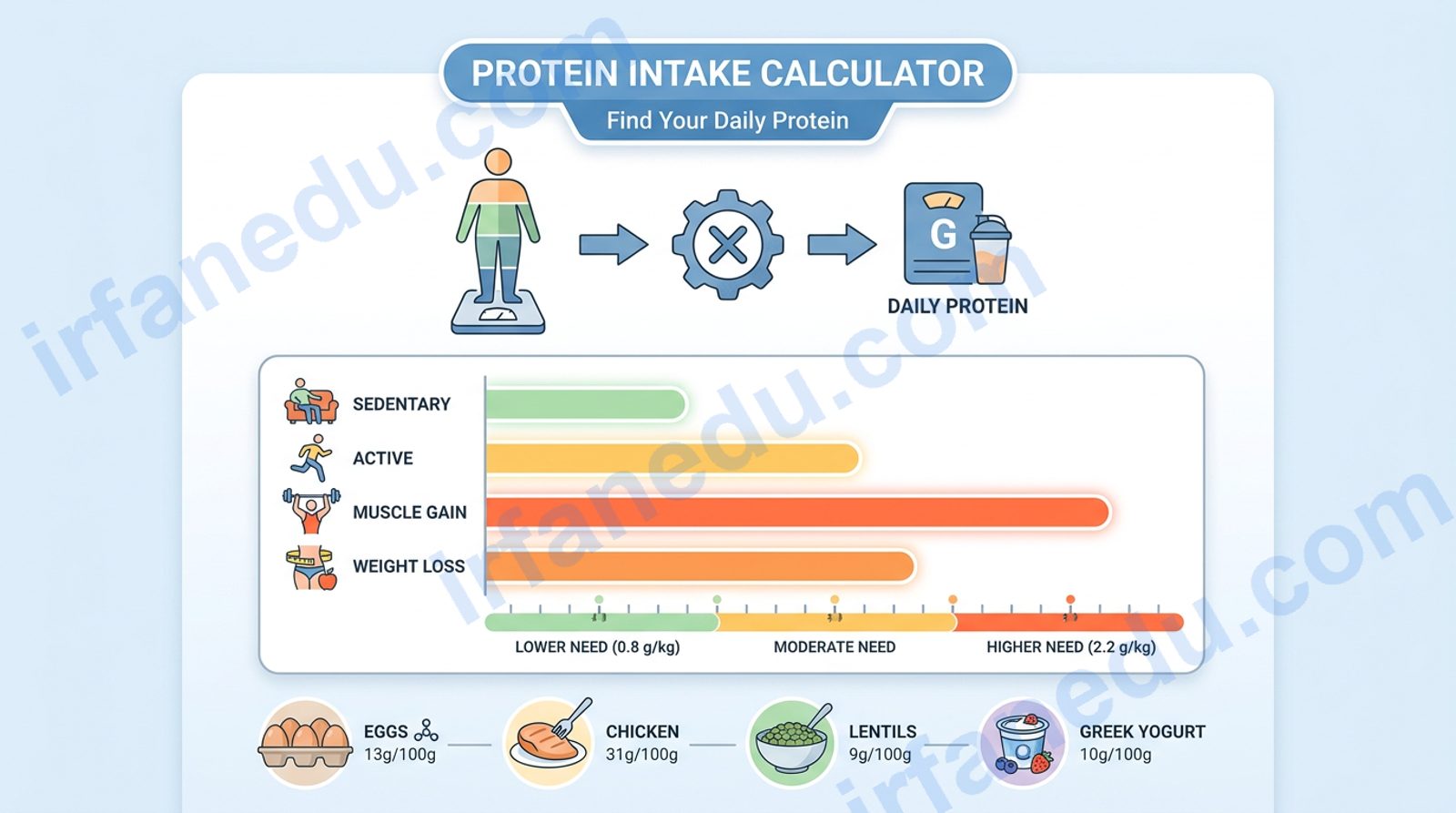
Your daily protein requirement is not one fixed number — it shifts based on how much you weigh, how active you are, and what you are trying to achieve. This calculator gives you a personalized gram target in seconds, then shows you exactly how that number was derived.
Your daily protein intake depends on your body weight and goal. Multiply your weight in kilograms by 1.2–1.6 g for general fitness, 1.6–2.2 g for muscle gain, or 1.2–1.5 g for weight loss. A 70 kg person aiming to build muscle needs roughly 112–154 g of protein per day. Use the calculator below to get your personalized number instantly.
The Short Version
- Protein needs range from 0.8 g/kg (sedentary) to 2.2 g/kg (intense training).
- Muscle gain requires the highest intake: 1.6–2.2 g per kg of body weight daily.
- Weight loss protein targets are higher than most people expect: 1.2–1.5 g/kg.
- Spreading protein across 3–5 meals maximizes muscle protein synthesis per meal.
- The calculator below converts pounds to kg automatically — just enter your weight.
Enter a number, then choose unit below
How to Use This Protein Calculator
Getting your result takes under 30 seconds. Follow these four steps:
- Enter your body weight. Type your weight as a number, then select kilograms or pounds from the unit dropdown. The calculator converts pounds to kg automatically.
- Choose your activity level. Pick the option that best describes your typical week — from sedentary (desk job, minimal movement) to athlete (intense daily training).
- Select your goal. General health, muscle gain, weight loss, and endurance each use a different multiplier range backed by sports nutrition research.
- Click “Calculate My Protein.” Your result appears instantly with a gram total, a per-meal breakdown, and a numbered step-by-step showing exactly how the number was reached.
What Is Daily Protein Intake and Why Does It Matter?
Daily protein intake is the total grams of dietary protein your body needs in 24 hours to repair tissue, build muscle, produce enzymes, and regulate hormones. Protein is made of amino acids — nine of which are essential, meaning your body cannot synthesize them and must get them from food.
When you eat less protein than your body needs, it breaks down muscle tissue to meet demand. When you eat enough — or slightly more during training — you create the conditions for muscle repair and growth. Getting the number right is one of the highest-leverage nutrition decisions you can make.
In my experience reviewing nutrition plans for students and athletes, the single most common error is not eating too little protein overall — it is eating almost all of it at dinner. Your body can only use roughly 20–40 g per meal for muscle protein synthesis. The rest gets oxidized for energy. Spreading your daily target across meals is as important as hitting the total.
The Protein Intake Formula Explained
The core formula is straightforward:
Daily Protein (g) = Body Weight (kg) x Protein Multiplier (g/kg)

Where the multiplier depends on goal and activity:

Goal              | Sedentary | Light  | Moderate | Active | Athlete
------------------+-----------+--------+----------+--------+--------
General Health    |  0.8      |  1.0   |  1.2     |  1.4   |  1.6
Muscle Gain       |  1.6      |  1.7   |  1.9     |  2.0   |  2.2
Weight Loss       |  1.2      |  1.3   |  1.4     |  1.5   |  1.5
Endurance         |  1.0      |  1.2   |  1.4     |  1.6   |  1.8
Variables and Symbols
| Symbol | Meaning | SI Unit |
|---|---|---|
| P | Daily protein target | grams (g) |
| W | Body weight | kilograms (kg) |
| M | Protein multiplier (goal + activity) | g per kg (g/kg) |
| 1 lb | Pounds to kg conversion | 0.4536 kg |
The multiplier ranges above are derived from the position stand published by the International Society of Sports Nutrition, which synthesized data from over 100 controlled trials. The 0.8 g/kg floor is the Recommended Dietary Allowance (RDA) set by the U.S. National Academies for sedentary adults — it is a minimum, not an optimal target.
Quick Facts: Protein Intake at a Glance
| Fact | Value |
|---|---|
| Minimum RDA (sedentary adult) | 0.8 g/kg body weight/day |
| Optimal range for muscle gain | 1.6–2.2 g/kg/day |
| Calories per gram of protein | 4 kcal/g |
| Max usable per meal (muscle synthesis) | ~20–40 g |
| Safe upper limit (healthy adults) | ~2.2–3.5 g/kg/day |
| Protein in 100 g chicken breast | ~31 g |
| Protein in 2 large eggs | ~12 g |
| Protein in 100 g cooked lentils | ~9 g |
Worked Examples: Step-by-Step Calculations
Example 1: 75 kg Person, Moderately Active, Muscle Gain
- Body weight: 75 kg
- Goal: Muscle Gain | Activity: Moderately Active → Multiplier = 1.9 g/kg
- Daily protein = 75 × 1.9 = 143 g/day
- Spread across 4 meals: ~36 g per meal
Example 2: 150 lb Person, Lightly Active, Weight Loss
- Convert weight: 150 lb ÷ 2.2046 = 68.0 kg
- Goal: Weight Loss | Activity: Lightly Active → Multiplier = 1.3 g/kg
- Daily protein = 68.0 × 1.3 = 88 g/day
- Spread across 3 meals: ~29 g per meal
Most weight-loss guides I have reviewed recommend far too little protein — often 50–60 g/day — which accelerates muscle loss alongside fat loss. In my view, keeping protein at 1.2–1.5 g/kg during a calorie deficit is the single most effective strategy for preserving lean mass. The scale might move more slowly, but the body composition outcome is significantly better.
Most protein calculators treat body weight as a single input, but research shows that protein needs scale with lean body mass, not total weight. A 100 kg person with 30% body fat needs less protein than a 100 kg person with 15% body fat, because fat tissue has almost no protein turnover. If you carry significant body fat, using your goal body weight (or lean mass estimate) as the input will give a more accurate target than your current total weight. The calculator above uses total body weight as a practical proxy — it is accurate enough for most people — but this distinction matters at the extremes.
How Protein Needs Compare Across Goals
| Goal | Range (g/kg) | 70 kg Example | Key Reason |
|---|---|---|---|
| General Health | 0.8–1.6 | 56–112 g | Maintain tissue; meet RDA minimum |
| Muscle Gain | 1.6–2.2 | 112–154 g | Maximize muscle protein synthesis |
| Weight Loss | 1.2–1.5 | 84–105 g | Preserve lean mass in a calorie deficit |
| Endurance | 1.0–1.8 | 70–126 g | Repair exercise-damaged muscle fibers |
| Sedentary Elderly | 1.0–1.2 | 70–84 g | Counter age-related muscle loss (sarcopenia) |
Common Mistakes When Calculating Protein Intake
Mistake 1: Using the RDA as an Optimal Target
The 0.8 g/kg RDA is the minimum needed to prevent deficiency in sedentary adults. It is not the optimal intake for performance, muscle gain, or healthy aging. Using it as a ceiling rather than a floor is one of the most widespread nutrition errors I see.
Mistake 2: Counting Total Protein Without Checking Completeness
Not all protein sources contain all nine essential amino acids. Animal proteins (meat, eggs, dairy) are complete. Most plant proteins are incomplete individually. If you eat primarily plant-based foods, combine sources across the day — rice and legumes together, for example — to cover all essential amino acids.
Mistake 3: Front-Loading Protein at One Meal
Eating 120 g of protein at dinner and almost none at breakfast does not produce the same result as spreading 40 g across three meals. Each meal triggers a separate muscle protein synthesis response, capped at roughly 20–40 g of usable protein. The rest is used for energy, not muscle building.
I have seen students and young athletes obsess over protein supplements while their actual whole-food protein intake is well below target. A 200 g chicken breast, two eggs, and a cup of Greek yogurt already deliver around 80 g of high-quality protein. Supplements are useful for convenience, not necessity. Build the whole-food base first, then fill gaps with a shake if needed.
Practice Problems: Test Your Understanding
Problem 1: A 60 kg woman, very active, wants to build muscle. What is her daily protein target?
Multiplier for Muscle Gain + Very Active = 2.0 g/kg. Daily protein = 60 × 2.0 = 120 g/day. Spread across 4 meals: ~30 g per meal.
Problem 2: A 180 lb man is sedentary and wants to lose weight. What is his daily protein target?
Convert: 180 lb ÷ 2.2046 = 81.6 kg. Multiplier for Weight Loss + Sedentary = 1.2 g/kg. Daily protein = 81.6 × 1.2 = 98 g/day.
Problem 3: An endurance athlete weighs 65 kg and trains 6 days a week. What is the recommended protein range?
Multiplier for Endurance + Very Active = 1.6 g/kg. Daily protein = 65 × 1.6 = 104 g/day. The range for this profile is 1.6–1.8 g/kg, so the full range is 104–117 g/day.
Frequently Asked Questions
How much protein do I need per day?
Most adults need 0.8–1.0 g of protein per kg of body weight for basic health. Active individuals and those building muscle need 1.6–2.2 g/kg. Use the calculator above to get a number tailored to your weight and goal.
Is it better to calculate protein by body weight or total calories?
Body weight (g/kg or g/lb) is more accurate because protein needs scale with lean mass, not total calorie intake. The g/kg method is used in most peer-reviewed sports nutrition research and is the standard recommended by the International Society of Sports Nutrition.
Can eating too much protein be harmful?
For healthy adults with normal kidney function, intakes up to 2.2 g/kg/day are considered safe. Extremely high intakes above 3.5 g/kg may stress the kidneys over time. If you have kidney disease, consult a doctor before increasing protein significantly.
Does protein timing matter as much as total daily intake?
Total daily protein is the primary driver of muscle protein synthesis. Spreading intake across 3–5 meals of 20–40 g each maximizes the anabolic response per meal, but hitting your daily total matters far more than precise timing windows.
Related Articles
Sources & References
- Stokes et al. (2018) — International Society of Sports Nutrition Position Stand: Protein and Exercise, Journal of the International Society of Sports Nutrition
- Harvard T.H. Chan School of Public Health — The Nutrition Source: Protein
- NIH Office of Dietary Supplements — Dietary Supplements for Exercise and Athletic Performance
Editorial note: This article was written and fact-checked by Dr. Irfan Mansuri. Protein multiplier ranges are based on published sports nutrition research. This tool is for educational purposes only and does not constitute medical or dietary advice. Consult a registered dietitian or physician for personalized guidance.