
How to Use the Mifflin St Jeor Calculator to Find Your Daily Calorie Needs
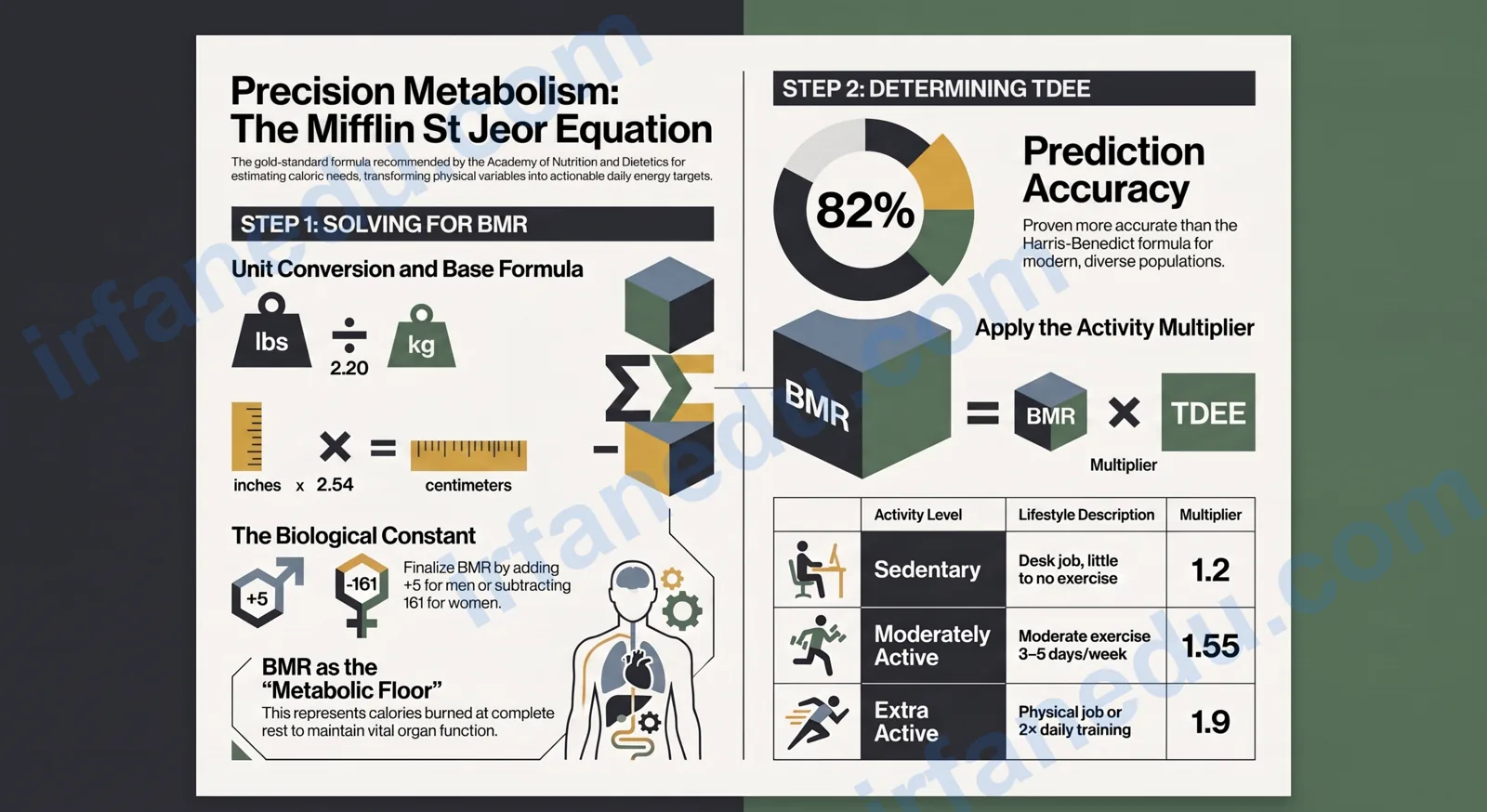
Good news: figuring out how many calories your body actually needs is not guesswork. The Mifflin St Jeor equation is the gold-standard formula recommended by the Academy of Nutrition and Dietetics for estimating Basal Metabolic Rate (BMR) in healthy adults. In this guide, I’ll walk you through the free interactive calculator below, explain the math step by step, and show you exactly how to turn your BMR into a real daily calorie target.
Whether you’re trying to lose weight, build muscle, or simply understand your metabolism, this calculator gives you a solid, science-backed starting point — in pounds, feet, and inches, the way Americans actually measure things.
| Answer First: What Does the Mifflin St Jeor Calculator Tell You? |
|---|
| The Mifflin St Jeor calculator gives you your Basal Metabolic Rate (BMR) — the calories your body burns at complete rest — and your Total Daily Energy Expenditure (TDEE). Enter your weight in pounds, height in feet and inches, age, and activity level. Men add +5 to their BMR; women subtract 161. Multiply BMR by your activity factor (1.2–1.9) to get TDEE. |
🧮 Mifflin St Jeor BMR & TDEE Calculator
lbs
ft
in
years
Your Basal Metabolic Rate (BMR)
How to Use This Calculator
Using the Mifflin St Jeor calculator takes under a minute. Follow these six steps:
- Select your sex — click Male or Female. The equation uses a different constant for each.
- Enter your weight in pounds (e.g., 165 lbs).
- Enter your height in feet and inches (e.g., 5 ft 9 in).
- Enter your age in whole years.
- Choose your activity level from the dropdown — be honest here; most people overestimate their activity.
- Click Calculate — your BMR, TDEE, and a full step-by-step solution appear instantly.
What Is Basal Metabolic Rate (BMR)?
Basal Metabolic Rate (BMR) is the number of calories your body burns at complete rest — just to keep your heart beating, lungs breathing, kidneys filtering, and brain running. It is the floor of your calorie needs, not the ceiling.
Think of BMR as your body’s “idle speed.” Even if you stayed in bed all day, you’d still burn your BMR in calories. For most American adults, BMR ranges from about 1,400 to 2,000 calories per day, depending on size, age, and sex.
BMR is different from TDEE (Total Daily Energy Expenditure), which adds the calories you burn through movement, exercise, and digestion. The Mifflin St Jeor equation gives you BMR first, then this calculator multiplies it by your activity factor to give you TDEE — the number you actually use for nutrition planning.
In my experience working with students and adults on health goals, most people skip straight to calorie apps without understanding what BMR actually represents. When you know your BMR, you understand the hard floor — the minimum your body needs to function. Eating below your BMR for extended periods doesn’t just stall weight loss; it signals your body to slow its metabolism. That’s why I always start here before talking about any calorie target.
The Mifflin St Jeor Equation Explained
The Mifflin St Jeor equation was developed by M.D. Mifflin and S.T. St Jeor in 1990 and published in the American Journal of Clinical Nutrition. It remains the most accurate BMR formula for non-hospitalized adults, according to the Academy of Nutrition and Dietetics.
BMR = (10 × weight in kg) + (6.25 × height in cm) − (5 × age in years) + 5
BMR = (10 × weight in kg) + (6.25 × height in cm) − (5 × age in years) − 161
The only difference between the male and female formulas is that final constant: +5 for men, −161 for women. This reflects the average difference in lean body mass between sexes at the same weight and height.
Variables & Symbols Table
| Symbol | Meaning | US Input | SI Unit Used in Formula |
|---|---|---|---|
| Weight | Body mass | Pounds (lbs) | Kilograms (kg) — divide lbs by 2.20462 |
| Height | Standing height | Feet + inches | Centimeters (cm) — multiply total inches by 2.54 |
| Age | Age in whole years | Years | Years |
| BMR | Basal Metabolic Rate | — | kcal/day |
| TDEE | Total Daily Energy Expenditure | — | kcal/day |
Activity Multipliers (Harris-Benedict Scale)
| Activity Level | Description | Multiplier |
|---|---|---|
| Sedentary | Desk job, little or no exercise | 1.2 |
| Lightly Active | Light exercise 1–3 days/week | 1.375 |
| Moderately Active | Moderate exercise 3–5 days/week | 1.55 |
| Very Active | Hard exercise 6–7 days/week | 1.725 |
| Extra Active | Physical job or twice-daily training | 1.9 |
Worked Examples: Step-by-Step Calculations
Example 1: 35-Year-Old Male, 185 lbs, 6 ft 0 in, Moderately Active
Height: 72 in × 2.54 = 182.88 cm
BMR = (10 × 83.91) + (6.25 × 182.88) − (5 × 35) + 5
= 839.1 + 1,143.0 − 175 + 5 = 1,812 cal/day
TDEE = 1,812 × 1.55 = 2,809 cal/day
Example 2: 28-Year-Old Female, 140 lbs, 5 ft 5 in, Lightly Active
Height: 65 in × 2.54 = 165.10 cm
BMR = (10 × 63.50) + (6.25 × 165.10) − (5 × 28) − 161
= 635.0 + 1,031.9 − 140 − 161 = 1,366 cal/day
TDEE = 1,366 × 1.375 = 1,878 cal/day
 Weight (lbs)          Height (ft+in)        Age (yrs)
     |                      |                    |
 ÷ 2.20462              × 2.54 (total in)        |
     |                      |                    |
  kg value              cm value                 |
     |                      |                    |
  × 10                   × 6.25               × 5
     |                      |                    |
     +----------+-----------+                    |
                |                                |
           Sum so far          −  (5 × age)  +/− constant
                |                                |
                +--------------------------------+
                                |
                              BMR
                                |
                          × Activity Factor
                                |
                             TDEE
Common Mistakes When Using the Mifflin St Jeor Equation
| ❌ Common Mistake | ✅ What to Do Instead |
|---|---|
| Entering height in decimal feet (e.g., 5.75 ft) | Separate feet and inches — 5 ft 9 in, not 5.75 ft |
| Using the same formula for men and women | Men add +5; women subtract 161 — the constant is different |
| Choosing “Very Active” because you go to the gym 3×/week | 3× moderate gym sessions = “Moderately Active” (×1.55) |
| Treating TDEE as a hard daily cap | TDEE is an estimate — adjust by 100–200 cal based on real results over 2–3 weeks |
| Eating below BMR to lose weight faster | Never eat below BMR without medical supervision — it slows metabolism |
Real-World Applications
The Mifflin St Jeor equation is used by registered dietitians, personal trainers certified by the American College of Sports Medicine (ACSM), and hospital nutrition teams to set calorie targets for patients. It’s the starting point for weight-loss programs, muscle-gain protocols, and athletic performance nutrition plans across the US.
If you’re preparing for a competition, recovering from surgery, or managing a chronic condition, your healthcare provider will likely use this exact formula — or a clinical variant of it — to set your nutrition prescription.
I’ve seen this pattern dozens of times: someone calculates their TDEE, picks “Very Active” because they feel like they work out a lot, sets their calorie target accordingly, and then wonders why they’re not losing weight. The activity multipliers are averages built from controlled studies — not self-assessments. In my experience, most office workers who exercise 4–5 times a week are “Moderately Active” (×1.55), not “Very Active” (×1.725). Start conservative, track your weight for two weeks, then adjust.
Most calorie guides still reference the Harris-Benedict equation (1919), which was revised in 1984. What they don’t tell you: a landmark 2005 study by Frankenfield et al., published in the Journal of the American Dietetic Association, tested five BMR equations against indirect calorimetry (the gold standard) in 200 adults. The Mifflin St Jeor equation predicted BMR within 10% for 82% of participants — significantly better than the revised Harris-Benedict (75%). The key reason: Mifflin St Jeor was developed on a more representative modern population, including people with higher body weights. If you’ve been using Harris-Benedict, you may be overestimating your calorie needs by 5–8%. That gap compounds fast — over a month, it can mean 1,500–2,400 extra calories consumed above your true maintenance level.
🧠 Quick Quiz: Test Your Knowledge
1. In the Mifflin St Jeor equation, what constant is added for men?
2. You weigh 154 lbs. What is that in kilograms (rounded to 2 decimal places)?
3. A person’s BMR is 1,600 cal/day and they are Moderately Active (×1.55). What is their TDEE?
Frequently Asked Questions
What is the Mifflin St Jeor equation?
How accurate is the Mifflin St Jeor calculator?
What activity level should I choose?
What is the difference between BMR and TDEE?
How do I use my BMR result to lose or gain weight?
Sources & References
- Mifflin MD, St Jeor ST, et al. (1990). “A new predictive equation for resting energy expenditure in healthy individuals.” American Journal of Clinical Nutrition, 51(2), 241–247. — Oxford Academic — American Journal of Clinical Nutrition
- Frankenfield D, et al. (2005). “Comparison of predictive equations for resting metabolic rate in healthy nonobese and obese adults.” Journal of the American Dietetic Association, 105(5), 775–789.
- Academy of Nutrition and Dietetics — EatRight.org — Academy of Nutrition and Dietetics
- American College of Sports Medicine — ACSM.org — American College of Sports Medicine
- Wikipedia — Wikipedia — Basal Metabolic Rate
✍ Editorial note: This article was written and fact-checked by Dr. Irfan Mansuri. All formulas reflect published peer-reviewed research. This calculator is for educational purposes only and does not constitute medical or nutritional advice. Consult a registered dietitian or physician before making significant changes to your diet.