
Part 107 Practice Test: How to Pass the FAA Drone Exam on Your First Try 🚁
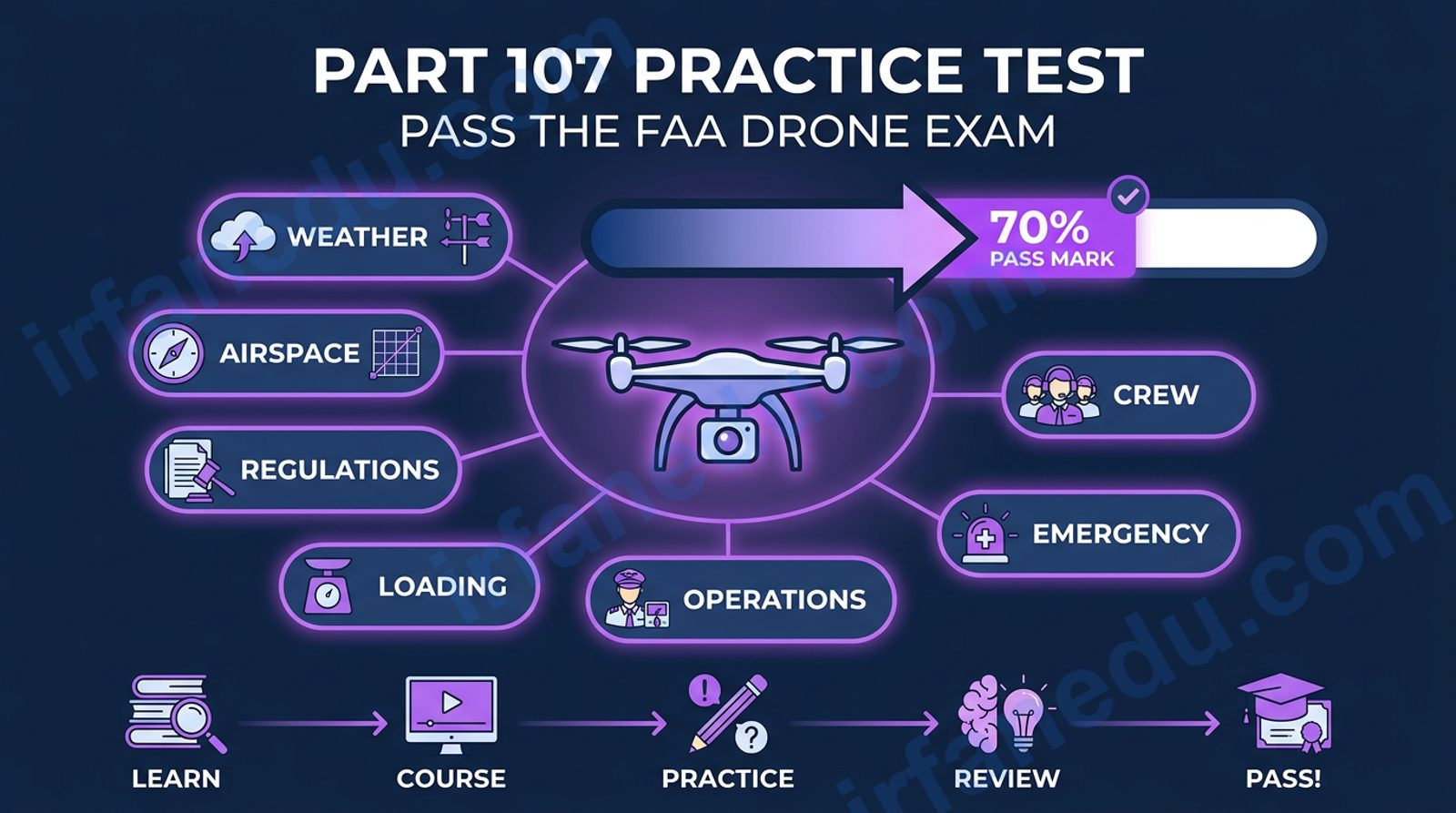
If I could teach you one thing about the Part 107 practice test, it is this: the candidates who fail are almost never the ones who studied the wrong material. They are the ones who studied passively — reading notes, watching videos, and never sitting through a timed, full-length mock exam under real conditions. That single habit change is the difference between a first-attempt pass and a frustrating retake.
The FAA Part 107 knowledge test is the written exam required to earn a Remote Pilot Certificate for commercial drone operations in the United States. It has 60 multiple-choice questions, a 2-hour time limit, and a 70% passing score. The exam tests airspace classification, weather interpretation, FAA regulations, loading and performance, and emergency procedures.
In this guide, I walk you through the exact exam structure, the highest-yield topics, a realistic study timeline, and worked practice examples with full explanations. By the end, you will know precisely what to study, how to study it, and how to tell when you are ready to book your real test. 🎯
After reading this guide, you will be able to:
- Describe the Part 107 exam format and scoring requirements
- Identify the six highest-weighted topic areas and study them strategically
- Decode a basic METAR report and apply airspace rules to sample questions
- Build a 3-week study plan calibrated to your starting knowledge level
- Avoid the three most common mistakes that cause first-time failures
Quick Facts: Part 107 Exam at a Glance 📊
| Detail | Value |
|---|---|
| Exam Name | FAA Aeronautical Knowledge Test (UAG) |
| Number of Questions | 60 multiple-choice |
| Time Limit | 2 hours |
| Passing Score | 70% (42 out of 60 correct) |
| Testing Provider | PSI Exams (FAA-approved centers) |
| Testing Fee | Approximately $175 USD (varies by location) |
| Certificate Validity | 24 months (recurrent knowledge test required) |
| Retake Wait Period | 14 calendar days after a failed attempt |
| ID Required | Valid government-issued photo ID |
| Governing Regulation | 14 CFR Part 107 |
What Is the Part 107 Knowledge Test? 🛸
The Part 107 knowledge test is the FAA’s written examination for anyone who wants to fly a drone commercially in the United States. Passing it earns you a Remote Pilot Certificate, which is required any time you fly an sUAS (small unmanned aircraft system) for business purposes — including real estate photography, surveying, film production, agriculture, and delivery services.
The exam is administered at FAA-approved PSI testing centers. You schedule your appointment online, show up with a valid photo ID, and complete the 60-question test on a computer. You receive your score immediately after finishing. If you pass, the FAA issues a temporary certificate within a few days; your permanent plastic certificate arrives by mail within 90 days.
The exam is not designed to trick you. Every question maps to a published topic area in the FAA’s Airman Certification Standards (ACS) document. This means the exam is entirely predictable in scope — which is great news for anyone willing to study strategically.
In my experience working with hundreds of exam candidates, the Part 107 test is one of the most learnable professional certifications I have encountered. The FAA publishes exactly what it tests. The question bank is finite. The concepts, while unfamiliar at first, are logical and consistent. If you treat this like a structured academic exam rather than a vague “aviation test,” you will pass it. The candidates who struggle are usually those who underestimate the airspace section and skip the METAR practice. Do not make that mistake.
What Topics Does the Part 107 Exam Cover? 📚
The Part 107 exam draws questions from eight core topic areas, each with a different weight in the question bank. Knowing which areas carry the most questions lets you prioritize your study time effectively.
Based on the FAA’s published Airman Certification Standards and the topic distribution reported by candidates, here is how the 60 questions are typically distributed:
| Topic Area | Approx. Questions | Priority |
|---|---|---|
| Airspace Classification & Operating Requirements | 15–18 | 🔴 Critical |
| Weather & Meteorology (incl. METAR) | 10–12 | 🔴 Critical |
| FAA Regulations (Part 107 Rules) | 10–12 | 🔴 Critical |
| Loading, Performance & Weight | 6–8 | 🟡 High |
| Airport Operations & Radio Communication | 5–7 | 🟡 High |
| Emergency Procedures | 4–5 | 🟢 Medium |
| Crew Resource Management | 3–4 | 🟢 Medium |
| Physiological Factors (crew fitness) | 2–3 | 🟢 Lower |
The top three topics — airspace, weather, and regulations — account for roughly 60% of the exam. Master those three areas first, and you are already most of the way to a passing score.
[IMAGE: Part 107 topic distribution pie chart | ALT: FAA Part 107 exam topic breakdown showing airspace weather and regulations as top categories]
How to Build a Part 107 Study Plan That Actually Works 🗓️
A structured 3-week study plan is the most reliable path to a first-attempt pass. Here is the exact sequence I recommend, based on topic weight and cognitive load.
- Week 1, Days 1–2: Download and skim the FAA study guide. Get the free FAA-G-8082-22 Remote Pilot – Small Unmanned Aircraft Systems Study Guide from faa.gov. Do not read it cover to cover yet — skim the chapter headings and note which sections feel unfamiliar. This gives you a baseline.
- Week 1, Days 3–5: Study airspace classification in depth. Learn Class A through G airspace: altitude ranges, entry requirements, and what permissions a drone pilot needs in each class. Draw the airspace layers from memory until you can do it without notes.
- Week 1, Days 6–7: Take your first full practice test (untimed). Do not worry about the score. The goal is to see which topics you are weakest on and calibrate your Week 2 focus.
- Week 2, Days 1–3: Master weather and METAR decoding. Learn to read a METAR report line by line. Practice identifying ceiling height, visibility, wind speed, and weather phenomena. This is where most candidates lose unnecessary points.
- Week 2, Days 4–6: Study FAA Part 107 regulations. Focus on altitude limits (400 ft AGL), line-of-sight rules, waiver types, registration requirements, and night operations rules. Know the exceptions as well as the rules.
- Week 2, Day 7: Take a second full timed practice test. Simulate real conditions: 60 questions, 2-hour limit, no interruptions. Review every wrong answer and categorize it by topic.
- Week 3, Days 1–4: Fill knowledge gaps and drill weak topics. Use your wrong-answer log to guide targeted review. For loading and performance questions, practice the density altitude formula. For airport operations, memorize runway markings and light signals.
- Week 3, Days 5–6: Take two more timed practice tests. If you are consistently scoring 80% or higher, you are ready to book your real exam. If not, extend your prep by one more week on your weakest topic.
- Week 3, Day 7: Light review and rest. Do not cram the night before. Review your summary notes, get a full night of sleep, and arrive at the testing center early.
How to Master Airspace Classification (The Hardest Topic) ✈️
Airspace classification is the single highest-weighted topic on the Part 107 exam, and it is the one most candidates underestimate. The good news: once you understand the logic of the system, the questions become very predictable.
The FAA divides US airspace into six classes. Here is a clean mental model:
FAA AIRSPACE CLASSIFICATION — DRONE PILOT QUICK REFERENCE
═══════════════════════════════════════════════════════════

  FL600 ┌─────────────────────────────────────────┐
        │         CLASS A  (18,000 ft MSL–FL600)  │
        │     IFR only · ATC clearance required   │
        │     ⛔ Drones: NOT permitted             │
 18,000 ├─────────────────────────────────────────┤
        │   CLASS B  (surface–10,000 ft MSL)      │
        │   Busiest airports · ATC clearance      │
        │   ✅ Drones: LAANC / DroneZone waiver   │
        ├─────────────────────────────────────────┤
        │   CLASS C  (surface–4,000 ft AGL)       │
        │   Busy airports · ATC communication     │
        │   ✅ Drones: LAANC / DroneZone waiver   │
        ├─────────────────────────────────────────┤
        │   CLASS D  (surface–2,500 ft AGL)       │
        │   Smaller airports · ATC communication  │
        │   ✅ Drones: LAANC / DroneZone waiver   │
        ├─────────────────────────────────────────┤
        │   CLASS E  (various altitudes)          │
        │   Controlled, no ATC clearance needed   │
        │   ✅ Drones: LAANC if surface Class E   │
        ├─────────────────────────────────────────┤
  0 AGL │   CLASS G  (surface–1,200 ft AGL)       │
        │   Uncontrolled · No ATC required        │
        │   ✅ Drones: Fly freely (follow rules)  │
        └─────────────────────────────────────────┘

  KEY RULE: Part 107 drones max altitude = 400 ft AGL
  (or 400 ft above a structure if within 400 ft of it)
The exam frequently asks you to identify which class of airspace a given location falls in, and what authorization a drone pilot needs to fly there. The LAANC (Low Altitude Authorization and Notification Capability) system is the fast-track authorization tool for Classes B, C, D, and surface Class E — know this term cold.
The airspace diagram above is the single most useful thing I give to my students. Most study guides describe airspace in paragraphs, which makes it hard to visualize. The moment you draw the layers yourself — by hand, from memory — the altitude ranges and entry requirements lock in. I recommend drawing this diagram at least three times during your study period. It takes five minutes and is worth more than an hour of re-reading notes.
Worked Practice Examples With Explanations 🧠
Working through real-style questions with full explanations is far more effective than passive reading. Here are three representative examples covering the three highest-weighted topics.
Question: A drone pilot wants to fly at 200 ft AGL near a regional airport with an operating control tower. The airspace around the airport extends from the surface to 2,500 ft AGL. What class of airspace is this, and what does the pilot need to fly there?
Answer: This is Class D airspace. To fly a drone in Class D airspace, the pilot must obtain authorization through the LAANC system or the FAA DroneZone portal before the flight. Simply communicating with ATC (as manned pilots do) is not sufficient for Part 107 drone operations — prior authorization is required.
Why candidates get this wrong: Many confuse Class D requirements with Class C. Remember: Class C has a larger, busier airport and a two-layer structure (inner and outer ring). Class D is smaller, with a single surface-to-2,500-ft-AGL cylinder.
Question: A METAR report reads: METAR KORD 151755Z 27015KT 10SM FEW040 SCT080 22/10 A2992. What is the wind speed, and is the visibility acceptable for a Part 107 flight?
Answer: Wind is from 270° (west) at 15 knots. Visibility is 10 statute miles. Part 107 requires minimum 3 statute miles flight visibility, so 10SM is well above the minimum. The flight is permissible from a visibility standpoint (subject to other conditions).
METAR decoding key: 27015KT = wind direction 270°, speed 15 knots. 10SM = 10 statute miles visibility. FEW040 = few clouds at 4,000 ft. SCT080 = scattered clouds at 8,000 ft.
Question: Under Part 107, a remote pilot wants to fly at night without a waiver. What equipment is required on the drone?
Answer: As of the FAA’s 2021 rule update (which is still current), night operations are permitted under Part 107 without a waiver, provided the drone is equipped with anti-collision lighting that is visible for at least 3 statute miles and has a flash rate sufficient to avoid a collision hazard. The pilot must also have completed the updated knowledge test that covers night operations.
Why this trips candidates up: Many study materials pre-dating 2021 still say night operations require a waiver. They do not anymore — but the lighting requirement is mandatory and is a common exam question.
Common Mistakes That Cause Candidates to Fail ⚠️
Most Part 107 failures are preventable. In my experience, three mistakes account for the majority of first-attempt failures.
Studying only from YouTube videos and never taking a full timed practice test before the real exam. Passive watching feels productive but does not build the recall speed you need under exam conditions.
Take at least three full 60-question timed practice tests before your real exam. Simulate the actual testing environment — no phone, no pausing, no looking things up mid-test.
Skipping METAR practice because “I’m not a weather person.” Weather questions appear on nearly every exam and are very learnable once you spend 3 to 4 hours on them.
Practice decoding 10 to 15 real METAR reports. Use the Aviation Weather Center’s free METAR tool to pull live reports and decode them manually until the format becomes automatic.
Memorizing answers to specific practice questions without understanding the underlying rule. The FAA rotates its question bank, so memorized answers often do not match the exact wording on the real exam.
Learn the principle behind each answer. Ask yourself: “What FAA rule or concept does this question test?” When you understand the rule, you can answer any variant of the question.
Practice Test Platforms: Which One Should You Use? 🖥️
Several platforms offer Part 107 practice tests. They vary significantly in question quality, update frequency, and price. Here is an honest comparison of the most widely used options.
| Platform | Cost | Question Count | Updated for 2023+ Rules | Best For |
|---|---|---|---|---|
| FAA Official Study Guide (faa.gov) | Free | Study guide only (no practice Qs) | ✅ Yes | Core reading — use as your primary reference |
| Pilot Institute Practice Tests | Free (basic) / Paid course | 300+ questions | ✅ Yes | Candidates who want structured question banks with explanations |
| UAV Coach Practice Exam | Free | ~60 questions | ✅ Yes | Quick diagnostic — good for a first baseline test |
| Gleim Aviation (Part 107) | ~$40–$60 | 500+ questions | ✅ Yes | Serious candidates who want the most comprehensive question bank |
| Generic “drone test” apps | Free | Varies widely | ⚠️ Often outdated | Avoid unless you can verify the last update date |
My recommendation: use the free FAA study guide as your primary reading material, take the UAV Coach free test as your first diagnostic, and use Pilot Institute or Gleim for your serious timed practice sessions. You do not need to pay for a full ground school course unless you are completely new to aviation concepts and want hand-holding through the material.
Scoring 70% on practice tests does not mean you are ready for the real exam. Most Part 107 practice test platforms recycle the same 200 to 300 questions, so after two or three sessions your brain starts recognizing questions rather than retrieving knowledge. This creates a false sense of readiness. I have seen candidates score 85% on a familiar practice platform and then score 68% on the real exam — failing by two questions — because the real exam used unfamiliar phrasing for the same concepts.
The fix: use at least two different practice platforms so you encounter varied question phrasing. More importantly, set your personal readiness benchmark at 80% or higher on a platform you have never used before. If you can score 80% on a fresh, unfamiliar question set, you have genuine knowledge — not just pattern recognition. This is the insight most study guides do not tell you, and it is the single biggest predictor of first-attempt success I have observed.
Reveal-and-Check Practice Problems 🔍
Test your knowledge with these five practice problems. Click each one to reveal the answer and explanation.
Problem 1: Under Part 107, what is the maximum altitude a drone may fly above the ground in uncontrolled (Class G) airspace?
Part 107 sets a default maximum altitude of 400 ft AGL for sUAS operations in Class G airspace. There is one exception: if the drone is within 400 horizontal feet of a structure, it may fly up to 400 ft above the top of that structure. This exception is frequently tested — make sure you know both the rule and the exception.
Problem 2: A METAR shows visibility of 2SM. Can a Part 107 pilot legally fly under these conditions?
Part 107 requires a minimum flight visibility of 3 statute miles. At 2SM, the visibility is below the legal minimum and the flight is not permitted. The pilot must wait for conditions to improve or obtain a waiver for reduced visibility operations. This is a common exam question — remember the number 3SM.
Problem 3: What does the acronym LAANC stand for, and what does it do?
LAANC is an FAA system that allows drone pilots to get near-real-time authorization to fly in controlled airspace (Classes B, C, D, and surface Class E) below approved altitude limits. Without LAANC authorization, flying in these airspace classes is illegal under Part 107. The system is available through several FAA-approved apps and is free to use.
Problem 4: A remote pilot in command (RPIC) must be how old to operate a drone commercially under Part 107?
Part 107 sets the minimum age for a Remote Pilot Certificate at 16 years. The applicant must also be able to read, speak, write, and understand English, and must not have a physical or mental condition that would interfere with safe operation. There is no upper age limit.
Problem 5: What is density altitude, and why does it matter for drone operations?
High density altitude means the air is less dense — which reduces a drone’s lift and battery efficiency, shortening flight time and reducing payload capacity. On hot days at high elevations, density altitude can be significantly higher than the actual elevation. The exam tests whether you understand that high density altitude degrades aircraft performance. Remember: hot + high + humid = high density altitude = reduced performance.
Frequently Asked Questions About the Part 107 Practice Test ❓
How many questions are on the Part 107 knowledge test?
The FAA Part 107 Aeronautical Knowledge Test has 60 multiple-choice questions. You must answer at least 42 correctly (70%) to pass. The test is administered at an FAA-approved PSI testing center and has a 2-hour time limit. Each question has three answer choices.
What topics are covered on the Part 107 exam?
The Part 107 exam covers airspace classification and operating requirements, weather and meteorology (including METAR reading), FAA regulations for sUAS, loading and performance, emergency procedures, crew resource management, airport operations, and radio communication procedures. Airspace, weather, and regulations together account for roughly 60% of the exam.
How long should I study for the Part 107 test?
Most candidates need 15 to 30 hours of focused study spread over 2 to 4 weeks. Candidates with prior aviation knowledge often need less time. Consistent daily practice with timed mock exams in the final week is the most effective strategy. Aim for 80% or higher on fresh practice tests before booking your real exam.
What score do you need to pass Part 107?
You need a minimum score of 70% to pass the FAA Part 107 knowledge test. That means answering at least 42 out of 60 questions correctly. There is no partial credit — each question is worth one point. Your score is displayed immediately after you finish the exam at the testing center.
Can I retake the Part 107 test if I fail?
Yes. If you fail the Part 107 knowledge test, you must wait 14 calendar days before retaking it. You will need to pay the testing fee again (approximately $175 USD). There is no limit on the number of retakes allowed. Use your score report to identify weak areas and focus your re-study on those specific topics.
Are Part 107 practice tests the same as the real exam?
No. Practice tests simulate the format, difficulty, and topic distribution of the real exam but do not use identical questions. The FAA draws from a rotating question bank, so memorizing specific answers is less effective than understanding the underlying concepts. Use multiple practice platforms to encounter varied question phrasing before your real test.
Do I need to take a ground school course to pass Part 107?
No formal course is required. Many candidates self-study using the FAA’s free study guide (FAA-G-8082-22), the Airman Certification Standards, and reputable practice test platforms. However, a structured course helps candidates who are completely new to aviation concepts. The FAA’s free materials are comprehensive enough for a disciplined self-studier to pass on the first attempt.
Sources & References
Written and fact-checked by Dr Irfan Mansuri. External links open in a new tab and are provided for further reading and verification.