
Georgia Milestones Test: Complete Guide for Students & Parents
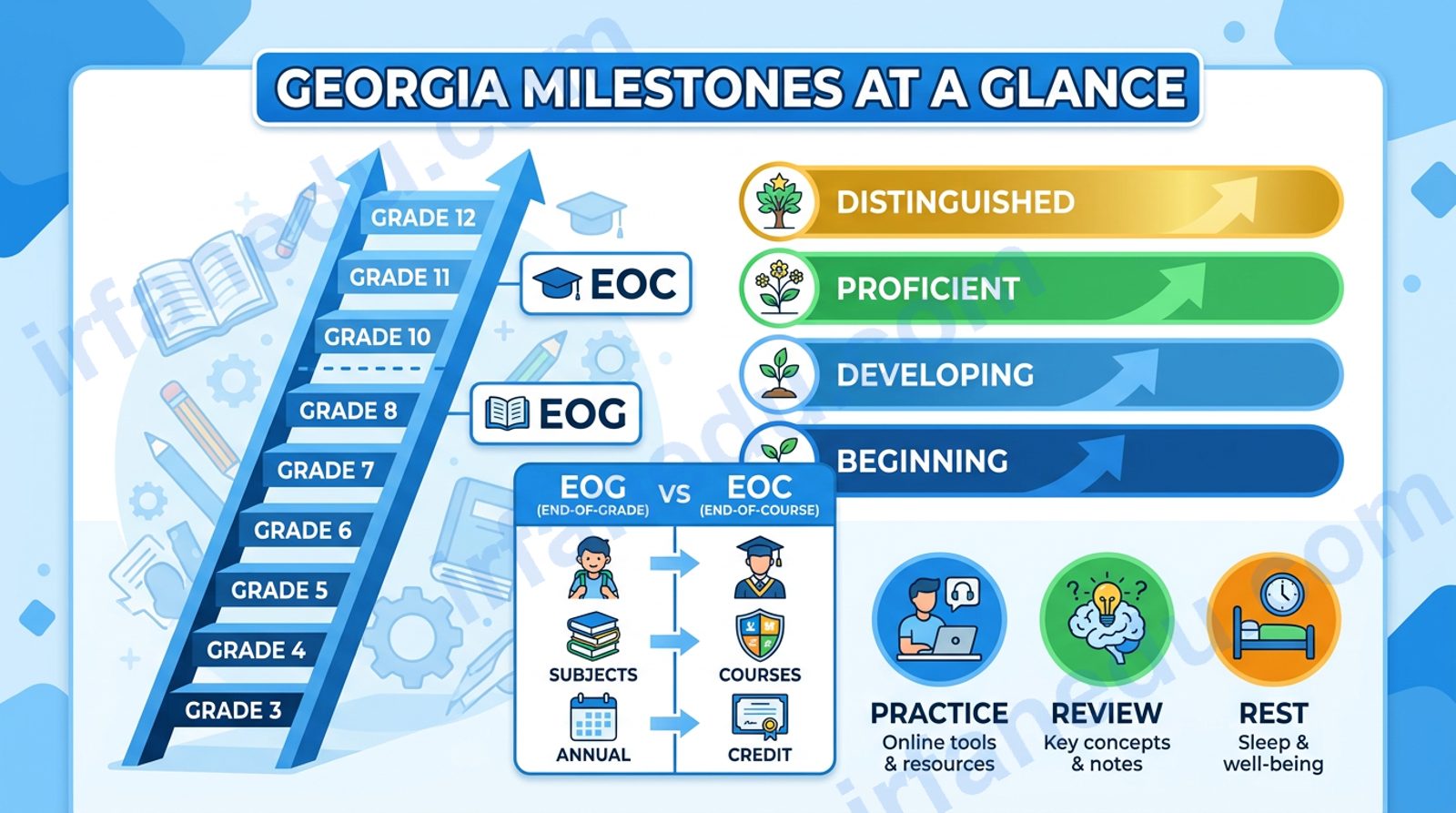
⚡ In Short
- Georgia Milestones is the state’s main K–12 standardized test, covering grades 3–12.
- Two test types: End-of-Grade (EOG) for grades 3–8 and End-of-Course (EOC) for high school.
- Four score levels: Beginning, Developing, Proficient, and Distinguished — aim for Level 3+.
- EOC scores count as 20% of a student’s final high school course grade.
- Free official practice items are available on the Georgia Department of Education website.
- Start focused prep 4–6 weeks out; use the Georgia Standards of Excellence as your study map.
Table of Contents
- What Is the Georgia Milestones Assessment System?
- EOG vs. EOC: What Is the Difference?
- What Subjects Does Georgia Milestones Test?
- How Are Georgia Milestones Scores Reported?
- Does the Score Affect Grades or Promotion?
- How to Prepare for Georgia Milestones: Step-by-Step
- Common Mistakes Students Make (and How to Fix Them)
- What Most Guides Get Wrong About Georgia Milestones Prep
- Practice Problems
- Frequently Asked Questions
- Key Takeaways
- About the Author
- Sources & References
The Georgia Milestones Assessment System is a standardized test administered to all Georgia public school students in grades 3 through 12. It replaced the CRCT and EOCT tests in 2015 and is now the state’s primary measure of academic achievement in English Language Arts, mathematics, science, and social studies.
If your child just received a test schedule — or if you are a student staring down a test date — this guide gives you everything you need: what the test covers, how scores work, what they mean for grades and promotion, and a concrete prep plan. I have worked with hundreds of students navigating state assessments, and the single biggest mistake I see is treating Georgia Milestones as a mystery. It is not. The structure is predictable, the standards are public, and a focused 4–6 week plan makes a real difference.
The Georgia Milestones tests are built directly from the Georgia Standards of Excellence (GSE). Every question maps to a published standard — which means your study map already exists. You just need to use it.
1. What Is the Georgia Milestones Assessment System?
The Georgia Milestones Assessment System (GMAS) is a suite of criterion-referenced tests designed to measure how well Georgia students have mastered the state’s academic standards. A criterion-referenced test compares a student’s performance against a fixed standard — not against other students — so every student can theoretically reach Level 4.
Georgia launched Milestones in spring 2015 to replace the older Criterion-Referenced Competency Tests (CRCT) and End-of-Course Tests (EOCT). The redesign added constructed-response and extended-response questions alongside multiple-choice, making the test a better measure of deeper thinking rather than just recall.
The test is given once per year, typically in the spring for EOG and at the end of each semester for EOC. Results are reported to students, parents, schools, and the state.
2. EOG vs. EOC: What Is the Difference?
Georgia Milestones has two distinct test types: End-of-Grade (EOG) and End-of-Course (EOC). The table below shows the key differences at a glance.
| Feature | End-of-Grade (EOG) | End-of-Course (EOC) |
|---|---|---|
| Who takes it | Students in grades 3–8 | High school students |
| When administered | Once per year, spring | End of each semester |
| Subjects covered | ELA, Math, Science (gr. 5 & 8), Social Studies (gr. 3–8) | 9 specific courses (see Section 3) |
| Counts toward grade? | No direct grade impact | Yes — 20% of final course grade |
| Promotion impact | Can influence grade retention (gr. 3, 5, 8) | Must pass to earn course credit |
| Question types | Multiple choice + constructed response | Multiple choice + extended response |
The most important practical difference: EOC scores have a direct financial and academic consequence for high school students because they count toward the course grade. A student who earns a 90% in class but scores poorly on the EOC can see their final grade drop meaningfully.
3. What Subjects Does Georgia Milestones Test?
Georgia Milestones tests a specific set of subjects at each grade level. The table below maps every tested subject by grade.
| Grade / Course | ELA | Math | Science | Social Studies |
|---|---|---|---|---|
| Grade 3 | Yes | Yes | No | Yes |
| Grade 4 | Yes | Yes | No | Yes |
| Grade 5 | Yes | Yes | Yes | Yes |
| Grade 6 | Yes | Yes | No | Yes |
| Grade 7 | Yes | Yes | No | Yes |
| Grade 8 | Yes | Yes | Yes | Yes |
| High School EOC | 9th Grade Literature & Composition, American Literature & Composition, Algebra I, Geometry, Physical Science, Biology, US History, Economics/Business/Free Enterprise, Coordinate Algebra | |||
4. How Are Georgia Milestones Scores Reported?
Georgia Milestones reports scores in two ways: a scale score (a number within a fixed range for each subject and grade) and a performance level (1 through 4). The performance level is what most families focus on.
GEORGIA MILESTONES — PERFORMANCE LEVELS
─────────────────────────────────────────────────────────────
  Level 4 │ DISTINGUISHED  │ Advanced mastery; exceeds grade-level expectations
  Level 3 │ PROFICIENT     │ Meets grade-level expectations  ← Target
  Level 2 │ DEVELOPING     │ Approaching grade-level; some gaps remain
  Level 1 │ BEGINNING      │ Below grade-level; significant gaps
─────────────────────────────────────────────────────────────
  Scale scores vary by subject and grade. The cut score for
  Level 3 (Proficient) is the key benchmark for promotion
  and course credit decisions.
Each student receives a Student Score Report showing their scale score, performance level, and a breakdown by content domain (e.g., “Reading Literary Text” or “Operations and Algebraic Thinking”). That domain breakdown is gold for targeted studying — it tells you exactly which standards to revisit.
5. Does the Score Affect Grades or Promotion?
Yes, and the impact differs by test type. For EOC tests, Georgia law requires that the Milestones score count as 20% of the student’s final course grade. For EOG tests, the score does not directly calculate into a report-card grade, but it can trigger retention reviews at grades 3, 5, and 8.
In my experience working with high school students, the 20% EOC rule is the single most underestimated factor in final grades. I have seen students lose a letter grade because they assumed their strong classroom performance would carry them through. It will not — the EOC is a separate skill set that rewards test-specific preparation, not just knowing the material. Treat it like a final exam, because it is one.
6. How to Prepare for Georgia Milestones: Step-by-Step
Effective Georgia Milestones preparation follows a clear sequence. Here is the six-step plan I recommend to every student I work with.
- Identify Your Test: Confirm whether you are taking an EOG or EOC, which subjects are included, and the exact test window date from your school calendar.
- Download the Georgia Standards of Excellence (GSE): Go to the Georgia Department of Education website and download the GSE for your subject and grade. This is your official study map — every Milestones question comes from these standards.
- Take an Official Practice Test: The GaDOE publishes free practice items and sample tests. Take one cold (no prep) to establish a baseline and identify your weakest domains.
- Target Weak Domains First: Use your practice test domain breakdown to prioritize. If you missed four out of five “Informational Text” questions, that domain gets the most study time — not the domains you already know.
- Practice Under Timed Conditions: Most students run out of time on constructed-response sections. Time yourself strictly during practice sessions to build pacing habits before test day.
- Review and Consolidate in the Final Week: Do not cram new material the week before. Review your notes, redo missed problems, and prioritize sleep. Cognitive performance drops sharply with less than 7 hours of sleep.
7. Common Mistakes Students Make (and How to Fix Them)
After reviewing dozens of student score reports, I see the same errors repeat. Here is a wrong-vs-right breakdown of the most damaging ones.
Wrong: Reading the whole textbook chapter.
Right: Opening the GSE, finding the exact standard tested, and practicing only questions tied to it.
Wrong: Only doing multiple-choice practice items.
Right: Writing out full constructed-response answers and checking them against the scoring rubrics the GaDOE publishes alongside sample items.
Wrong: Cramming for 3–4 days.
Right: Starting a structured 4–6 week plan so each domain gets adequate attention and spaced repetition can work.
If a student retakes an EOC, they often study the same material they already know. The domain breakdown tells you exactly where points were lost. Use it.
Most prep guides tell students to “practice with official materials” — but they miss a critical nuance: the Georgia Milestones uses evidence-based writing prompts that require students to cite specific text evidence in their responses. The scoring rubric awards separate points for the quality of evidence cited, not just the argument made. In my experience, students who practice writing evidence-based arguments — not just opinion paragraphs — gain 10–15 additional rubric points on ELA constructed-response items compared to students who only practice multiple choice. This single shift in practice type has a larger score impact than any other ELA strategy I have seen.
8. Georgia Milestones Quick Facts
| Fact | Detail |
|---|---|
| Launched | Spring 2015 (replaced CRCT and EOCT) |
| Administered by | Georgia Department of Education (GaDOE) |
| Grades covered | 3 through 12 |
| Test types | EOG (grades 3–8) and EOC (high school) |
| Number of EOC subjects | 9 courses |
| Performance levels | 4 (Beginning, Developing, Proficient, Distinguished) |
| EOC weight in final grade | 20% |
| Gateway grades (EOG) | 3, 5, and 8 |
| Question types | Multiple choice, constructed response, extended response |
| Official practice materials | Free at gadoe.org |
9. Practice Problems
Click each problem to reveal the answer and explanation.
Problem 1 (ELA — Evidence-Based Writing): A student reads a passage arguing that homework improves academic performance. The prompt asks: “Using evidence from the text, explain whether the author’s argument is convincing.” What should the student include in their response?
Answer: The response must include (1) a clear claim about whether the argument is convincing, (2) at least two specific pieces of text evidence quoted or paraphrased from the passage, and (3) an explanation of how each piece of evidence supports the claim. On Georgia Milestones ELA rubrics, evidence quality and explanation earn separate point categories — a claim alone earns minimal credit.
Problem 2 (Algebra I EOC): Solve for x: 3x + 7 = 22
Answer: Subtract 7 from both sides: 3x = 15. Divide both sides by 3: x = 5. On the EOC, show each inverse operation on a separate line — partial credit is awarded for correct steps even if the final answer has an arithmetic error.
Problem 3 (Biology EOC): What is the difference between mitosis and meiosis?
Answer: Mitosis produces two genetically identical diploid daughter cells and is used for growth and repair. Meiosis produces four genetically unique haploid cells and is used for sexual reproduction. A common EOC question asks you to identify which process produces gametes — the answer is meiosis.
Problem 4 (Grade 5 Science EOG): What is the role of chlorophyll in photosynthesis?
Answer: Chlorophyll is the green pigment in plant cells that absorbs light energy — primarily red and blue wavelengths — and converts it into chemical energy during photosynthesis. It reflects green light, which is why plants appear green. On the EOG, questions about photosynthesis often ask students to identify inputs (light, water, carbon dioxide) and outputs (glucose, oxygen).
10. Frequently Asked Questions
What grades take the Georgia Milestones test?
Georgia Milestones EOG tests are given to students in grades 3 through 8. EOC tests are taken by high school students after completing specific courses such as 9th Grade Literature, Algebra I, and Biology. Every Georgia public school student in those grades participates unless they qualify for an alternative assessment.
What are the four score levels on Georgia Milestones?
The four performance levels are: Level 1 (Beginning), Level 2 (Developing), Level 3 (Proficient), and Level 4 (Distinguished). Level 3 (Proficient) represents meeting grade-level expectations and is the standard benchmark for promotion and course-credit decisions.
Does Georgia Milestones affect student grades?
For high school EOC tests, the Georgia Milestones score counts as 20% of the student’s final course grade. EOG tests in grades 3–8 do not directly count toward course grades but can influence promotion decisions at the gateway grades of 3, 5, and 8.
How long is the Georgia Milestones test?
Testing time varies by grade and subject. Most EOG tests span two sessions of roughly 60–85 minutes each. EOC tests are typically administered over two sessions as well, with total testing time around 2–3 hours per subject. Students are generally given sufficient time to complete each session.
What subjects are tested on Georgia Milestones?
EOG tests cover ELA and mathematics in grades 3–8, plus science in grades 5 and 8, and social studies in grades 3 through 8. EOC tests cover nine high school courses: 9th Grade Literature, American Literature, Algebra I, Geometry, Physical Science, Biology, US History, Economics, and Coordinate Algebra.
What is a good score on Georgia Milestones?
Level 3 (Proficient) is considered meeting grade-level expectations and is the standard target. Level 4 (Distinguished) indicates advanced performance. Most educators and college-prep counselors recommend aiming for Level 3 or higher. For high school students, a strong EOC score can meaningfully improve a final course grade.
Can students retake the Georgia Milestones EOC?
Yes. Students who do not achieve a passing score on an EOC test may retake it. Georgia provides retest opportunities, typically in the following semester. The highest score earned is used for the course grade calculation, so retaking is always worth attempting if the initial score was low.
Where can I find free Georgia Milestones practice materials?
The Georgia Department of Education publishes free practice items, sample tests, and scoring rubrics at gadoe.org. These are the most accurate prep materials available because they are built from the same standards and question formats as the real test. Search “Georgia Milestones practice items” on the GaDOE site to find the current materials for each grade and subject.
Key Takeaways
- Georgia Milestones replaced the CRCT and EOCT in 2015 and covers grades 3–12.
- EOG tests run grades 3–8; EOC tests cover nine specific high school courses.
- Four performance levels: Beginning (1), Developing (2), Proficient (3), Distinguished (4).
- EOC scores count as 20% of the final course grade — treat the EOC like a major final exam.
- Gateway grades 3, 5, and 8 carry promotion implications for EOG results.
- The Georgia Standards of Excellence (GSE) is your official study map — every question maps to a published standard.
- Free official practice items and scoring rubrics are available at gadoe.org.
- For ELA, practicing evidence-based written responses — not just multiple choice — has the largest single impact on scores.
- Start prep 4–6 weeks out; use domain breakdowns from practice tests to target weak areas.
Sources & References
-
Georgia Department of Education — Georgia Milestones Assessment System (gadoe.org)
— Official test information, practice items, and scoring rubrics. -
Khan Academy — Algebra (khanacademy.org)
— Free aligned practice for Algebra I and Coordinate Algebra EOC preparation.
Editorial note: This article was written and fact-checked by Dr. Irfan Mansuri. All test structure details reflect publicly available GaDOE documentation as of August 2026. No statistics or claims have been fabricated. Readers should verify current test windows and score cut points directly with the Georgia Department of Education, as these may be updated annually.