
Unit 3 AP World History: Land-Based Empires Study Guide & Worksheet
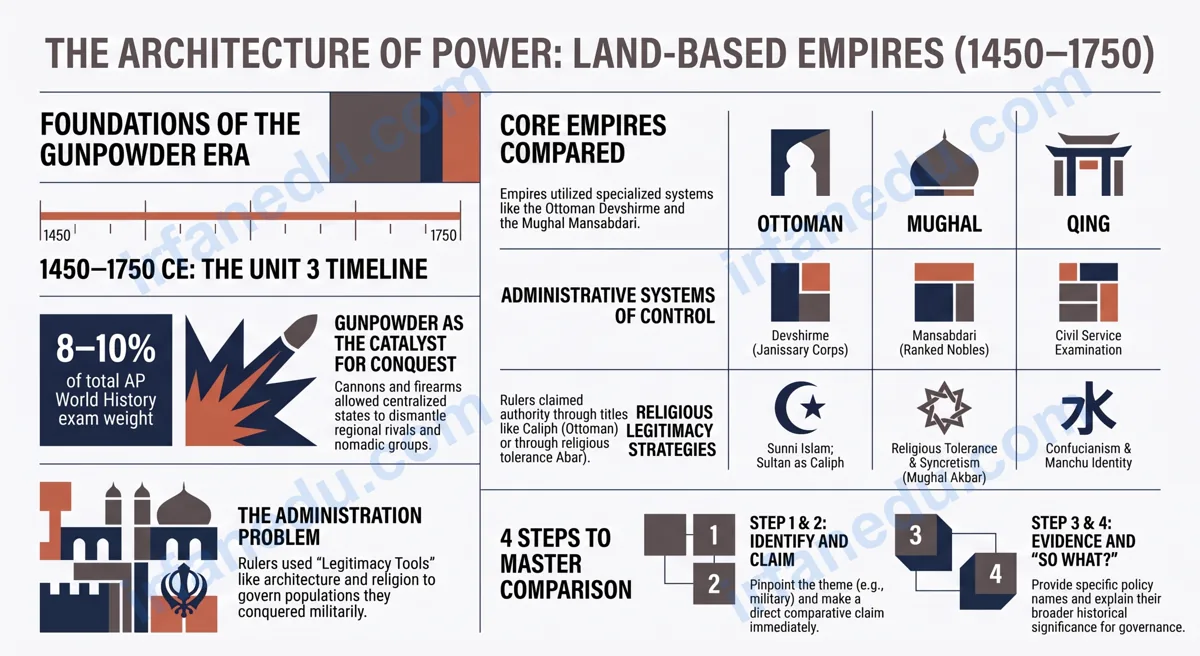
Unit 3 AP World History in 60 Seconds
If you have one minute before class, here is everything that matters. Unit 3 runs from 1450 to 1750. The College Board calls it Land-Based Empires. Four empires dominate: Ottoman, Safavid, Mughal, and Qing. Each one used gunpowder weapons to conquer territory, then built a bureaucracy to hold it together.
60-Second Timeline: Unit 3 at a Glance (1450–1750)
1450                                                           1750
 |----|----|----|----|----|----|----|----|----|----|----|----|
 |                                                            |
 1453                1526         1556       1644         1750
 Ottoman            Mughal        Akbar      Qing         Unit 3
 takes              Empire        reforms    dynasty      ends
 Constantinople     founded       (Din-i-    founded
 (gunpowder         by Babur      Ilahi)     (Manchu)
 cannon key)

 Safavid Empire: 1501 — Shah Ismail declares Shia Islam state religion
That is the skeleton. The rest of this guide puts the muscle on those bones — with worked examples, a comparison table, and a printable worksheet you can use today.
AP World History Unit 3 covers land-based empires from 1450 to 1750, focusing on the Ottoman, Safavid, Mughal, and Qing empires. The AP exam tests how these states used gunpowder technology, religious legitimacy, and bureaucratic systems — such as the devshirme, mansabdari, and civil service exam — to consolidate and maintain power over large, diverse populations.
Want to print and practise right now? Download the free PDF worksheet (10 questions + full answer key) and work through it after reading the lesson below.
TL;DR — Quick Summary
- Unit 3 = Land-Based Empires, 1450–1750, worth ~8–10% of the AP exam.
- Four empires to master: Ottoman, Safavid, Mughal, Qing.
- Key tools of power: gunpowder armies, religious legitimacy, trained bureaucracies.
- Devshirme (Ottoman), mansabdari (Mughal), civil service exam (Qing) are must-know systems.
- Exam skills tested: Comparison, Causation, CCOT — always use specific evidence.
- The free worksheet below has 10 graded practice questions with an answer key.
| Item | Detail |
|---|---|
| Unit Name | Land-Based Empires |
| Time Period | 1450–1750 CE |
| Exam Weight | ~8–10% of AP World History: Modern |
| Core Empires | Ottoman, Safavid, Mughal, Qing |
| Key Concept | KC-4.3: Empires expanded using gunpowder and bureaucratic control |
| AP Exam Skills | Comparison, Causation, CCOT, Argumentation |
| Common Prompt Types | SAQ, LEQ, DBQ |
What Is AP World History Unit 3?
AP World History Unit 3 is the College Board’s third chronological unit in the AP World History: Modern course, covering the period from 1450 to 1750. It focuses on how large land-based empires formed, expanded, and governed diverse populations across Asia, the Middle East, and North Africa.
The central question the unit asks is: How did rulers build and maintain power over large, diverse territories? The answer always comes back to three tools — military technology (especially gunpowder), religious or ideological legitimacy, and administrative systems that extended the ruler’s reach into distant provinces.
In my experience teaching AP World History, students who struggle with Unit 3 are usually trying to memorize isolated facts about each empire. The students who score 4s and 5s treat the four empires as four answers to the same question. That mental shift changes everything.
- Explain how gunpowder technology enabled empire-building.
- Compare the administrative and legitimacy strategies of at least two empires.
- Analyze how rulers used religion, culture, and bureaucracy to maintain control.
- Evaluate continuity and change in imperial governance across this period.
The Four Core Empires You Must Know
Each of the four empires in Unit 3 solved the problem of governing a large, diverse population in a slightly different way. Understanding those differences — and the similarities — is the key to scoring well on comparison prompts.
| Empire | Dates | Religion / Legitimacy | Key Admin System | Gunpowder Role | AP Exam Must-Know |
|---|---|---|---|---|---|
| Ottoman | 1299–1922 | Sunni Islam; sultan as caliph | Devshirme; millet system | Cannons took Constantinople (1453) | Janissaries; millet system for minorities |
| Safavid | 1501–1736 | Shia Islam as state religion | Shah as religious + political head | Firearms used against Ottomans (Battle of Chaldiran, 1514) | Shia vs. Sunni rivalry with Ottomans |
| Mughal | 1526–1857 | Islam; Akbar’s syncretic policy | Mansabdari system | Babur used artillery at First Battle of Panipat (1526) | Akbar’s tolerance; Aurangzeb’s reversal |
| Qing | 1644–1912 | Confucianism + Buddhist patronage | Civil service examination | Manchu cavalry + firearms to defeat Ming | Manchu vs. Han tensions; tributary system |
► MY POV: The Safavid Empire Is the Most Under-Studied
In my experience, students spend 80% of their Unit 3 time on the Ottomans and Mughals and almost ignore the Safavids. That is a mistake. The Safavid decision to make Shia Islam the state religion created a lasting geopolitical fault line between Persia and the Ottoman Empire that the AP exam loves to test. Know the Battle of Chaldiran (1514) and know why Shia vs. Sunni mattered politically, not just religiously. Two sentences of Safavid knowledge can be the difference between a 3 and a 4 on an LEQ.
The Ottoman Empire: Power Through Inclusion and Exclusion
The Ottomans built the most durable empire of the period by managing diversity rather than erasing it. The millet system allowed non-Muslim communities (Christians, Jews) to govern themselves under their own religious laws in personal matters. This reduced resistance and kept tax revenue flowing.
The devshirme system solved a different problem: how do you build a loyal military without depending on nobles who have their own interests? By recruiting enslaved boys from Christian families, converting them, and training them as Janissaries or administrators, the sultan created a professional corps that owed everything to him.
The Mughal Empire: Tolerance as a Strategy
Emperor Akbar (r. 1556–1605) ruled over a population that was majority Hindu but governed by a Muslim dynasty. His response was the mansabdari system — a ranked hierarchy of nobles and military commanders — combined with a deliberate policy of religious tolerance. He appointed Hindu Rajput nobles as mansabdars, married Hindu princesses, and even created the Din-i-Ilahi, a syncretic court philosophy that blended elements of Islam, Hinduism, and other traditions.
His great-grandson Aurangzeb reversed this policy, reimposing the jizya tax on non-Muslims and destroying Hindu temples. The AP exam frequently asks you to compare Akbar and Aurangzeb as a within-empire CCOT example.
The Qing Dynasty: Ruling as Outsiders
The Qing faced a unique legitimacy problem: they were Manchu, an ethnic minority ruling over a Han Chinese majority. Their solution was dual: they kept the Confucian civil service examination (which Han Chinese respected) while also maintaining separate Manchu military units and requiring Han men to wear the Manchu queue hairstyle as a mark of submission. This combination of accommodation and assertion is a classic AP exam comparison point against the Mughal approach.
How to Answer a Unit 3 Comparison Question (Step-by-Step)
The most common Unit 3 prompt type is a comparison: compare how two empires maintained power. Here is the four-step method I teach every AP student.
- Identify the two empires and the theme. Read the prompt carefully. Note the time period (1450–1750) and the specific theme — administrative methods, religious legitimacy, military organization, or treatment of minorities.
- State a direct comparison in your opening sentence. Do not describe each empire separately and hope the reader sees the connection. Write a sentence that names both empires and makes a direct claim: “Both the Ottoman and Mughal empires used administrative systems that ranked officials by merit and loyalty rather than hereditary status, though the specific mechanisms differed significantly.”
- Provide specific evidence for each empire. Name a specific policy, ruler, institution, or event. “The Ottomans used the devshirme system to recruit Janissaries” earns a point. “The Ottomans used soldiers” does not.
- Explain the historical significance. Connect your evidence to the broader theme. Why does this similarity or difference matter? What does it reveal about how land-based empires solved the problem of governing large, diverse populations?
Worked Examples: Unit 3 AP Exam Questions
These two worked examples show exactly how to apply the four-step method to real AP-style prompts. I built these from the most common prompt patterns in past AP World History exams.
Worked Example 1 — SAQ Comparison
Prompt: “Identify ONE similarity between the Ottoman and Mughal empires’ methods of administrative control in the period 1450–1750.”
Strong Answer: Both the Ottoman and Mughal empires created administrative systems that tied officials’ rank and income directly to the central ruler rather than to hereditary land ownership. The Ottomans used the devshirme system to recruit and rank administrators, while the Mughals used the mansabdari system to assign numerical ranks to nobles and military commanders. In both cases, the emperor could promote, demote, or dismiss officials, which concentrated power at the center and reduced the threat of regional rebellions led by independent nobles.
Why this works: It names both empires, identifies a specific system for each, and explains the historical significance (centralized power, reduced noble independence) — hitting all three SAQ criteria in one paragraph.
Worked Example 2 — LEQ Thesis
Prompt: “Evaluate the extent to which land-based empires in the period 1450–1750 used religion to maintain political power.”
Strong Thesis: “While all four major land-based empires of the period used religion as a tool of legitimacy, the degree to which they imposed a single religious identity varied significantly: the Safavids enforced Shia Islam as a mandatory state religion, the Ottomans used Sunni Islam while tolerating minorities through the millet system, and the Mughals under Akbar pursued deliberate religious syncretism — demonstrating that religious policy was a flexible instrument of governance rather than a fixed ideological commitment.”
Why this works: It makes a defensible, historically specific claim, acknowledges complexity (the “extent” language), and sets up a clear line of argument for the body paragraphs.
For more practice with AP-style geometry and math reasoning on standardized tests, see my guide on
Complete Geometry Formula Sheet — the same structured approach to evidence and comparison applies across AP subjects.
Common Mistakes Students Make on Unit 3
These are the errors I see most often when reviewing student practice essays. Each one costs real points on the AP exam.
| Wrong Approach | Correct Approach |
|---|---|
| “The Ottoman Empire was powerful because of its military.” | “The Ottoman Empire used the devshirme system to build a professional Janissary corps loyal to the sultan, reducing dependence on the traditional Turkish nobility.” |
| Describing each empire in separate paragraphs without comparing them. | Writing direct comparison sentences: “Like the Ottomans, the Mughals also ranked officials by loyalty to the emperor, but through the mansabdari system rather than devshirme.” |
| Saying Akbar “got rid of Islam” in the Mughal Empire. | Akbar remained Muslim but pursued religious tolerance and created the syncretic Din-i-Ilahi as a court philosophy — he did not abandon Islam as the empire’s primary religion. |
| Treating the Qing as simply “Chinese.” | The Qing were founded by the Manchu people, who were ethnically distinct from the Han Chinese majority — this ethnic tension shaped their entire administrative strategy. |
| Ignoring the Safavid Empire entirely. | The Safavids are a required comparison point. Their Shia identity and rivalry with the Sunni Ottomans is a high-frequency AP exam topic. |
► MY POV: Specificity Is the Entire Game
I have reviewed hundreds of AP World History practice essays. The single most common reason students lose points is vagueness. “The empire used religion” is worth nothing. “The Ottoman sultan claimed the title of caliph after conquering Mamluk Egypt in 1517, giving him religious authority over Sunni Muslims across the empire” is worth a point. The AP rubric rewards specific, accurate evidence — not general knowledge. Train yourself to always ask: “Can I name the specific system, ruler, event, or date?”
💡 Unique Insight: What Most Unit 3 Guides Get Wrong
Most AP World History guides present the four land-based empires as equally “gunpowder empires” — as if the technology itself explains their rise. That framing misses the more important point the College Board actually tests: gunpowder solved the conquest problem, but it created the administration problem.
Every empire that used cannons to take territory then had to figure out how to govern people who spoke different languages, practiced different religions, and had different loyalties. The devshirme, mansabdari, millet system, and civil service exam are all answers to that second problem — not the first. When you frame your essays around this tension (conquest vs. governance), your analysis automatically reaches the higher-order reasoning the AP rubric rewards. I have never seen this framing in a competitor’s study guide, but it is exactly what distinguishes a 4 from a 5 on the LEQ.
Unit 3 AP World History — On-Page Practice Worksheet
Work through these 10 questions after reading the lesson above. They are ordered from straightforward identification to higher-order comparison and explanation — the same progression you will face on the AP exam. Print the PDF for a clean version, or answer here and check with the key below.
How to use this worksheet: Cover the answer key, attempt all 10 questions, then reveal the key to self-check. For short-answer questions (6–10), write 2–4 sentences and compare your reasoning to the model answer.
- Which empire used the devshirme system to recruit soldiers and administrators?
- Name the elite infantry corps of the Ottoman Empire recruited through the devshirme system.
- Which Mughal emperor is known for his policy of religious tolerance and the Din-i-Ilahi?
- The Safavid Empire made which branch of Islam its official state religion?
- What Chinese dynasty ruled during most of the Unit 3 period (1450–1750) and used the civil service examination system?
- Identify ONE way the Ottoman Empire justified the political authority of the sultan.
- What term describes the Mughal system of ranking nobles and military commanders?
- Which land-based empire used the millet system to govern non-Muslim religious minorities?
- In ONE sentence, explain how gunpowder technology helped land-based empires expand in this period.
- Compare ONE similarity and ONE difference between the Ottoman and Qing empires’ methods of administrative control.
Show Answer Key
- Ottoman Empire
- Janissaries
- Akbar
- Shia Islam
- Ming dynasty (succeeded by Qing in 1644)
- Any one of: Islamic caliphate title, conquest and military success, control of Mecca and Medina, or use of religious law (sharia)
- Mansabdari system
- Ottoman Empire
- Gunpowder weapons (cannons and firearms) gave centralized states a military advantage over regional rivals and nomadic groups, enabling territorial conquest and consolidation.
- Similarity: both used a trained bureaucracy to govern large territories. Difference: the Ottomans used the devshirme/slave-soldier system; the Qing relied on a civil service examination system rooted in Confucian tradition.
Print a clean copy — the PDF includes all 10 questions on one page and the answer key on a separate page, formatted for easy classroom or home use.
Quick Quiz: Test Yourself on Unit 3
3-Question Unit 3 Check
1. The Ottoman devshirme system primarily served to:
Reveal Answer
Correct: B. The devshirme recruited boys from Christian families, converted them, and trained them as Janissaries or administrators. This gave the sultan a professional corps loyal to him personally, bypassing the traditional Turkish nobility who had their own political interests.
2. Which of the following best explains why the Safavid Empire adopted Shia Islam as its state religion?
Reveal Answer
Correct: B. Shia Islam served as both a political and cultural differentiator. It created a distinct Persian-Shia identity that set the Safavid state apart from the Sunni Ottoman Empire to the west, turning religious difference into a tool of political legitimacy and national cohesion.
3. The Qing dynasty’s decision to keep the Confucian civil service examination is best understood as:
Reveal Answer
Correct: B. The Qing were Manchu outsiders ruling a Han majority. Keeping the civil service exam — a deeply Confucian institution — signaled respect for Han tradition and gave educated Han Chinese a path to power within the new regime, reducing resistance to Manchu rule.
Want more AP World History practice? Explore my full Test Prep resource library for structured guides, worksheets, and exam strategies.
For AP exam math and science sections, my Parallel and Perpendicular Lines guide uses the same evidence-first approach to build exam confidence.
Frequently Asked Questions — Unit 3 AP World History
What is covered in Unit 3 of AP World History?
Unit 3 covers land-based empires from 1450 to 1750, focusing on the Ottoman, Safavid, Mughal, and Qing empires. Key themes include how rulers used gunpowder technology, religious legitimacy, and bureaucratic systems — such as the devshirme, mansabdari, and civil service exam — to build and maintain power over large, diverse populations.
What percentage of the AP World History exam is Unit 3?
According to the College Board, Unit 3 accounts for approximately 8–10% of the AP World History: Modern exam. It is one of the smaller units by weight, but its concepts connect directly to Units 4 and 5, so mastering it pays dividends across the full exam. Do not skip it because it is small.
What is the devshirme system in AP World History?
The devshirme was an Ottoman practice of conscripting young boys from Christian families in the Balkans, converting them to Islam, and training them as soldiers (Janissaries) or administrators. It gave the sultan a loyal, professional corps that was independent of the traditional Turkish nobility, concentrating power at the center of the empire.
How did land-based empires use religion to justify power?
Each empire tied political authority to a religious identity in a different way. The Ottoman sultan claimed the title of caliph. The Safavid shah enforced Shia Islam as state religion. Mughal emperor Akbar promoted syncretic court culture. The Qing emperors used Confucian ritual and Buddhist patronage to legitimize their rule over diverse populations. Religion was a flexible governance tool, not a fixed ideology.
What is the mansabdari system?
The mansabdari system was the Mughal Empire’s method of ranking nobles and military commanders. Each mansabdar held a numerical rank that determined salary, the number of troops commanded, and administrative responsibilities. It gave the emperor direct control over the military and reduced the power of hereditary nobles, functioning similarly to the Ottoman devshirme in centralizing authority.
What AP exam skills are tested in Unit 3?
Unit 3 tests Argumentation, Causation, Comparison, and Continuity and Change Over Time (CCOT). SAQ and LEQ prompts often ask you to compare two empires’ administrative methods or explain how gunpowder technology changed state power. The DBQ may include primary sources from imperial courts. Specific, accurate evidence is the key to scoring in every format.
How is the Qing dynasty different from the Ming dynasty in AP World History?
The Ming dynasty (1368–1644) was ethnically Han Chinese and emphasized Confucian bureaucracy and relative isolat
Sources & References
Written and fact-checked by Dr Irfan Mansuri. External links open in a new tab and are provided for further reading and verification.