
Adding and subtracting rational expressions: step-by-step guide with worksheet
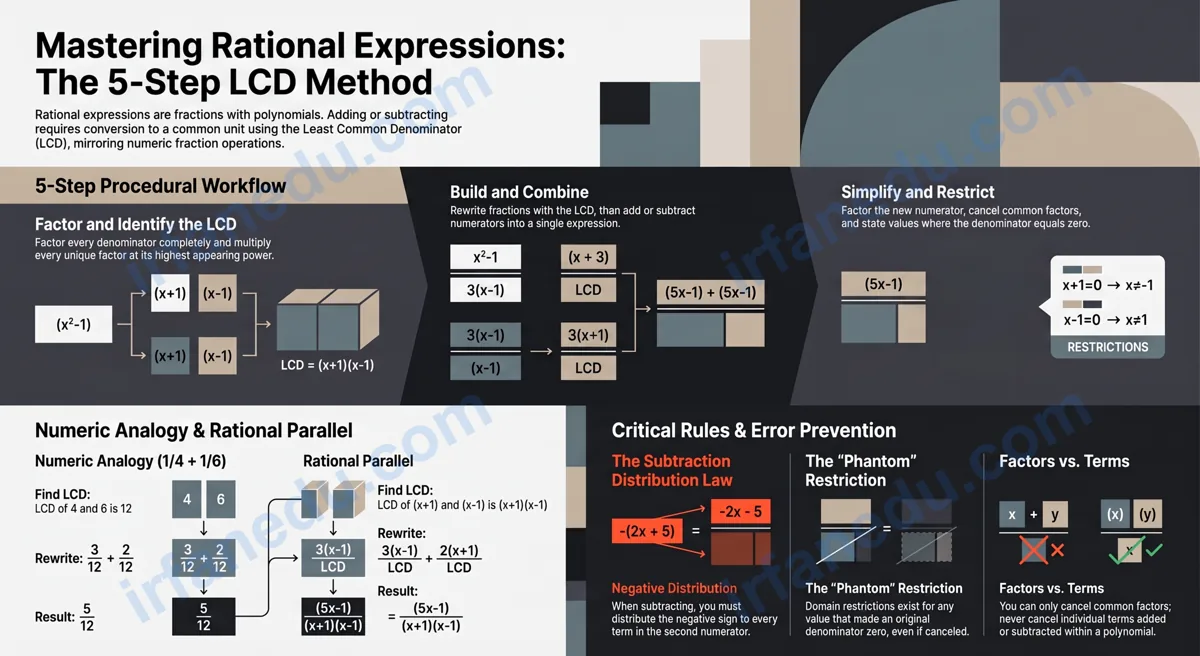
Rational expressions are the algebra world’s version of fractions, and adding or subtracting them trips up more students than almost any other algebra topic. The reason is not the arithmetic — it is the multi-step setup that has to happen before a single number gets added. Once you understand the mechanism, the whole process clicks into place.
Adding and subtracting rational expressions requires finding a least common denominator (LCD) built from polynomial factors, rewriting each fraction with that LCD, combining the numerators, and then simplifying by cancelling common factors. Every step mirrors what you already do with numeric fractions, scaled up to polynomials.
In this guide I break down the mechanism first, then walk through fully worked examples from simple to complex, flag the mistakes I see most often, and give you a free printable worksheet to lock in the skill.
- Exactly why a common denominator is required and how to build one from polynomial factors
- A reliable 5-step method that works for every problem type
- The single most destructive mistake students make (and how to avoid it)
- 10 practice problems with a full answer key
Free printable worksheet included: 10 problems, easy to hard, with a full answer key.
What is a rational expression?
A rational expression is a fraction in which both the numerator and the denominator are polynomials. Examples include 3/(x+2), (x² – 1)/(x² + 5x + 6), and 5/x. The variable sits inside the fraction, which is what makes these different from ordinary numeric fractions.
A rational expression is undefined for any value of the variable that makes the denominator equal to zero. For example, 3/(x+2) is undefined when x = -2. Identifying these domain restrictions is part of every problem.
Rational expression: a fraction P(x)/Q(x) where P and Q are polynomials and Q(x) ≠ 0. Adding or subtracting two rational expressions produces another rational expression.
Quick facts
| Fact | Detail |
|---|---|
| What they are | Fractions with polynomial numerators and denominators |
| Core operation needed | Finding the Least Common Denominator (LCD) |
| LCD method | Factor all denominators; take each unique factor to its highest power |
| Key difference from numeric fractions | Denominators are factored polynomials, not integers |
| Domain restrictions | Any value making any original denominator = 0 is excluded |
| Final step | Factor the combined numerator and cancel common factors |
| Grade level | Typically Algebra 2 / Grades 9-11 |
| Prerequisite skills | Factoring polynomials, simplifying fractions, polynomial arithmetic |
How the mechanism works: the LCD method
Before touching any numbers, it helps to understand why the LCD method works. When you add 1/4 + 1/6, you are asking: “how many equal-sized pieces do I have in total?” You cannot count pieces of different sizes, so you convert both fractions to twelfths — the smallest unit that fits evenly into both 4 and 6. The LCD is simply the smallest common unit.
The same logic applies to rational expressions. The denominators are polynomials, so the “unit” is a polynomial expression. The LCD is the smallest polynomial that every denominator divides into evenly. You build it by factoring.
  NUMERIC ANALOGY            RATIONAL EXPRESSION PARALLEL
  ─────────────────────────────────────────────────────────
  1     1                    3         2
  ─  +  ─                   ─────  +  ─────
  4     6                   x+1       x-1

  LCD of 4 and 6:            Factor denominators:
    4 = 2²                     (x+1) already prime
    6 = 2 × 3                  (x-1) already prime
    LCD = 2² × 3 = 12          LCD = (x+1)(x-1)

  Rewrite:                   Rewrite:
  3/12 + 2/12                3(x-1)        2(x+1)
                             ──────────  + ──────────
                             (x+1)(x-1)   (x+1)(x-1)

  Combine:                   Combine:
  5/12                       3(x-1) + 2(x+1)   3x-3+2x+2   5x-1
                             ───────────────── = ──────── = ──────────
                             (x+1)(x-1)          (x+1)(x-1)  (x+1)(x-1)
The parallel is exact. The only new skill is polynomial factoring to find the LCD. Everything else is fraction arithmetic you already know.
Step-by-step: how to add and subtract rational expressions
Use this 5-step method on every problem. The steps never change — only the complexity of the factoring varies.
- Factor every denominator completely. Use difference of squares, trinomial factoring, GCF — whatever applies. Do not skip this step even if the denominator looks simple.
- Identify the LCD. List every unique factor from all denominators. Raise each to the highest power it appears in any single denominator. Multiply them together.
- Build equivalent fractions. For each fraction, divide the LCD by that fraction’s denominator to find the missing factor. Multiply both numerator and denominator of that fraction by the missing factor.
- Combine numerators over the LCD. Write one fraction with the LCD as denominator. Add or subtract the numerators. When subtracting, distribute the minus sign to every term in the second numerator.
- Factor the numerator and simplify. Factor the combined numerator. Cancel any factor that appears in both numerator and denominator. State domain restrictions.
Step 4 is where most errors happen. When you subtract, the minus sign applies to the entire second numerator, not just its first term. Write out the distribution explicitly every time.
Worked examples
Example 1: Same denominator (warm-up)
Simplify: 5/(x+3) + 2/(x+3)
Step 1-2: Denominators are already the same. LCD = (x+3).
Step 3-4: (5 + 2)/(x+3) = 7/(x+3).
Step 5: 7 and (x+3) share no common factors. Answer: 7/(x+3), x ≠ -3.
Example 2: Unlike denominators, linear factors
Simplify: 4/x – 1/(x+2)
Step 1: Denominators are x and (x+2). Both are already fully factored.
Step 2: LCD = x(x+2).
Step 3: Rewrite: 4(x+2)/[x(x+2)] – 1(x)/[x(x+2)].
Step 4: [4(x+2) – x] / [x(x+2)] = [4x + 8 – x] / [x(x+2)] = (3x+8) / [x(x+2)].
Step 5: (3x+8) does not factor over the integers, and it shares no factor with x(x+2). Answer: (3x+8)/[x(x+2)], x ≠ 0, -2.
Example 3: Factorable quadratic denominator
Simplify: 2/(x²-4) + 1/(x+2)
Step 1: x²-4 = (x-2)(x+2). The second denominator is (x+2), already factored.
Step 2: Unique factors: (x-2) and (x+2), each to the first power. LCD = (x-2)(x+2).
Step 3: First fraction already has LCD. Second fraction: multiply by (x-2)/(x-2).
2/[(x-2)(x+2)] + (x-2)/[(x-2)(x+2)]
Step 4: [2 + (x-2)] / [(x-2)(x+2)] = x / [(x-2)(x+2)].
Step 5: x shares no factor with (x-2)(x+2). Answer: x/[(x-2)(x+2)], x ≠ 2, -2.
Note: x = -2 is a restriction even though (x+2) cancelled in the LCD step. Always track original restrictions.
The “phantom restriction” problem most textbooks ignore
Here is something I have never seen explained clearly in a standard textbook: when a factor cancels during simplification, the domain restriction it created does not disappear. In Example 3, (x+2) cancelled when building the LCD, but x = -2 is still excluded from the domain because it made the original second denominator zero.
This matters on exams. A simplified answer of x/[(x-2)(x+2)] looks like it only excludes x = 2 and x = -2, which happens to be correct here — but students who do not track original restrictions will miss cases where a cancelled factor creates a “hidden” restriction not visible in the final form.
The fix: before you simplify anything, write down every value that makes any original denominator zero. Those restrictions travel with your answer to the end, regardless of cancellation.
Common mistakes when adding and subtracting rational expressions
In my experience grading algebra work, the same four errors appear on almost every incorrect paper. Here they are, with the wrong approach and the correct fix side by side.
| Mistake | Wrong approach | Correct approach |
|---|---|---|
| Not distributing the minus sign | a/(d) – (b+c)/(d) = (a – b+c)/d | (a – b – c)/d — minus applies to every term |
| Adding denominators instead of finding LCD | 1/x + 1/y = 2/(x+y) | LCD = xy; answer = (y+x)/(xy) |
| Cancelling terms instead of factors | (x+3)/(x+5) = 3/5 (cancelled x) | Cannot cancel — x is a term, not a factor of the whole expression |
| Forgetting domain restrictions after cancellation | State only restrictions visible in the simplified form | State all restrictions from the original denominators before any cancellation |
Same vs. unlike denominators: what changes?
Students often wonder whether the process is completely different for same-denominator vs. unlike-denominator problems. It is not — it is the same 5 steps, but steps 2 and 3 become trivial when denominators already match.
| Feature | Same denominators | Unlike denominators |
|---|---|---|
| LCD needed? | Already have it — skip to step 4 | Must factor and build LCD |
| Rewriting fractions | Not required | Multiply each fraction by missing factor(s) |
| Combining numerators | Straightforward addition/subtraction | Same, but after expanding multiplied numerators |
| Simplification | Factor numerator, cancel with denominator | Same — factor numerator, cancel with LCD factors |
| Typical error | Forgetting to factor/simplify the result | Minus-sign distribution error in step 4 |
| Example | 5/(x+3) + 2/(x+3) = 7/(x+3) | 4/x – 1/(x+2) = (3x+8)/[x(x+2)] |
Why I teach the mechanism before the steps
In my 15+ years of teaching algebra, I have noticed that students who memorise the 5 steps without understanding the “why” get stuck the moment a problem looks slightly different — say, a denominator with three factors instead of two. When I spend five minutes on the numeric-fraction analogy first (as I did above), students stop asking “what do I do next?” and start asking “what do I need to make these fractions comparable?” That shift in thinking is the difference between a student who can do textbook problems and one who can handle novel exam questions.
Real-world applications of rational expressions
Rational expressions appear in physics, engineering, and finance more often than most students expect. Understanding how to add and subtract them is not just an algebra exercise.
- Electrical circuits: When resistors are connected in parallel, the total resistance R satisfies 1/R = 1/R1 + 1/R2. Solving for R requires adding rational expressions with variable denominators.
- Work-rate problems: If person A completes a job in x hours and person B in y hours, their combined rate is 1/x + 1/y — a direct application of adding rational expressions.
- Optics: The thin-lens equation 1/f = 1/d_o + 1/d_i involves adding rational expressions to find focal length.
- Harmonic mean in statistics: The harmonic mean of two values a and b is 2ab/(a+b), derived by adding 1/a + 1/b and taking the reciprocal.
Practice worksheet: adding and subtracting rational expressions
Work through these 10 problems in order — they progress from straightforward same-denominator problems to multi-factor unlike-denominator challenges. Print the PDF for a clean workspace, or work directly on this page and check your answers with the key below.
How to use this worksheet: Attempt each problem on paper using the 5-step method. After finishing all 10, open the answer key to check your work. For any problem you got wrong, re-read the corresponding worked example above and try again with fresh numbers.
- 3/x + 5/x
- 7/(2x) – 3/(2x)
- 2/x + 3/y
- 5/(x+1) + 2/(x+1)
- 4/x – 1/(x+2)
- 3/(x-2) + 5/(x+3)
- 2/(x^2-4) + 1/(x+2)
- x/(x+3) – 2/(x-1)
- 3/(x^2+5x+6) + 2/(x+2)
- 5/(x^2-1) – 2/(x^2-x)
Show Answer Key
- 8/x
- 2/x
- (2y + 3x)/(xy)
- 7/(x+1)
- (3x+8)/[x(x+2)]
- (8x-1)/[(x-2)(x+3)]
- x/[(x-2)(x+2)] (x ≠ 2, -2)
- (x^2-3x-6)/[(x+3)(x-1)]
- (2x+7)/[(x+2)(x+3)] Hint: factor x^2+5x+6 = (x+2)(x+3)
- (3x-5)/[x(x-1)(x+1)] Hint: x^2-1 = (x-1)(x+1); x^2-x = x(x-1)
Want a clean printable version? Download the PDF with all 10 problems and a separate answer key section.
What most algebra courses skip — and why it costs students marks
Most courses teach adding and subtracting rational expressions as a mechanical procedure and move on. What they rarely address is the connection between factoring skill and LCD quality. If you factor a denominator incorrectly or incompletely, your LCD is wrong, and every subsequent step inherits that error. I tell my students: “The LCD step is the whole game. Spend 80% of your thinking time there, and the rest is just arithmetic.” Students who internalise this stop making careless errors because they treat factoring as the critical path, not a warm-up.
Frequently asked questions
What is a rational expression?
How do you find the LCD of rational expressions?
Why do you need a common denominator to add rational expressions?
What is the most common mistake when subtracting rational expressions?
Can you cancel terms instead of factors when simplifying?
When is a rational expression fully simplified?
Do you need to state domain restrictions in the final answer?
- A rational expression is a polynomial fraction; adding/subtracting them mirrors numeric fraction arithmetic.
- The LCD is built by factoring all denominators and taking each unique factor to its highest power.
- Always distribute the minus sign to every term in the second numerator when subtracting.
- Cancel only common factors, never common terms.
- Domain restrictions from original denominators survive even after cancellation — always state them.
- Factoring accuracy is the single biggest determinant of whether your LCD (and everything after it) is correct.