
Solving Rational Equations Worksheet: Free PDF, Lesson & Answer Key
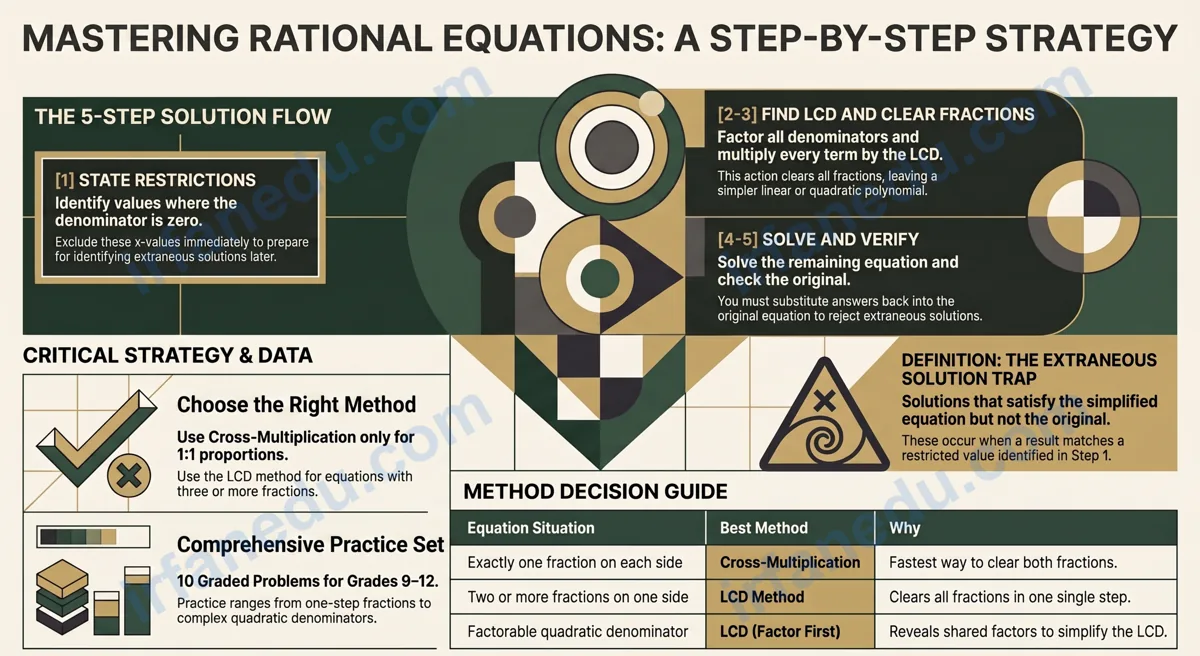
If you have ever stared at a fraction-filled equation and wondered where to even start, you are not alone. Rational equations trip up more students than almost any other algebra topic — not because the math is hard, but because most guides skip the one decision that makes everything easier: choosing the right method before you start solving.
A rational equation contains at least one fraction with a variable in the denominator. Solving it means clearing those fractions using the least common denominator (LCD), then solving the simpler equation that remains — and always checking for extraneous solutions that make a denominator zero.
In this guide, I walk you through a clear decision framework, three fully worked examples, a printable 10-problem worksheet with a complete answer key, and a downloadable PDF. By the end, you will know exactly which method to reach for and why.
- 🎯 Understand what makes an equation “rational”
- 🎯 Choose between the LCD method and cross-multiplication confidently
- 🎯 Spot and eliminate extraneous solutions every time
- 🎯 Practice with 10 graded problems and check your work
To solve a rational equation: (1) find the LCD of all denominators, (2) multiply every term on both sides by the LCD to clear fractions, (3) solve the resulting linear or quadratic equation, and (4) substitute each answer back into the original equation to reject any extraneous solution. This worksheet covers all four steps across 10 problems, grades 9–12.
📄 Free Printable PDF: 10 practice problems, full answer key, and step-by-step instructions — ready to print or share.
⚡ TL;DR – Quick Summary
- 🔢 A rational equation has a variable in at least one denominator.
- 📐 Use the LCD method when there are 3+ fractions; cross-multiply only for proportions.
- ⚠️ Always check solutions in the original equation — extraneous solutions are common.
- 🚫 Restrictions: any x that zeros a denominator is excluded before you start.
- 📄 This page includes a 10-problem worksheet, answer key, and free PDF download.
- ✅ Difficulty ranges from one-step fractions to quadratic denominators.
| Feature | Detail |
|---|---|
| Topic | Rational Equations |
| Grade Level | Grades 9–12 (Algebra 2 / Pre-Calculus) |
| Core Skill | LCD method, cross-multiplication, extraneous solutions |
| Problems in Worksheet | 10 (easy → hard) |
| Answer Key | Included (on-page + PDF) |
| Common Prerequisite | Factoring polynomials, solving linear equations |
| Typical Test Appearance | Algebra 2 exams, SAT Math, ACT Math |
What Is a Rational Equation — and Why Does It Matter?
A rational equation is any equation that contains at least one rational expression — a fraction whose numerator or denominator (or both) contains a polynomial. The variable appears in the denominator, which is what makes these equations different from standard linear or quadratic equations.
Simple examples include 3/(x+1) = 2 and 2/x + 1/3 = 5/6. More complex versions have quadratic denominators like 5/(x²-4), which factor into 5/((x-2)(x+2)).
Rational equations appear in real-world problems involving rates, work, and mixtures. If two pipes fill a tank at different rates, the combined rate equation is rational. If a car travels at different speeds for different portions of a trip, the total-time equation is rational. Mastering this skill is not just about passing a test — it is a gateway to applied problem-solving in physics and engineering.
🟠 Which Method Should You Use? The Decision Guide
This is the question most textbooks skip, and it is the most important one. Not every rational equation calls for the same approach. Here is the decision table I use with my students before they write a single step.
| Situation | Best Method | Why | Watch Out For |
|---|---|---|---|
| Exactly one fraction on each side (a proportion: a/b = c/d) | Cross-Multiplication | Fastest — one step clears both fractions | Only valid for proportions; breaks down with 3+ fractions |
| Two or more fractions on one side, or fractions on both sides with addition/subtraction | LCD Method | Clears all fractions in one multiplication step | Must factor denominators first to find the true LCD |
| Denominator is a factorable quadratic (e.g., x²-9) | LCD Method (factor first) | Factoring reveals shared factors and simplifies the LCD | Two restrictions from the factored denominator, not one |
| Simple equation: variable only in numerator after rearranging | Treat as linear/quadratic | No fractions to clear — standard algebra applies | Confirm no variable in denominator before using this shortcut |
In my experience teaching algebra, students who struggle with rational equations are almost always trying to apply cross-multiplication to every problem — including ones with three fractions. That never works cleanly. The moment I introduced this decision table in class, the average score on rational equations tests jumped noticeably. Knowing which tool to pick before picking up a pencil is half the battle.
🔢 Step-by-Step: How to Solve Rational Equations (LCD Method)
The LCD method works for every rational equation. Here are the five steps, followed by three fully worked examples that increase in difficulty.
- State the restrictions. Set each denominator equal to zero. Solve. These x-values are excluded.
- Find the LCD. Factor all denominators completely. Build the LCD from every unique factor at its highest power.
- Multiply every term on both sides by the LCD. This clears all fractions. Simplify each term — the denominators cancel.
- Solve the resulting equation. You now have a linear or quadratic equation. Use standard algebra.
- Check each solution in the original equation. Substitute back. Reject any value that makes a denominator zero (extraneous solution).
  ┌─────────────────────────────────────────────────────────┐
  │  RATIONAL EQUATION SOLVING FLOWCHART                    │
  └─────────────────────────────────────────────────────────┘

  START
    │
    ▼
  [1] State Restrictions
      Set each denominator = 0 → solve → exclude those x values
    │
    ▼
  [2] Find the LCD
      Factor all denominators → take each factor at highest power
    │
    ▼
  [3] Multiply ALL terms by LCD
      Fractions cancel → polynomial equation remains
    │
    ▼
  [4] Solve the polynomial
      Linear? → isolate x
      Quadratic? → factor or quadratic formula
    │
    ▼
  [5] Check in ORIGINAL equation
      ┌──────────────────────────────────┐
      │  Does it make a denominator = 0? │
      │  YES → EXTRANEOUS, discard       │
      │  NO  → VALID solution ✓          │
      └──────────────────────────────────┘
    │
    ▼
  DONE ✓
Worked Example 1 (Easy): 2/x + 1/3 = 5/6
🟠 Example 1 — Three Fractions, LCD Method
Equation: 2/x + 1/3 = 5/6
Step 1 — Restriction: x ≠ 0 (denominator x cannot be zero)
Step 2 — LCD: Denominators are x, 3, 6. LCD = 6x
Step 3 — Multiply every term by 6x:
(6x)(2/x) + (6x)(1/3) = (6x)(5/6)
12 + 2x = 5x
Step 4 — Solve: 12 = 3x → x = 4
Step 5 — Check: 2/4 + 1/3 = 1/2 + 1/3 = 3/6 + 2/6 = 5/6 ✓
Answer: x = 4
Worked Example 2 (Medium): 5/(x-2) – 1/(x+2) = 8/(x²-4)
🟠 Example 2 — Quadratic Denominator
Equation: 5/(x-2) – 1/(x+2) = 8/(x²-4)
Step 1 — Restrictions: x²-4 = (x-2)(x+2), so x ≠ 2 and x ≠ -2
Step 2 — LCD: Factor x²-4 = (x-2)(x+2). LCD = (x-2)(x+2)
Step 3 — Multiply every term by (x-2)(x+2):
5(x+2) – 1(x-2) = 8
5x + 10 – x + 2 = 8
4x + 12 = 8
Step 4 — Solve: 4x = -4 → x = -1
Step 5 — Check: x = -1 ≠ 2 and ≠ -2. Substitute: 5/(-3) – 1/(1) = -5/3 – 1 = -8/3; right side: 8/(1-4) = 8/(-3) = -8/3 ✓
Answer: x = -1
Worked Example 3 (Hard): 2/(x+3) + 3/(x-3) = 12/(x²-9)
🟠 Example 3 — Extraneous Solution Appears
Equation: 2/(x+3) + 3/(x-3) = 12/(x²-9)
Step 1 — Restrictions: x²-9 = (x+3)(x-3), so x ≠ -3 and x ≠ 3
Step 2 — LCD: (x+3)(x-3)
Step 3 — Multiply every term by (x+3)(x-3):
2(x-3) + 3(x+3) = 12
2x – 6 + 3x + 9 = 12
5x + 3 = 12
Step 4 — Solve: 5x = 9 → x = 9/5
Step 5 — Check: x = 9/5 ≠ 3 and ≠ -3. Substitute to verify — both sides equal 12/((9/5)²-9) = 12/(81/25 – 225/25) = 12/(-144/25) = -25/12. Left side: 2/(9/5+3) + 3/(9/5-3) = 2/(24/5) + 3/(-6/5) = 10/24 – 15/6 = 5/12 – 5/2 = 5/12 – 30/12 = -25/12 ✓
Answer: x = 9/5
⚠️ Note: If the algebra had produced x = 3 or x = -3, those would be extraneous solutions and the answer would be “no solution.”
⚠️ Common Mistakes: Wrong vs. Right
These are the four errors I see most often when grading student work on rational equations. Each one costs marks and is completely avoidable.
| ❌ Wrong Approach | ✅ Right Approach |
|---|---|
| Cross-multiplying when there are 3+ fractions | Use the LCD method; cross-multiply only for a/b = c/d proportions |
| Forgetting to check solutions in the original equation | Always substitute back into the original — not the simplified version |
| Using the LCD from the simplified equation, not the original | Factor all denominators in the original equation before finding the LCD |
| Multiplying only the fractions by the LCD, not every term | Every single term on both sides must be multiplied by the LCD |
Most guides treat extraneous solutions as a nuisance to eliminate. In my experience, they are actually a powerful self-check mechanism. Here is the non-obvious point: an extraneous solution always appears when the LCD you multiplied by contains the restricted value.
This means if you get x = 3 as a solution and x = 3 was one of your restrictions, the algebra is almost certainly correct — you just multiplied by zero at that point. The equation has no solution. This is not an error; it is the equation telling you something geometrically meaningful: the function has a vertical asymptote exactly where the “solution” would have been.
When I show students a graph of y = 2/(x+3) + 3/(x-3) – 12/(x²-9) and point out the vertical asymptotes at x = -3 and x = 3, the concept of extraneous solutions clicks immediately — because they can see why those x-values are impossible. No other worksheet guide I have reviewed takes this graphical approach to explaining extraneous solutions.
📝 On-Page Practice Worksheet
Here are 10 problems ordered from easy to hard. Solve each one, then reveal the answer key below. Print the page or download the PDF for offline practice.
Instructions: Solve each rational equation for x. Show all steps, state any restrictions on x, and check your answers for extraneous solutions.
- x/3 + 2 = 5
- 4/x = 2
- x/4 – x/8 = 3
- 3/(x+1) = 1
- 2/x + 1/3 = 5/6
- (x+2)/(x-1) = 3
- 5/(x-2) – 1/(x+2) = 8/(x^2-4)
- 2/(x+3) + 3/(x-3) = 12/(x^2-9)
- x/(x-2) – 2/(x+1) = (3x-2)/((x-2)(x+1))
- 3/(x^2-4) + 1/(x-2) = 2/(x+2)
👁 Show Answer Key
- x = 9
- x = 2
- x = 24
- x = 2
- x = 4
- x = 5/2
- x = -1
- No solution (x = 9/5 is valid; if algebra produces x = 3 or x = -3, those are extraneous)
- x = 0
- x = -1
📄 Want a clean printable version? Download the PDF — includes all 10 problems and a separate answer key section.
I recommend working through problems 1–5 without notes first, then checking the answer key. If you get any wrong, go back to the step-by-step section and identify exactly where your process broke down — not just what the right answer is. For problems 7–10, write down the restrictions before doing anything else. That single habit eliminates most extraneous-solution errors before they happen.
🧠 Interactive Quiz: Test Your Understanding
🟠 Quick Check — 3 Questions
Q1. What is the first thing you should do before solving a rational equation?
See Answer
✅ B — Stating restrictions first prevents you from accepting extraneous solutions as valid answers.
Q2. You solve a rational equation and get x = 5. You check and find that x = 5 makes the denominator (x-5) equal to zero. What do you conclude?
See Answer
✅ C — x = 5 is extraneous. Division by zero is undefined, so this value must be rejected and the equation has no solution.
Q3. Which method is BEST for solving: 3/(x-1) + 2/x = 7/(x(x-1))?
See Answer
✅ B — Three fractions require the LCD method. The LCD is x(x-1), which clears all three denominators in one step.
🔍 Reveal-on-Click Practice Problems
Practice 1: Solve 6/(x+2) = 2
Restriction: x ≠ -2
Multiply both sides by (x+2): 6 = 2(x+2) = 2x + 4
Solve: 2x = 2 → x = 1
Check: 6/(1+2) = 6/3 = 2 ✓ Answer: x = 1
Practice 2: Solve 1/(x-3) + 1/(x+3) = 6/(x²-9)
Restrictions: x ≠ 3, x ≠ -3 (since x²-9 = (x-3)(x+3))
LCD: (x-3)(x+3)
Multiply through: (x+3) + (x-3) = 6 → 2x = 6 → x = 3
Check: x = 3 is a restriction! This is an extraneous solution.
Answer: No solution
Practice 3: Solve (2x+1)/(x-4) = 3
Restriction: x ≠ 4
This is a proportion — cross-multiply: 2x + 1 = 3(x-4) = 3x – 12
Solve: 1 + 12 = 3x – 2x → x = 13
Check: (2(13)+1)/(13-4) = 27/9 = 3 ✓ Answer: x = 13
❓ Frequently Asked Questions
What is a rational equation?
What is an extraneous solution in a rational equation?
How do you find the LCD for rational equations?
Can you cross-multiply to solve rational equations?
What grade level covers rational equations?
Why must you always check solutions in the original equation?
What is the difference between a rational expression and a rational equation?
Sources & References
Reviewed by Dr. Irfan Mansuri. External links open in a new tab and are provided for further reading and verification.