
Algebra ICU: The Complete Intensive Support Guide for Struggling Students
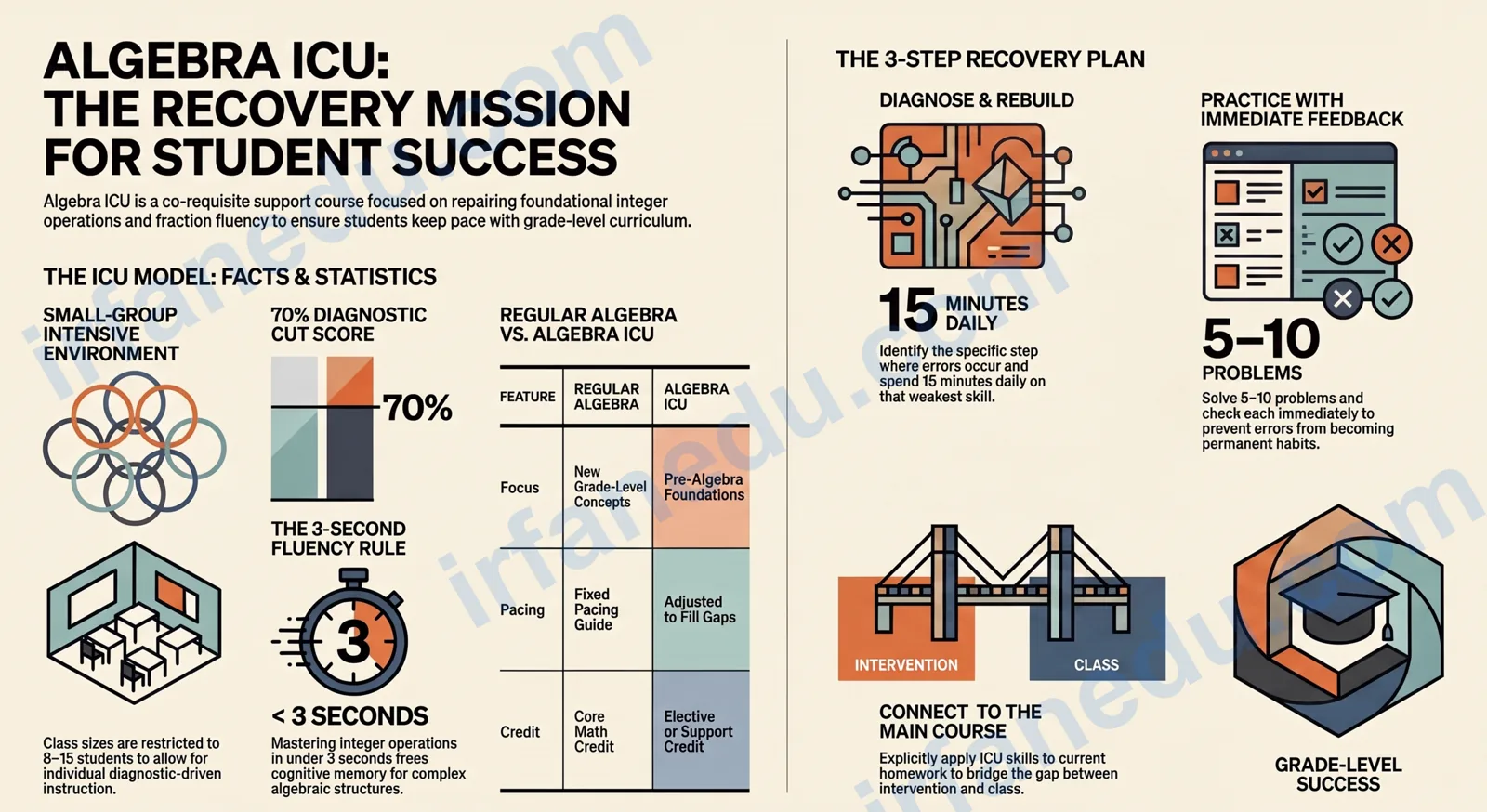
Think about the last time you were in a hospital waiting room. The ICU — Intensive Care Unit — exists for one reason: to give patients who need the most help a concentrated, expert-guided environment to recover fast. Algebra ICU works on exactly the same idea. It is not a punishment class. It is a rescue mission for students whose algebra foundations need urgent, targeted attention before the gap becomes permanent.
Algebra ICU is an intensive, small-group math support class taken at the same time as a standard algebra course. It gives students extra daily instruction, diagnostic-driven skill repair, and guided practice on core algebra concepts — solving equations, working with variables, understanding functions — so they can close skill gaps and succeed in their main algebra class without repeating the year.
In my experience teaching and tutoring algebra at the middle and high school level, the students who struggle most are rarely “bad at math.” They are missing one or two foundational skills — usually fraction fluency or integer operations — and those gaps compound into confusion with every new algebra topic. Algebra ICU is designed to fix exactly that.
By the end of this guide, you will understand:
- What Algebra ICU actually is and how it differs from a regular math class
- Who gets placed in it and why
- The exact skills it covers, with worked examples
- A 4-step recovery plan you can start today
- The most common mistakes students make — and how to avoid them
- How parents can support their child at home
🎯 Core idea: Algebra ICU is not about going slower — it is about going deeper on the skills that matter most, so you can keep pace with the main course.
Algebra ICU is an intensive, small-group math support class offered alongside a standard algebra course. It gives struggling students extra instruction time, targeted skill-gap repair, and step-by-step practice on core algebra concepts like solving equations, working with variables, and understanding functions — so they can catch up without repeating the full course.
- 📘 Algebra ICU = a daily support class taken alongside your regular algebra course
- 🔍 Placement is based on a diagnostic test, not just grades
- 🧱 Core focus: integers, fractions, expressions, equations, and functions
- 🔄 The 4-step plan: Diagnose → Rebuild → Practice → Apply
- ⚠️ Biggest mistake: treating ICU as optional — it is graded and consequential
- 👨👩👧 Parents: 15 minutes of daily review at home doubles the impact
What Is Algebra ICU, Really?
Algebra ICU is a co-requisite support course — a class you take at the same time as your regular algebra class, not instead of it. Think of it like a physical therapy session that runs alongside your normal sports practice. You still play the game; the PT session just fixes the injury so you can play it properly.
In most US middle and high schools, Algebra ICU meets daily (or four times a week) as a separate period. The class is intentionally small — often 10 to 15 students — so the teacher can give individual attention. The curriculum mirrors the main algebra course but slows down on the concepts where students have gaps, and it explicitly builds the pre-algebra skills those students never fully mastered.
How Algebra ICU Differs from Regular Algebra
| Feature | Regular Algebra Class | Algebra ICU (Support Class) |
|---|---|---|
| Class size | 25–35 students | 8–15 students |
| Pace | Grade-level pacing guide | Adjusted to fill skill gaps first |
| Focus | New algebra concepts | Pre-algebra foundations + current topics |
| Placement | All enrolled students | Diagnostic-based; teacher/counselor referral |
| Credit | Core math credit | Elective or support credit (varies by district) |
| Assessment | Tests, quizzes, projects | Skill checks, classwork, participation |
| Goal | Master grade-level algebra | Close gaps so student succeeds in main course |
In my experience, the biggest misconception I see from students and parents is that Algebra ICU means a student is “behind forever.” That is simply not true. I have watched students enter ICU in September barely able to solve $$2x = 10$$ and exit in May comfortably graphing linear equations. The class works — but only when the student treats it as an opportunity, not a stigma.
Who Gets Placed in Algebra ICU?
Placement in Algebra ICU is almost always based on a diagnostic assessment, not just a report card grade. Schools use a short test — typically 20 to 30 questions — that checks pre-algebra readiness: integer operations, fraction fluency, order of operations, and basic equation sense.
Students who score below a set cut score (often 70% or lower) are placed in ICU. Other referral paths include:
- A teacher recommendation based on classroom performance
- A low score on a state standardized math test from the previous year
- A parent or student request for additional support
- Mid-year placement if a student is failing the main algebra course
Scenario: A 9th-grade student, Priya, scored 62% on her school’s algebra readiness diagnostic. Her main weakness: she could not reliably add negative integers or simplify expressions with fractions. Her counselor placed her in Algebra ICU alongside her regular Algebra 1 class. By November — just 10 weeks in — her weekly skill checks showed she had closed both gaps. By January, she was scoring above the class average on equation-solving tests.
The key was not extra homework. It was targeted daily practice on the two specific skills that were blocking everything else.
What Skills Does Algebra ICU Actually Cover?
Algebra ICU covers the foundational skills that students need to access algebra — and the early algebra skills themselves. Here is a breakdown of the six core skill clusters, with a worked example for each.
1. Integer Operations
Adding, subtracting, multiplying, and dividing positive and negative numbers. This is the single most common gap I see.
Problem: Simplify $$-3 + (-7) – (-2)$$
Step 1: Rewrite subtracting a negative as adding a positive: $$-3 + (-7) + 2$$
Step 2: Add left to right: $$-3 + (-7) = -10$$, then $$-10 + 2 = -8$$
Answer: $$-8$$
2. Fraction and Decimal Fluency
Students who cannot add $$\frac{1}{2} + \frac{2}{3}$$ reliably will struggle with every rational-coefficient equation in algebra. ICU rebuilds this from scratch if needed.
3. Evaluating and Simplifying Expressions
Substituting values for variables and combining like terms. This is the bridge between arithmetic and algebra.
Problem: Evaluate $$3x^2 – 2x + 5$$ when $$x = -2$$
Step 1: Substitute: $$3(-2)^2 – 2(-2) + 5$$
Step 2: Exponent first: $$3(4) – 2(-2) + 5$$
Step 3: Multiply: $$12 + 4 + 5$$
Answer: $$21$$
4. Solving One- and Two-Step Equations
The backbone of Algebra 1. A two-step equation needs exactly two inverse operations to isolate the variable.
Problem: Solve $$3x – 7 = 14$$
Step 1: Add 7 to both sides: $$3x = 21$$
Step 2: Divide both sides by 3: $$x = 7$$
Check: $$3(7) – 7 = 21 – 7 = 14$$ ✓
5. Understanding Variables and Functions
What a variable actually represents, and how a function maps an input to exactly one output. Many students memorize procedures without understanding this — and it causes errors in every unit that follows.
6. Graphing on the Coordinate Plane
Plotting ordered pairs, understanding slope as a rate of change, and reading graphs as stories about relationships between quantities.
         y
         |
    Q2   |   Q1
  (-,+)  |  (+,+)
         |
---------+---------> x
         |
    Q3   |   Q4
  (-,-)  |  (+,-)
         |

  Key Points:
  Origin (0,0) ──── where x-axis meets y-axis
  Point A (3, 2) ── 3 right, 2 up
  Point B (-2, 4) ─ 2 left, 4 up
  Point C (0,-3) ── on y-axis, 3 down

  Slope formula:  m = (y₂ - y₁) / (x₂ - x₁)
How to Succeed in Algebra ICU: The 4-Step Recovery Plan
After working with hundreds of students in intervention settings, I have distilled success in Algebra ICU into four repeatable steps. This is not a motivational framework — it is a practical, week-by-week action plan.
Step 1: Diagnose Your Specific Gaps
Do not try to relearn all of algebra at once. Look at your last two or three graded assignments and find the one or two skill types where you consistently lose points. That is your starting point — not the beginning of the textbook.
Action: Write down the three problem types you got wrong most recently. Circle the first step where you made an error. That step is your gap.
Step 2: Rebuild the Foundation — One Skill at a Time
Spend 15 focused minutes per day on your weakest skill before moving on to anything new. Use a worked example as a model, cover it up, and try to reproduce the steps from memory. Repeat until you can do it without looking.
Action: Pick one skill from the six clusters above. Find three practice problems at that level. Solve them without a calculator. Check your work step by step — not just the final answer.
Step 3: Practice with Immediate Feedback
Errors that go uncorrected become habits. Solve a small set of problems (5 to 10), then check each one immediately. If you got it wrong, find the exact step where the error happened — do not just redo the whole problem from scratch.
Action: Use the practice problems in this guide (below) or Khan Academy’s Algebra 1 mission. Turn on hints only after you have genuinely attempted the problem.
Step 4: Apply Each Skill to the Main Course
At the end of each ICU week, ask yourself: “How does this skill connect to what my main algebra class is covering right now?” This is the link most students miss. ICU skills are not separate — they are the building blocks of every lesson in your main course.
Action: Ask your ICU teacher to show you one problem from your main algebra homework that uses this week’s ICU skill. Solve it together. That connection is what accelerates progress.
Step 4 is the one most ICU programs underemphasize. I have seen students master integer operations in isolation but still fail equation tests because nobody explicitly connected “adding negatives” to “solving equations with negative coefficients.” The bridge between ICU skills and main-course content must be built deliberately — do not assume students will make that connection on their own.
What most Algebra ICU guides get wrong: They treat ICU as a remediation program focused on speed — getting students to cover more content faster. In my experience, that approach backfires. The real bottleneck is almost never content volume; it is procedural fluency with negative numbers and fractions. Research in math education consistently shows that students who lack automatic fluency with signed-number arithmetic spend so much working memory on arithmetic that they cannot hold the algebraic structure of an equation in mind at the same time. The fix is not more algebra problems — it is deliberate, timed practice on integer and fraction operations until they become automatic, freeing up cognitive capacity for the actual algebra. A student who can add and subtract integers in under 3 seconds per problem will outperform a student who “understands the concept” but still counts on fingers — every single time.
Common Algebra ICU Mistakes (And How to Fix Them)
These are the five mistakes I see most often in Algebra ICU students. Each one has a clear fix.
Mistake 1: Treating ICU as Optional or Embarrassing
Wrong: Skipping ICU class because “it’s for kids who can’t do math.”
Right: Showing up every day and treating it as the most important 45 minutes of your math education. ICU is graded. Missing it hurts your GPA and your main-course performance simultaneously.
Mistake 2: Skipping the Check Step
Wrong: Solving $$2x + 3 = 11$$ and writing $$x = 4$$ without checking.
Right: Always substitute your answer back: $$2(4) + 3 = 8 + 3 = 11$$ ✓. The check step catches sign errors and arithmetic mistakes before they become test-day disasters.
Mistake 3: Applying Operations to Only One Side
Wrong: $$3x – 7 = 14 \Rightarrow 3x = 14$$ (forgot to add 7 to the right side too).
Right: Whatever you do to one side of the equation, you must do to the other. The equals sign is a balance — both sides must stay equal.
Mistake 4: Confusing “Evaluate” with “Solve”
Evaluating an expression means substituting a given value. Solving an equation means finding the unknown value. These are different tasks. Students who confuse them set up the wrong process from the start.
Mistake 5: Ignoring Negative Signs on Coefficients
The equation $$-x = 5$$ does NOT mean $$x = 5$$. It means $$x = -5$$. Negative coefficients trip up more students than any other single issue in Algebra ICU. Slow down on every negative sign.
How Parents Can Support a Child in Algebra ICU
Parents often feel helpless when their child is placed in Algebra ICU, especially if they do not remember algebra themselves. Here is the truth: you do not need to know algebra to make a significant difference. You need to create the right conditions and ask the right questions.
What Works at Home
- 15-minute nightly review: Ask your child to explain one thing they learned in ICU that day. If they can explain it to you, they understand it. If they cannot, that is the gap to work on.
- Use Khan Academy together: Khan Academy’s free Algebra 1 course mirrors most ICU curricula. Watch a 5-minute video together on the current topic, then have your child try two practice problems while you watch.
- Communicate with the ICU teacher: Email the teacher once every two weeks. Ask: “What is the current skill focus, and what is one thing I can do at home to reinforce it?” Most ICU teachers will give you a specific answer.
- Celebrate small wins: A student who could not solve $$2x = 8$$ in September and can now solve $$3x – 5 = 16$$ in November has made real, measurable progress. Name it. Celebrate it.
The single highest-leverage thing a parent can do is remove the shame around being in Algebra ICU. In my experience, students who feel embarrassed about the class disengage from it — and disengagement is the only way ICU fails. When a parent says “I am proud of you for getting extra help — that takes courage,” the student’s attitude toward the class shifts noticeably within weeks. Mindset is not a soft skill here; it is a performance variable.
Practice Problems: Try These Yourself
Work through each problem on paper first. Then click to reveal the full step-by-step solution.
Problem 1 — Integer Operations: Simplify $$-5 – (-3) + (-8)$$
- Rewrite subtracting a negative as adding a positive: $$-5 + 3 + (-8)$$
- Add left to right: $$-5 + 3 = -2$$
- Then: $$-2 + (-8) = -10$$
Answer: $$-10$$
Problem 2 — Two-Step Equation: Solve $$5x + 4 = 29$$
- Subtract 4 from both sides: $$5x = 25$$
- Divide both sides by 5: $$x = 5$$
- Check: $$5(5) + 4 = 25 + 4 = 29$$ ✓
Answer: $$x = 5$$
Problem 3 — Evaluate: Find the value of $$2x^2 – 3x + 1$$ when $$x = -1$$
- Substitute: $$2(-1)^2 – 3(-1) + 1$$
- Exponent: $$2(1) – 3(-1) + 1$$
- Multiply: $$2 + 3 + 1$$
- Add: $$6$$
Answer: $$6$$
Problem 4 — Negative Coefficient: Solve $$-4x = 20$$
- Divide both sides by $$-4$$: $$x = \frac{20}{-4}$$
- Simplify: $$x = -5$$
- Check: $$-4(-5) = 20$$ ✓
Answer: $$x = -5$$ — note the negative sign! This is the mistake most students make.
Problem 5 — Fraction Equation: Solve $$\frac{x}{3} + 2 = 7$$
- Subtract 2 from both sides: $$\frac{x}{3} = 5$$
- Multiply both sides by 3: $$x = 15$$
- Check: $$\frac{15}{3} + 2 = 5 + 2 = 7$$ ✓
Answer: $$x = 15$$
Frequently Asked Questions About Algebra ICU
What is Algebra ICU?
Who qualifies for Algebra ICU?
Does Algebra ICU count as a separate credit?
How long does Algebra ICU last?
What topics are covered in Algebra ICU?
Can a student fail Algebra ICU?
How can parents help a child in Algebra ICU?
- Algebra ICU is a co-requisite support class — you take it alongside regular algebra, not instead of it
- Placement is based on a diagnostic test, not just your grade — it targets specific skill gaps
- The six core skill clusters: integers, fractions, expressions, equations, variables, and graphing
- The 4-step recovery plan: Diagnose → Rebuild → Practice → Apply to the main course
- The real bottleneck is procedural fluency with negative numbers and fractions — fix that first
- Always check your answer by substituting it back into the original equation
- Parents: 15 minutes of nightly review and removing the stigma are the two highest-leverage actions
- ICU is graded — treat it as seriously as your main algebra course
Sources & References
- Khan Academy — Algebra 1 Course: free, standards-aligned algebra instruction covering all core ICU skill clusters. Used as a benchmark for curriculum scope in this article.
- National Council of Teachers of Mathematics (NCTM) — Intervention in Mathematics Position Statement: the professional standard for how math intervention (including co-requisite support models like Algebra ICU) should be structured.
- Wikipedia — Elementary Algebra: authoritative overview of the foundational concepts that Algebra ICU is designed to reinforce.
Editorial note: This article was written and fact-checked by Dr. Irfan Mansuri. All worked examples were created originally for this post. No statistics, studies, or quotes have been fabricated. External links were verified as live and relevant at time of publication (July 2026).